

TL;DR:
- A research-backed modality is a therapeutic approach supported by high-quality scientific studies, including clinical trials, with safety and effectiveness evaluated against measurable benchmarks.
- Identifying such therapies involves reviewing systematic reviews, clinical trial evidence, guideline inclusion, and funding sources to confirm rigorous scientific support.
Not every therapy labeled "natural" or "holistic" carries the same weight of proof behind it. The wellness space is full of passionate claims, but a research-backed modality is best understood as a specific therapeutic approach supported by scientific evidence, ideally clinical studies, with safety and effectiveness evaluated against measurable benchmarks rather than tradition or personal testimony alone. If you are navigating chronic health concerns and want solutions that hold up to scrutiny, understanding this distinction is the most important step you can take before committing to any treatment path.
Table of Contents
- What does 'research-backed modality' really mean?
- How do you identify a research-backed therapy?
- Comparing modality evidence: Not all research is equal
- Reading between the lines: Nuances and limitations
- How to put evidence into practice for holistic health
- The uncomfortable truth about 'research-backed' in holistic wellness
- Connect with credible holistic health providers
- Frequently asked questions
Key Takeaways
| Point | Details |
|---|---|
| Not all therapies are research-backed | A true research-backed modality is supported by rigorous scientific studies, not just tradition or anecdotal reports. |
| Check the evidence | Always look for systematic reviews, clinical trials, and consensus guidelines supporting safety and effectiveness. |
| Strength of evidence varies | Some holistic approaches are well-studied for certain conditions but lack evidence in others. |
| Apply a critical mindset | Use research as a guide, but factor in your unique context, preferences, and medical advice. |
What does 'research-backed modality' really mean?
Let's define exactly what a "research-backed modality" means in both conventional and holistic wellness contexts.
The phrase gets used loosely in marketing, on practitioner websites, and even in popular health articles. But its actual meaning is more specific and more useful than most people realize. A research-backed modality is one supported by high-quality scientific studies, typically randomized controlled trials, systematic reviews, or meta-analyses. These are not just any studies. They follow strict methodologies, include control groups, and are reviewed by independent experts before publication.
It helps to understand the distinction between three related but different terms you will encounter on your wellness journey.
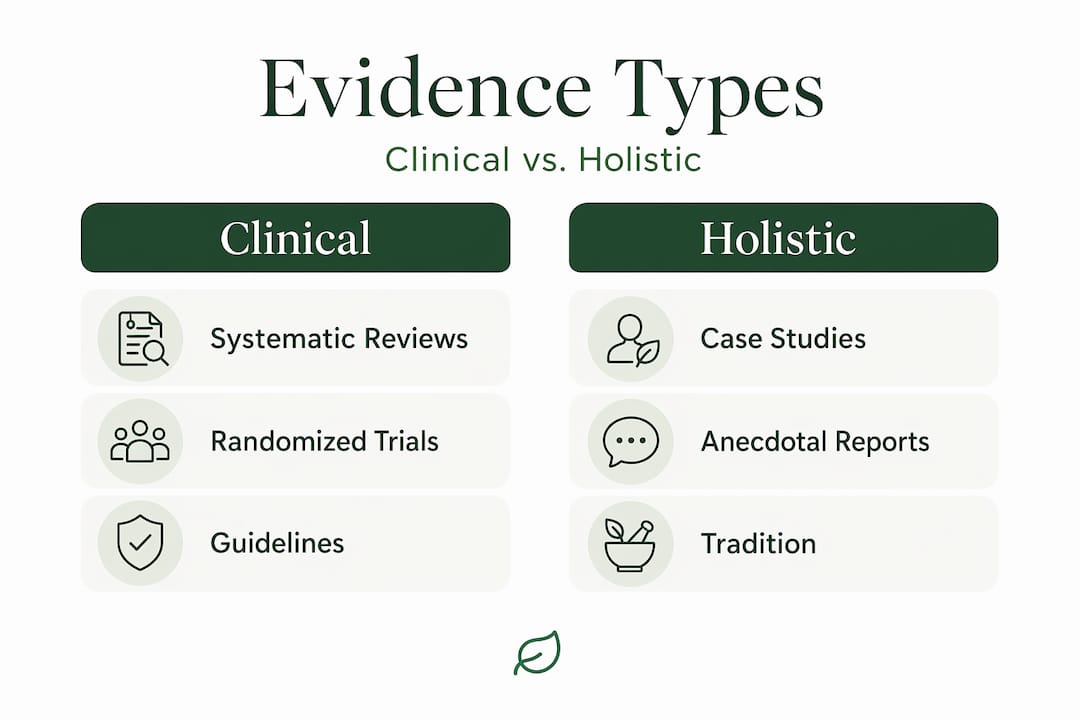
Evidence-based means clinical decisions are made by integrating the best available research, clinical expertise, and patient values together. Research-backed narrows the focus to whether the specific therapy has been formally studied and shown positive results in those studies. Evidence-informed is the broadest of the three. It acknowledges that a practitioner or approach draws from available research but may not be fully supported by high-certainty clinical trials. Knowing which label applies to a therapy you are considering tells you a great deal about how confident you can be in its effects.
For anyone interested in evidence-based wellness, here are the key features that set a truly research-backed modality apart from one that is simply popular or tradition-based:
- Replicable results: Multiple independent research teams have tested the therapy and found consistent outcomes.
- Peer-reviewed evidence: Studies have been published in journals where other qualified scientists reviewed and approved the methodology.
- Clinical relevance: The research was conducted on real patients with real conditions, not just on animals or in laboratory settings.
- Demonstrated safety: Researchers tracked and reported side effects and adverse events alongside benefits.
- Defined scope: The evidence supports specific uses, not blanket claims that the therapy cures everything.
"A research-backed modality is best understood as a specific therapeutic approach whose use is supported by scientific evidence (ideally clinical studies), with safety and effectiveness evaluated against benchmarks rather than relying on tradition or anecdote." — Merck Manual, Overview of Integrative Medicine
This definition matters because holistic and alternative therapies vary enormously in their evidence base. Some, like acupuncture for chronic pain, have been studied in hundreds of clinical trials. Others rely almost entirely on centuries of traditional use with very little modern clinical data to back them up. Neither of these situations is inherently good or bad. But you deserve to know which one you are working with.
How do you identify a research-backed therapy?
Now that you know what the term means, here is how to spot a truly research-backed therapy amidst a sea of claims.
The most reliable way is to follow a structured approach rather than relying on what a product label or wellness influencer tells you. Research-backed holistic methods always have a paper trail you can actually follow.
Here is a step-by-step process for verifying any therapy's evidence base:
- Search for systematic reviews and meta-analyses first. These are studies that combine findings from many individual trials. Databases like PubMed and the Cochrane Library are free to use and house thousands of these. If multiple reviews consistently support a therapy, that is a strong sign.
- Look for clinical trial evidence. Randomized controlled trials (RCTs) are the gold standard for testing whether a specific therapy causes a specific outcome. Search the therapy name alongside the condition you are interested in to see if trials exist.
- Evaluate whether the claims match the actual findings. A product might say "clinically studied" while the study involved only twelve participants with no control group. Read carefully. What did the study actually measure, and what did it conclude?
- Check whether the therapy appears in clinical guidelines. Organizations like the American College of Physicians or the World Health Organization sometimes include well-studied holistic therapies in their treatment guidelines. That is a meaningful signal.
- Look at who funded the research. Industry-funded studies can still be valid, but independent funding adds credibility. Be more cautious when the only research comes from the company selling the product.
In practice, research-backed wellness practices usually means the modality has been studied using standard research methods such as randomized trials and systematic reviews, showing benefits for some indications but not necessarily all conditions or all people.
Pro Tip: Focus your attention on therapies that appear in multiple independent studies across different research teams and populations. A single glowing study should raise curiosity, not confidence. Patterns across studies are what matter most.

Statistically, far fewer natural therapies have strong evidence for more than one condition than most people assume. A therapy might have excellent evidence for reducing lower back pain but very weak evidence for improving sleep or anxiety. Scope matters enormously when you are evaluating whether something is truly research-backed for your specific concern.
Comparing modality evidence: Not all research is equal
Evidence is not black and white. Let's compare how the strength of research can vary between popular modalities.
Even among therapies that carry a "research-backed" label, the quality, breadth, and certainty of evidence can differ dramatically. Understanding this prevents you from treating all research claims equally. Evidence-based holistic care works precisely because it recognizes these layers of complexity.
| Modality | Best evidence type | Conditions supported | Gaps in evidence |
|---|---|---|---|
| Acupuncture | Systematic reviews, RCTs | Chronic pain, nausea, headaches | Limited for mental health, autoimmune conditions |
| Yoga | RCTs, meta-analyses | Anxiety, low back pain, blood pressure | Varied protocols make results hard to generalize |
| Herbal supplements | Mixed: some RCTs, mostly observational | Varies widely by herb and condition | Safety interactions, dosing standards often unclear |
| Naturopathy | Expert consensus, some trials | Metabolic health, lifestyle conditions | Few large-scale RCTs for naturopathy as a whole system |
| Chiropractic care | Systematic reviews | Acute low back pain, neck pain | Limited for non-musculoskeletal claims |
One important nuance here is that evidence can be strong for one outcome but weak or uncertain for others. Yoga, for example, has solid trial evidence for reducing anxiety and improving low back pain. But that does not automatically mean yoga is research-backed for every condition it gets promoted for. The scope of the evidence matters as much as its existence.
There are also red flags to watch for when a therapy's "research-backed" claim does not hold up:
- No clinical trials exist for the specific condition being claimed, only testimonials or anecdotes.
- Claims are extremely broad, suggesting the therapy works for dozens of unrelated conditions simultaneously.
- The only supporting research comes from one team or one institution with financial ties to the product.
- Safety data is absent or downplayed, with no mention of side effects or contraindications in the marketing.
- Terminology is vague, using terms like "clinically proven" without specifying what was proven, in whom, and under what conditions.
Reading between the lines: Nuances and limitations
Understanding these differences is vital. Here is what most guides overlook when interpreting the real-world impact of research-backed therapies.
Even when a therapy genuinely earns the label "research-backed," you still need to interpret what that means for you personally. Strong population-level evidence does not guarantee the same result for every individual who tries that therapy. This is one of the most important truths to hold onto as you evaluate your options.
Even when a modality has supportive evidence, effects can be modest and subgroup-dependent, and limited by study design. Research-backed does not necessarily mean highly effective for everyone.
Consider this data overview of common modalities and what the evidence actually tells us about typical benefits:
| Modality | Evidence grade | Typical benefit level | Uncertainty notes |
|---|---|---|---|
| Acupuncture (chronic pain) | High | Moderate reduction in pain scores | Effects vary by acupuncturist training and technique |
| Mindfulness-based stress reduction | High | Moderate for anxiety and depression | Less studied in severe psychiatric conditions |
| Omega-3 supplementation | Moderate to high | Modest cardiovascular risk reduction | Dosage and form affect outcomes significantly |
| Massage therapy | Moderate | Short-term pain and stress relief | Maintenance requires ongoing sessions |
| Herbal adaptogens (e.g., ashwagandha) | Moderate | Modest stress and cortisol reduction | Long-term safety data still limited |
The safest way to interpret "research-backed" when you are managing chronic health conditions is to focus on four things: mechanism plausibility (does the biology make sense?), demonstrated clinical outcomes (do real patients in real trials benefit?), safety and study quality as ideally summarized by systematic reviews or official guidelines, and the specific population studied (were they similar to you in age, condition severity, and health status?).
Pro Tip: Before committing to a therapy, ask your practitioner whether the research supporting it was conducted on people with your specific condition, health history, and lifestyle. A therapy proven effective in healthy young adults may behave very differently in someone managing multiple chronic conditions.
Transparency in how research is communicated is a core value we hold at Go Holistic. You can explore more about transparency in wellness decision-making and why it matters so deeply for your long-term health journey.
How to put evidence into practice for holistic health
With these nuances in mind, here is how you can confidently put evidence-based wellness into action in your daily life.
Knowing how to evaluate evidence is only useful if you can actually apply it. The good news is that a research-backed mindset does not require you to become a clinical researcher. It simply means building a few steady habits into how you approach new wellness options.
Here is a practical framework you can use:
- Investigate the therapy's evidence base using trusted databases like PubMed, Cochrane, or the National Center for Complementary and Integrative Health before your first appointment.
- Evaluate the quality of the evidence, not just its existence. Ask: Are there multiple independent studies? Were they published in peer-reviewed journals? Do the findings agree?
- Consult a qualified practitioner who can help you interpret the research in the context of your personal health history. A good practitioner welcomes these conversations.
- Track your own response once you begin a therapy. Keep simple notes on symptoms, energy levels, mood, and any side effects over the first four to eight weeks.
- Adjust based on real outcomes. If a well-evidenced therapy is not working for you after a fair trial period, that is important information. Personal response is its own form of evidence.
A practical benchmark is to look for systematic reviews and clinical guidelines that specify the condition, comparator, outcomes, and certainty of evidence. Then compare the modality's claimed benefit to those findings rather than to marketing language.
For deeper guidance on applying these steps, our collection of integrative wellness tips gives you a broader picture of how to weave evidence-based thinking into a genuinely holistic lifestyle.
Pro Tip: The most effective approach is never research alone or personal preference alone. It is the thoughtful combination of both, shaped by your unique biology, values, and goals. Think of research as your map and your lived experience as the territory you are actually walking through.
The uncomfortable truth about 'research-backed' in holistic wellness
Here is a perspective that is too often missing from the mainstream discussion about evidence in wellness.
"Research-backed" is one of the most reassuring phrases in health marketing. It signals credibility, safety, and scientific legitimacy. But here is what most articles will not tell you: the label is a starting point, not a finish line.
We have seen the wellness industry weaponize this phrase. A single pilot study with twenty participants becomes a marketing headline reading "scientifically proven." A traditional herbal remedy with centuries of use gets a clinical sheen by citing one small observational study. This is not science communication. It is selective storytelling.
At the same time, we genuinely believe that research-backed modalities represent the best available guide to safety and effectiveness. The solution is not to distrust all research. It is to read it more carefully and demand more specificity from the practitioners and brands you trust.
Many holistic therapies hold promise precisely because they are personalized. Acupuncture, for example, may work differently depending on the specific points targeted, the individual's constitution, and the practitioner's skill. Even when naturopathy and its evidence base show promising results in trials, those results emerge from individualized treatment protocols, not standardized one-size-fits-all approaches.
The real error is in assuming that "research-backed" automatically means "will definitely work for me." It means "has shown meaningful effects in studied populations under specific conditions." Your personal context always adds a layer that no trial can fully capture. The smartest wellness seekers we know use research as their foundation while staying genuinely curious about their own individual response. That combination is what real evidence-based holistic health looks like.
Connect with credible holistic health providers
Ready to find wellness solutions tailored to you?
Understanding the evidence behind different modalities is empowering. The next step is finding practitioners who share that commitment to transparency, rigor, and personalized care. At Go Holistic, we connect you with verified, qualified practitioners across disciplines including acupuncture, massage therapy, Ayurveda, and many more.
Our platform uses AI-assisted research summaries to help you explore over 200 therapy types, so you can walk into any consultation already informed. Whether you want to find holistic practitioners who prioritize research-backed approaches or explore our full library of evidence-backed holistic treatments, we have built the tools to make that search straightforward, trustworthy, and deeply personalized. Get Started today and let your wellness journey be guided by both science and genuine care.
Frequently asked questions
Is every holistic therapy research-backed?
No. Many holistic therapies lack strong evidence from clinical studies, so it is vital to look for specific research supporting each approach for your particular condition, as research-backed typically means being studied through randomized trials or systematic reviews showing benefits for defined indications.
How do I verify if a modality is really research-backed?
Check for systematic reviews or clinical trials published in reputable journals, and confirm that multiple independent studies support both safety and effectiveness. A practical benchmark is to compare the therapy's claimed benefit to what formal guidelines actually conclude, not what marketing materials say.
Does 'research-backed' mean a therapy works for everyone?
No. Effects can be modest and vary significantly by individual, so personalization and your specific health context matter enormously even for well-studied therapies. Always consider whether the studied population matches your own situation.
Why do some experts disagree on what counts as evidence?
Standards differ across fields. Some practitioners accept tradition, expert consensus, or small observational studies as sufficient, while others require large randomized trials and formal guideline endorsement. According to the Merck Manual definition, the highest standard means safety and effectiveness evaluated against measurable scientific benchmarks, not tradition or anecdote alone.