

Living with a chronic health condition can feel like an uphill battle. You want relief, but you're also cautious about treatments that lack scientific backing. The good news is that evidence-based holistic methods combine conventional care with scientifically supported complementary approaches, offering a balanced path forward. This guide walks you through proven holistic strategies, practical steps to personalize your plan, and safety tips to help you avoid common pitfalls while improving your quality of life.
Table of Contents
- What are evidence-based holistic methods?
- Preparing for your holistic journey: What you need
- Step-by-step guide: Implementing evidence-based holistic methods
- Troubleshooting mistakes and overcoming challenges
- Verifying results: How to track progress and set realistic goals
- Find holistic treatments and practitioners for personalized wellness
- Frequently asked questions
Key Takeaways
| Point | Details |
|---|---|
| Choose proven holistic approaches | Focus on therapies like acupuncture, yoga, and mindfulness that have scientific support and clinical guideline recommendations. |
| Combine holistic with conventional care | Use evidence-based holistic methods as part of an integrated approach, not as a replacement for medical treatments. |
| Track progress and set realistic goals | Measure outcomes regularly, expect modest improvements, and collaborate with your healthcare team for best results. |
| Prioritize safety and provider credentials | Make sure your practitioner is licensed and that all therapies are reported to your care team to minimize risks. |
What are evidence-based holistic methods?
Evidence-based holistic methods are therapies supported by scientific research that address your mind, body, and lifestyle as interconnected parts of your health. Unlike unproven alternatives, these approaches have been studied in clinical trials and systematic reviews, giving you confidence that they can work alongside your conventional treatments.
Integrative medicine combines conventional treatments with complementary approaches like acupuncture, yoga, tai chi, mindfulness-based stress reduction, and cognitive behavioral therapy. These methods don't replace your medications or medical care. Instead, they enhance your overall wellness by targeting pain, stress, fatigue, and mood in ways that pills alone often can't.
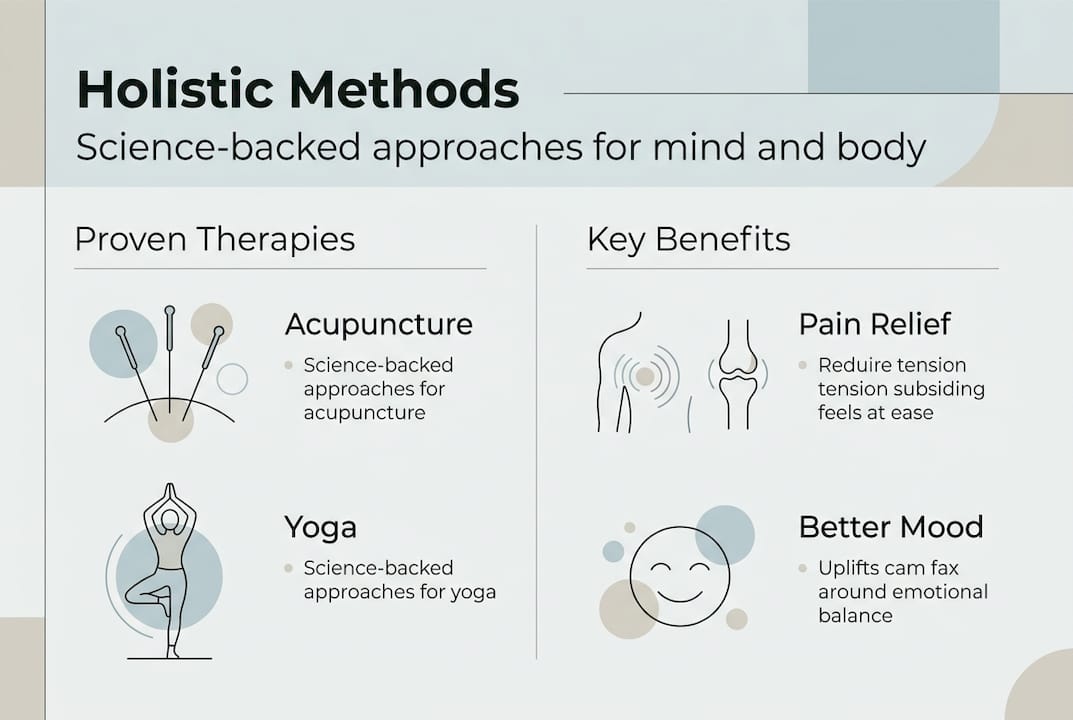
Not every holistic therapy has strong evidence. Some popular treatments lack rigorous studies or show inconsistent results. That's why focusing on what works matters so much. Here are the key evidence-based holistic methods you can trust:
- Acupuncture: Shown to reduce pain and depression in multiple studies
- Yoga and tai chi: Improve flexibility, balance, and mental well-being
- Mindfulness-based stress reduction (MBSR): Lowers anxiety and enhances coping skills
- Cognitive behavioral therapy (CBT): Helps manage pain perception and emotional distress
- Meditation: Supports relaxation and emotional resilience
These therapies work best when tailored to your specific condition and integrated with your existing care plan. To explore how these fit into a broader wellness strategy, check out our integrative health overview.
Preparing for your holistic journey: What you need
Before you start any holistic therapy, a little preparation goes a long way. You'll want to ensure you're ready, your providers are qualified, and you understand the safety considerations.

Personal readiness means being willing to track your symptoms, set realistic goals, and commit to regular practice. Holistic methods often require consistency over weeks or months to show results. Ask yourself if you're ready to keep a symptom journal, attend sessions regularly, and communicate openly with your care team.
Requirements include working with licensed practitioners who specialize in evidence-backed therapies. Look for credentials like licensed acupuncturists, certified yoga therapists, or psychologists trained in CBT. Verify their qualifications and ask about their experience with your specific condition.
Safety is critical. Evidence quality is low-to-moderate, and adverse events are rarely reported, but that doesn't mean risks don't exist. Always share your full treatment plan with your primary care provider, especially if you're taking medications or have complex health issues. Monitor for any unexpected symptoms and report them immediately.
Pro Tip: Keep a symptom journal to measure results and share with your care team. Track pain levels, energy, mood, and sleep quality daily. This data helps you and your providers adjust your plan for better outcomes.
Here's a quick comparison of what to look for in evidence-based versus unproven holistic methods:
| Criteria | Evidence-Based Methods | Unproven Methods |
|---|---|---|
| Scientific support | Multiple clinical trials and reviews | Limited or no research |
| Provider credentials | Licensed, certified professionals | Varies widely, often unregulated |
| Safety monitoring | Adverse events tracked and reported | Risks often unknown |
| Integration with conventional care | Designed to complement medical treatment | May conflict with standard care |
| Outcome tracking | Patient-reported measures used | Subjective claims without data |
For more guidance on vetting providers, visit our safety checks for providers and wellness checklist.
Step-by-step guide: Implementing evidence-based holistic methods
Now that you're prepared, let's walk through the exact steps to integrate holistic methods into your care plan. This structured approach maximizes your results while keeping you safe.
-
Consult your provider and co-design your plan. Schedule a conversation with your primary care doctor or specialist. Share your interest in holistic methods and ask which therapies align with your condition. Work together to create a plan that includes both conventional and complementary approaches.
-
Choose therapies with guideline support and moderate evidence. Focus on methods recommended by clinical guidelines. Guidelines and reviews show modest benefits from acupuncture, yoga, tai chi, MBSR, and CBT for pain, anxiety, depression, and fatigue. These therapies have been studied enough to give you confidence in their safety and effectiveness.
-
Integrate mind-body activities into your routine. Start with one or two therapies and build from there. For example, you might begin with a weekly yoga class and daily meditation. CBT provides small benefits for pain and distress, while acupuncture may moderately reduce depression severity. Consistency matters more than intensity.
-
Track outcomes weekly. Use a journal or app to record pain levels, function, mood, and sleep. Rate your pain on a 0-10 scale and note any changes in energy or emotional well-being. This data helps you see patterns and adjust your approach.
-
Adjust with your healthcare team and watch for adverse events. Review your progress monthly with your providers. If you're not seeing improvements after 8-12 weeks, consider switching therapies or adjusting your routine. Report any side effects, even minor ones, to ensure your safety.
Pro Tip: Pair holistic methods with conventional therapy, especially for severe pain or cancer-related issues. Holistic approaches work best as complements, not replacements, for medical care.
Here's what you can realistically expect from evidence-based holistic methods:
| Outcome | Typical Improvement | Timeframe |
|---|---|---|
| Pain reduction | 2-5 points on 0-100 scale | 8-12 weeks |
| Mood and anxiety | Small to moderate improvement | 6-10 weeks |
| Physical function | Modest gains in mobility and strength | 10-16 weeks |
| Sleep quality | Gradual improvement in duration and restfulness | 4-8 weeks |
| Fatigue | Small reduction in daily tiredness | 6-12 weeks |
These improvements may seem small, but they add up over time. For more on integrating these therapies, explore our alternative treatments guide, alternative therapies in wellness, and care impact and transparency.
Troubleshooting mistakes and overcoming challenges
Even with the best intentions, mistakes happen. Knowing what can go wrong and how to fix it keeps you on track.
Common mistakes:
- Using unproven methods or relying solely on holistic care. Some therapies lack scientific support and may waste your time or money. Worse, skipping conventional care for serious conditions can lead to complications. Always prioritize evidence-based methods and use them alongside medical treatment.
- Ignoring clinical guidelines for serious conditions. If you have severe pain, cancer, or another complex illness, following official guidelines is essential. Holistic methods can help, but they shouldn't replace proven medical interventions.
- Failing to monitor supplement interactions. Many people take herbs or supplements alongside holistic therapies. Some of these can interact with medications, especially for cancer or heart conditions. Always disclose everything you're taking to your care team.
Challenges and solutions:
Severe pain may require conventional meds plus integrative methods, and cancer-related symptoms should follow official guidelines. If you're dealing with these edge cases, work closely with specialists who understand both conventional and holistic approaches. They can help you balance treatments safely.
"Improvements are often modest; track patient-reported outcomes and stay realistic."
This mindset helps you avoid disappointment and stay motivated. Holistic methods aren't miracle cures, but they can meaningfully improve your quality of life when used correctly.
For more on tailoring your approach, visit our guide on personalized wellness outcomes.
Verifying results: How to track progress and set realistic goals
Measuring your progress keeps you motivated and helps you refine your approach. Here's how to do it effectively.
Set clear, realistic goals. Instead of vague aims like "feel better," define specific targets: reduce pain by 2 points, sleep 7 hours nightly, or walk 15 minutes without discomfort. These concrete goals make it easier to track success.
Use journals and patient-reported outcome measures. Write down your symptoms, activities, and mood daily. Many apps and templates can help. Patient-reported outcomes are the gold standard for tracking holistic therapies because they capture what matters most to you.
Review progress monthly with your care team. Schedule regular check-ins to discuss your data. Your providers can help you interpret trends, adjust therapies, and celebrate wins. Improvements often small, such as a 2-5 point shift on 0-100 pain scales, should drive decisions about continuing or changing your plan.
Pro Tip: Celebrate small wins and adjust as needed. Holistic methods work best when integrated over time. If you see even modest improvements, you're on the right path. If progress stalls, don't hesitate to try a different therapy or tweak your routine.
Key metrics to track:
- Pain levels: Rate daily on a 0-10 scale
- Energy and fatigue: Note how tired you feel each morning and evening
- Mood and anxiety: Use a simple scale or mood tracker
- Sleep quality: Record hours slept and how rested you feel
- Physical function: Track activities like walking, climbing stairs, or household tasks
For additional tools and checklists, revisit our wellness checklist.
Find holistic treatments and practitioners for personalized wellness
You've learned the steps, the science, and the strategies. Now it's time to connect with trusted experts who can tailor your holistic care for lasting results.
Finding the right practitioner makes all the difference. You need someone who understands your condition, respects evidence-based methods, and collaborates with your medical team. That's where we come in.
Our platform connects you with vetted holistic health practitioners who specialize in therapies proven by scientific evidence. Whether you're exploring acupuncture, yoga, CBT, or mindfulness, you'll find licensed professionals ready to guide your journey. Browse our holistic treatment options to discover therapies that match your needs, or search our holistic provider directory to find qualified experts near you. You can also explore nearby wellness practitioners to start building your personalized care team today.
Frequently asked questions
Are holistic methods safe for chronic pain and illness?
Most evidence-based holistic methods, like acupuncture or yoga, are safe when used alongside conventional care and guided by licensed providers. Risks are rarely reported, but always check provider credentials and share all therapies with your care team.
Can holistic methods replace my current medications?
No, holistic approaches are best used as adjuncts. Severe pain may require conventional meds plus integrative methods, and you should always follow medical guidelines, especially for cancer-related conditions.
How much improvement can I expect from evidence-based holistic treatments?
You may see small improvements, such as a 2-5 point reduction on pain scales or small boosts to mood and energy. Track patient-reported outcomes and stay realistic about expectations.
Are all holistic therapies equally supported by scientific evidence?
No, not all holistic therapies have strong evidence. Focus on those recommended in guidelines, such as acupuncture, yoga, CBT, and mindfulness. Prioritize evidence-based over unproven methods to ensure safety and effectiveness.