

Holistic health has a reputation problem. Many people assume that therapies like acupuncture and Ayurveda are purely rooted in tradition, unsupported by modern science. But that picture is changing fast. Evidence-based wellness involves systematic interventions grounded in scientific research, demonstrating measurable impacts on health outcomes. This article breaks down what that actually means for you, how acupuncture and Ayurveda measure up under scientific scrutiny, and how you can build a wellness routine that balances ancient wisdom with modern validation.
Table of Contents
- What is evidence-based wellness?
- Why evidence matters: Insights from acupuncture and Ayurveda
- How alternative therapies are evaluated: From trials to real-world results
- Integrating evidence-based approaches: Practical steps and expert advice
- A deeper look: What most people miss about evidence-based wellness
- Explore evidence-based holistic health solutions
- Frequently asked questions
Key Takeaways
| Point | Details |
|---|---|
| Definition of evidence-based wellness | Combines holistic therapies with rigorous scientific validation for measurable health outcomes. |
| Strong evidence for acupuncture | Acupuncture is well-supported for chronic pain, anxiety, and symptom management based on studies and guidelines. |
| Ayurveda shows promise but needs more research | Ayurvedic approaches are promising for some chronic conditions but require further high-quality trials. |
| Assessment and personalization are key | Safe integration requires careful research, multiple sessions, and personal coordination with health teams. |
| Continuous evaluation matters | Evidence-based wellness is about staying informed and adapting as new research and guidelines emerge. |
What is evidence-based wellness?
Evidence-based wellness means choosing therapies that have been tested, measured, and validated through scientific methods. It is not about dismissing traditional practices. It is about asking: does this actually work, for whom, and under what conditions?
The concept grew out of evidence-based medicine, which became the standard in clinical care during the 1990s. It relies on tools like randomized controlled trials (RCTs), where participants are randomly assigned to treatment or control groups to measure real effects. Systematic reviews then pool results from multiple studies to find consistent patterns.
Systematic interventions grounded in research produce measurable impacts rather than relying on anecdote or tradition alone. For holistic health seekers, this matters because it separates therapies that genuinely support your goals from those that may waste your time or, in rare cases, cause harm.
Here is what evidence-based wellness looks like in practice:
- Validated therapies: Supported by at least one well-designed RCT or systematic review
- Transparent outcomes: Clear data on what improved, by how much, and for how long
- Safety monitoring: Adverse effects are tracked and reported honestly
- Personalized application: Evidence guides recommendations for specific conditions, not blanket claims
- Ongoing evaluation: Conclusions update as new research emerges
| Approach | Basis | Reliability |
|---|---|---|
| Evidence-based wellness | Clinical trials, systematic reviews | High |
| Traditional use only | Historical practice, anecdote | Variable |
| Anecdotal claims | Personal stories | Low |
"The goal is not to replace tradition but to build a bridge between time-tested practices and the scientific rigor that protects patients."
Exploring holistic methods for chronic health through this lens gives you a much clearer picture of what to expect from your care.
Why evidence matters: Insights from acupuncture and Ayurveda
Let's look at how two of the most popular alternative modalities actually perform when put under the scientific microscope.
Acupuncture has accumulated some of the strongest evidence in the alternative medicine space. Strong evidence from meta-analyses supports its efficacy for chronic pain, postoperative nausea, and cancer-related symptoms. Effect sizes in pain studies are clinically meaningful, often comparable to low-dose analgesics but without the side effects. That is a significant finding.

Ayurveda tells a more nuanced story. Promising results need more rigorous research before broad clinical recommendations can be made. Some Ayurvedic protocols show reductions in cardiovascular disease risk markers and improvements in metabolic conditions. But study quality varies widely, and standardization of herbal formulations remains a challenge.
| Modality | Strongest evidence areas | Evidence quality | Key limitation |
|---|---|---|---|
| Acupuncture | Chronic pain, nausea, anxiety | High (multiple RCTs, meta-analyses) | Placebo design is complex |
| Ayurveda | CVD risk, metabolic health | Moderate (some RCTs, case series) | Standardization gaps |
Here is how to use this information practically:
- Match therapy to condition. Acupuncture for chronic back pain has strong backing. Ayurveda for stress management shows promise but requires a more personalized approach.
- Ask your practitioner what studies support the protocol they are recommending.
- Check resources like evidence-based alternative treatments before committing to a treatment plan.
- Use the holistic practitioners directory to find verified providers who stay current with research.
Pro Tip: When evaluating any therapy, search for systematic reviews rather than single studies. A single positive trial can be misleading. A systematic review of ten trials tells a much more reliable story.
How alternative therapies are evaluated: From trials to real-world results
Researchers use several layers of evidence to validate holistic therapies, and understanding these layers helps you become a more informed consumer.
The gold standard is the randomized controlled trial. Participants are randomly assigned to receive the therapy or a control condition (often a sham treatment or standard care). This design controls for the placebo effect and other biases. For acupuncture, sham needling studies have been especially revealing, showing that real acupuncture often outperforms sham by a meaningful margin for pain outcomes.
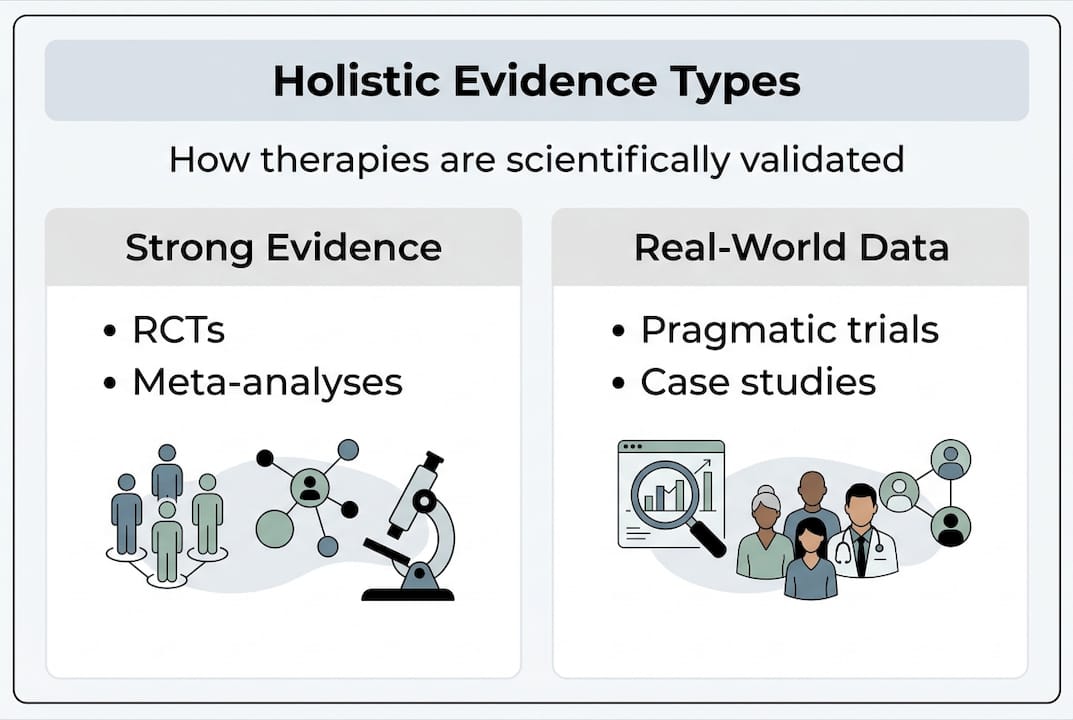
Beyond RCTs, pragmatic trials test how therapies perform in real clinical settings, with real patients who have multiple conditions and varied backgrounds. These trials sacrifice some control for greater relevance to everyday practice. Evidence-based integration methodologies include rigorous clinical trials, pragmatic designs, real-world evidence, and guidelines from organizations like WHO.
Real-world evidence is equally important. Patient registries, electronic health records, and session-based outcome tracking all reveal how therapies perform outside controlled lab conditions. This is where holistic care often shines, because patient experience and quality-of-life improvements are captured in ways that RCTs sometimes miss.
Here is what to look for when assessing a therapy's evidence base:
- Multiple RCTs with consistent results across different research teams
- Systematic reviews or meta-analyses that pool data from several studies
- Guidelines from credible bodies like WHO or professional medical associations
- Transparent reporting of both benefits and side effects
- Real-world outcome data from clinics and patient registries
Pro Tip: The holistic treatments overview on Go Holistic includes research summaries for over 200 therapy types, making it easy to check the evidence before you book. You can also explore holistic methods for chronic health for condition-specific guidance.
Integrating evidence-based approaches: Practical steps and expert advice
Knowing the research is one thing. Putting it into practice is another. Here is a clear path forward for integrating acupuncture, Ayurveda, or other evidence-backed therapies into your life.
- Start with a conversation. Talk to your primary care provider before beginning any new therapy. Share what you are considering and why. Guidelines support integrating evidence-backed therapies with a focus on safety and patient-centered care, but coordination with your existing care team is essential.
- Match the therapy to your condition. Choose modalities with the strongest evidence for your specific concern. Chronic pain? Acupuncture has robust support. Digestive health or stress? Ayurveda's personalized protocols may be worth exploring with a qualified practitioner.
- Plan for a realistic course of treatment. Multiple sessions are needed for acupuncture to produce meaningful results, and personalized Ayurveda protocols require time and monitoring. Commit to at least 6 to 8 sessions before evaluating outcomes.
- Track your progress. Use simple tools like a pain scale (0 to 10), a fatigue log, or an anxiety journal. Objective tracking helps you and your practitioner assess whether the therapy is working.
- Adjust as you learn. Evidence-based care is iterative. If outcomes plateau, revisit the research and discuss modifications with your care team.
"Personalized wellness is not a one-size-fits-all formula. It is a living process of observation, adjustment, and informed decision-making."
For deeper guidance on tailoring your approach, personalized wellness approaches offer practical frameworks that align with your unique health profile.
A deeper look: What most people miss about evidence-based wellness
Here is something the wellness world rarely admits: insisting on RCT-only evidence can actually limit your options in unhelpful ways. RCTs are powerful, but they are also expensive, difficult to design for complex therapies, and often exclude the very populations who use holistic care most.
Real evidence-based practice has always included clinical expertise and patient values alongside research data. That means your lived experience matters. Your cultural background, your risk tolerance, and your personal goals are legitimate inputs into your care plan, not noise to be filtered out.
What we have learned is that the most effective integrative care happens when patients stay curious and engaged. You do not need a medical degree to read a summary of a systematic review or ask your practitioner what evidence supports their recommendation. The landscape of alternative therapies in 2026 is evolving quickly, and staying informed puts you in the driver's seat.
Safety and transparency are non-negotiable. But so is flexibility. The goal is not perfect certainty. It is informed, ongoing progress toward your best health.
Explore evidence-based holistic health solutions
You have done the reading. Now it is time to take a real step forward. Go Holistic makes it easy to move from curiosity to action, connecting you with verified practitioners who practice evidence-informed care across acupuncture, Ayurveda, massage therapy, and more.
Browse the find holistic practitioners directory to filter by specialty, location, and credentials. Explore the evidence-based treatments library to review research summaries before you book. The Go Holistic platform also uses AI to match your health concerns with personalized recommendations, so your wellness journey feels supported every step of the way. Get started today.
Frequently asked questions
What is evidence-based wellness in holistic health?
Evidence-based wellness means integrating therapies proven by solid research, like clinical trials and real-world studies, into a holistic care plan rather than relying on tradition or anecdote alone.
Which holistic therapies are most evidence-based?
Acupuncture is strongly supported by systematic reviews for chronic pain and symptom management, while Ayurveda shows promise but needs more high-quality standardized studies before broad clinical endorsement.
How do I know if a therapy is evidence-based?
Look for supportive randomized trials, meta-analyses, and official guidelines from WHO or recognized medical associations that evaluate both efficacy and safety data.
Can I safely combine acupuncture or Ayurveda with conventional medicine?
Yes. WHO promotes integration of validated alternative therapies alongside conventional care, provided treatments are evidence-based and coordinated openly with your healthcare team.