

TL;DR:
- Functional medicine combines advanced diagnostics with personalized, systems-based approaches to address root causes of health issues. It emphasizes individualized care, preventive strategies, and integration of lifestyle, nutrition, and biomedical interventions, supported by varying levels of scientific evidence. Deciding on its suitability depends on personal health goals, practitioner credibility, and an understanding of the current evidence landscape.
Functional medicine sits at a fascinating crossroads where cutting-edge diagnostics meet whole-person healing, yet it remains one of the most misunderstood approaches in the wellness world. Many people assume anything outside conventional prescriptions must be unscientific or fringe. But functional medicine tells a more nuanced story. It weaves together biomedical research, personalized care, and lifestyle strategies into a framework that looks deeper than surface symptoms. This guide walks you through exactly what functional medicine is, how it fits into a broader holistic health picture, and what the current science actually supports.
Table of Contents
- Understanding functional medicine: Principles and philosophy
- How functional medicine compares to conventional and holistic care
- What does the science actually say about functional medicine therapies?
- Is functional medicine right for you? Making informed decisions
- Why the conversation about functional medicine needs nuance
- Discover holistic health solutions with Go Holistic
- Frequently asked questions
Key Takeaways
| Point | Details |
|---|---|
| Defines root-cause focus | Functional medicine seeks to address the root causes of illness using a blend of conventional and holistic approaches. |
| Evidence varies by therapy | Some functional medicine therapies are supported by moderate evidence, while others still lack robust scientific backing. |
| Compare care models | Functional medicine stands between conventional and holistic care, offering personalization and integrating diverse methods. |
| Informed choices matter | Understanding the science and asking informed questions can help you make safer, more effective wellness decisions. |
| Expert guidance available | Platforms like Go Holistic connect individuals with credible practitioners and resources for holistic health journeys. |
Understanding functional medicine: Principles and philosophy
At its heart, functional medicine asks a simple but powerful question: Why is this happening, not just what is happening? Instead of matching a symptom to a drug, functional medicine practitioners dig into the root causes driving your health challenges. That might mean exploring gut health, hormonal balance, nutrient deficiencies, sleep patterns, chronic stress, or environmental exposures.
This approach draws on what's called a systems biology framework, meaning it views your body as an interconnected web rather than a collection of separate parts. A digestive issue might be tied to your immune function; fatigue might connect back to thyroid health or chronic inflammation. Functional medicine tries to trace those threads and address them together.
Here are the core principles you'll find running through most functional medicine practices:
- Patient-centered care: Your story, lifestyle, and genetics shape your treatment plan, not a one-size-fits-all protocol.
- Root cause focus: Practitioners investigate underlying drivers of illness rather than managing symptoms alone.
- Preventive and proactive strategies: Catching imbalances early, before they become chronic conditions, is a priority.
- Integrative methods: Plans often combine nutrition, movement, sleep optimization, stress reduction, and targeted supplementation.
- Dynamic and evolving care: Treatment plans are adjusted as your health changes and as new data emerges.
It's worth noting that integrative health benefits extend across many of these same principles, and functional medicine often overlaps with broader integrative health models. When it comes to evidence, functional-medicine–aligned therapies overlap with evidence-backed biomedical approaches, but the quality of evidence varies. Understanding that nuance is key before diving in.
The integrative nutrition guide offers a deeper look at how food and lifestyle intersect with personalized health care, which pairs naturally with functional medicine's philosophy.
Pro Tip: When meeting a functional medicine practitioner for the first time, ask them specifically how they personalize treatment plans based on your lifestyle history, not just your lab results. The answer will tell you a lot about their approach.
How functional medicine compares to conventional and holistic care
Understanding functional medicine gets much clearer when you set it side by side with the care models you already know. Conventional medicine excels at acute care, emergency intervention, and pharmaceutical management of diagnosed conditions. Traditional holistic care emphasizes whole-body wellness, energy systems, and natural therapies. Functional medicine sits between and across both.
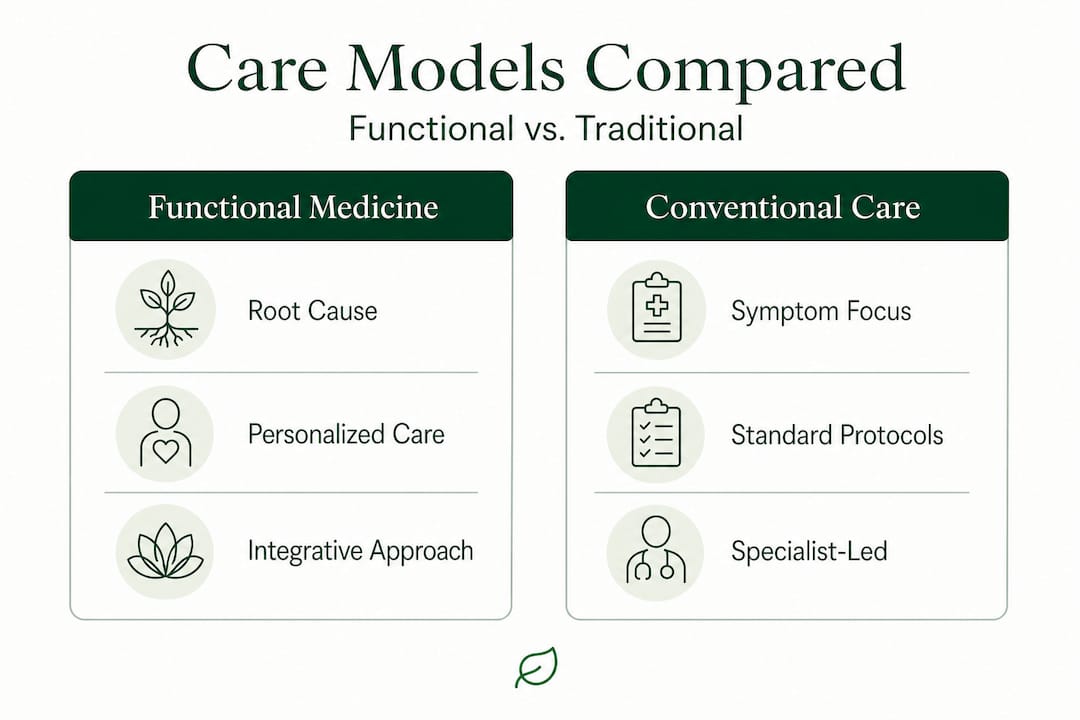
Here's a quick comparison to make those distinctions concrete:
| Feature | Functional medicine | Traditional holistic care | Conventional medicine |
|---|---|---|---|
| Primary focus | Root causes and systems | Whole-person energy and balance | Diagnosis and symptom management |
| Use of lab testing | Extensive and detailed | Minimal or none | Standard diagnostics |
| Therapy types | Blended (natural + biomedical) | Natural, energy-based, lifestyle | Pharmaceutical and surgical |
| Personalization | Highly individualized | Practitioner-dependent | Standardized protocols |
| Evidence use | Moderate, varies by therapy | Often limited | Strong, peer-reviewed |
| Preventive focus | High | High | Growing but secondary |
Both functional and holistic medicine share a commitment to treating the whole person, not just the presenting condition. The difference lies in how much functional medicine leans on diagnostic testing and where it places its evidence bar. It's more willing to run detailed bloodwork, genetic panels, or microbiome assessments than a traditional herbalist might be.
The following points highlight where functional medicine stands out compared to other models:
- It accepts non-pharmacological approaches when research supports them.
- It bridges the gap between a patient's subjective experience and objective lab findings.
- It often involves longer appointment times and more thorough health histories.
- It is more likely to refer back to conventional medicine when necessary.
"The quality of evidence can vary by therapy and condition" is something every informed patient should keep in mind. Some evidence-based holistic health practices carry robust research support, while others are still being studied. Knowing that difference protects you as you make care decisions.
Exploring the full range of holistic health treatments available today can help you see where functional medicine fits within the broader wellness landscape.
What does the science actually say about functional medicine therapies?
This is where things get genuinely interesting, and where informed curiosity really pays off. The research landscape around functional medicine therapies is not black and white. Some interventions have meaningful scientific support. Others are still early in their evidence journey.

Reviews show a range from very low to moderate evidence quality for functional-medicine–aligned therapies like acupuncture and photobiomodulation (light-based therapy). That doesn't mean therapies with moderate evidence are weak, but it does mean patients need to approach each one with clear eyes.
Here's a snapshot of evidence grades for some commonly used therapies:
| Therapy | Common use | Evidence quality |
|---|---|---|
| Acupuncture | Fibromyalgia, chronic pain | Moderate |
| Photobiomodulation | Wound healing, inflammation | Moderate (some outcomes) |
| Elimination diets | Food sensitivities, IBS | Low to moderate |
| Herbal supplementation | Various conditions | Very low to low |
| Gut microbiome protocols | Digestive health | Low to moderate |
| Mindfulness-based stress reduction | Anxiety, pain | Moderate to strong |
So how should you evaluate a functional medicine therapy before trying it? Here's a practical step-by-step process:
- Search for systematic reviews or meta-analyses. These pool results from multiple studies and give you a broader picture than a single trial. Resources like PubMed make this accessible to anyone.
- Look at randomized controlled trials (RCTs). RCTs reduce bias by randomly assigning participants to treatment or control groups. They're the gold standard in clinical research.
- Check the quality rating. Research often includes a GRADE system (Grading of Recommendations, Assessment, Development, and Evaluations) to rate evidence strength. Look for "moderate" or "high" ratings where possible.
- Evaluate the sample size and duration. A study with 30 participants run for six weeks tells you far less than one with 500 participants followed for two years.
- Cross-reference with your specific condition. Evidence that supports acupuncture for lower back pain doesn't automatically mean it works for your migraines. Specificity matters.
Exploring evidence-based wellness practices can help you start building a foundation of therapies with meaningful research behind them. You'll also find it helpful to understand what evidence-based means in the context of holistic health, since the term is sometimes used loosely. For those managing long-term conditions, holistic methods for chronic health offers targeted guidance worth exploring.
Pro Tip: Always check whether a study was conducted on humans (not just animals or cell cultures) and whether the journal it was published in is peer-reviewed. These two filters alone will sharpen your reading of health research dramatically.
Is functional medicine right for you? Making informed decisions
Deciding whether functional medicine fits your health journey is a personal process. There's no universal answer, but there are clear signals worth paying attention to.
Start by asking yourself what you're hoping to address. Functional medicine tends to shine brightest for people dealing with:
- Chronic conditions like fatigue, digestive disorders, or persistent pain that haven't responded well to conventional treatment
- Hormonal imbalances or autoimmune challenges where root causes are unclear
- A desire to prevent illness rather than simply manage symptoms
- Health goals that include lifestyle change, not just medication
Once you have clarity on your goals, evaluating a practitioner becomes your next priority. Here's a practical checklist to guide that process:
- Check credentials. Look for training from institutions like the Institute for Functional Medicine (IFM) or board certification in an integrative specialty.
- Ask about their process. A strong practitioner will take a thorough health history, often through a detailed intake questionnaire before your first appointment.
- Expect transparency about evidence. They should be able to tell you what research supports their recommended therapies and acknowledge when evidence is limited.
- Assess personalization. If a practitioner offers everyone the same protocol regardless of health history, that's a red flag.
- Look at follow-up structure. Functional medicine is an ongoing relationship, not a one-time visit. Understand how often you'll be seen and how plans will be adjusted.
Questions to ask before committing to any functional medicine therapy:
- What is the evidence base for this specific therapy for my specific condition?
- How will we measure progress, and over what timeframe?
- What are the known risks or contraindications?
- Does this therapy interact with any medications I currently take?
Not all therapies have strong evidence backing, and quality varies by condition, so these questions aren't just good practice, they're essential protection for your wellbeing. The investment in personalized wellness for health outcomes is real, and understanding your options helps you direct that investment wisely.
If you're curious about starting points that carry solid safety profiles, non-invasive holistic treatments offer a lower-risk entry point while you explore what resonates most with your body and values.
Why the conversation about functional medicine needs nuance
Here's an opinion worth sitting with: the loudest voices in the functional medicine debate are often the least helpful ones. On one side, you have enthusiastic advocates who treat every functional therapy as a miracle. On the other, skeptics who dismiss the entire field because a handful of studies were poorly designed. Both camps are doing a disservice to people genuinely searching for better health.
The truth is that functional medicine is evolving. Rapidly. What had low-quality evidence five years ago may now have solid RCT support. And what was once promoted with confidence may have since been revised. This isn't a weakness of functional medicine specifically. It's how all of science works.
What's more, context and individualization matter enormously in health care. A therapy that shows modest average results in a population study might be genuinely life-changing for someone whose specific biology, history, and lifestyle align with what that therapy addresses. Dismissing it because the average effect size wasn't large misses the point of personalized care entirely.
We think the wisest stance is curious skepticism. That means staying genuinely open to what emerging research suggests while consistently asking for the evidence. It means valuing personal experience without letting it override safety considerations. And it means engaging with practitioners as partners, not just authorities.
Following integrative wellness tips grounded in both science and real-world application is one way to keep that balance. The goal isn't to choose between conventional science and holistic care. It's to build a health approach that draws the best from both, guided by your unique needs.
Discover holistic health solutions with Go Holistic
Understanding functional medicine is a meaningful first step. What comes next is finding the support that helps you move from curiosity to real, lasting change.
Go Holistic connects you with verified, credentialed practitioners across disciplines including acupuncture, Ayurveda, massage therapy, and functional nutrition. Our AI-powered platform analyzes your health concerns and matches you with personalized, research-backed recommendations, so you're never navigating your wellness journey alone. Whether you're ready to explore holistic treatments, find health providers who align with your values, or simply start researching your options, we make it accessible and transparent. Take the next step and find practitioners who are equipped to support your unique path to well-being. Get Started today and let your health journey be guided by both science and heart.
Frequently asked questions
Is functional medicine evidence-based?
Some functional medicine therapies have moderate scientific support, while others may have limited or low-quality evidence depending on the condition and therapy. Reviews show evidence quality ranges from very low to moderate for various therapies, so evaluating each one individually is important.
What types of conditions might benefit from functional medicine?
Chronic issues like digestive problems, some autoimmune disorders, and persistent pain are commonly addressed through functional medicine approaches. Non-pharmacological therapies for conditions like functional constipation and chronic pain have been reviewed in evidence analyses, though results and approaches vary widely between individuals.
How do I find a credible functional medicine practitioner?
Look for practitioners who are transparent about their evidence base, explain their approach in clear terms, and tailor care to your specific health history and goals rather than offering a one-size-fits-all plan.
Are there risks associated with functional medicine?
Some therapies lack robust scientific backing, which is why verifying evidence and consulting qualified practitioners is essential to ensure both safety and effectiveness. Evidence can be very low for certain therapies, so patient caution is always advised before beginning any new treatment protocol.