

TL;DR:
- Integrative nutrition takes a whole-person approach, considering stress, sleep, culture, and emotional health.
- Evidence supports plant-rich diets like Mediterranean and DASH for reducing disease and improving longevity.
- Personalization and lifestyle integration are essential for sustainable, effective wellness beyond generic diets.
Even the healthiest diet can fall short if it ignores the bigger picture. You might be eating plenty of vegetables, tracking your macros, and still feeling off. That's because conventional nutrition guidelines often zoom in on calories, proteins, and fats while missing the broader landscape of your life: your stress levels, cultural food traditions, sleep patterns, and emotional health. Integrative nutrition challenges that narrow view. It brings together the science of food with the full context of who you are. This guide walks you through what integrative nutrition really means, what the evidence says, and how you can start applying its principles to your own wellness journey.
Table of Contents
- Understanding integrative nutrition: A holistic definition
- What makes integrative nutrition evidence-based?
- Personalization and holistic focus: Beyond one-size-fits-all diets
- Debates and criticisms: Is integrative nutrition too alternative?
- A fresh perspective: What most people miss about integrative nutrition
- Ready to personalize your wellness journey?
- Frequently asked questions
Key Takeaways
| Point | Details |
|---|---|
| Whole-person approach | Integrative nutrition looks beyond food to address lifestyle, stress, and environment for comprehensive health. |
| Science-backed patterns | Evidence shows plant-rich diets like Mediterranean and DASH help prevent disease and promote healthy aging. |
| Personalization matters | Success often comes from tailored strategies that suit your body, culture, and stage of life. |
| Critical perspective | It's vital to distinguish science-based integrative nutrition from unproven fads or supplements. |
Understanding integrative nutrition: A holistic definition
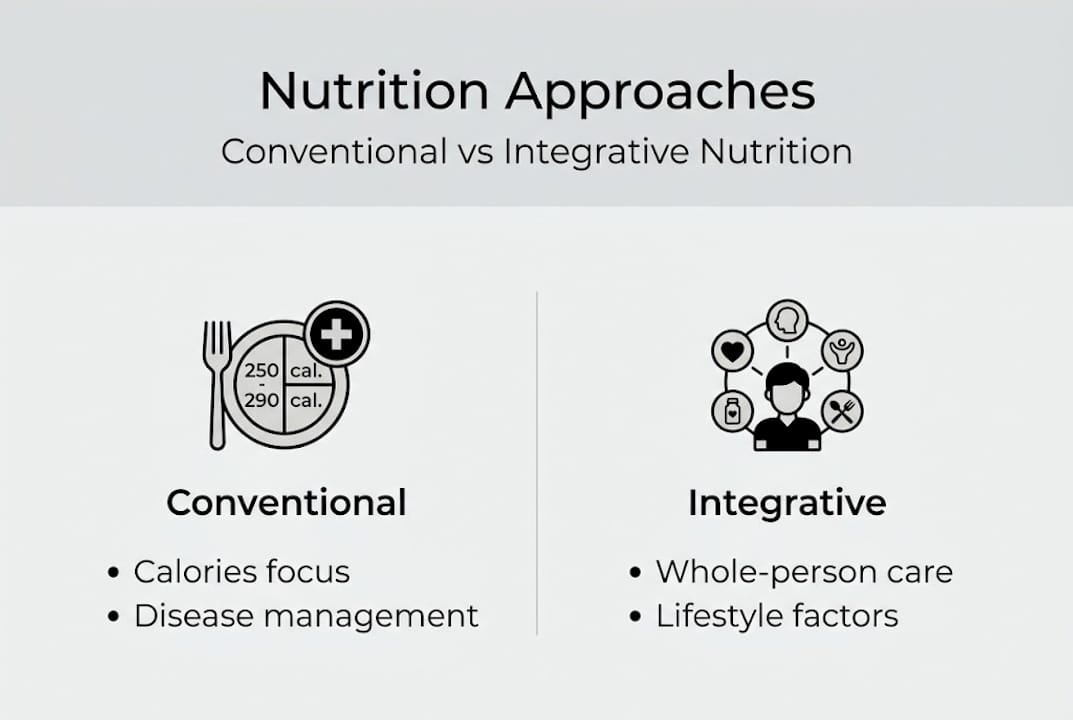
Integrative nutrition is not a single diet plan or a trendy eating protocol. It's a philosophy and a practice that treats food as one important piece of a much larger health puzzle. Where conventional nutrition might hand you a calorie target or a macronutrient ratio, integrative nutrition asks deeper questions: How is your stress affecting your digestion? Does your cultural background shape your relationship with food? Are your eating habits sustainable for your actual life?
The contrast is meaningful. As whole-person perspective research confirms, integrative nutrition differs from conventional nutrition, which focuses on macronutrients, calories, and disease-specific guidelines, by adopting a broader whole-person view. That shift in lens changes everything about how you approach eating and health.
At its core, integrative nutrition is built on a few foundational ideas:
- Personalization over prescription: No single plan works for everyone. Your biology, history, and lifestyle matter.
- Lifestyle integration: Sleep, movement, stress, and relationships all influence how your body uses food.
- Cultural sensitivity: Food is deeply tied to identity and community. Effective nutrition honors that.
- Long-term sustainability: A plan you can't maintain for years isn't truly healthy.
- Whole-person focus: Physical, emotional, and social well-being are all part of the equation.
Here's a quick comparison to make the distinction clear:
| Feature | Conventional nutrition | Integrative nutrition |
|---|---|---|
| Focus | Calories, macros, disease management | Whole person, lifestyle, culture |
| Approach | Standardized guidelines | Personalized plans |
| Tools | Food logs, nutrient targets | Lifestyle assessments, practitioner collaboration |
| Goal | Treat or prevent specific conditions | Optimize overall well-being |
| Flexibility | Often rigid | Adaptive and evolving |
This is why personalized wellness has become such a central theme in modern holistic health. When nutrition is tailored to your unique circumstances, it becomes far more effective and far easier to sustain. Learning more about science-backed nutrition can help you see just how far this field has come from simple calorie counting.

What makes integrative nutrition evidence-based?
One fair question you might ask is: how do we know integrative nutrition actually works? It's a good question, and the answer lies in looking at the types of evidence that support it.
Integrative nutrition draws on randomized controlled trials (RCTs), long-term cohort studies, and dietary pattern research rather than relying on single-nutrient studies. This is an important distinction. Most conventional nutrition research historically studied one nutrient at a time, like vitamin C or saturated fat. But that approach misses how foods interact within a whole diet. Pattern-based research looks at how entire ways of eating affect health over time, which is a much more realistic reflection of how people actually eat.
Two of the most studied patterns in integrative nutrition are the Mediterranean and DASH diets. Both emphasize whole foods, healthy fats, lean proteins, and abundant plant matter. The dietary pattern research shows that higher adherence to plant-rich patterns like Mediterranean or DASH diets reduces chronic disease risk and improves healthy aging odds. That's not a small finding.
Key insight: People who consistently follow plant-rich dietary patterns show measurably better outcomes for cardiovascular health, metabolic function, and longevity compared to those following standard Western diets.
These patterns don't just reduce disease risk. They also support mental clarity, energy levels, and emotional resilience, all of which matter deeply in a holistic model of health. Exploring the full range of integrative health benefits can help you understand why these patterns are so widely recommended by integrative practitioners.
Of course, not every claim made under the integrative nutrition umbrella is equally supported. Some supplement protocols and detox programs lack rigorous evidence. The key is learning to distinguish credible integrative principles from wellness trends dressed up in scientific language.
Pro Tip: When evaluating any nutrition claim, ask: Is this supported by peer-reviewed studies in humans? Does the evidence come from pattern-based research or just a single small trial? Credible wellness practices will always point you toward transparent, reproducible research.
Personalization and holistic focus: Beyond one-size-fits-all diets
Understanding the science is one thing. Applying it to your real life is another. This is where personalization becomes the heart of integrative nutrition, and where it truly separates itself from generic dietary advice.
As nutrition research makes clear, there is no single best diet. Risks like nutrient deficiencies in strict plant-based variants without careful planning, along with the need to account for culture, comorbidities, and sustainability, mean that personalization isn't optional. It's essential.
Think about what that means in practice. Someone managing type 2 diabetes needs a different carbohydrate approach than a healthy young athlete. A person from a culture where rice is a staple food shouldn't be handed a low-carb protocol that erases their food heritage. A new parent running on minimal sleep needs different nutritional support than someone in a low-stress season of life.
Here's a practical framework for individualizing your nutrition safely:
- Assess your full health picture. Consider existing conditions, medications, energy levels, and digestive health before changing your diet.
- Identify your cultural and personal food preferences. Sustainable nutrition works with your life, not against it.
- Set realistic goals. Focus on gradual, meaningful shifts rather than dramatic overhauls.
- Monitor and adjust. Track how you feel, not just what you eat. Energy, mood, and digestion are all useful signals.
- Plan for nutrient gaps. If you're reducing or eliminating food groups, identify alternative sources or appropriate supplementation.
Pro Tip: Working with a qualified practitioner, such as a registered dietitian or a certified integrative health coach, gives you a personalized roadmap rather than a generic plan. Explore holistic health treatments to find the right support for your specific needs.
Personalization also means staying flexible. What works for you at 35 may not serve you at 55. Integrative nutrition is designed to evolve alongside you, which is one of its greatest strengths. Pairing food choices with broader evidence-based holistic wellness strategies amplifies results even further.
Debates and criticisms: Is integrative nutrition too alternative?
Integrative nutrition has real science behind it, but it also has real critics. Being informed means understanding both sides.
One of the most common criticisms targets popular programs like the Institute for Integrative Nutrition (IIN). As an IIN review notes, some critique IIN-style programs for lacking the rigorous science found in registered dietitian training, while functional medicine extensions face concerns over unproven tests and supplements. These are valid concerns worth taking seriously.
Here's how to tell a science-grounded integrative nutrition approach from one that's more hype than substance:
- Science-based signals: Practitioners cite peer-reviewed research, acknowledge uncertainty, and refer out when needed.
- Red flags: Promises of rapid transformation, heavy reliance on proprietary supplements, or dismissal of conventional medicine entirely.
- Licensing matters: Look for credentials like Registered Dietitian (RD), Certified Nutrition Specialist (CNS), or licensed integrative health practitioners.
- Transparency counts: Reputable programs disclose their evidence base and limitations openly.
A balanced view: Integrative nutrition at its best bridges evidence-based dietary science with whole-person care. At its worst, it can become a vehicle for wellness marketing that prioritizes profit over patient outcomes. The difference lies in the rigor, transparency, and humility of the practitioner.
This is why transparency in wellness matters so much when you're choosing who to trust with your health. And when it comes to managing ongoing health concerns, exploring holistic chronic health methods that are grounded in evidence gives you a much safer foundation.
The goal isn't to dismiss integrative nutrition because some programs fall short. It's to be a discerning consumer who asks good questions and seeks qualified guidance.
A fresh perspective: What most people miss about integrative nutrition
Here's something most articles won't tell you: the biggest mistake people make with integrative nutrition isn't choosing the wrong diet. It's treating food as the only lever worth pulling.
We've seen people follow beautifully designed, evidence-based meal plans and still struggle. Why? Because they're sleeping four hours a night, carrying chronic stress, and feeling disconnected from their community. Food is powerful, but it doesn't operate in isolation. The real strength of integrative nutrition lies in its insistence on lifestyle synergy, the idea that food, movement, rest, and emotional well-being all amplify each other.
Personalization is the other piece most people underestimate. Rigid rules feel motivating at first, but they rarely last. What actually fuels long-term results is a flexible, evolving approach that grows with you. Explore integrative health tips that reflect this whole-life perspective.
Integrative nutrition is not a destination. It's an ongoing, adaptable practice. What nourishes you today may need to shift as your life changes, and that's not failure. That's wisdom.
Ready to personalize your wellness journey?
When you're ready to put integrative nutrition principles into practice, finding the right support makes all the difference.
At Go Holistic, we connect you with verified, evidence-based practitioners across disciplines like nutrition coaching, Ayurveda, acupuncture, and more. Our AI-powered platform analyzes your health concerns and matches you with personalized recommendations backed by research. You can browse our curated directory of holistic providers, explore over 200 holistic health treatments, and book directly with licensed professionals. Whether you're just starting your wellness journey or looking to go deeper, we're here to support every step. Get Started today and discover what truly personalized, whole-person nutrition can feel like.
Frequently asked questions
How does integrative nutrition differ from standard nutrition?
Integrative nutrition addresses the whole person, combining diet, lifestyle, and personal factors, while standard nutrition often focuses on calories and macronutrients alone. The integrative model treats food as one piece of a broader wellness picture.
Are there proven health benefits to integrative nutrition?
Yes. Higher adherence to integrative, plant-rich patterns like the Mediterranean or DASH diets is linked to reduced chronic disease risk and healthier aging. These findings come from large-scale, peer-reviewed dietary pattern studies.
What are potential risks of integrative nutrition?
Risks include nutrient deficiencies if restrictive diets aren't carefully planned and over-reliance on non-evidence-based approaches without qualified personal guidance. Working with a credentialed practitioner significantly reduces these risks.
Is integrative nutrition recognized by mainstream medicine?
Some integrative nutrition concepts, like plant-rich dietary patterns, align with recognized medical guidelines. However, certain programs and practices may lack the scientific validation and regulatory oversight found in mainstream dietetics, so vetting credentials is important.