

TL;DR:
- The mind-body connection illustrates how mental processes influence physical health and vice versa, supported by extensive scientific evidence. Practicing techniques like meditation, yoga, and biofeedback can enhance well-being, especially for chronic conditions and stress management. Integrating these practices with conventional medicine offers a holistic approach to health, emphasizing patience and personalized care.
Your stomach tightens before a big presentation. A wave of calm washes over you mid-massage. A grief-stricken person falls physically ill within weeks of a major loss. These aren't coincidences or poetic metaphors. They're your body and mind speaking the same language, and once you learn to listen, your approach to wellness changes completely. This guide walks you through what the mind-body connection really means, what the science actually shows, and how you can use this knowledge to feel better, starting today.
Table of Contents
- What is the mind-body connection?
- The science behind mind-body integration
- Popular mind-body practices and their benefits
- When and how mind-body practices work for health issues
- Practical ways to strengthen your mind-body connection
- Why most people misunderstand the mind-body connection
- How to connect with holistic mind-body wellness solutions
- Frequently asked questions
Key Takeaways
| Point | Details |
|---|---|
| Mind and body are linked | Your thoughts, feelings, and physical health form a two-way relationship that can affect overall well-being. |
| Science supports the connection | Recent research shows brain networks integrate mental and physical functions for health impact. |
| Holistic practices offer benefits | Techniques like meditation, yoga, and massage help manage stress and pain, supported by evidence. |
| Practical steps make a difference | Simple, consistent mind-body practices can boost your wellness, especially when chosen mindfully. |
| Seek expert guidance when needed | Combining self-help strategies with holistic professionals gives the best results for complex health needs. |
What is the mind-body connection?
Now that you see why mind-body understanding matters, let's break down what it actually means in real-life terms.
Most of us grow up treating the mind and body as two separate systems. You visit a doctor for physical symptoms and a therapist for mental ones. But that division misses a profound truth about how you actually function.
The mind-body connection is defined as the bidirectional, ongoing relationship between mental processes (thoughts, emotions, attention, and beliefs) and physical and physiological processes such as nervous system activity and cardiovascular function, meaning each side can influence the other. That word "bidirectional" is key. The traffic flows both ways, constantly.
"The mind and body are not separate. What affects one, affects the other." This isn't just a wellness slogan. It's a biological reality backed by decades of research.
Here are some everyday examples that show this relationship in action:
- Stress and digestion: When you're anxious, your gut slows down or speeds up. Irritable bowel syndrome, for example, is strongly linked to psychological stress.
- Relaxation and blood pressure: Slow, intentional breathing and calming mental states can measurably lower blood pressure within minutes.
- Grief and immunity: Prolonged emotional distress suppresses immune function, making you more vulnerable to illness.
- Positive emotions and healing: Studies have found that patients with optimistic outlooks recover faster from surgery and illness.
- Placebo and pain: Believing a treatment will help can produce real, measurable relief, even when no active medication is involved.
Understanding these connections isn't about dismissing conventional medicine. It's about adding another layer to how you care for yourself.
The science behind mind-body integration
Having defined the mind-body relationship, let's look at the scientific evidence that makes this concept real and actionable.
For a long time, the mind-body connection was treated as philosophy or speculation. That has changed dramatically. Brain imaging technology now lets researchers watch these interactions happen in real time, and what they're finding is remarkable.

Functional connectivity in the motor cortex integrates movement-related networks with networks involved in thinking and planning, as well as control of involuntary bodily functions like blood pressure and heartbeat. In plain terms, the part of your brain that moves your body is also wired into your thought processes and your automatic survival systems. They share real estate. They share bandwidth.
This isn't a small finding. It suggests that when you move intentionally, think clearly, or practice calming techniques, you're influencing a deeply interconnected system, not just one isolated part of yourself.
| Brain region | Linked function | Mind-body relevance |
|---|---|---|
| Motor cortex | Movement and physical action | Connects to planning and involuntary functions |
| Prefrontal cortex | Decision-making and focus | Regulates emotional reactivity |
| Amygdala | Stress and fear response | Triggers physical stress signals |
| Insula | Interoception (body awareness) | Bridges internal sensation and emotion |
| Hypothalamus | Hormonal regulation | Responds to thoughts and emotional state |
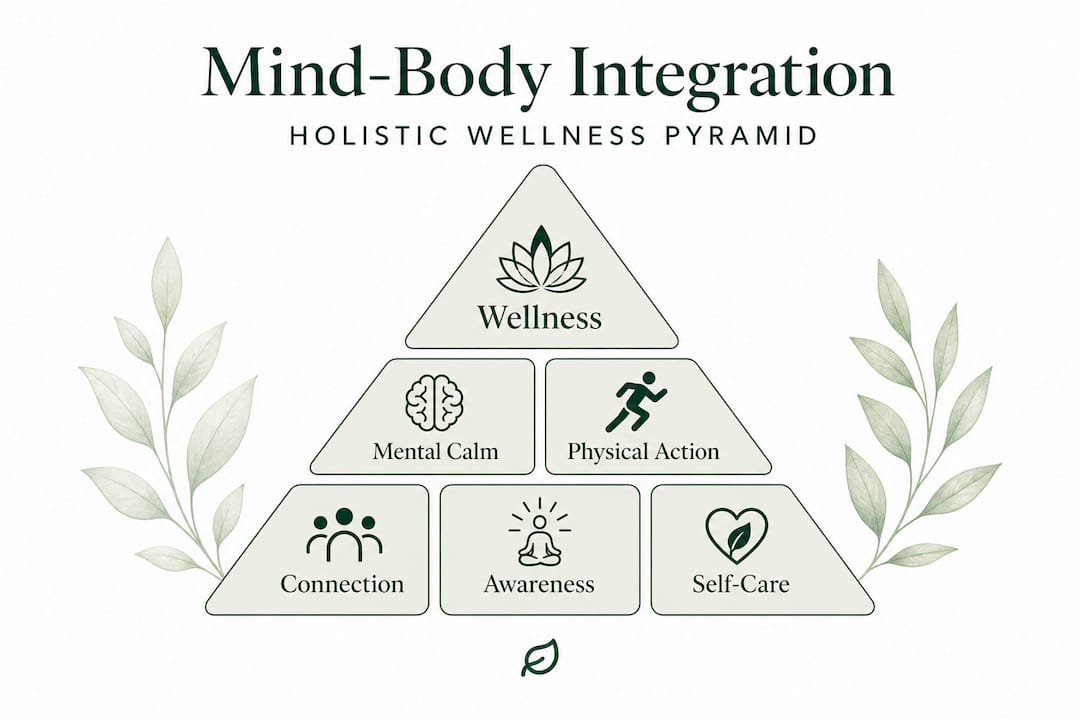
Each of these areas responds to mental input, and their outputs affect your body directly. Practices grounded in evidence-based mind-body approaches are designed with exactly this in mind.
Pro Tip: If you want to start experiencing mind-body integration, try a simple 5-minute body scan before sleep. Close your eyes, breathe slowly, and mentally move your attention from your feet to your head. This activates the insula and trains your awareness of internal signals, which is the foundation of nearly every mind-body practice.
What this means for your evidence-based wellness journey is that you're not choosing between your mind and your body. You're learning to care for a single, interwoven system.
Popular mind-body practices and their benefits
With the science in mind, what practical strategies can you use? Here's a look at the most effective mind-body practices and what they offer.
The National Center for Complementary and Integrative Health (NCCIH), part of the National Institutes of Health, defines mind and body practices as diverse techniques that target brain-body interactions to promote health. Their list includes meditation, relaxation techniques, massage therapy, spinal manipulation, acupuncture, yoga, and tai chi.
That's a wide range, which can feel overwhelming. Here's a comparison to help you see what each approach primarily targets:
| Practice | Primary input | Main benefits | Best for |
|---|---|---|---|
| Meditation | Mental | Stress reduction, emotional regulation | Anxiety, sleep issues |
| Yoga | Combined | Flexibility, breath awareness, calm | Stress, mild pain |
| Tai chi | Combined | Balance, gentle movement, focus | Older adults, joint health |
| Acupuncture | Physical | Pain relief, energy flow | Chronic pain, headaches |
| Massage therapy | Physical | Muscle tension, relaxation | Stress, sore muscles |
| Biofeedback | Mental and physical | Autonomic self-regulation | Migraines, hypertension |
| Guided imagery | Mental | Anxiety reduction, healing intention | Pre-surgery prep, fear |
To get the most out of these practices, consider starting with these steps:
- Identify your primary goal. Are you managing chronic pain, reducing anxiety, improving sleep, or simply building resilience? Your goal shapes which practice fits best.
- Start with one practice. Trying everything at once often leads to burnout. Pick one and commit to it for at least four weeks.
- Track how you feel. Keep a simple journal noting your mood, energy, and physical sensations before and after each session.
- Adjust based on feedback. If a practice isn't resonating after a month of consistent effort, try another. There's no one-size-fits-all in mind-body wellness.
- Add professional guidance early. A certified practitioner can correct your form, deepen your technique, and help you avoid common pitfalls.
Pro Tip: Combine a mental and a physical practice for synergistic benefits. Pairing a 10-minute meditation with a short yoga session, for example, addresses both the cognitive and somatic (body-based) sides of your stress response at once.
Exploring natural wellness practices can help you discover which combination feels right for your lifestyle. And if you're curious about where these modalities are heading, it's worth looking at 2026 alternative therapy trends to see what's gaining traction with both researchers and practitioners.
When and how mind-body practices work for health issues
With so many options, when are mind-body practices not just beneficial but actually recommended by experts? Let's examine what the evidence says.
The conversation around mind-body practices has moved well beyond self-care blogs. Major health institutions now include these approaches in clinical guidelines for specific conditions, and that shift matters for you.
Evidence from NCCIH shows that practices such as tai chi, qi gong, yoga, acupuncture, mindfulness, and biofeedback may help relieve some fibromyalgia symptoms. For chronic low-back pain, clinical guidelines strongly recommend starting with nonpharmacologic options, meaning treatments that don't rely on medication, including exercise, multidisciplinary rehabilitation, acupuncture, or mindfulness-based stress reduction (MBSR).
Key stat: For chronic low-back pain, leading clinical guidelines now list mindfulness-based stress reduction and acupuncture as first-line (the initial, preferred) recommended treatments before turning to prescription medications.
That's a significant shift from even a decade ago, when these approaches were considered supplementary at best.
Here's when you might seriously consider mind-body therapies as part of your care plan:
- You're managing a chronic condition like fibromyalgia, arthritis, or persistent low-back pain
- Prescription medications are causing side effects that impact your quality of life
- You're looking for safe holistic pain relief options that complement your existing treatment
- Stress, anxiety, or emotional distress seems to be worsening your physical symptoms
- You want to support recovery after surgery, illness, or injury
- You're interested in prevention and long-term resilience, not just treating symptoms
It's also worth noting that evidence-backed pain relief doesn't have to mean replacing your current care. Many people find the most benefit by layering mind-body approaches alongside conventional treatment. Resources like holistic pain solutions can help you think through what combinations might work for your situation.
Practical ways to strengthen your mind-body connection
After learning which approaches are most effective, here's how you can begin or deepen your own mind-body journey.
The science is clear, the practices are defined, and the benefits are documented. But knowing about something and actually building it into your daily life are two very different things. Here's a grounded, practical approach to developing your mind-body awareness.
These methods work by training your attention toward internal bodily signals (a capacity called interoception), regulating your stress physiology, and using body-based mind-body practices like meditation, breathing, yoga, tai chi, and massage to influence your mental state and functioning.
Follow these steps to build your practice from the ground up:
- Start with breath awareness. Spend five minutes each morning paying attention to your natural breathing pattern. Don't force changes. Just observe. This single habit trains your insula and grounds your nervous system before the day begins.
- Add a short body scan. Once you're comfortable with breath awareness, expand to a body scan. Slowly move your attention through each area of your body and notice where you hold tension. This is your personal feedback system.
- Move with intention. Choose a physical activity that encourages awareness, such as yoga, tai chi, or even a slow, mindful walk. The goal isn't fitness. It's connection between movement and sensation.
- Practice mindful eating. Eat one meal per day without screens or distractions. Pay attention to taste, texture, and how your body responds. This is one of the easiest ways to develop interoception.
- Build a wind-down ritual. End each day with 10 minutes of calming activity: journaling, light stretching, guided breathing, or gentle reading. This signals your nervous system that safety has returned and recovery can begin.
- Work with a practitioner. Personalized guidance from someone trained in Ayurveda for mind-body balance, yoga therapy, or acupuncture accelerates what you can achieve alone.
Pro Tip: The most common mistake people make is treating these practices as tasks to complete rather than states to experience. If you're rushing through a meditation to check it off your list, you're missing the point entirely. Quality of attention matters far more than duration.
Start small, stay consistent, and let your practice grow organically. Even ten intentional minutes per day, sustained over weeks, produces measurable changes in stress hormones, inflammatory markers, and subjective well-being.
Why most people misunderstand the mind-body connection
Let's confront a persistent myth and offer a more balanced perspective on this fascinating topic.
Here's what we've noticed after years of working in the holistic wellness space: people tend to fall into one of two traps. Either they dismiss the mind-body connection as feel-good mysticism with no real scientific grounding, or they swing to the other extreme and treat it as an all-powerful cure that can overcome any physical condition through positive thinking alone. Both views create problems.
The first group misses real, documented benefits that could meaningfully improve their lives. The second group sometimes delays necessary medical care or feels guilty when a positive mindset doesn't heal a structural problem. Neither response serves you well.
The honest reality is more nuanced. Broader philosophical debates continue around how to explain consciousness and subjective experience, and these are genuinely unresolved questions. But for day-to-day clinical practice and personal wellness, those debates don't change the practical value of these approaches. What matters is that the mechanisms are real, the benefits are measurable, and the risks are low.
We also see wellness seekers who treat mind-body practices like a vending machine: insert effort, receive healing. That's not how it works. These practices build capacity over time. They improve your baseline, sharpen your self-awareness, and give your nervous system more room to recover. They work with your body's natural intelligence, not around it.
The best outcomes we've seen come from people who bring two things to the table: genuine curiosity and reasonable patience. They try approaches with an open mind, track their experience honestly, stay flexible when something isn't working, and resist the urge to over-explain every sensation they have. They let the practice be what it is.
That kind of open, grounded engagement is far more powerful than either skepticism or zealotry.
How to connect with holistic mind-body wellness solutions
If you're ready to go further in your wellness journey, here's how to take the next step with expert support.
Learning about the mind-body connection is a meaningful first step, but putting it into practice is where real change happens. You don't have to figure it out alone.
At Go Holistic, we've built a platform designed to meet you exactly where you are. Whether you want to explore holistic treatments across our library of over 200 therapy types, or you're ready to find a holistic practitioner who fits your specific needs, we make that process simple, transparent, and personalized. Our AI-powered recommendation engine analyzes your health concerns and connects you with verified, licensed practitioners in disciplines like acupuncture, massage therapy, Ayurveda, yoga therapy, and more. You can browse, filter, and book consultations directly, all in one place. Get Started today and let your mind-body journey take its next step with the right support behind you.
Frequently asked questions
How quickly can I notice benefits from mind-body practices?
Some people report feeling changes in stress or relaxation within a single session, while lasting benefits usually appear after regular practice over several weeks. Consistency matters more than any single session's duration.
Are mind-body therapies safe to combine with conventional medicine?
Most mind-body approaches are safe as complements to conventional care, but it's always best to discuss new therapies with your healthcare provider, especially if you're managing a serious or complex condition.
Which mind-body practice is best for beginners?
Gentle approaches like guided meditation or basic yoga are good starting points for most people new to these techniques. NCCIH's list of entry-level practices includes relaxation techniques and breathing exercises that require no prior experience.
Is there scientific proof that the mind impacts the body?
Yes. Brain imaging research confirms that the motor cortex integrates movement networks with those controlling involuntary bodily functions like heartbeat and blood pressure, showing the mind and body operate as deeply connected systems.
Can mind-body techniques help with chronic pain?
Practices like tai chi, yoga, and mindfulness are backed by clinical evidence for certain chronic pain conditions. For chronic low-back pain and fibromyalgia, leading health guidelines recommend these nonpharmacologic approaches as strong first-line options.