

TL;DR:
- Ayurveda is a holistic system focused on balance of physical, mental, and spiritual health.
- It emphasizes personalized dosha types for tailored diet, routines, and therapies.
- While evidence is promising, always consult qualified practitioners and source products carefully.
Ayurveda has been quietly shaping how millions of people understand their bodies for thousands of years, yet it still gets dismissed as folklore or fringe medicine in many Western conversations. That's a missed opportunity. This guide is here to change that. We'll walk you through what Ayurveda actually is, how its core principles work, what the evidence says, and how you can begin applying its insights to your own wellness journey. Whether you're brand new to holistic health or looking to go deeper, you'll find practical, grounded information here that respects both ancient wisdom and modern science.
Table of Contents
- Ayurveda's origins and core philosophy
- The doshas: Ayurveda's mind-body blueprint
- Ayurveda in practice: Diet, lifestyle, and therapies
- Evidence, safety, and debates: How Ayurveda fits modern health
- A clear-eyed view: What most articles miss about Ayurveda
- Unlock holistic health with expert guidance
- Frequently asked questions
Key Takeaways
| Point | Details |
|---|---|
| Timeless holistic system | Ayurveda has guided natural health for thousands of years with a balance-focused philosophy. |
| Personalized wellness | Core dosha types help you tailor diet, routine, and therapy for unique needs. |
| Modern use, responsible practice | Combine evidence-backed Ayurvedic practices with medical advice for the safest results. |
| Seek expert guidance | Work with trained providers for customized plans and to minimize risks from unregulated products. |
Ayurveda's origins and core philosophy
The word "Ayurveda" comes from two Sanskrit roots: ayur, meaning life, and veda, meaning knowledge or science. Together, they translate to "the science of life." It's a fitting name for a system that treats the whole person, not just symptoms.
Ayurveda originated in ancient India and has been practiced for over 3,000 years, with some scholars tracing its roots back 5,000 years. Its foundational knowledge was codified in two major classical texts:
- Charaka Samhita: Focused on internal medicine and preventive care
- Sushruta Samhita: Centered on surgical techniques and anatomy
These texts weren't just medical manuals. They were philosophical frameworks for living well, covering diet, behavior, mental health, and spiritual practice. That breadth is exactly what makes Ayurveda so relevant to modern wellness seekers.
At its heart, Ayurveda views life as a dynamic balance between physical, mental, and spiritual forces. Illness isn't seen as an isolated event but as a signal that something in this balance has shifted. This is why Ayurveda places such a strong emphasis on preventive care rather than reactive treatment. You don't wait until you're sick to pay attention to your health. You build habits and routines that keep you resilient.
"The goal of Ayurveda is to maintain the health of a healthy person and to heal the illness of a sick person." This dual focus is what sets it apart from systems that only address disease after it appears.
This philosophy aligns naturally with what we now call integrative health, which combines conventional medicine with evidence-informed complementary practices. Ayurveda was doing this kind of whole-person thinking long before it had a modern name.
With this context, let's examine the fundamental pillars that Ayurveda is built upon.
The doshas: Ayurveda's mind-body blueprint
Knowing the philosophical foundations, the next step is to explore Ayurveda's defining framework: the doshas.
Ayurveda teaches that everything in nature, including the human body, is made up of five elements: earth, water, fire, air, and space. These elements combine to form three biological energies called doshas. According to core Ayurvedic principles, the three doshas are Vata, Pitta, and Kapha, each derived from these five elements.
| Dosha | Elements | Key qualities | Governs |
|---|---|---|---|
| Vata | Air + Space | Light, dry, mobile, cool | Movement, breath, nerve signals |
| Pitta | Fire + Water | Sharp, hot, intense, oily | Digestion, metabolism, intellect |
| Kapha | Earth + Water | Heavy, slow, stable, cool | Structure, immunity, fluid balance |
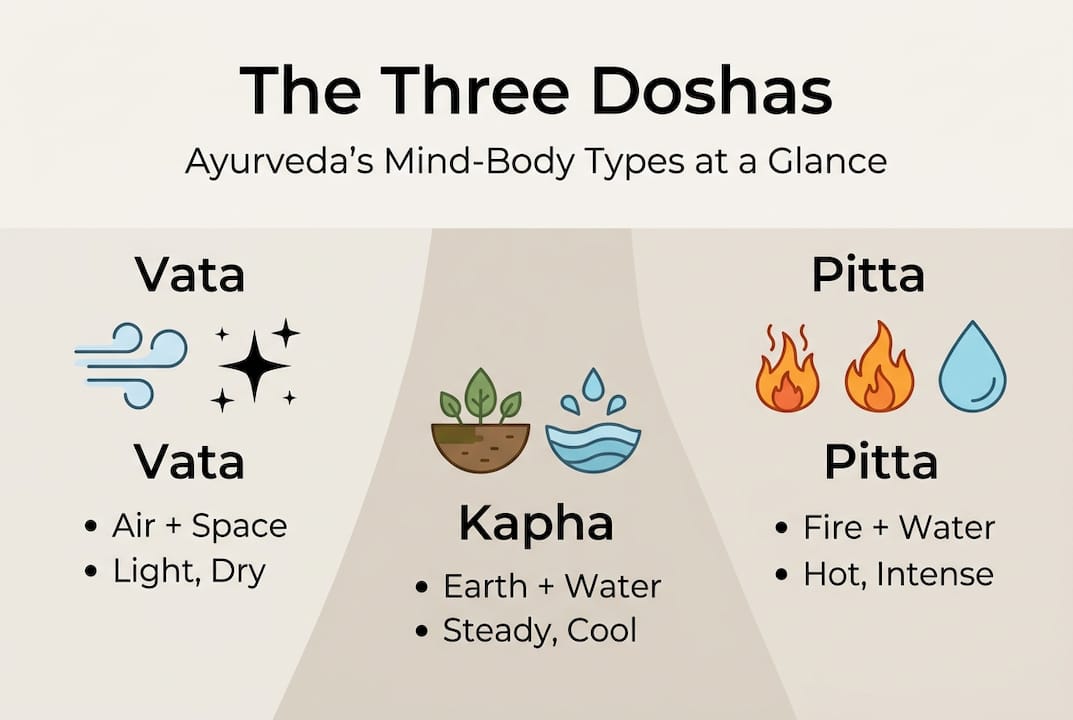
Each person is born with a unique combination of these three doshas, called their prakriti (constitution). Your prakriti shapes your physical tendencies, emotional patterns, and even how you respond to stress. When life throws you off balance, the resulting shift is called vikriti, which represents your current state of imbalance.
Here's why this matters practically:
- A Vata-dominant person may struggle with anxiety, dry skin, and irregular digestion when out of balance.
- A Pitta-dominant person might experience inflammation, irritability, or acid reflux under stress.
- A Kapha-dominant person could deal with sluggishness, congestion, or emotional heaviness when their dosha is elevated.
Understanding your dosha isn't about putting yourself in a box. It's about gaining self-awareness that leads to smarter, more personalized wellness choices.
Pro Tip: Most people are a blend of two doshas, with one slightly dominant. Don't stress about fitting neatly into one category. A qualified Ayurvedic practitioner can help you identify your unique mix and what it means for your daily habits.
Ayurveda in practice: Diet, lifestyle, and therapies
With a clear idea of the mind-body blueprint, it's easier to see how Ayurveda's practices fit into daily living.
Ayurveda's practical methods include personalized diet, herbal protocols, yoga, meditation, massage, structured daily routines, and Panchakarma detoxification. That's a wide toolkit, and it's designed to work together.
Diet is one of the most immediate entry points. Each dosha thrives on specific foods and struggles with others. Vata types benefit from warm, grounding meals. Pitta types do well with cooling, less spicy foods. Kapha types feel best with light, stimulating meals that counter heaviness.

Daily routines, called dinacharya, are another pillar. These include practices like tongue scraping, oil pulling, self-massage, and mindful meal timing. Seasonal routines, known as ritucharya, adjust these habits to match the natural rhythms of the year.
Here's a quick look at some of Ayurveda's most recognized therapies:
| Therapy | Description | Primary benefit |
|---|---|---|
| Abhyanga | Warm oil self-massage | Calms nervous system, improves circulation |
| Panchakarma | Five-step detox program | Deep cleansing and rejuvenation |
| Shirodhara | Warm oil poured on forehead | Reduces stress and anxiety |
| Nasya | Herbal oil nasal application | Clears sinuses, supports mental clarity |
Yoga and breathwork (pranayama) are woven throughout Ayurvedic practice as tools for balancing both mind and body. These aren't add-ons. They're core to the system.
- Yoga postures are often prescribed based on your dosha
- Meditation supports emotional regulation and mental clarity
- Breathwork techniques directly influence the nervous system
For those interested in evidence-based holistic health approaches, Ayurveda offers a structured, layered system that goes well beyond herbal teas. You can also explore how these practices align with other wellness practices that support natural health.
Evidence, safety, and debates: How Ayurveda fits modern health
Bringing together these holistic practices, it's crucial to evaluate whether Ayurveda works and how to approach it safely.
Current research shows mixed but promising results. Studies point to benefits in areas like arthritis, diabetes management, and hypertension, though high-quality, large-scale clinical trials are still limited. The challenge is that Ayurveda's highly individualized approach doesn't fit neatly into the standardized format of double-blind studies.
"The evidence is growing, but so is the recognition that measuring personalized, whole-system medicine requires new research frameworks, not just adapted Western models."
This is an honest tension. Ayurveda's strengths, such as personalization and prevention, are also what make it harder to study using conventional methods.
Safety is a real consideration. Some Ayurvedic products, particularly herbal supplements imported without regulation, have been found to contain heavy metals like lead, mercury, or arsenic. This isn't a reason to avoid Ayurveda entirely, but it is a reason to be careful about where your products come from and to always work with a qualified practitioner.
Here are key safety guidelines to follow:
- Always consult a certified Ayurvedic practitioner before starting any herbal protocol.
- Inform your primary care doctor about any Ayurvedic treatments you're using.
- Source products from reputable, third-party-tested suppliers.
- Avoid self-diagnosing serious conditions using Ayurvedic frameworks alone.
- Seek conventional care immediately for acute or emergency health situations.
For those managing chronic health concerns, Ayurveda can be a meaningful complement to conventional treatment. It's also worth exploring how alternative therapies are being integrated into mainstream wellness in 2026.
Pro Tip: Think of Ayurveda as a long-term wellness partner, not a quick fix. Combine evidence-based Ayurvedic guidance with regular medical check-ups for the safest, most effective approach.
A clear-eyed view: What most articles miss about Ayurveda
Most Ayurveda articles fall into one of two camps. They either oversell it as a cure-all or dismiss it because it lacks the volume of randomized controlled trials that pharmaceutical drugs require. Both miss the point.
Here's what we think is actually worth saying: Ayurveda's greatest contribution to modern wellness isn't any single herb or therapy. It's the framework. The idea that your body has a unique constitution, that prevention matters as much as treatment, and that lifestyle choices shape your health trajectory every single day. These are ideas that modern medicine is increasingly validating, even if it arrived there by a different path.
Where we'd caution you is around unregulated products and inflated claims. The wellness industry loves to attach Ayurvedic language to products that have little connection to the actual tradition. Be discerning.
The most realistic wellness practices blend self-awareness with scientific rigor. Ayurveda offers rich tools for the first part. Pairing it with modern diagnostics and professional oversight handles the second. That combination is where the real value lives.
Unlock holistic health with expert guidance
If Ayurveda has sparked your curiosity, you don't have to figure it out alone. Personalized, professional support makes all the difference when you're navigating a system as nuanced as this one.
At Go Holistic, we connect you with verified, certified practitioners who specialize in Ayurveda and a wide range of holistic treatments. Whether you're ready to book a consultation or just want to explore your options, our platform makes it easy to find holistic providers who match your needs. You can also browse our curated directory to discover holistic practitioners near you and take your first confident step toward balanced, personalized wellness. Get started today and let the right support guide your journey.
Frequently asked questions
Is Ayurveda scientifically proven?
Some studies show benefits for conditions like chronic pain, arthritis, and diabetes, but high-quality research is still limited and results vary by condition and individual.
Are Ayurvedic remedies safe?
Ayurveda is generally safe when supervised by a qualified professional, but unregulated products carry real risks, including contamination with heavy metals.
How do I find out my dosha type?
A trained Ayurvedic provider can assess your unique dosha blend through detailed consultation, or you can use a self-assessment guide as a helpful starting point.
Can Ayurveda be combined with Western medicine?
Yes, many people use Ayurveda alongside conventional care, especially for prevention and chronic wellness. Always keep your healthcare provider informed so they can support you safely.