

TL;DR:
- Clarifying your target audience and removing booking friction can significantly increase appointments without advertising.
- Practitioners should prioritize positioning and booking system fixes first, then expand outreach and retention efforts.
The single highest-impact move you can make this week is clarifying exactly who you serve and removing one friction point from your booking path. Before you invest in any new software, those two steps will produce more booked appointments than any ad campaign. Here is where to start:
- Write your positioning statement today. Name your specialty, your ideal client, and the outcome you deliver ("I help women in chronic pain recover through acupuncture and Ayurvedic care in Austin, TX").
- Add a scheduling widget to every service page. If a visitor has to navigate away to book, many simply won't.
- Set up missed-call-to-text within 48 hours. A missed call without an instant text follow-up is a lost client.
Research shows retaining an existing patient costs approximately 90% less than acquiring a new one. That single figure should reshape where you spend your first dollar.
Table of Contents
- Why positioning must come before you add any tools
- The core tool categories every holistic practice needs
- Your step-by-step implementation roadmap
- The integration checklist that prevents tool-stacking
- What to measure and when to expect results
- Real-world stacks for three common practice types
- How Goholistic fits into your growth roadmap
- Key Takeaways
- The part most practitioners skip
- Goholistic gives your practice a verified presence from day one
- Useful sources
Why positioning must come before you add any tools
Sequencing is the most underestimated factor in practice growth. Most practitioners buy tools first and define their niche later, which is exactly backwards. When your positioning is vague, every tool you add amplifies that vagueness. You end up paying for clicks from people who were never going to book.
The right sequence is: positioning, then content, then retention systems, then paid outreach. Each layer compounds the one before it. Skip to paid outreach before your booking path converts, and you are filling a leaky bucket.
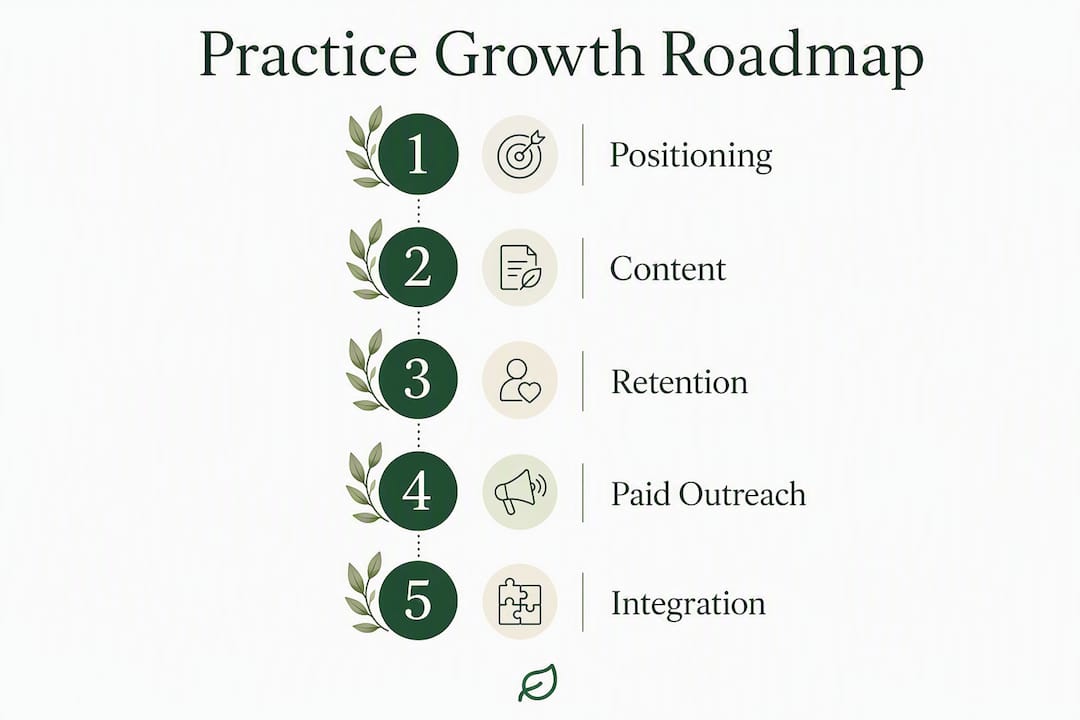
Wrong sequence: A massage therapist runs Google Ads, gets 200 clicks, earns 4 bookings, and concludes ads don't work. The real problem? Her service page has no scheduling widget and no clear specialty.
Right sequence: She defines her niche (prenatal massage in her zip code), adds a booking widget to each service page, then runs a small ad test. The same budget produces 18 bookings.
Pro Tip: Test your positioning in one sentence: "I help [specific person] with [specific problem] using [your method]." If you can't say it clearly, your website can't say it clearly either.
Retention compounds this further. A structured reactivation process brings a meaningful share of past clients back into active care without any new ad spend. Fix the bucket before you run the tap.
The core tool categories every holistic practice needs
Think of your toolkit as eight interconnected layers. Each one serves a distinct function, and each affects either bookings or retention directly.
- Website + booking widget. Your site is your storefront. A scheduling widget on every service page is the single highest-converting feature you can add. Time-to-value: days.
- Payments and billing. Integrated payment collection at booking reduces no-shows and eliminates awkward checkout moments. Look for tools that handle deposits and package billing.
- Digital intake forms. Paperless intake speeds up the first visit and captures the health history you need. For any tool collecting health data, HIPAA compliance is non-negotiable.
- CRM and email/SMS automation. A lightweight CRM tracks client history, automates appointment reminders, and triggers reactivation messages at 3, 6, and 12 months.
- Reviews and reputation. Google Business Profile optimization is the highest-ROI marketing activity for most local health practices. A steady, automated review request flow after each visit compounds over months.
- Online directories and listings. Verified listings on wellness-specific directories extend your reach to clients already searching for your modality.
- Content and treatment library. Short explainer videos (30–90 seconds) and dedicated treatment pages build trust before a first visit and improve search visibility.
- Analytics and integrations. Without tracking, you cannot attribute bookings to channels. Connect your tools so data flows from booking through CRM to reporting.
A 5% improvement in retention can boost profitability by up to 75%, which is why retention tools deserve at least as much attention as acquisition tools.
Your step-by-step implementation roadmap
Start with positioning and one booking fix. Add retention systems next. Only add paid outreach once your conversion path is proven.
Days 1–30: Foundation
- Write your positioning statement and update your website headline.
- Add a booking widget to every service page.
- Activate missed-call-to-text automation.
- Claim and optimize your Google Business Profile.
- Set up digital intake forms with a HIPAA-compliant tool.
Days 30–90: Retention and reputation
- Connect your booking tool to a CRM.
- Build automated appointment reminders (24-hour and 2-hour).
- Launch a post-visit review request sequence.
- Create three treatment-specific content pages or short videos.
- Audit your lead generation workflow to confirm bookings are being attributed correctly.
Days 90–180: Visibility and growth
- Add paid outreach only after your booking-to-conversion rate is measurable.
- Expand your directory listings and optimize each profile.
- Build a reactivation sequence for clients inactive for 6+ months.
Before adding any new tool, ask yourself:
- Do I know my current inquiry-to-booking conversion rate?
- Is my booking path three clicks or fewer?
- Are my existing tools connected and producing trackable data?
If the answer to any of these is no, fix that first. Adding AI or paid ads without a connected system leads to tool-stacking and wasted spend.
The integration checklist that prevents tool-stacking

Connect your tools in this order: booking → CRM → payments → reminders → analytics. Every gap in that chain is a place where a booked client can fall through.
Connect these first:
- Booking tool synced to your CRM so every new appointment creates a client record automatically.
- Payment processor linked to booking so deposits are collected at the time of scheduling.
- Automated SMS and email reminders triggered from the CRM, not manually.
- Missed-call-to-text active on your practice phone number.
- UTM parameters on any paid campaign links so you can trace bookings back to their source.
- Review request triggered automatically 24 hours after a completed visit.
Avoid these mistakes:
- Running duplicate reminder sequences from two different tools (clients get four texts and unsubscribe).
- Adding a chatbot or AI assistant before your booking path converts at a measurable rate.
- Buying a new CRM before auditing whether your current one is actually being used.
Audit your new-client flow, conversion from inquiry to appointment, and retention over 3–6 months before purchasing anything new. The audit almost always reveals a fixable gap that costs nothing.
What to measure and when to expect results
Measure what ties directly to revenue. Vanity metrics like page views and social followers tell you almost nothing about practice health.
Primary metrics:
- Booked appointments per week
- Inquiry-to-booking conversion rate
- Show rate (appointments kept vs. scheduled)
- Rebook rate at visit 3 and visit 6
- Client lifetime value (LTV)
- Acquisition cost per new client by channel
| Phase | Setup time | Typical cost range | When to expect lift |
|---|---|---|---|
| Website + booking widget | 1–3 days | — | Within 2 weeks |
| CRM + email/SMS automation | 1–2 weeks | $30/month | 30–60 days |
| Review automation | 1–3 days | Included in most CRMs | 60–90 days |
| Paid ads (Google/Meta) | 1 week setup | — | 60–90 days minimum |
Track inquiry source, conversion by channel, and which pages produce actual bookings on a weekly basis. Monthly reviews miss the patterns that weekly check-ins catch early.
Real-world stacks for three common practice types
Massage therapist
Positioning: "Deep tissue and prenatal massage for active adults and expecting mothers in [city]."
- Stack: Website with booking widget, Google Business Profile, HIPAA-compliant intake form, CRM with automated reminders and review requests.
- 90-day sequence: Optimize GBP in week 1, add booking widget, launch review automation at day 30, publish two treatment pages by day 60.
- Non-obvious win: A 30-second video on the prenatal massage service page showing the table setup and explaining safety protocols converts skeptical first-time clients far better than text alone.
Acupuncturist
Positioning: "Acupuncture for chronic pain, fertility support, and stress relief in [city]."
- Stack: Directory listings (including Goholistic), booking integration, email nurture sequence for new inquiries, condition-specific landing pages.
- 90-day sequence: Claim and optimize all directory profiles in week 1, connect booking to CRM by day 14, build a 3-email welcome sequence by day 30.
A missed-call-to-text automation alone recovered multiple lost inquiries per week for one acupuncture clinic that had adequate traffic but a high call-abandonment rate. The fix took under an hour to set up.
Ayurvedic practitioner
Positioning: "Personalized Ayurvedic consultations and lifestyle plans for digestive health and chronic fatigue in [city]."
- Stack: Booking tool with package billing (consultations are often multi-session), CRM with care-plan follow-up triggers, evidence-based treatment content linked from service pages.
- Non-obvious win: A scheduled check-in message at session 3 asking "How are you feeling about your progress?" dramatically increases rebook rates by making the client feel seen rather than sold to.
How Goholistic fits into your growth roadmap
Goholistic aligns naturally with the positioning-first approach because it starts with a verified practitioner profile, not an ad account. When you activate a profile, you are placing yourself in front of clients who are already searching for your specific modality, which means the traffic is pre-qualified.
Here is how Goholistic maps to each roadmap phase:
- Phase 1 (Foundation): Optimize your practitioner profile with your specialty, credentials, and treatment focus. This acts as your directory listing and a trust signal simultaneously.
- Phase 2 (Retention): Use Goholistic's integrative wellness booking features to connect booking directly to your client workflow.
- All phases: The platform's treatment library covering over 200 therapy types gives your profile content authority and helps clients understand your modality before they book.
- Discovery: Goholistic's AI-powered recommendation tool surfaces your profile to clients whose health concerns match your specialty, reducing the gap between search and booking.
Where you may still need additional tools: Goholistic does not replace a full CRM for complex automation sequences or a dedicated billing platform for insurance-adjacent billing. For most solo practitioners and small clinics, pairing a Goholistic profile with a lightweight CRM covers the full roadmap.
Pro Tip: Complete every field in your Goholistic profile, including treatment specialties and conditions you address. Profiles with complete information appear more frequently in AI-driven discovery results.
Key Takeaways
The most direct path to practice growth is positioning clearly, fixing your booking path, and building retention systems before spending on paid outreach.
| Point | Details |
|---|---|
| Positioning comes first | Define your specialty and ideal client before adding any marketing tool. |
| Fix booking friction immediately | Add a scheduling widget to every service page and activate missed-call-to-text within 48 hours. |
| Retention beats acquisition | Retaining an existing client costs approximately 90% less than acquiring a new one; a 5% improvement in retention can boost profitability by up to 75%. |
| Measure booked outcomes weekly | Track inquiry-to-booking conversion rate and rebook rate as your primary success metrics. |
| Goholistic accelerates visibility | A complete Goholistic profile places your verified practice in front of pre-qualified clients searching for your modality. |
The part most practitioners skip
The practitioners who grow steadily are rarely the ones with the most tools. They are the ones who picked a clear niche, made it easy to book, and stayed in touch with existing clients. That sounds simple, and it is. The difficulty is resisting the pull of the next shiny platform before the fundamentals are working.
Sequencing is everything. A beautiful website with no booking widget is a brochure. A CRM with no client data is an empty filing cabinet. Start with positioning, add one booking fix, measure what happens, and only then layer in the next tool. Small, tracked experiments compound into a practice that grows without burning you out.
Audit your booking path today. Count the clicks from your homepage to a confirmed appointment. If it is more than three, that is your first experiment.
Goholistic gives your practice a verified presence from day one
Most practitioners spend months building visibility from scratch. Goholistic shortens that timeline by placing your verified profile inside a directory that wellness seekers are already using to find and book practitioners like you.
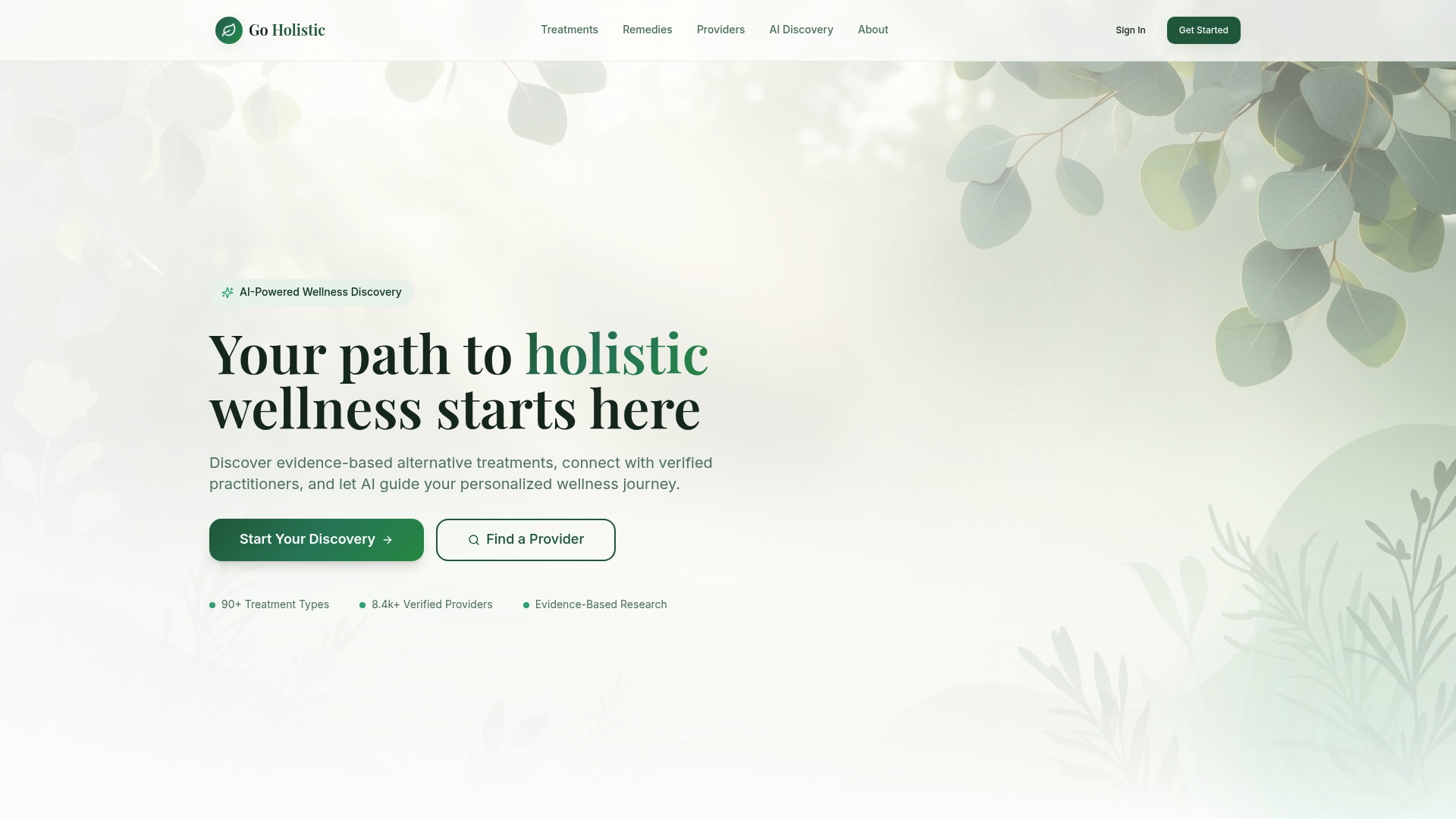
Activate your profile on Goholistic and you get immediate access to the platform's AI-driven discovery engine, a treatment library that adds content authority to your listing, and a direct booking path that connects to your existing workflow. Within your first 30 days, you can have a complete, optimized profile visible to clients searching for your specific modality, with no ad spend required.
Ready to see your first qualified booking from a pre-warmed client? Browse the treatment categories to see where your specialty fits, then activate your profile and complete every field. The practitioners who fill their calendars fastest are the ones who show up completely.
Useful sources
The claims in this article draw from the following research and guidance:
- How to Get Consistent Patient Flow: Modern Practice Method — foundational sequencing framework for holistic practices.
- Patient Retention Strategy: Modern Practice Method — retention cost data and reactivation process guidance.
- Turn Wellness Traffic into Booked Appointments: Emanuel Rose — booking path conversion tactics and missed-call-to-text evidence.
- AI Marketing for Wellness Clinics: Raasis Technology — integration sequencing and measurement framework.
- Digital Marketing for Health and Wellness Businesses: 20 Minute Marketing — GBP optimization and content tactics for local practices.
- Holistic Practice Management: Effective Practice Management — patient journey audit methodology.