

TL;DR:
- Building a personalized holistic wellness plan requires assessing your starting point with validated tools like the Wellness Wheel and WPHI, then setting SMART goals across key health domains. Regular tracking and flexible adaptation based on measurements help ensure sustainable progress aligned with evidence-based practices. Most successful plans treat wellness as a dynamic, multi-domain journey rather than a single-focus trend or rigid program.
You've probably tried the new supplement everyone was talking about, the wellness app that promised transformation in seven days, or the trendy detox that left you more drained than energized. These scattered attempts feel frustrating, especially when you genuinely want better health. The good news is that building a personalized holistic wellness plan isn't mysterious or complicated. It just requires the right structure, some honest self-awareness, and a willingness to blend time-tested holistic practices with evidence-based thinking. This guide walks you through exactly that, step by step.
Table of Contents
- What do you need to start a holistic wellness plan?
- Step-by-step process: From baseline to your personalized plan
- Choosing holistic and complementary practices: What works and what to avoid
- Review, measure, and adapt: Tracking your results and refining your wellness plan
- Our perspective: Why most wellness plans fail (and what actually works))
- Looking for guidance or the next step?
- Frequently asked questions
Key Takeaways
| Point | Details |
|---|---|
| Start with self-assessment | A clear baseline using holistic tools sets the right foundation for your plan. |
| Set SMART goals | Specific, measurable, achievable, relevant, and time-bound goals turn intentions into results. |
| Prioritize evidence and safety | Evaluate therapies and routines with medical research and avoid red-flag practices. |
| Track and adapt | Use structured measurement tools to monitor progress and adjust your plan for best results. |
| Treat your plan as dynamic | Revisit, review, and refine your wellness plan as you grow and your needs change. |
What do you need to start a holistic wellness plan?
Before you can take action, you need a clear picture of where you're starting from. Think of this as drawing your own wellness map before you start the journey. Without it, you risk heading in the wrong direction with a lot of enthusiasm but little traction.
The two most valuable self-assessment frameworks to know are the Wellness Wheel, which evaluates interconnected life domains rather than focusing solely on physical health, and the Whole Person Health Index (WPHI). The WPHI, developed by NCCIH, is a validated questionnaire designed to provide a comprehensive snapshot of your overall wellbeing and to track change over time in a structured, measurable way. These tools give you something solid to work with rather than relying on vague impressions.
You'll also want to read up on integrative health benefits and understand the core domains your wellness plan should address. Here's a quick overview:
- Physical: Movement, sleep, nutrition, and body-based therapies
- Emotional: Stress management, emotional regulation, and mental health
- Social: Connection, relationships, and support networks
- Spiritual: Meaning, purpose, values, and mindfulness practices
- Environmental: Your surroundings, access to nature, and daily living conditions
- Occupational: Fulfillment at work or in daily roles
- Intellectual: Learning, creativity, and mental engagement
Matching your starting point to these domains helps you see the full picture, not just the loudest symptom. You can explore how a personalized wellness assessment can clarify your starting point before you design a single habit.
Getting-started checklist:
| Tool or mindset | Why it matters |
|---|---|
| Curiosity and openness | Keeps you exploring rather than giving up when plans need adjusting |
| A tracking method (journal or app) | Lets you measure real progress, not just feelings |
| Wellness Wheel or WPHI questionnaire | Gives a multi-domain baseline before you start |
| Reasonable first timeline (6 to 12 weeks) | Builds momentum without burning out |
| Access to quality information | Helps you separate hype from evidence |
For practical ideas on building wellness routines into your daily life, holistic wellness blog tips offer a great starting point for inspiration and actionable ideas.
Pro Tip: Don't wait until you feel "ready" to start tracking. Begin your tracking method on day one, even if your first entry is messy. Baseline data from week one is incredibly valuable when you look back at week eight.
Step-by-step process: From baseline to your personalized plan
Now that you have a foundation, let's break down exactly how to transition from "where you are" to a personalized, actionable plan. A strong wellness planning process typically begins with a multi-domain baseline, moves into goal-setting, then routine design, and finishes with consistent tracking and adaptation. Think of it as building a house: foundation first, then walls, then the roof.
Step 1: Complete your baseline assessment. Use the Wellness Wheel to rate your satisfaction from one to ten across all wellness domains. Be honest. The areas scoring lowest aren't failures; they're your greatest opportunities. Additionally, complete the WPHI questionnaire to get a validated, multi-domain snapshot that you can reference for real comparison later.
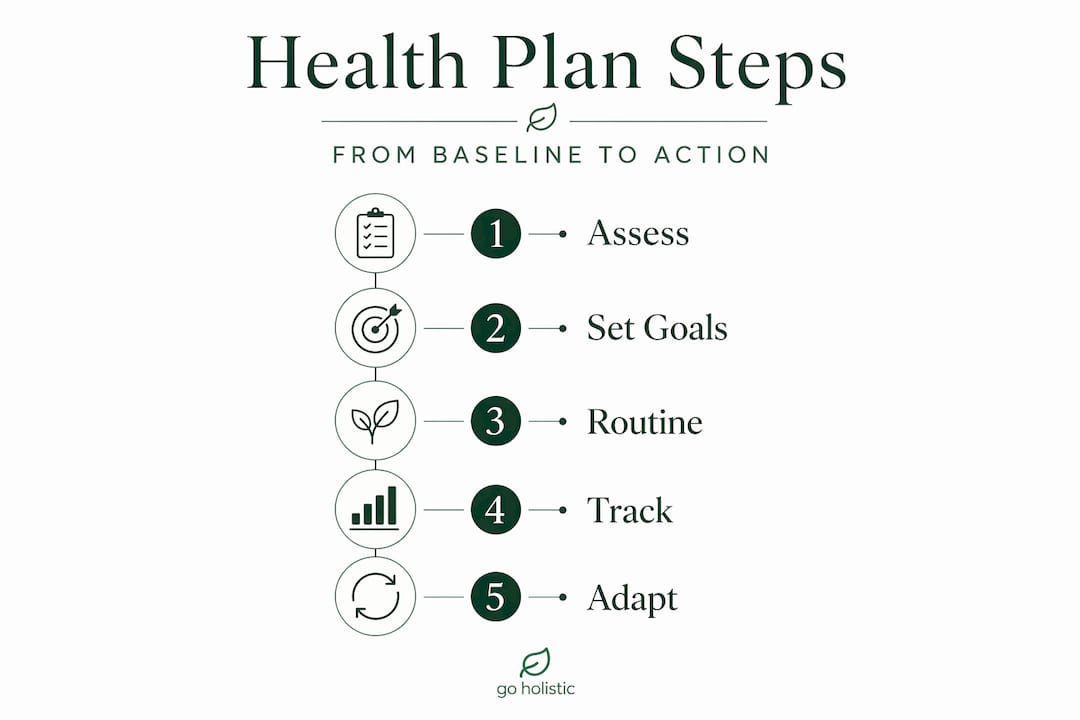
Step 2: Set SMART goals. SMART stands for Specific, Measurable, Achievable, Relevant, and Time-bound. Instead of "I want to feel less stressed," try "I will practice ten minutes of guided breathing three times a week for the next six weeks." Specific goals tell you exactly when you've succeeded.
Step 3: Design your weekly routine. Map your chosen holistic practices and habits across the week. Keep it realistic. A plan you can follow 80% of the time beats a perfect plan you abandon in two weeks. Make sure your routine touches at least two or three wellness domains each week, not just physical health.

Step 4: Build in tracking touchpoints. Schedule a brief weekly review of your tracking journal or app. Note what worked, what didn't, and how your energy or mood shifted. This isn't about judgment; it's about data.
Step 5: Adapt based on what you learn. Every four to six weeks, return to your baseline scores and compare. Review your consultation workflow steps if you're working with a practitioner. Adjust practices that aren't generating results and double down on those that are.
| Common planning mistake | Evidence-based alternative |
|---|---|
| Choosing practices based on trends alone | Select practices with research support for your specific concern |
| Setting goals that are too vague | Use SMART goal format for every target |
| Skipping the baseline step | Always measure before you act |
| Only tracking physical symptoms | Track mood, energy, social connection, and sleep too |
| Abandoning the plan after a rough week | Build in "minimum viable" versions of each habit for hard days |
Pro Tip: Start smaller than feels necessary. If you're tempted to meditate daily for 30 minutes, begin with seven minutes. Research consistently shows that small starting commitments build stronger long-term adherence than ambitious ones you struggle to maintain. Your future self will thank you for the momentum. You can explore personalized wellness strategies to find the right-sized approach for your lifestyle.
Choosing holistic and complementary practices: What works and what to avoid
Once your personal plan takes shape, the next crucial step is selecting the right mix of holistic or alternative practices that best support your goals. Not all practices are created equal, and the landscape of wellness options can feel overwhelming.
NCCIH categorizes complementary approaches by their primary therapeutic input: psychological (like meditation or hypnotherapy), physical (like massage therapy or acupuncture), or combined psychological-physical (like yoga, tai chi, or qigong). This taxonomy helps you make deliberate choices rather than collecting random wellness habits.
Here's a quick overview of commonly used holistic practices grouped by type:
- Primarily psychological: Mindfulness meditation, guided imagery, cognitive-based stress reduction, and breathwork
- Primarily physical: Acupuncture, chiropractic care, massage therapy, and movement-based bodywork
- Combined psychological-physical: Yoga, tai chi, qigong, dance/movement therapy, and Ayurveda
- Nutritional and herbal: Evidence-based dietary approaches, herbal infusions, and adaptogenic herbs with safety profiles
It's also worth exploring evidence-based herbal infusions as one example of how traditional plant-based practices can be supported by thoughtful research.
When it comes to evidence, the picture is nuanced. Research on complementary approaches shows that effectiveness is highly condition-specific and modality-specific; for example, acupuncture shows modest but meaningful benefits for certain types of chronic pain, while other approaches may have limited evidence for the same concern. This is why matching the practice to your specific goal matters more than picking the most popular option.
For evaluating any therapy, use these guiding questions: Is there peer-reviewed research supporting this practice for my concern? Is the practitioner licensed or certified? Does this approach recommend extreme restrictions or promise unrealistic results? Mayo Clinic emphasizes that any sound wellness approach should be grounded in research, medically safe, and free from unregulated supplements or extreme claims. You can also review the risks of alternative therapies to make more informed choices.
Red flag alert: Be cautious of any program that requires you to purchase proprietary supplements not reviewed by a third party, promises to cure or reverse diagnosed conditions without medical oversight, discourages you from consulting your healthcare provider, or uses urgency and fear-based marketing. These are signs of a program prioritizing profit over your wellbeing.
Pair red-flag awareness with a strong understanding of evidence-based holistic health principles to build a truly sound practice.
Review, measure, and adapt: Tracking your results and refining your wellness plan
Setting your plan is only the beginning. Sustainable health requires feedback and course adjustment as you gather real results. This is the part most wellness plans skip, and it's exactly why so many of them fade out after a few weeks.
Here's how to build a review cycle that actually works:
- Re-take the WPHI questionnaire every four to six weeks. The WPHI is designed to track change over time, so use it as your consistent benchmark rather than relying on memory or mood.
- Update your wellness domain scores. Return to your Wellness Wheel ratings monthly and note any shifts, even small ones. A move from a four to a six in emotional wellbeing is meaningful progress.
- Compare against your SMART goals. Check which goals you met, which ones you partially met, and which need rethinking. No judgment; just information.
- Consult a practitioner when results plateau. When you've been consistent but progress stalls, a qualified holistic or integrative health professional can offer perspective you can't get from self-monitoring alone.
- Update your plan for the next cycle. Use what you learned to retire practices that aren't contributing, strengthen routines that are, and introduce one or two new approaches thoughtfully.
| Wellness domain | Baseline score (week 1) | Score at week 6 | Next focus area |
|---|---|---|---|
| Physical health | 5/10 | 7/10 | Maintain movement; add sleep hygiene |
| Emotional wellbeing | 4/10 | 5/10 | Add mindfulness sessions weekly |
| Social connection | 6/10 | 6/10 | Schedule regular community time |
| Spiritual/purpose | 3/10 | 5/10 | Continue journaling and nature walks |
For ongoing support, integrative health tracking tips can help you stay consistent between formal review cycles.
An important nuance: Even NCCIH's strategic framework acknowledges that evidence for many complementary approaches in prevention and health promotion is still developing. Some modalities also have limited adverse event reporting, as a systematic review in pediatric research highlights. This makes professional guidance especially important when combining multiple therapies or working with vulnerable health conditions.
Our perspective: Why most wellness plans fail (and what actually works)
We've seen a clear pattern emerge across thousands of wellness journeys. The plans that collapse aren't failing because people lack willpower or commitment. They fail because they're built on a single pillar rather than a flexible structure.
Here's the uncomfortable truth: most wellness plans are actually marketing products wearing the costume of a health plan. They're designed around a single product, a single approach, or a single identity. You become a "keto person" or a "meditator" and frame your whole wellness around one axis. When that axis wobbles, the whole structure falls.
What actually works is treating your wellness plan as a living document. Not a commitment carved in stone, but a working hypothesis you test and refine. The multi-domain approach backed by validated measurement tools like the WPHI isn't just a nice idea; it's a structural advantage. When one area of your health challenges you, other domains can carry more of the load while you recalibrate.
We also believe strongly in the power of small, consistent actions over dramatic overhauls. The people who quietly improve their energy, manage stress better, and build lasting physical resilience aren't usually doing anything extraordinary. They're doing ordinary practices consistently, adjusting when needed, and staying curious rather than rigid.
Chasing trends is the biggest trap. Every year brings a new "breakthrough" in wellness. Sometimes the research is real but overhyped; sometimes it's early-stage and not ready for daily practice. A sound plan filters out the noise by anchoring every new addition to your established goals and measurement framework. Explore top holistic therapies with this lens and you'll find it much easier to separate signal from noise.
Your plan should grow with you. That's not a failure of the original plan; it's evidence that the plan is working exactly as it should.
Looking for guidance or the next step?
You now have a clear framework for building a wellness plan that's grounded in evidence, personalized to your life, and flexible enough to grow with you. But knowing the steps and having the right support are two very different things.
At Go Holistic, we've built a platform specifically designed to bridge that gap. Whether you're ready to explore holistic health treatments across more than 200 therapy types or you want to find holistic wellness practitioners who are vetted, licensed, and matched to your specific health concerns, we make that next step approachable and clear. Our AI-powered tools analyze your health concerns and surface personalized recommendations backed by real research, so you're never guessing. Ready to get started? Learn more at Go Holistic and take your first step with confidence.
Frequently asked questions
What is the Wellness Wheel and how do I use it?
The Wellness Wheel is a self-assessment tool that evaluates health across interconnected life areas like physical, emotional, social, and spiritual; you use it by rating your satisfaction in each domain to identify where your focus is most needed.
Why is tracking with a validated framework better than just going by "how I feel"?
Validated frameworks like the WPHI capture real trends across multiple health domains over time, so you can adjust your strategies based on objective patterns rather than daily mood swings.
Are all holistic and alternative therapies safe?
Not all are equally safe or equally evidence-backed; Mayo Clinic recommends choosing approaches grounded in peer-reviewed research, avoiding unregulated supplements, and consulting qualified professionals whenever you have specific health risks or conditions.
How often should I review and adjust my wellness plan?
You should formally review your plan at least once a month using a measurement tool, and make meaningful adjustments whenever your WPHI scores plateau or when new feedback suggests your current approach isn't serving your goals.