

TL;DR:
- A holistic profile provides an integrated, multi-dimensional view of health data to support personalized wellness decisions. It captures behavioral, emotional, physical, and environmental factors, revealing patterns often missed by single-metric assessments. Regularly updated and connected data improve treatment accuracy and foster active collaboration between patients and providers.
A holistic profile is an integrated, multi-dimensional representation of your behavioral, emotional, physical, and contextual health data that enables more accurate and personalized wellness decisions. Most people approach their health through a single lens: a lab result, a symptom, or a diagnosis. That narrow view misses the bigger picture. Understanding why holistic profiles matter means recognizing that your health is shaped by dozens of overlapping factors, and treating just one of them rarely produces lasting results. The research is clear: multi-dimensional modeling identifies patterns that traditional assessments routinely miss, capturing up to 40% more relevant context about who you are and what your body actually needs.
Why holistic profiles matter more than single-metric assessments
Traditional health assessments focus on one data point at a time: your blood pressure, your BMI, your stress score. That approach is efficient, but it is also incomplete. Single-metric evaluations often ignore up to 40% of the context that shapes your health outcomes. That missing context is not trivial. It includes sleep quality, emotional patterns, environmental stressors, and behavioral tendencies that interact with your physical markers in ways no single test can reveal.
Multi-dimensional profiling solves this by layering validated, non-overlapping evidence from different data types. The concept is called criterion-related validity, and it means each new data layer you add genuinely improves the accuracy of the overall picture rather than just adding noise. Think of it like a mosaic: one tile tells you almost nothing, but hundreds of tiles together reveal a clear image.
Here is how the layering typically works in a well-built health profile:
- Physical markers — lab results, vital signs, body composition, and chronic condition history
- Behavioral data — sleep patterns, exercise frequency, dietary habits, and substance use
- Emotional indicators — stress levels, mood patterns, anxiety triggers, and resilience factors
- Environmental inputs — workplace conditions, social support, geographic exposures, and seasonal influences
Each layer adds predictive power. Providers who combine behavioral and physiological markers report higher engagement and better success rates than those relying on physical data alone. That outcome is not accidental. It reflects the reality that your body does not operate in isolation from your mind, your habits, or your environment.
Pro Tip: More data is not always better. The quality of connections between data points matters far more than sheer volume. A profile stuffed with disconnected metrics creates noise, not insight. Prioritize meaningful integration over raw data accumulation.
How do holistic profiles transform your wellness journey?
The shift from provider-centered to patient-curated evaluation is one of the most significant changes in modern wellness. Traditional models place the practitioner at the center: they gather data, interpret it, and prescribe a plan. Holistic profiling flips that dynamic. You become an active contributor to your own health picture, bringing in behavioral, psychological, and social data that a clinical visit alone cannot capture.

Unified profiling reduces data duplication and expands health insights across cognitive, psychological, and social dimensions. That means your practitioner spends less time asking redundant questions and more time making meaningful connections between what your data reveals. The result is a treatment plan that reflects your actual life, not a generic protocol designed for an average patient who does not exist.
Several practical shifts happen when you move to a profile-based wellness approach:
- Personalized treatment planning becomes possible because your provider sees patterns across time, not just snapshots from a single visit
- Redundant testing decreases because your profile already holds baseline data that does not need to be re-collected at every appointment
- Cross-disciplinary insights emerge when an acupuncturist, a nutritionist, and a therapist all draw from the same integrated picture of your health
- Your own self-awareness grows as you track how lifestyle changes affect multiple dimensions of your wellbeing simultaneously
One critical point: a holistic profile is a living document. Profiles treated as static data sets lose their value quickly. Your priorities shift, life stressors change, and your body responds differently across seasons and life stages. A profile that was accurate six months ago may already be missing the context that matters most today. Building in regular updates is not optional. It is what keeps the profile useful. You can learn more about structuring this process in a guide to building a personalized health plan that evolves with you.
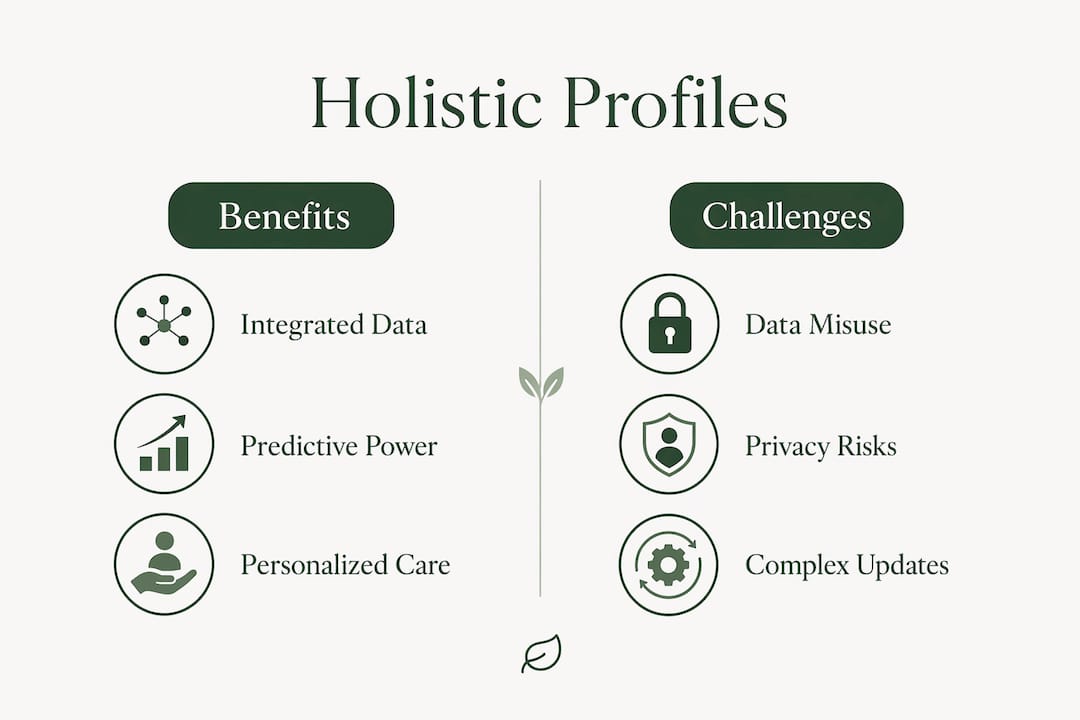
What are the hidden benefits and real challenges of holistic profiles?
The most underappreciated benefit of a well-built health profile is what researchers call structural blind-spot removal. Standard assessments search one database at a time, one symptom at a time, one system at a time. Broad, integrated search reveals relevant factors and research that isolated data sources simply cannot surface. You discover what you did not know to look for.
A second hidden advantage involves what are called tail-end factors. These are obscure, non-obvious influences on your health that standard tools overlook entirely. A pattern of poor sleep combined with high workplace noise exposure and a low-fiber diet might individually seem minor. Together, they can drive chronic inflammation in ways that no single intervention will resolve. Integrating behavioral, environmental, and emotional data exposes these contradictions and enables tailored interventions with significantly higher efficacy than simply adding treatments one by one.
"The most effective holistic discovery starts with deep understanding rather than numbers, shifting focus to root causes instead of symptoms." — Gadoci Consulting
That said, holistic profiles carry real risks when misused. The most important caution: a profile is not a person. A profile is a tool to inform decisions, not a substitute for human judgment. Treating a profile as a complete representation of who you are leads to category mistakes, where the map gets confused with the territory. Your practitioner should use your profile as a starting point for conversation, not as a final verdict on your health.
Pro Tip: When reviewing your profile with a practitioner, ask them to identify the two or three connections between data points that surprised them most. Those unexpected links are usually where the most useful insights live.
How can you use holistic profiles to improve your treatment outcomes?
Knowing the value of comprehensive profiles is one thing. Building and using one effectively is another. The process starts with collecting the right categories of data, then keeping that data current, and finally using it collaboratively with your wellness providers.
The four core data categories to prioritize are:
- Physical data: lab panels, vital signs, medication history, diagnosed conditions, and family health history
- Behavioral data: sleep quality and duration, physical activity levels, dietary patterns, and screen time habits
- Emotional and psychological data: stress triggers, mood tracking, anxiety patterns, and resilience indicators
- Environmental data: workplace conditions, social support quality, housing environment, and seasonal health changes
Once you have collected across these categories, the next step is creating a personalized wellness assessment that organizes this data into a format your providers can actually use. Raw data sitting in separate apps or paper files does not constitute a profile. It needs a unifying framework that prioritizes meaningful connections between data points over raw volume.
Here is a direct comparison of what changes when you move from traditional to profile-based care:
| Factor | Traditional Assessment | Holistic Profile Approach |
|---|---|---|
| Data scope | Single metric or system | Behavioral, physical, emotional, environmental |
| Update frequency | At each clinical visit | Continuous, living document |
| Treatment basis | Symptom-driven protocols | Pattern-driven, personalized plans |
| Patient role | Passive recipient | Active contributor and co-creator |
| Blind spot risk | High, due to isolated data | Lower, through cross-dimensional integration |
| Provider collaboration | Single specialist | Multi-disciplinary, shared data view |
The importance of holistic profiles shows up most clearly in chronic condition management, where single-system treatments consistently underperform. When your provider can see the full picture, they stop treating symptoms and start addressing systems. That shift is where real, lasting improvement begins.
Key takeaways
Holistic profiles improve personalized wellness outcomes by integrating behavioral, emotional, physical, and environmental data into a living, continuously updated picture that no single-metric assessment can replicate.
| Point | Details |
|---|---|
| Multi-dimensional data captures more | Single-metric assessments miss up to 40% of relevant health context. |
| Living profiles require regular updates | Static profiles lose accuracy as your health priorities and life circumstances change. |
| Blind-spot removal reveals hidden factors | Integrated profiling surfaces tail-end influences that isolated assessments never detect. |
| Profiles inform, not replace, judgment | A profile is a decision-support tool, not a substitute for practitioner expertise. |
| Collaboration multiplies the value | Sharing your profile across disciplines produces cross-system insights no single provider can generate alone. |
What i have learned about holistic profiles after years of watching them work
I have seen a lot of wellness plans built on incomplete pictures. Someone comes in with chronic fatigue, gets their thyroid checked, receives a normal result, and walks away with no answers. The problem was never the thyroid in isolation. It was the combination of disrupted sleep, high cortisol from a stressful commute, and a diet low in magnesium. None of those factors showed up in a single lab panel.
What strikes me most about the value of comprehensive profiles is that they change the quality of the conversation between you and your provider. When a practitioner can see your behavioral patterns alongside your physical markers, the appointment stops being a guessing game. It becomes a genuine collaboration. You stop describing symptoms and start discussing systems.
The misconception I encounter most often is that building a holistic profile means collecting more data. It does not. It means collecting connected data. I have reviewed profiles with 30 tracked metrics that told a less coherent story than a profile with 10 well-chosen, well-integrated data points. The wellness continuum is not a checklist. It is a dynamic relationship between dimensions of your health that shift and influence each other constantly.
My honest recommendation: start with the four core categories, update your profile at least quarterly, and bring it to every practitioner appointment. The providers who engage with it seriously are the ones worth working with. The profile does not just improve your treatment. It helps you identify who is actually paying attention.
— Andrew
Start building your holistic health profile with Goholistic
Goholistic is built specifically for people who are ready to move beyond symptom-by-symptom care and into a fuller understanding of their own health.
The platform connects you with verified practitioners across disciplines including acupuncture, Ayurveda, and massage therapy, all accessible through a single, integrated directory. Goholistic's AI technology analyzes your health concerns and matches you with personalized treatment options backed by evidence-based research summaries. With a treatment library covering over 200 therapy types and flexible subscription plans, you can explore the full range of what integrative care looks like for your specific profile. Browse holistic health practitioners near you and take the first step toward care that actually reflects who you are.
FAQ
What is a holistic health profile?
A holistic health profile is an integrated record of your behavioral, emotional, physical, and environmental health data used to guide personalized wellness decisions. It goes beyond clinical snapshots to capture the full context of your health across time.
Why do holistic profiles outperform single-metric assessments?
Single-metric assessments miss up to 40% of relevant health context, while multi-dimensional profiles layer non-overlapping data types to improve accuracy and reduce treatment errors. The added dimensions reveal patterns that isolated data points cannot detect.
How often should you update a holistic health profile?
A holistic profile should be updated continuously, with structured reviews at least every three to six months. Profiles treated as static documents lose their decision-making value as your health priorities, stressors, and life circumstances evolve.
Can a holistic profile replace a doctor's diagnosis?
A profile is a decision-support tool, not a clinical diagnosis. It informs and improves conversations with your practitioners but does not automate or replace professional medical judgment.
What data should you include in a holistic health profile?
The four core categories are physical markers, behavioral patterns, emotional and psychological indicators, and environmental inputs. Prioritizing meaningful connections between these categories produces more useful insights than simply accumulating more data points.