
TL;DR:
- Structured holistic guides provide evidence-based frameworks that promote safe, effective, and personalized wellness practices. They connect individual techniques to broader health systems, ensuring comprehensive support and integration with conventional care. Using such guides with clear goals, progression, and qualified practitioners enhances long-term health outcomes and mitigates risks associated with unregulated therapies.
If you've ever felt overwhelmed sorting through wellness blogs, supplement ads, and conflicting health advice, you already understand why seek holistic guides is such a pressing question right now. The term "holistic guide" is often misunderstood as a loose collection of alternative health tips, but the reality is very different. Credible holistic guides, which align with what practitioners call integrative health frameworks, offer structured, evidence-informed, and safety-conscious pathways to whole-person wellness. This article walks you through what they actually are, why they matter, and how to use them well.
Table of Contents
- Key Takeaways
- What holistic wellness actually means
- Why evidence and safety cannot be separated
- How guides connect you to larger health systems
- How to actually use holistic guides effectively
- My honest take on holistic guides
- Start your wellness path with Goholistic
- FAQ
Key Takeaways
| Point | Details |
|---|---|
| Holistic guides go beyond tips | They provide structured, evidence-informed frameworks covering body, mind, spirit, and community. |
| Evidence supports key practices | Mindfulness programs show measurable benefits for anxiety and stress when followed for 8 to 12 weeks. |
| Safety requires guidance | Unregulated complementary therapies carry real risks; credible guides clarify interactions and when to seek conventional care. |
| Systems integration matters | Effective guides map how practices connect to health systems, referral pathways, and social supports. |
| Wellness stacking improves adherence | Sequencing practices in a repeatable order reduces decision fatigue and builds lasting habits. |
What holistic wellness actually means
The phrase "holistic wellness" gets used loosely, but it has a precise and meaningful definition. At its core, whole-person health addresses four interconnected dimensions: the physical body, mental and emotional well-being, spiritual or purpose-driven life, and social or community connections. Treating only one of these while ignoring the others is like watering one root of a tree and wondering why the branches are struggling.
Integrative health takes this further. The National Blueprint for Whole Health Transformation describes integrative health as healing that moves beyond symptom-focused care, combining evidence-based conventional and complementary approaches such as mindfulness, acupuncture, yoga, and nutrition into a unified, person-centered plan.
Here is where the distinction between holistic guides and casual wellness advice becomes clear. Wellness advice might tell you to meditate more or drink herbal tea. A genuine holistic guide does something more useful:
- It explains why a practice works and what the research actually says
- It outlines safe starting points and how to progress over time
- It identifies when a practice may not be appropriate or when a conventional provider should be involved
- It connects individual practices to a broader care plan that includes your existing health team
- It accounts for your personal goals, values, and circumstances, not just general recommendations
This structure is what separates a guide that genuinely supports your health from content that simply sounds good. When you are exploring holistic health treatments, having a framework to evaluate and apply them makes all the difference.
Why evidence and safety cannot be separated
One of the most compelling reasons to seek structured holistic guidance is safety. Complementary and alternative medicine (CAM) is not automatically safe simply because it is natural. The Merck Manual highlights that CAM carries real risks, especially when it delays or replaces proven therapies, and that many supplements have safety uncertainties due to gaps in FDA regulation.
At the same time, there is strong, published evidence supporting specific practices when they are applied correctly. A 2026 meta-analysis on mindfulness showed moderate effect sizes for anxiety, depression, and stress reduction across structured programs, with an overall Hedges' g of -0.45 and stronger effects for anxiety at -0.56. These results were tied to programs lasting 8 to 12 weeks with consistent practice, not occasional or random sessions.
Pro Tip: When evaluating any holistic guide, look for one that specifies practice duration and progression. A guide that tells you to "meditate daily" without a structured program or timeline is offering inspiration, not guidance.
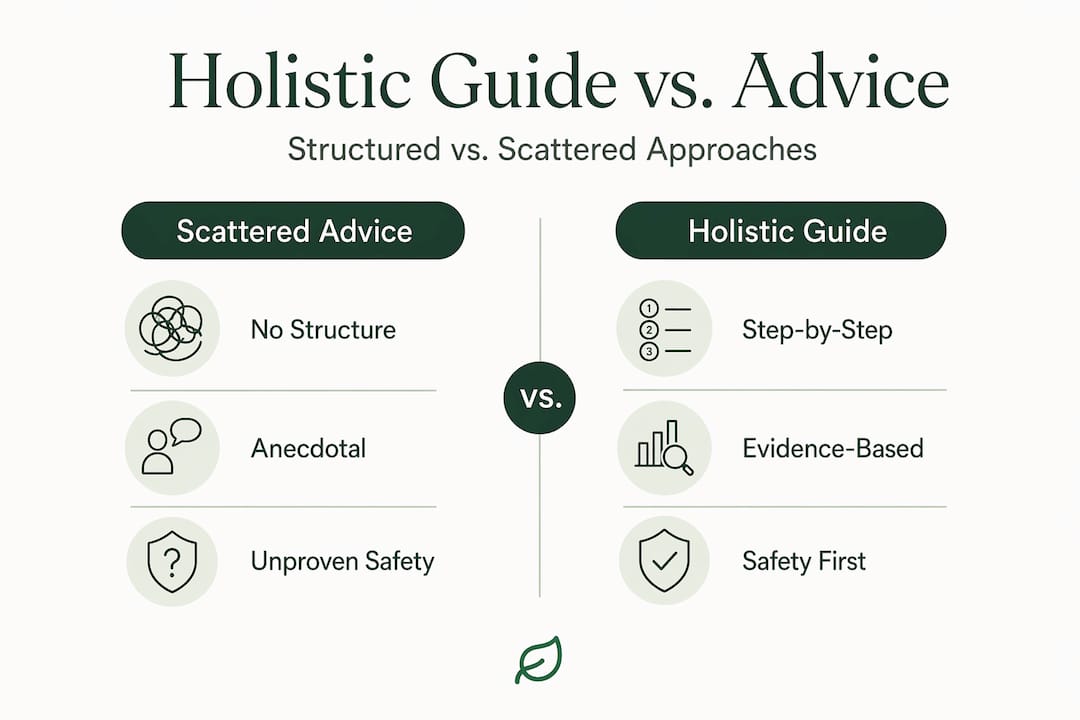
Here is a practical comparison to help you distinguish between guide quality levels:
| Feature | Scattered wellness advice | Structured holistic guide |
|---|---|---|
| Evidence basis | Anecdotal or general claims | Cites published research or clinical frameworks |
| Safety information | Rarely addressed | Explicitly covers risks and contraindications |
| Practice duration | Vague ("do it regularly") | Specifies weeks, sessions, and progression |
| Integration with care team | Not mentioned | Recommends clinician involvement where relevant |
| Personalization | One size fits all | Accounts for individual health context |
The difference in outcomes between these two approaches is significant. Unguided or random techniques frequently fail because they lack the structure that produces real results. This is not a judgment on curiosity or exploration. It is a recognition that your time and health deserve better than guesswork.
How guides connect you to larger health systems
Holistic wellness does not exist in a vacuum. One of the most underappreciated benefits of quality holistic guidance is how it situates individual practices within broader health systems and community supports. This is what separates genuinely useful resources from well-meaning but incomplete ones.
The WHO Conceptual Framework on Integrative Medicine outlines four models for integrating traditional and complementary medicine into health systems, from people-led approaches to fully blended systems. Each model connects to six core health system building blocks, including governance, financing, and safety regulation. Understanding these models helps you see where your chosen practices fit and how they can work alongside, rather than against, conventional care.
The table below shows how different integration levels affect what a holistic guide should address:
| Integration model | What it means for you | What a good guide covers |
|---|---|---|
| People-led | You direct your own wellness choices | Self-care frameworks, safety checks, red flags |
| Practitioner-led | A specialist guides your plan | How to vet and select qualified practitioners |
| Coordinated care | Holistic and conventional providers collaborate | Referral pathways, shared care documentation |
| Blended system | Fully integrated in primary health care | Understanding coverage, access, and clinical roles |
In the United States, the National Blueprint for Whole Health is actively reshaping how care is delivered, moving from a treatment-first model toward one centered on empowerment, prevention, and alignment of clinical and community resources. This system-wide shift means that learning to use holistic practices wisely now positions you well within the future of healthcare.
The WHO Traditional Medicine Strategy reinforces this direction, promoting people-centered, preventive, community-based care models that respect self-care autonomy while remaining anchored in evidence. A good holistic guide reflects this balance.
How to actually use holistic guides effectively
Knowing the value of holistic guidance is one thing. Building it into your life is another. Here is a practical sequence for getting started, especially if you are new to using holistic practices in a structured way.
- Start with a clear health intention. Identify one or two specific areas where you want support, whether that is stress reduction, sleep quality, pain management, or energy. Vague goals produce scattered efforts.
- Use the "wellness stacking" principle. Research on mental health habit formation shows that deciding your practice sequence once and repeating it consistently reduces decision fatigue and improves long-term adherence. Attach your holistic practices to existing daily anchors, like a morning routine or an after-work transition.
- Build a bridge plan. The Merck Manual recommends creating a plan that specifies which practices to start, which to pause, and which clinicians to loop in. This protects you from supplement interactions or from unintentionally replacing a proven treatment with something unverified.
- Choose guides that progress with you. Look for resources that are structured in stages, not just lists of techniques. A beginner session should feel different from a session at week ten. Progression is what builds real skill and lasting benefit.
- Connect with a qualified practitioner. Self-guided learning has real value, but working with someone trained in your chosen modality, whether that is acupuncture, Ayurveda, or massage therapy, provides accountability, personalization, and safety checks that no article can fully replace.
Pro Tip: Before starting any new complementary practice, write down your current medications and health conditions and share them with both your holistic practitioner and your primary care provider. This one step prevents the majority of CAM safety issues.
The goal is not perfection. It is building a personal wellness system that grows with you, supported by knowledge you can trust and practitioners who genuinely know their craft.
My honest take on holistic guides
I've spent years observing how people engage with holistic wellness, and the pattern I see most often is this: someone feels unwell, stumbles onto wellness content online, tries a few things inconsistently, gets minimal results, and concludes that holistic approaches "didn't work." What actually didn't work was the absence of structure, not the practices themselves.
In my experience, the single biggest gap in most popular holistic resources is that they present techniques without any consideration for duration, progression, or safety. A list of ten things to do for better gut health is not a guide. It is content dressed up as guidance. The difference becomes obvious when you compare someone following a random wellness list to someone working through a structured 8-week mind-body program with a clear goal and a practitioner's support.
I've also seen the opposite problem. Some people get so cautious about not wanting to "do it wrong" that they never start at all. The truth is that curiosity combined with a credible framework is the most powerful starting point. You do not need to understand every mechanism before you begin. You do need a guide that is honest about what the evidence shows, what the risks are, and when to seek more specialized support.
My honest recommendation: treat holistic guidance the way you would treat any serious investment in your health. Verify the source, check for evidence, and work with people who are qualified. The wellness world has extraordinary depth to offer. Accessing it thoughtfully makes all the difference.
— Andrew
Start your wellness path with Goholistic
Ready to move from curiosity to a real plan? Goholistic is built precisely for this moment. The platform connects you with verified holistic practitioners across disciplines like acupuncture, Ayurveda, and massage therapy, all vetted for credentials and clinical approach. Its AI-powered system analyzes your health concerns and delivers personalized recommendations backed by research, so you are not guessing. Browse the holistic treatment library covering over 200 therapy types, or connect directly with qualified holistic providers who can support a care plan that fits your life. Sign in or get started today at Goholistic and take your first real step toward whole-person wellness.
FAQ
What are holistic guides, exactly?
Holistic guides are structured, evidence-informed resources that address whole-person wellness across physical, mental, emotional, and social dimensions. Unlike casual wellness tips, they include safety information, practice progressions, and guidance on integrating complementary approaches with conventional care.
Why seek holistic guides instead of general wellness advice?
Structured holistic guides include safety considerations, evidence-based practice durations, and system-level context that general wellness advice typically skips. This structure is what produces consistent, measurable results over time.
How do I know if a holistic guide is credible?
Look for guides that cite published research, address contraindications and safety risks, specify program length and progression, and recommend involving qualified practitioners or your primary care provider when appropriate.
Are complementary health practices safe to try on your own?
Some practices carry real risks, especially supplements, which have limited FDA oversight. The Merck Manual recommends building a bridge plan with your care team to clarify what to start, stop, and monitor before adding new complementary therapies.
How long does it take to see results from holistic practices?
Research on mindfulness programs shows meaningful benefits for anxiety and stress typically emerge over structured 8 to 12-week programs. Unguided or irregular practice tends to produce much weaker results, which is why program structure and consistency matter so much.