

TL;DR:
- Most consumer wellness data is outside HIPAA's protection, so laws like FTC and states fill privacy gaps.
- Taking simple steps, such as reviewing permissions and requesting data deletion, can significantly reduce exposure.
Wellness data privacy means protecting the personal health and behavior information you generate through apps, wearables, booking platforms, and practitioner intake forms — and understanding who actually has legal authority to keep it safe. The short answer most people don't hear: HIPAA often doesn't apply to the tools you use outside a doctor's office, which leaves a meaningful gap between what you assume is protected and what actually is.
Here's what you need to know upfront:
- Most consumer wellness apps and wearables fall outside HIPAA's scope — the FTC and state privacy laws are your primary backstops
- The FTC can enforce privacy promises wellness vendors make, and the Health Breach Notification Rule covers many health apps
- State laws like California's CCPA/CPRA and Virginia's CDPA give you access, deletion, and opt-out rights
- A reputable platform should show you a clear privacy policy, purpose-limited data use, and user controls
- Goholistic is built around practitioner verification and transparent data practices — covered in detail below
Table of Contents
- What counts as "wellness data" in the first place?
- Why HIPAA often doesn't protect your wellness app data
- Who else protects your wellness data — and what that means for you
- What are the real privacy risks with wellness data?
- How to evaluate any wellness app or platform before you sign up
- Concrete steps you can take today to protect your wellness data
- Special rules for employer wellness programs
- What a privacy-minded wellness marketplace should look like
- Key Takeaways
- Why privacy is the foundation of real wellness trust
- Goholistic puts your privacy at the center of your wellness experience
- Authoritative sources and further reading
What counts as "wellness data" in the first place?
Wellness data is any health-related information you generate outside a traditional clinical setting. That includes:
- Fitness trackers and wearables: heart rate, sleep patterns, activity levels, SpO2 readings
- Mental health and mood apps: daily check-ins, therapy session notes, symptom logs
- Fertility and reproductive trackers: cycle data, ovulation predictions, pregnancy status
- Nutrition and weight logs: calorie intake, dietary restrictions, body composition
- Booking and intake forms: health history you share when scheduling a massage, acupuncture session, or Ayurvedic consultation
- AI-powered recommendation tools: symptom inputs and health-concern descriptions you enter to receive personalized suggestions
That data typically lives in multiple places at once: on your device, with the app vendor, on third-party analytics platforms, and sometimes with advertising networks. When you book a holistic treatment, the intake information you provide can travel further than you'd expect if the platform hasn't set clear boundaries on how it's used.
Why HIPAA often doesn't protect your wellness app data
HIPAA protects protected health information (PHI) only when it's held by a covered entity (a healthcare provider, health plan, or healthcare clearinghouse) or that entity's business associate. Most consumer apps and wearables are neither. HHS guidance makes this explicit: once an app receives ePHI at an individual's direction and the app is not a covered entity or business associate, HIPAA no longer governs what that app does with the data.
There are real exceptions worth knowing:
- App provided by a covered entity: If your hospital system gives you a patient portal app, HIPAA applies.
- Business associate arrangement: If an app processes data on behalf of a covered entity under a signed agreement, it's bound by HIPAA.
- Workplace group health plans: If your employer's wellness program is administered through a group health plan, the health information collected can be PHI. (More on this below.)
Pro Tip: Ask any wellness vendor two direct questions: "Are you a HIPAA covered entity or business associate?" and "Do you treat the health data I share as ePHI?" A vendor who can't answer clearly is telling you something important.
Who else protects your wellness data — and what that means for you
When HIPAA doesn't apply, three layers of protection can still matter.

The FTC is the most active federal enforcer for consumer wellness privacy. When a company makes a privacy promise — "we never sell your data," "your information is secure" — the FTC treats that as an enforceable obligation under the FTC Act. The agency also enforces the Health Breach Notification Rule, which requires non-HIPAA entities holding personal health records to notify consumers after a breach of unsecured data. Many health apps that aggregate data from multiple sources fall under this rule.
HHS provides ongoing guidance on HIPAA's boundaries and interprets how the rules apply to emerging technologies, including apps and APIs.
State privacy laws are increasingly filling the gap. California's CCPA/CPRA gives residents the right to know what data is collected, to delete it, and to opt out of its sale. Virginia's CDPA provides similar rights. Washington State's My Health MY Data Act goes further, requiring affirmative consent before collecting or sharing consumer health data and prohibiting its sale without explicit authorization.
"Health data collected by noncovered entities, including certain apps and websites, are not afforded the same protections [as HIPAA-covered data]. Chapter 191, Laws of 2023 works to close the gap between consumer knowledge and industry practice." — Washington State Legislature, RCW 19.373
You can file a complaint with the FTC at ftc.gov/complaint or with your state attorney general if you believe a wellness vendor violated its privacy promises or your state rights.
What are the real privacy risks with wellness data?
The risks go well beyond a data breach. Here's what actually happens with wellness data in the wild:
- Resale to data brokers: Your app may sell de-identified (or thinly anonymized) data to brokers who re-identify it using other datasets
- Inference and profiling: Mood logs and fertility data can be used to infer conditions you never disclosed — and target you with ads accordingly
- Purpose drift: A platform collects data for personalization, then quietly repurposes it for analytics partnerships or advertising. The OHCHR health-data principles call purpose limitation a core safeguard precisely because this drift is so common
- Insecure storage: Encryption gaps and weak access controls leave data vulnerable to breaches
- Re-identification: Even "anonymized" data can be matched back to individuals when combined with location, device ID, or behavioral patterns
The most sensitive data types — mental health records, fertility and reproductive data, genetic wellness results, and substance use information — carry the highest downstream risk if exposed or misused.
"Much wellness-generated data flows outside HIPAA's perimeter and can be inferred and shared across ecosystems — creating gaps in consumer control and deletion rights." — UMKC Law Review
Understanding how AI uses your personal data for recommendations is part of evaluating any platform's privacy posture.
How to evaluate any wellness app or platform before you sign up
Use this checklist before sharing health information with any app, wearable, or practitioner platform.
- Read the privacy policy for purpose limitation. Does it state exactly why your data is collected and prohibit secondary uses without consent?
- Check data minimization. Does the platform ask only for what it needs, or does it request broad access to contacts, location, and device data?
- Look for a deletion option. Can you request that your data be deleted, and is the process clearly described?
- Review data-sharing disclosures. Does the policy name the third parties your data is shared with, or does it use vague language like "trusted partners"?
- Confirm breach notification procedures. Does the vendor commit to notifying you if your data is compromised?
- Assess security measures. Look for mentions of encryption in transit and at rest, and access controls.
- Understand the business model. If the service is free, ask how it generates revenue. Ad-supported models often monetize user data.
- Check for user consent controls. Can you withdraw consent for specific data uses without losing access to the service?
Questions to ask a platform's support team:
- "What third parties receive my health data, and for what purposes?"
- "How do I request deletion of my account and all associated data?"
- "Is your platform a HIPAA covered entity or business associate?"
Red flags in privacy policies:
| Red Flag | What It Signals |
|---|---|
| "We may share with affiliates and partners" | Broad, undefined sharing with no limits |
| No deletion or opt-out mechanism | You can't reclaim your data |
| "Aggregate or de-identified data" shared freely | Re-identification risk is real |
| Policy updated frequently with no change log | Terms can shift without clear notice |
| No mention of security standards | Encryption and access controls may be absent |
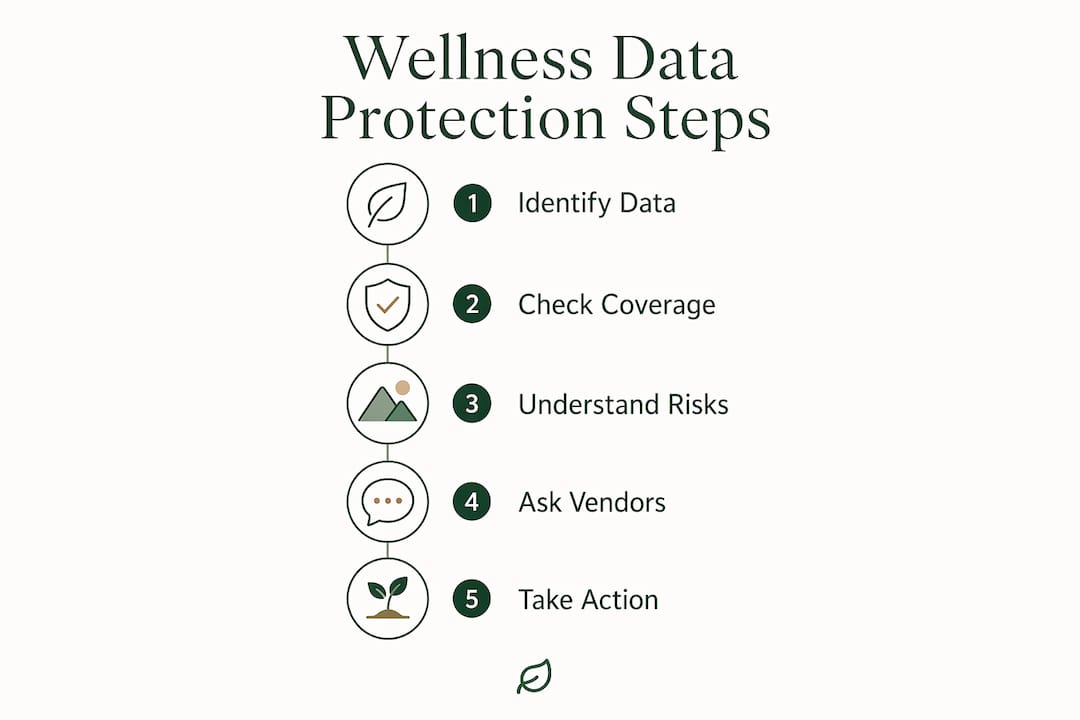
Concrete steps you can take today to protect your wellness data
You don't need a legal background to reduce your exposure. Start here:
- Audit app permissions. On iOS or Android, review which apps have access to your health data, location, microphone, and contacts. Revoke anything unnecessary.
- Tighten privacy settings. Most health apps have in-app privacy controls. Disable ad personalization and data-sharing toggles.
- Limit Bluetooth and GPS sharing to when you're actively using a fitness device.
- Enable device encryption and a strong passcode on any device that stores health data.
- Turn on multi-factor authentication for wellness app accounts.
- Export and delete your data when you stop using a service. Most platforms are required to honor deletion requests under applicable state laws.
- Choose platforms that document their security practices and vet their practitioners before listing them.
- Check your state privacy rights. If you're in California, Virginia, Washington, or another state with a health-data law, submit a formal access or deletion request to any vendor holding your information.
Pro Tip: When asking a practitioner or platform about data use, try this phrasing: "Can you tell me in writing what health information you store, who has access to it, and how I can request its deletion?" A clear, prompt answer is a good sign. Hesitation or a vague response is not.
Special rules for employer wellness programs
Whether HIPAA applies to your workplace wellness program depends entirely on how the program is structured. If it's administered through a group health plan, the health information collected is PHI and HIPAA protections apply. If the program runs separately from the group plan, different laws may govern it — or none at all.
Ask your HR department or plan administrator:
- Is this wellness program part of our group health plan?
- Who holds the health data I submit, and how is it used?
- Can my employer see my individual results, or only aggregate data?
- Is participation voluntary, and does opting out affect my benefits?
- Has a written authorization been obtained for any data sharing?
Under HIPAA, when a group health plan does apply, the employer acting as plan sponsor can access PHI only under strict conditions and must maintain a clear separation between plan data and general employment decisions.
What a privacy-minded wellness marketplace should look like
A trustworthy platform does more than post a privacy policy, offering telehealth and luxury concierge care that ensures patient data privacy through strong technical and operational protections. Here's what good practice looks like in a holistic-care marketplace:
- Transparent privacy policy with explicit purpose limitation — data collected for booking is used for booking, not advertising
- Data minimization on intake forms — practitioners receive only what they need for your care, reducing the risk of sensitive data reaching analytics vendors
- User controls for accessing, correcting, and deleting your data
- Practitioner credential verification before any provider is listed, so you know who you're sharing intake information with
- Encryption in transit and at rest for all stored health and booking data
- Documented breach-notification procedures aligned with FTC Health Breach Notification Rule obligations
- No sale of personal health data to third-party brokers
Goholistic applies these principles directly. The platform verifies practitioner credentials across disciplines including acupuncture, massage therapy, and Ayurveda before listing any provider. Intake forms are designed to collect only what a practitioner genuinely needs. And the platform's evidence-based treatment library supports informed decisions without requiring you to overshare personal health details upfront.
Pro Tip: On any practitioner profile, look for a verification badge, listed credentials, and a clear note on how intake data is stored and shared. If a profile shows none of those, ask before you book.
Key Takeaways
Wellness data privacy requires understanding that HIPAA rarely covers consumer apps, that FTC enforcement and state laws fill the gap, and that you can take concrete steps today to limit your exposure.
| Point | Details |
|---|---|
| HIPAA has a large gap | Most consumer wellness apps and wearables fall outside HIPAA — they are not covered entities or business associates. |
| FTC and state laws apply | The FTC enforces privacy promises and the Health Breach Notification Rule; CCPA, CDPA, and similar state laws add deletion and opt-out rights. |
| Purpose limitation is your best test | If a privacy policy allows vague secondary uses like "analytics" or "partners," treat that as a red flag and limit what you share. |
| Act on permissions and deletion | Audit app permissions, enable device encryption, and submit data-deletion requests when you leave any wellness service. |
| Goholistic verifies practitioners | Goholistic checks credentials before listing providers and limits intake data to what practitioners actually need for your care. |
Why privacy is the foundation of real wellness trust
Most wellness privacy guides stop at "read the privacy policy." That advice is fine as far as it goes, but it misses the deeper issue: the wellness space collects some of the most sensitive data a person generates, and the legal framework protecting it is genuinely fragmented. HIPAA, designed for clinical settings, leaves a wide open lane for consumer apps. The FTC fills part of that lane, but enforcement is reactive — it responds after harm occurs, not before.
What actually protects you is choosing platforms that treat privacy as a design principle rather than a compliance checkbox. That means practitioner verification, minimal intake forms, clear purpose statements, and user controls that work. The evidence-based approach to holistic care and the privacy-first approach to data handling are not separate values. They're the same value: respect for the person seeking care.
Goholistic puts your privacy at the center of your wellness experience
When you're looking for a certified holistic practitioner, you deserve a platform that handles your health information with the same care a practitioner brings to your treatment. Goholistic verifies every provider's credentials before they appear in the directory, limits intake data to what your care actually requires, and maintains transparent privacy practices so you always know how your information is used. The treatment library covers over 200 therapy types, all backed by evidence-based research, so you can make informed decisions without oversharing personal details to get there.
Ready to find a verified holistic practitioner you can trust? Browse treatments and providers on Goholistic and take your next wellness step with confidence.
Authoritative sources and further reading
These US-focused primary sources back the claims in this article and are useful if you want to file a complaint or verify your rights:
- HHS HIPAA Privacy Overview — The official starting point for understanding HIPAA rules, covered entities, and how to file a complaint with the Office for Civil Rights (OCR).
- HHS Guidance: Access Right, Health Apps, and APIs — Explains when HIPAA follows ePHI into a third-party app and when it doesn't, including the individual-directed transfer rule.
- HHS Workplace Wellness and HIPAA — Clarifies when employer wellness programs are HIPAA-covered and what protections apply.
- FTC Health Privacy Guidance — Explains how the FTC enforces privacy promises and what security obligations wellness vendors carry.
- FTC Health Breach Notification Rule — The rule requiring non-HIPAA health apps to notify consumers after breaches of unsecured personal health record data.
- HHS Non-Covered Entities Report — Documents the privacy and security gaps for health data held outside HIPAA's scope.
- OHCHR Health-Related Data Privacy Principles — International framework stressing purpose limitation, transparency, and proportional safeguards — a useful benchmark for evaluating any wellness vendor.
- Washington State My Health MY Data Act (RCW 19.373) — One of the strongest state-level consumer health data laws in the US; a model for the rights consumers should expect everywhere.
This article is general information, not legal or medical advice. Confirm your specific rights and the current rules with the relevant agency or a qualified professional for your situation.