

TL;DR:
- Mind-body therapy encompasses techniques like mindfulness, meditation, yoga, and tai chi, grounded in mind-physical health connection.
- Scientific evidence supports its benefits in reducing stress, anxiety, depression, and chronic pain when practiced consistently.
- It is most effective as a complementary, habit-forming approach for manageable conditions, not as a standalone treatment.
Mind-body therapy is often lumped together with vague wellness buzzwords, which can make it easy to dismiss. But that reaction misses something important. These mind-body practices form a broad, evidence-backed spectrum of techniques, including mindfulness, meditation, yoga, tai chi, and breathing exercises, all grounded in the principle that your mental and physical health are deeply connected. This guide cuts through the noise and gives you the real picture: what mind-body therapy actually is, how it works on a physiological and psychological level, what the research says, and how you can start using it in your daily life safely and effectively.
Table of Contents
- What is mind-body therapy?
- How mind-body therapy works: The science and evidence
- Benefits and limitations: Who should (and shouldn't) try mind-body therapy?
- Getting started: Practical tips for applying mind-body therapy to your life
- Our take: Beyond the hype—practical truths about mind-body therapy
- Find trusted mind-body therapy resources and practitioners
- Frequently asked questions
Key Takeaways
| Point | Details |
|---|---|
| Multifaceted practice | Mind-body therapy includes practices like mindfulness, yoga, and Tai Chi linked by their focus on the mind-body connection. |
| Strong research support | Studies show mind-body therapies can notably reduce stress, anxiety, depression, and chronic pain for many people. |
| Personalization matters | The most effective results come from matching proven techniques to your individual health goals and needs. |
| Not a miracle cure | These approaches are best used alongside standard medical care and may not suit everyone, especially in severe cases. |
| Start safely | Begin with established practices, consult professionals for complex needs, and build routines gradually for sustainable benefit. |
What is mind-body therapy?
Mind-body therapy isn't a single technique or a trendy wellness fad. It's a broad category of health practices built on one foundational idea: your thoughts, emotions, and mental states directly influence your physical health, and vice versa. That connection is far more powerful than most people realize.
In conventional medicine, the body is often treated as separate from the mind. If you have back pain, a doctor might prescribe medication or physical therapy. Mind-body therapy takes a different view. It treats the whole person, working with both the psychological and physical dimensions of a health concern at the same time. This is why it fits naturally within a holistic health treatments framework, where the goal is overall balance rather than isolated symptom relief.
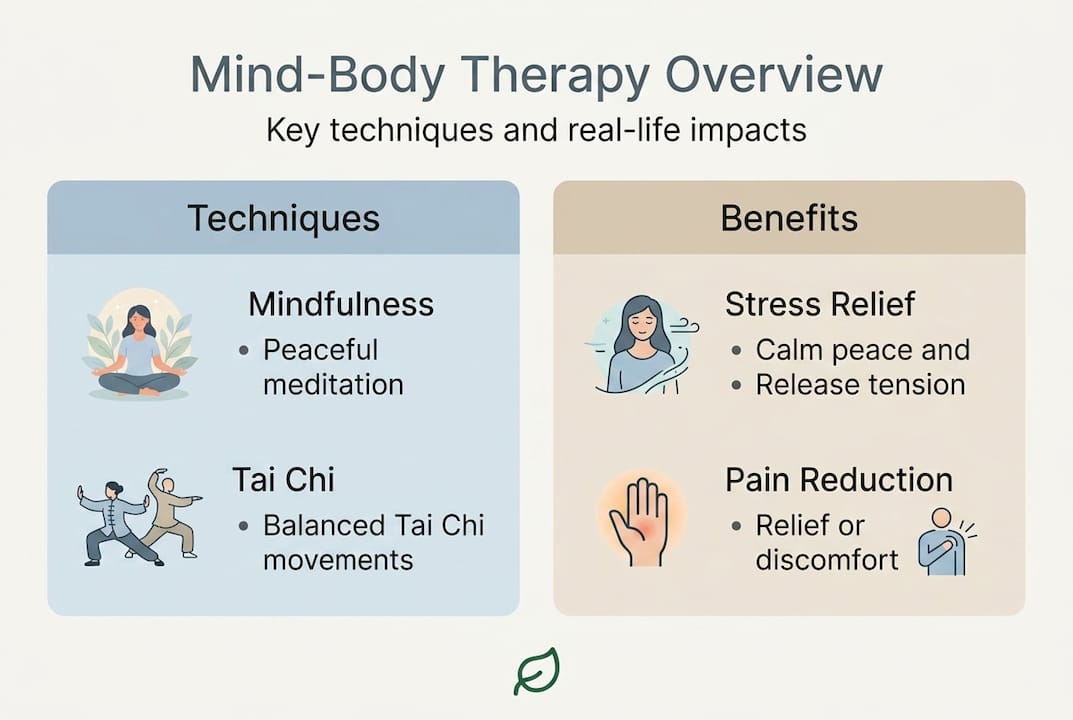
The major modalities in mind-body therapy include:
- Mindfulness — Paying deliberate, nonjudgmental attention to the present moment, often through guided or silent practice.
- Meditation — A broader category that includes mindfulness, loving-kindness meditation, transcendental meditation, and body scan techniques.
- Yoga — A movement-based practice that integrates breathwork, physical postures, and meditative awareness.
- Tai chi — A flowing martial art form practiced slowly for health benefits, particularly balance, coordination, and stress reduction.
- Pilates — A structured movement system emphasizing core strength, alignment, and body awareness.
- Breathing exercises — Techniques like diaphragmatic breathing, box breathing, and alternate nostril breathing that regulate the nervous system.
Here's a quick comparison of the most widely practiced techniques:
| Technique | Primary aim | Key benefits | Level of evidence |
|---|---|---|---|
| Mindfulness | Awareness and focus | Reduced anxiety, better emotional regulation | High |
| Meditation | Calming the mind | Stress reduction, improved sleep | High |
| Yoga | Mind-body integration | Flexibility, pain relief, mood improvement | Moderate to high |
| Tai chi | Balance and flow | Chronic pain relief, fall prevention | Moderate to high |
| Pilates | Core and alignment | Posture, low back pain, body awareness | Moderate |
| Breathwork | Nervous system regulation | Anxiety reduction, blood pressure control | Moderate |
Mind-body therapy doesn't aim to replace your doctor or your medication. Instead, it works alongside conventional care, adding a layer of self-directed healing that conventional medicine sometimes overlooks. You can explore many of these approaches on their own or as part of a broader plan guided by a qualified practitioner. If you're curious about how these approaches sit within the wider wellness landscape, the guide to top holistic therapies is a helpful starting point.
How mind-body therapy works: The science and evidence
Having defined what mind-body therapy is, we now examine how and why it works, and what the science actually shows.

The link between mind and body isn't metaphor. It's biology. When you experience stress, your body activates the hypothalamic-pituitary-adrenal (HPA) axis, flooding your bloodstream with cortisol and adrenaline. Over time, chronic activation of this stress response contributes to inflammation, weakened immunity, sleep disruption, and increased cardiovascular risk. Mind-body practices work by training your nervous system to shift out of this stress state and into a more regulated, parasympathetic mode, commonly called "rest and digest."
This is supported by a growing body of research. A recent review found that mind-body exercises reduce depression with a Hedges' g of -0.86, which is a large effect size, and reduce anxiety with a g of -0.38. For somatic symptoms, meaning physical symptoms driven or worsened by psychological factors, these interventions performed comparably to cognitive behavioral therapy (CBT), with effect sizes of d = -0.50 to -0.55 versus a waitlist control.
That's not a small finding. CBT is widely considered the gold standard in psychotherapy. The fact that mind-body practices approach its effectiveness for certain conditions tells you something meaningful about their real-world value.
Research also shows that Pilates and Tai Chi rank highly for pain reduction in conditions like knee osteoarthritis and chronic low back pain. These aren't just feel-good activities. They produce measurable, clinically meaningful outcomes.
Here's a summary of what current reviews show across key health areas:
| Condition | Best-studied practice | Effect size | Notes |
|---|---|---|---|
| Depression | Mindfulness, yoga | Large (g = -0.86) | Comparable to CBT |
| Anxiety | Meditation, breathwork | Moderate (g = -0.38) | Consistent across populations |
| Chronic low back pain | Tai chi, yoga, Pilates | Moderate | Best with regular practice |
| Knee osteoarthritis | Tai chi | Moderate to large | Improves function and pain |
| Sleep quality | Mindfulness, yoga | Moderate | Especially in older adults |
| Stress | All major modalities | Moderate to large | Measured by cortisol and self-report |
One thing the evidence makes clear: intensity matters less than consistency. A short daily mindfulness session of 10 to 15 minutes delivers more benefit over time than an occasional hour-long session every few weeks.
Pro Tip: If you're just starting out, choose one practice and commit to it for 30 days before adding another. Research consistently shows that habit formation, not practice variety, drives the most reliable outcomes.
This is why evidence-based wellness approaches emphasize building sustainable routines over chasing the latest technique. The same principle applies to your mind-body practice. For those curious about what the broader research landscape looks like, exploring evidence-based wellness practices provides solid grounding before you choose your path.
Benefits and limitations: Who should (and shouldn't) try mind-body therapy?
Understanding the science leads to a crucial practical question: Is mind-body therapy right for you, and are there situations when it shouldn't be used?
The good news is that for a wide range of people, mind-body therapy offers real, accessible benefits. The research on stress, anxiety, and chronic pain consistently supports its use as part of a broader wellness strategy. Here are the populations and scenarios where it tends to work especially well:
- Adults managing mild to moderate anxiety or depression alongside or between conventional treatment
- People with chronic pain conditions like low back pain, fibromyalgia, or osteoarthritis
- Individuals experiencing work-related stress, burnout, or sleep difficulties
- Those recovering from illness or surgery who want to support healing and regain body awareness
- Anyone looking to build long-term resilience against stress and maintain emotional balance
- Older adults seeking to improve balance, coordination, and mental clarity
The benefits go beyond symptom relief. Regular practice tends to improve self-awareness, reduce emotional reactivity, and help people feel more in control of their health. That sense of agency matters enormously for long-term wellness.
Mind-body therapy offers a holistic, evidence-supported complement to conventional treatments, particularly for stress-related and somatic conditions. Its strength lies in how it works with the whole person, but it's most powerful when integrated thoughtfully into a broader care plan.
That said, there are important limitations you should be aware of. Mind-body therapy is not a standalone treatment for acute or severe medical conditions. It won't set a broken bone, treat an infection, or manage a medical crisis. And in some cases, it may not be appropriate without professional supervision.
Research highlights that certain psychiatric conditions like psychosis and acute post-traumatic stress disorder (PTSD) require co-management with a mental health professional before adding mind-body practices. Some individuals may also experience a temporary increase in anxiety when beginning practices like body scan meditation, particularly if they have a history of trauma. That reaction is worth knowing about before you start.
Pro Tip: If you live with a complex health condition, whether physical or mental, always speak with your doctor or a qualified mental health professional before beginning a new mind-body practice. A personalized wellness approach that accounts for your full health picture is always safer and more effective than a one-size-fits-all routine.
The benefits of integrating mind-body approaches are well documented, and you can learn more about the broader picture through integrative health benefits, which explores how these therapies work within conventional care frameworks.
Getting started: Practical tips for applying mind-body therapy to your life
Ready to give mind-body therapy a try? Here's how to start safely and effectively, based on the latest research.
The most common mistake people make is jumping straight into a practice without a clear intention. They download an app, try a yoga class, and wonder why nothing sticks. Starting with clarity about what you're hoping to achieve makes every step after that more focused and more sustainable.
The research recommends prioritizing established practices like mindfulness-based interventions or Tai Chi over unverified somatic "hacks." High heterogeneity across studies means that results vary significantly between individuals, which is why personalization matters so much in practice selection.
Follow these steps to build a solid foundation:
- Set clear, specific goals. Ask yourself what you're hoping to address. Is it chronic stress? Better sleep? Reduced back pain? Your goal shapes your practice choice. Vague intentions lead to vague results.
- Choose an evidence-supported practice. Start with a modality that has solid research behind it for your specific concern. Yoga and mindfulness for stress and anxiety. Tai chi for balance and pain. Pilates for core stability and low back issues.
- Find qualified guidance. Look for certified instructors or evidence-based programs. Online resources vary wildly in quality. When working with a condition, a trained practitioner provides accountability and safety.
- Track your progress consistently. Keep a simple journal or use a wellness app to note how you feel before and after sessions. Over time, patterns will emerge that help you adjust your approach intelligently.
- Adjust as you learn. What works well in week one may need to shift by week six. Your body and mind adapt, and your practice should evolve with you. Flexibility in approach is as important as consistency in effort.
Beyond those steps, it's worth knowing what to watch out for. Here are some common missteps that can slow your progress or cause unnecessary discomfort:
- Choosing a practice based on popularity rather than evidence or personal fit
- Practicing infrequently and expecting consistent results
- Skipping consultation with a health professional when you have a chronic or complex condition
- Expecting dramatic changes within days rather than allowing weeks or months for results to develop
- Following online influencers or social media accounts that promote unverified somatic techniques as quick fixes
- Ignoring discomfort signals during movement-based practices
One powerful option is to explore non-invasive treatments as a companion to your mind-body practice, particularly if you're managing chronic pain or recovery from injury. Many people find that combining modalities creates a more complete and sustainable approach than any single practice alone.
The key is to trust the process, stay curious, and give your body and mind enough time to respond. Healing and growth rarely happen in straight lines.
Our take: Beyond the hype—practical truths about mind-body therapy
Stepping back, here's a grounded perspective from our experience helping people navigate holistic health methods.
Mind-body therapy gets both too much praise and too much skepticism, often at the same time. Advocates sometimes overstate its reach, marketing breathwork retreats as cures for everything from chronic illness to trauma. Skeptics, meanwhile, paint the entire field with the same brush used for genuinely pseudoscientific approaches.
The honest truth sits in the middle. Some critics are right to point out that certain somatic approaches lack rigorous randomized controlled trials and may rely on outdated theoretical frameworks or methodological flaws that inflate reported effects. That criticism deserves to be heard.
But it shouldn't lead you to dismiss practices like mindfulness, Tai Chi, and yoga, which have decades of solid research behind them. The issue is selectivity. Not every method labeled "mind-body" carries equal evidence. Your job as a wellness seeker is to be curious but discerning, asking what the evidence shows before you invest your time and money.
The biggest overlooked truth? Mind-body therapy works best as a consistent habit, not a dramatic intervention. It's more like tending a garden than fixing a pipe. Regular, gentle attention over time produces the most lasting change. Explore what resonates through the lens of the role of alternative therapies to help you build a personal framework rooted in both openness and critical thinking.
Find trusted mind-body therapy resources and practitioners
If you're inspired to explore mind-body therapy further, these resources can help you connect with evidence-based practitioners and programs.
At Go Holistic, we've built a platform specifically designed for people at exactly this stage of the journey. You're informed, you're motivated, and you're ready for personalized support that matches your health goals.
Browse our holistic treatments directory to explore over 200 therapy types, including yoga, Tai Chi, mindfulness programs, and somatic practices, each supported by research summaries. When you're ready to work with someone directly, use our find holistic practitioners tool to connect with verified, licensed professionals in your area. You can also browse our full list of holistic health providers to filter by specialty, condition, and location. Your next step toward balance is closer than you think. Get Started today.
Frequently asked questions
Is mind-body therapy supported by scientific evidence?
Yes, research shows moderate to large benefits for stress, anxiety, depression, and some chronic pain conditions. Studies show depression reduction with a Hedges' g of -0.86, and anxiety reduction with g = -0.38, effects comparable to CBT for somatic symptoms.
Who should avoid mind-body therapy?
Mind-body therapy is generally not recommended for severe psychiatric conditions such as psychosis or acute PTSD without supervision. Clinical reviews note that vulnerable individuals may experience increased anxiety without proper professional co-management.
Are all mind-body practices equally effective?
No, techniques like mindfulness, Tai Chi, and Pilates have significantly more research support than newer or less-studied somatic methods. Studies confirm that Tai Chi and Pilates rank among the highest for measurable pain relief in conditions like osteoarthritis.
Is mind-body therapy a replacement for medication or psychotherapy?
For most people, mind-body therapy works best as a complement, not a substitute, for medical or psychological care. As noted by NCCIH, efficacy varies by modality and individual, and integration with conventional treatment requires care in complex cases.