

TL;DR:
- Integrative pain management combines conventional treatments with complementary therapies for holistic relief.
- Evidence supports therapies like acupuncture, yoga, and mindfulness as effective for chronic pain.
- Consistent, long-term engagement and self-management are key to achieving lasting benefits.
If you've been managing chronic pain and feel like medications alone aren't giving you the full picture, you're not imagining it. There's a growing body of evidence showing that patient-centered holistic care combining conventional and complementary therapies can deliver real, lasting relief. This guide explains what integrative pain management actually is, which therapies have the strongest research behind them, what risks to watch for, and how to build a plan that fits your life. Whether you're navigating back pain, fibromyalgia, or post-surgical discomfort, the options are broader than you might think.
Table of Contents
- What is integrative pain management?
- Core therapies and methods in integrative pain care
- Evidence, benefits, and outcomes: What the science shows
- Risks, controversies, and practical barriers
- A holistic pain management perspective: What most people miss
- Find integrative pain solutions and support
- Frequently asked questions
Key Takeaways
| Point | Details |
|---|---|
| Whole-person care | Integrative pain management addresses physical, emotional, and social aspects of chronic pain. |
| Evidence matters | Certain therapies like acupuncture and yoga have strong research support for reducing pain. |
| Individualized plans | Multidisciplinary teams create personalized pain management plans that blend conventional and holistic methods. |
| Know the risks | Patient education and professional guidance are vital, especially for higher-risk or less-studied therapies. |
| Empowerment | Integrative programs help patients take active roles in their pain management and may reduce medication reliance. |
What is integrative pain management?
Let's lay the groundwork with a clear definition of what makes integrative pain management unique.
Integrative pain management is not just about swapping pills for acupuncture needles. It's a whole-system approach that brings together conventional treatments like medications, nerve blocks, and physical therapy alongside complementary modalities like yoga, massage, and mindfulness. The goal is to treat you, not just your pain signal.
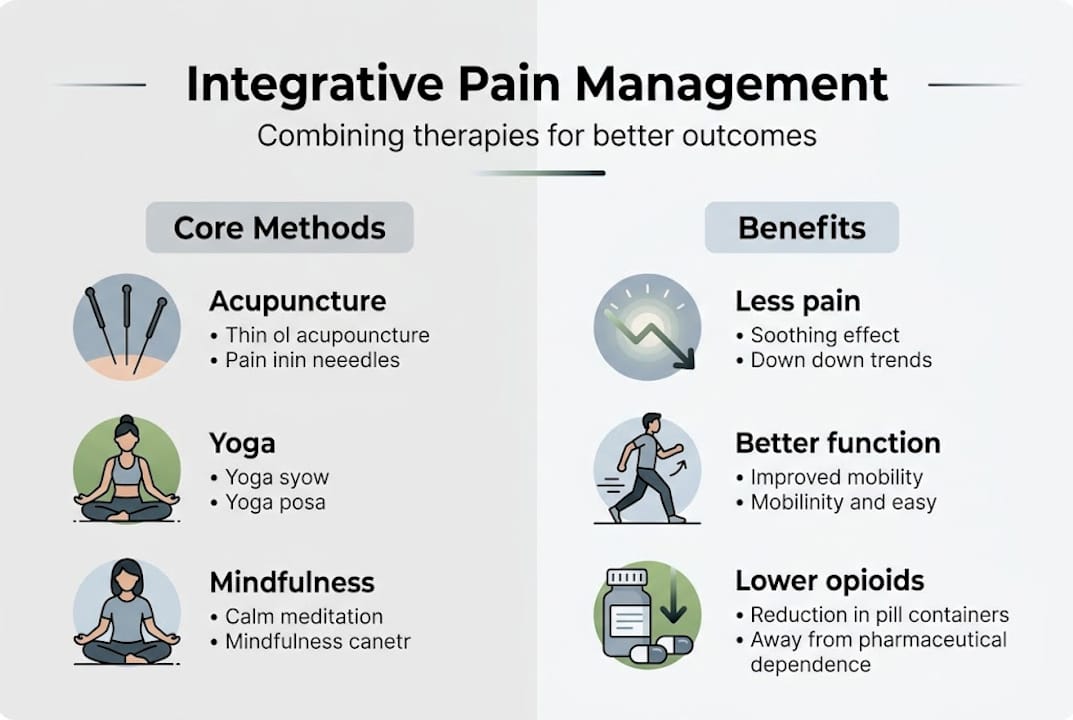
At the heart of this model is something called the biopsychosocial framework. This simply means that pain is addressed from physical, psychological, emotional, and social angles all at once. Chronic pain isn't purely mechanical. Stress, sleep quality, relationships, and mental health all influence how intensely you feel pain and how well you recover.
Here's what makes integrative care distinct from a standard doctor's visit:
- Team-based approach: You're supported by a coordinated group that might include physicians, physical therapists, psychologists, and acupuncturists.
- Individualized plans: There's no one-size-fits-all protocol. Your history, goals, and preferences shape your care.
- Evidence-focused: Therapies are selected based on research, not trends.
- Whole-person focus: Emotional well-being and lifestyle are treated as essential, not optional.
The growth in this field is striking. Use of integrative approaches in the US for pain management climbed from 19.2% in 2002 to 36.7% in 2022. That's nearly double in two decades, and it reflects a real shift in how both patients and providers think about pain.
Exploring the integrative health benefits of this approach can help you understand why so many people are making the switch. And if you're just starting out, practical integrative health tips can make the transition feel much more manageable.
The shift matters because chronic pain is notoriously difficult to treat with a single method. Most people living with it for months or years eventually hit a wall with conventional care. Integrative pain management is designed specifically to address that gap, offering a wider toolkit and a more personal approach.
Core therapies and methods in integrative pain care
Now that you know what integrative pain management is, let's look at the therapies and methods it brings together.
The landscape of integrative therapies is wide, but some have earned far more research support than others. Acupuncture, yoga, and mindfulness, along with physical therapy and nutritional changes, have shown modest but meaningful benefits for pain reduction and improved daily function.
Here's a quick comparison of the most commonly used therapies:
| Therapy | Evidence strength | Primary benefit |
|---|---|---|
| Acupuncture | Strong | Pain reduction, improved function |
| Mindfulness/meditation | Strong | Stress reduction, pain coping |
| Yoga | Moderate to strong | Flexibility, mood, pain relief |
| Physical therapy | Strong | Mobility, strength, injury recovery |
| Massage therapy | Moderate | Muscle tension, relaxation |
| Biofeedback | Moderate | Self-regulation of pain response |
| Nutrition and lifestyle | Moderate | Inflammation reduction, energy |
These therapies don't replace each other. They work best in combination, layered into a personalized plan. For example, someone with chronic low back pain might pair physical therapy with mindfulness practice and targeted nutritional support. The synergy between modalities is often where the real benefit shows up.

A recent review of integrative therapies confirms that multidisciplinary programs consistently outperform single-modality approaches for chronic pain. That's not surprising when you consider how complex persistent pain actually is.
You can explore more about natural pain relief methods backed by science, or read about holistic methods used across a range of chronic conditions. Understanding the broader role of alternative therapies can also help you see where these tools fit in the bigger picture of modern wellness.
Pro Tip: Start with therapies that have the strongest research support, specifically acupuncture, yoga, and mindfulness-based stress reduction, before moving into less-studied options. Building on a solid foundation makes it easier to track what's actually helping.
Evidence, benefits, and outcomes: What the science shows
Understanding the options is important, but you also want to know what actually works. Here's what research tells us.
The evidence for integrative pain management has grown considerably over the past decade. It's no longer a fringe idea. Studies consistently show that well-structured programs deliver improvements in pain intensity, physical function, and quality of life, often without increasing medication loads.
84% of studies on cancer pain using integrative approaches showed positive pain reduction. Interdisciplinary programs have also been shown to reduce opioid use, emergency department visits, and unnecessary imaging.
These aren't small wins. Reducing opioid dependence and ER visits has a meaningful impact on both safety and quality of life. It also speaks to the long-term value of investing in integrative care rather than relying solely on reactive treatment.
Here's a summary of where the evidence lands:
| Therapy | Evidence level | Outcome |
|---|---|---|
| Acupuncture | High | Reduced pain intensity |
| Mindfulness-based stress reduction | High | Improved coping, less distress |
| Interdisciplinary pain programs | High | Lower opioid use, better function |
| Yoga | Moderate | Pain relief, mood improvement |
| Massage therapy | Moderate | Short-term muscle relief |
The practical benefits of integrative care stack up quickly. Here are the most commonly reported outcomes:
- Better day-to-day symptom control
- Fewer medication side effects
- Improved sleep quality
- Greater emotional resilience
- Higher overall quality of life
Cleveland Clinic data on interdisciplinary pain programs backs this up, showing that patients in structured programs achieve better outcomes than those receiving standard care alone. Exploring evidence-based wellness practices can help you identify which approaches to prioritize for your specific situation.
One thing the research makes clear: patience matters. Most gains from integrative therapies build gradually over weeks and months. That's actually a strength, since those changes tend to be more durable than short-term medication fixes.
Risks, controversies, and practical barriers
Every treatment comes with pros and cons. Here's what to know to stay safe and make wise decisions.
Integrative care is generally safer than high-dose medication regimens, but it isn't without risk. Some modalities require careful consideration, especially if you have underlying health conditions or are already taking medications.
Higher-risk modalities like chiropractic manipulation and certain herbal supplements have variable evidence and can cause harm if used incorrectly or without proper screening. Spinal manipulation, for instance, carries a small but real risk for people with osteoporosis or certain vascular conditions. Some supplements interact with blood thinners or affect liver function.
Here are the key risk areas to keep in mind:
- Chiropractic adjustments: Effective for some conditions, but not appropriate for everyone. Ask about contraindications before starting.
- Herbal supplements: Regulation is inconsistent. Quality, dosage, and interactions with medications vary widely.
- Unverified practitioners: The field lacks uniform licensing standards across all modalities, making it essential to seek verified, credentialed providers.
- Delayed conventional care: Relying only on complementary therapies for serious conditions can be dangerous. Integrative means both, not instead of.
Practical barriers also deserve honest acknowledgment. Lack of standardization across integrative medicine practices, limited insurance coverage for many therapies, and uneven geographic access to qualified practitioners are real obstacles that many people face. The financial burden of out-of-pocket costs for acupuncture or massage can be significant.
Learning about the safe use of natural remedies and reviewing adaptogenic herbs and safety can help you navigate supplements more confidently.
Pro Tip: Always tell every member of your care team, including your primary doctor, about every therapy you're using. What seems harmless, like a herbal tea or a new supplement, can have real interactions with prescriptions. Full transparency protects you.
A holistic pain management perspective: What most people miss
Putting it all together, here's a perspective shaped by both research and practical experience.
The biggest mistake people make when exploring integrative pain care is treating it like a shopping list. They try acupuncture for a few weeks, add some turmeric, and expect transformation. When it doesn't arrive quickly, they move on. But that's borrowing the mindset of conventional medicine, where a pill either works fast or gets replaced.
Chronic pain doesn't respond to that model. What actually moves the needle, more than any single therapy, is consistent engagement over time. Small, repeated lifestyle shifts, like a ten-minute mindfulness practice or a short daily walk, often deliver more lasting change than one-off treatments.
The other thing most people miss is how much self-management matters. Care teams are essential, but the broader benefits of integrative health are most fully realized when you become an active participant, not a passive recipient. Tracking your symptoms, communicating openly with providers, and adjusting your approach based on feedback is where real progress lives.
Access and motivation barriers are real, and they shouldn't be minimized. But they can be approached incrementally. Starting with one low-cost, evidence-backed practice and building from there is far more sustainable than overhauling everything at once.
Find integrative pain solutions and support
If you're ready to explore integrative pain solutions tailored to you, here's how to get started.
Go Holistic makes it straightforward to move from curiosity to action. Our platform connects you with verified holistic health practitioners across disciplines including acupuncture, massage therapy, Ayurveda, and more, all in one place.
You can browse our full library of holistic health treatments, covering over 200 therapy types with research summaries, so you know exactly what you're choosing and why. When you're ready to book, our health providers directory lets you filter by specialty, location, and credential so you find the right fit for your needs. Whether you're just starting to explore or ready to build a full integrative care plan, Go Holistic is here to support every step of your journey. Get Started today and take that first step toward a more balanced approach to pain care.
Frequently asked questions
How is integrative pain management different from conventional pain treatment?
Integrative care combines medications and procedures with evidence-based complementary therapies like acupuncture and yoga, focusing on the whole person rather than just the symptoms. Conventional care typically targets the physical source of pain alone.
Which integrative therapies have the strongest evidence for pain relief?
Acupuncture, yoga, and mindfulness have the best research support for reducing chronic pain and improving daily function. These are the most reliable starting points for building an integrative plan.
Are there risks with integrative pain management therapies?
Some therapies, like chiropractic manipulation and certain supplements, carry variable evidence and potential risks, so always consult with a qualified, verified provider before starting anything new.
Can integrative pain management reduce reliance on pain medications?
Yes. Interdisciplinary pain programs have been shown to lower opioid use and reduce emergency department visits by building stronger long-term self-management skills and addressing the root contributors to chronic pain.
Recommended
- Natural pain relief: 5 science-backed methods that work
- Evidence-based holistic methods for chronic health
- 10 integrative health tips for natural wellness success
- What is integrative nutrition? A science-based holistic guide
- How physiotherapy relieves pain: proven methods and benefits
- Top herbs for holistic wellness: relief for inflammation & swelling – Gutted.