

TL;DR:
- Wellness mapping visually assesses eight areas of personal health and guides goal setting.
- Focusing on 2–3 key dimensions every 3–6 months helps improve overall well-being efficiently.
Wellness mapping is defined as a systematic method that visualizes and analyzes multiple factors influencing your personal health and well-being across eight core life areas. The practice draws from behavioral change psychology to help you move from vague feelings of being "off" to concrete, measurable insight. Most wellness maps rate dimensions like physical health, relationships, and finances on a scale of 1–10, then guide you to focus on 2–3 key imbalances over 3–6 month cycles. The result is a clear picture of where your energy is going and where it needs to go.
What is wellness mapping and how does it work?
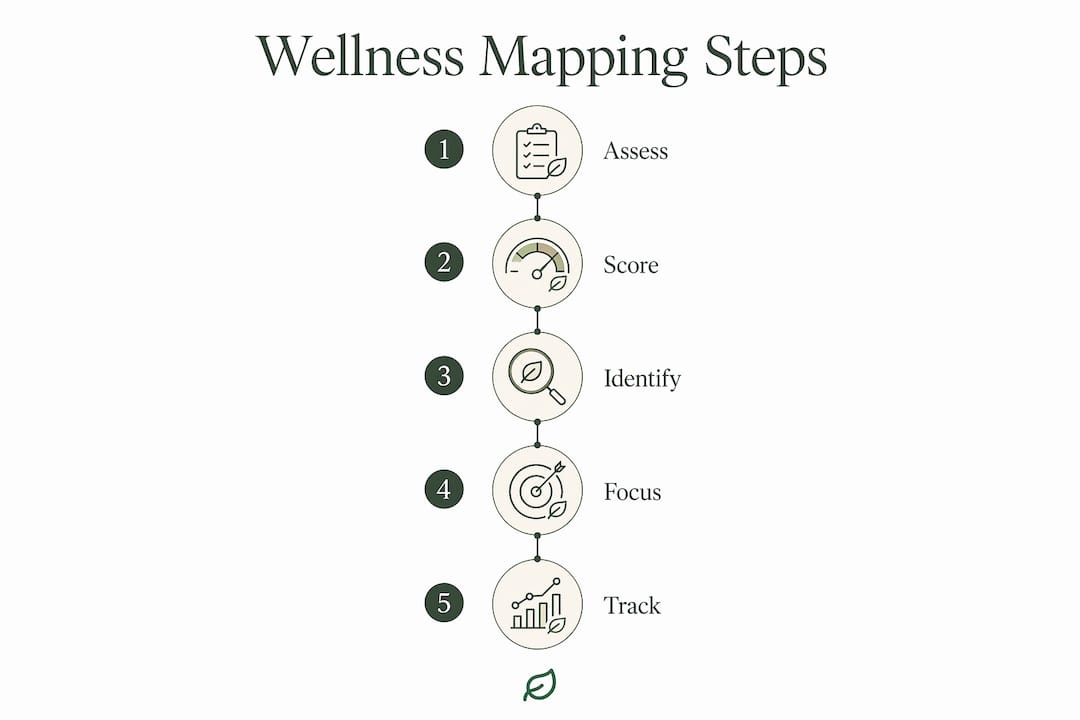
Wellness mapping is the practice of rating multiple life dimensions on a numbered scale to reveal where you are thriving and where you are struggling. The industry often calls this process a "wellness wheel" or "life balance map," and both terms describe the same core method. You score each area, plot the scores visually, and use the pattern to set focused goals. The visual gap between your current scores and your ideal scores becomes your personal health roadmap.
The eight dimensions most commonly assessed are:
- Physical health: Sleep quality, exercise frequency, nutrition, and energy levels
- Emotional wellness: Stress management, mood regulation, and self-awareness
- Social relationships: Connection with family, friends, and community
- Career and purpose: Satisfaction with work, meaning, and contribution
- Finances: Stability, debt management, and financial confidence
- Personal growth: Learning, creativity, and self-development habits
- Spirituality: Sense of meaning, values alignment, and inner peace. A thorough spiritual wellness guide can help you rate this dimension accurately.
- Environment: Home, workspace, and the physical spaces you spend time in
| Dimension | Example rating question | What a low score signals |
|---|---|---|
| Physical health | "How energized do I feel daily?" | Poor sleep, low activity, or poor nutrition |
| Emotional wellness | "How well do I manage stress?" | Burnout risk or unresolved anxiety |
| Social relationships | "How connected do I feel to others?" | Isolation or relationship strain |
| Career and purpose | "Does my work feel meaningful?" | Disengagement or misalignment |
| Finances | "Do I feel financially secure?" | Chronic stress from money pressure |
| Personal growth | "Am I learning something new regularly?" | Stagnation or low motivation |
| Spirituality | "Do my daily actions reflect my values?" | Disconnection from purpose |
| Environment | "Does my space support my well-being?" | Clutter, noise, or unsafe conditions |
Once you score each area, the lowest 2–3 scores become your focus. This prevents the common trap of trying to fix everything at once and getting nowhere.

What are the benefits of wellness mapping for personal health?
Wellness mapping works because it addresses your health as a whole system, not a collection of separate problems. People who track wellness activities show 35% better adherence to health goals than those who do not track at all. That number matters because most people abandon health goals within weeks of setting them.
"Strong relationships are the greatest predictor of life satisfaction, demonstrating how interconnected wellness dimensions affect overall health outcomes. Mental stimulation reduces dementia risk. Financial wellness reduces stress and directly affects emotional health."
The ripple effect between dimensions is one of the most underappreciated benefits of this approach. When you improve sleep quality (physical health), your emotional regulation improves. When your stress drops, your relationships strengthen. These connections mean that improving one wellness area often produces gains in two or three others without extra effort.
Wellness mapping for mental health is particularly well supported. Regular check-ins and progress tracking using wellness maps improve mental health outcomes compared to single-focus approaches. Monthly assessments also help you adapt your plan when life circumstances shift, which is exactly when most people abandon their health goals entirely.
The benefits extend beyond motivation. Mapping turns abstract well-being into measurable data. That data supports evidence-based wellness strategies and makes it far easier to have productive conversations with health practitioners about where you actually need support.
How to use wellness mapping effectively: techniques and practical steps
The wellness mapping process follows four clear steps. Each one builds on the last, and skipping any of them reduces the accuracy of your map.
- Rate all eight dimensions honestly. Use a scale of 1–10. Score each area based on how you feel right now, not how you want to feel. Honesty here is the entire foundation.
- Identify your 3 lowest scores. These are your focus areas for the next 3–6 months. Resist the urge to address more than three at once.
- Set one specific, measurable goal per focus area. Vague goals fail. "Sleep better" is not a goal. "Be in bed by 10:30 PM on weekdays" is. Specific, measurable targets increase success rates significantly compared to general intentions.
- Schedule monthly re-ratings. Re-score all eight dimensions at the end of each month. Adjust your goals based on what changed. This is what makes the map a living tool rather than a one-time exercise.
Weekly check-ins work well for people in active change phases. Monthly check-ins suit those in a maintenance phase. The recommended frequency is weekly to monthly depending on where you are in the process.
For tools, keep it simple. A printed worksheet, a basic journal, or a straightforward notes app all work well. Simple tracking systems like journals or basic apps show higher long-term adherence than complex digital platforms. Complex tracking often leads to abandonment within two weeks. The best tool is the one you will actually use consistently.
Pro Tip: When you identify a low-scoring area, start with the smallest possible action. If your social connection score is a 3, your first goal is not "join three new groups." It is "text one friend this week." Small wins build momentum faster than ambitious plans.
For readers who want a structured framework to build on their map, a personalized holistic health plan gives you the next layer of detail beyond the initial scoring exercise.
What common mistakes do people make with wellness mapping?
The biggest misconception about wellness mapping is that the goal is perfect balance across all eight dimensions at all times. That is not realistic, and chasing it causes more stress than it relieves. The goal of wellness mapping is harmony and intentionality, not perfection. Life is seasonal. Some areas naturally demand more focus at certain times.
Common pitfalls to watch for:
- Baseline bias: Rating areas based on feelings rather than facts. Objective data like lab results, symptom logs, or sleep tracking data produces a far more accurate map. Accurate baseline data prevents misdirected goals and wasted effort.
- Targeting too many areas at once: Focusing on more than three dimensions per season leads to low success rates. Successful wellness mappers focus on 2–3 key areas each season rather than trying to balance everything simultaneously.
- Treating the map as fixed: Your map should change as your life changes. A map you created in january may be completely irrelevant by july. Review and revise it regularly.
- Using overly complex systems: A wellness map buried inside a 40-field spreadsheet will not get used. Simplicity drives consistency.
Pro Tip: Before you rate any dimension, spend two minutes writing down three specific recent events related to that area. This grounds your score in actual experience rather than general mood, which makes your baseline far more accurate.
How does wellness mapping connect to holistic health and personalized care?
Wellness mapping sits at the center of holistic health practice because it operationalizes the core principle: mind, body, spirit, and environment are all connected and all matter. Personalized wellness becomes far more effective when it starts with a clear picture of where each dimension currently stands.
The mapping process turns abstract well-being into measurable data that informs targeted interventions and lifestyle changes. A practitioner working with a client who has a wellness map can immediately see that low scores in environment and social connection are likely compounding the physical health issues. Without the map, that connection stays invisible.
Wellness mapping also shifts you from a passive patient to an active participant in your own care. You arrive at appointments with data, not just symptoms. That shift changes the quality of every health conversation you have. Paired with integrative health approaches, wellness mapping creates a feedback loop where your lifestyle data continuously informs your care plan and your care plan continuously refines your map.
Key Takeaways
Wellness mapping is the most direct method for turning vague health concerns into a focused, measurable plan that addresses your whole life, not just your symptoms.
| Point | Details |
|---|---|
| Core definition | Wellness mapping rates 8 life dimensions on a 1–10 scale to reveal imbalances and guide focused goals. |
| Focus rule | Target only 2–3 dimensions per 3–6 month cycle to avoid burnout and improve measurable progress. |
| Tracking adherence | People who track wellness activities show 35% better adherence to health goals than those who do not. |
| Avoid perfectionism | The goal is harmony and intentionality across dimensions, not perfect scores in all areas at once. |
| Keep tools simple | Simple journals or basic apps outperform complex systems for long-term consistency and follow-through. |
Why wellness mapping changed how I think about health priorities
I have worked with a lot of people who come in knowing something is wrong but unable to name it. They are tired, disconnected, or stuck, and they have tried fixing one thing at a time for years without lasting results. Wellness mapping is the first tool that consistently moves people from that fog into clarity, and it does it fast.
What surprises most people is how often the area they thought was the problem turns out to be a symptom of a lower-scoring area they had been ignoring. Someone convinced their issue is physical exhaustion discovers their environment score is a 2 because they have been working in a chaotic, overstimulating space for two years. Fix the environment, and the exhaustion often follows.
The key to making mapping sustainable is treating it as a living document, not a report card. The people who benefit most are not the ones who score highest. They are the ones who return to their map every month, adjust honestly, and celebrate small movement. A score that moves from 3 to 5 in one dimension over three months is a genuine win. That kind of progress compounds over time in ways that single-focus health plans rarely achieve.
— Andrew
How Goholistic supports your wellness mapping goals
Knowing where your wellness gaps are is only the first step. Acting on that knowledge with the right support makes the difference between a map that sits in a drawer and one that actually changes your health.
Goholistic connects you with verified holistic practitioners across disciplines including acupuncture, Ayurveda, massage therapy, and more, all matched to the specific areas your wellness map identifies as priorities. The platform's holistic health treatments library covers over 200 therapy types, each backed by evidence-based research summaries. Whether your map points to emotional wellness, physical health, or spiritual connection, you can browse, filter, and book directly with a practitioner who specializes in exactly that area. Get started at Goholistic and put your map to work.
FAQ
What is wellness mapping in simple terms?
Wellness mapping is a self-assessment method where you rate eight life dimensions on a numbered scale to identify imbalances and set focused health goals. It gives you a visual snapshot of your overall well-being.
How often should I update my wellness map?
Weekly check-ins work well during active change phases, while monthly re-ratings suit maintenance periods. The key is consistency rather than frequency.
Can wellness mapping help with mental health?
Yes. Regular progress tracking using wellness maps improves mental health outcomes compared to single-focus approaches, and the process helps reduce overwhelm by turning vague feelings into concrete, addressable priorities.
How many areas should I focus on at once?
Focus on 2–3 dimensions per season. Targeting more areas simultaneously leads to low success rates and increases the risk of abandoning the process entirely.
Do I need a special app or tool for wellness mapping?
No special tool is required. Simple journals or basic apps show higher long-term adherence than complex platforms. The best format is whichever one you will return to consistently each week or month.