

A digital treatment library is a clinician-vetted, evidence-graded catalog of holistic therapies that gives you the research summaries, safety checks, and practical steps you need to build a personalized care plan with confidence. Think of it as the difference between scrolling through wellness forums and reading a structured, peer-reviewed reference built specifically for your health decisions.
Goholistic's library covers over 200 therapy types, from acupuncture and Ayurveda to massage therapy and herbal protocols. Every entry is organized around three practical capabilities:
- Evidence grading: Each therapy is rated by the strength of its supporting research, so you know whether a treatment has meta-analysis backing or only traditional use.
- Safety checks: Contraindications, drug-supplement interaction flags, and practitioner credential requirements appear on every entry.
- Personalization input: Library data feeds directly into AI-assisted care plans, connecting your goals, lifestyle, and health history to the therapies most likely to help.
Pro Tip: When you first open a treatment entry, scroll straight to the evidence grade and the "last reviewed" date before reading anything else. Those two fields tell you whether the information is current and how much weight to give it.
Table of Contents
- What a digital treatment library actually contains
- How evidence strength is graded and why it matters
- How a treatment library turns into your personalized care plan
- How to read a treatment library entry as a wellness seeker
- What treatment libraries cannot do alone
- How Goholistic's treatment library works in practice
- Key Takeaways
- Why the library matters more than most wellness seekers realize
- Goholistic gives you evidence and a clear path forward
- Useful sources and further reading
What a digital treatment library actually contains
A digital treatment library is not a blog post or a wellness FAQ. It is a structured, governed reference system where each therapy entry is built to a consistent template, reviewed by clinicians, and versioned so you always know how current it is.
A well-built entry typically includes:
| Field | What it tells you |
|---|---|
| Therapy description | One-paragraph overview of the modality and its mechanism |
| Evidence grade | Strength tier (strong, moderate, emerging, traditional-only) |
| Effect size | Magnitude of benefit where primary research supports it |
| Contraindications | Conditions, medications, or populations for whom the therapy is unsafe |
| Practitioner credentials | Required licensure or certification to deliver the therapy |
| Suggested micro-tasks | Time-bound daily or weekly actions tied to the treatment protocol |
| Last reviewed date | Version timestamp confirming editorial currency |
What separates a library entry from a general health article is governance. Evidence-driven platforms use version control, editorial review cycles, and interoperability standards to keep recommendations defensible. A forum post has none of that. A library entry does.
Pro Tip: Check the "practitioner credentials" field before booking. If a therapy requires a licensed acupuncturist or a certified Ayurvedic practitioner, that field will say so, and Goholistic's provider directory filters by those exact credentials.
How evidence strength is graded and why it matters
Evidence grading is the core skill for reading a treatment library well. Most integrative medicine platforms use a four-tier system:
| Tier | What it means | Decision guidance |
|---|---|---|
| Strong | Multiple meta-analyses or large RCTs with consistent results | Appropriate as a primary or adjunct therapy with clinician oversight |
| Moderate | Several good-quality studies with generally consistent findings | Worth considering; monitor outcomes carefully |
| Emerging | Early-stage or small studies with promising but inconclusive results | Explore cautiously; prioritize safety checks |
| Traditional-only | Long historical use but no clinically meaningful research support | Discuss with a clinician before starting |
Two concrete examples show why this matters. Acupuncture for chronic pain sits firmly in the strong tier: systematic reviews published in journals like JAMA Internal Medicine confirm clinically meaningful pain reduction across multiple conditions. Homeopathy, by contrast, falls into the traditional-only tier. Rigorous reviews have found no evidence of effects beyond placebo for most applications, and experts advise that clearly marking this distinction is the library's most protective function, keeping you from investing time and money in interventions with little proof while still leaving room to explore genuinely promising modalities.
Beyond the tier label, look for these metadata signals: the number of studies cited, whether effect sizes are reported, publication dates on the primary sources, and any disclosed conflicts of interest from the reviewing clinicians.
Pro Tip: "Emerging" does not mean "ineffective." It means the research is young. Treat emerging-tier therapies as worth watching, not worth betting your health on without clinical supervision.
How a treatment library turns into your personalized care plan
A library entry on its own is information. Connected to your health profile, it becomes a care plan. Personalized holistic plans work by mapping library data against multiple inputs simultaneously: lab or biomarker results, current medications, lifestyle factors like sleep and stress, and your stated wellness goals.
The workflow looks like this:
- You complete a health intake covering symptoms, goals, and any existing treatments.
- The AI engine cross-references your profile against the library, filtering for therapies where the evidence grade, contraindication profile, and modality type all align with your inputs.
- A clinician reviews the AI-generated shortlist, adjusts for nuances the algorithm may miss, and approves a modular care plan.
- Each approved module links back to its library entry, so you can read the evidence behind every recommendation.
- The plan breaks into time-bound micro-tasks: a six-session acupuncture series, a daily 20-minute movement practice, a weekly check-in with your practitioner.
A treatment library functions as clinical governance: it standardizes care by linking therapies to evidence quality, preventing decisions driven solely by anecdotes. When treatments are cataloged in a structured, machine-readable way, the library becomes the data substrate that lets AI and clinical rules match interventions to individual biomarkers and patient goals.
This prototype CDSS research for integrative medicine confirms the feasibility of combining AI synthesis with lab parsing to produce clinician-facing plans, while noting that privacy safeguards and validation steps remain non-negotiable parts of the process.
Pro Tip: Ask your Goholistic clinician to show you which library entries informed your plan. Reading the evidence summaries yourself deepens your understanding and helps you track whether the therapy is working as the research predicts.
How to read a treatment library entry as a wellness seeker
Reading a library entry well takes about five minutes and can save you from a costly or unsafe decision. Work through these questions in order:
- What is the evidence grade? If it is traditional-only, proceed only with clinical guidance.
- When was this entry last reviewed? Anything older than two years deserves a quick check for newer research.
- Are there contraindications that apply to you? Cross-reference your medications, conditions, and pregnancy status.
- What credentials does the practitioner need? Confirm your provider holds them before booking.
- Are the citations peer-reviewed? Look for links to PubMed, JAMA, or similar indexed sources, not just wellness blogs.
Red flags to watch for in any treatment resource:
- No citations or only links to product pages
- Absolute cure claims ("eliminates," "reverses," "guaranteed")
- No contraindications listed at all
- Undisclosed financial relationships between the reviewer and a product brand
- Missing or no "last reviewed" date
When you bring findings to a clinician, print or screenshot the evidence summary and ask three specific questions: Does this interact with anything I currently take? What monitoring would you recommend? How will we know if it is working? Individualized care conversations that start with shared evidence tend to produce better outcomes than those that start with a patient's self-diagnosis alone.
Pro Tip: Use Goholistic's personalized treatment selection guide alongside any library entry you are seriously considering. It walks you through converting evidence summaries into questions for your next appointment.
What treatment libraries cannot do alone
No library replaces clinical judgment, and the best ones are transparent about their limits. Three structural gaps are worth knowing:
- Research gaps: Many holistic modalities have limited primary research, especially for specific populations. A library can only grade what has been studied.
- Small-study bias: Emerging-tier therapies often rely on small trials that overestimate effect sizes. The library flags this, but the flag is easy to overlook.
- Interoperability: Most holistic platforms are not yet fully integrated with electronic health records, so your primary care physician may not see your library-informed plan unless you share it manually.
Safety features you should insist on in any treatment library:
- Drug-supplement interaction checks on every entry
- Practitioner credential verification linked to a licensing body
- Clear version dates and editorial review cycles
- Conflict-of-interest disclosures from reviewing clinicians
- Explicit contraindications, not just general cautions
Ethical curation matters too. A library that includes every therapy without editorial criteria is not a library; it is a catalog. Responsible governance means having clear inclusion criteria, marking uncertain evidence honestly, and removing entries when new research contradicts earlier conclusions. Clinician-facing governance resources like Goholistic's internal practitioner guide are one sign that a platform takes this seriously. Wellness data privacy is an equally important consideration when your health profile is being used to generate AI recommendations.
How Goholistic's treatment library works in practice
Goholistic's library covers evidence summaries for 200+ therapy types, each entry clinician-reviewed and linked to peer-reviewed sources. The platform's AI matches your health concerns to relevant therapies, and verified practitioners are available to review and refine those recommendations.
Getting started takes four steps:
- Search a therapy by name or symptom in the treatments directory.
- Read the evidence summary, check the evidence grade, and review contraindications.
- Run the AI matching tool to see how the therapy fits your specific health profile.
- Schedule a clinician review to confirm the plan and set monitoring milestones.
Trust signals Goholistic provides on every entry include version dates, practitioner credential requirements, internal clinician guides, and direct links to supporting research. The platform's evidence-based wellness approach is documented publicly, so you can see exactly how therapies are evaluated before you commit to one.
Pro Tip: Use the free tier to explore evidence summaries and run an initial AI match. Upgrade to premium when you are ready for a full clinician-reviewed care plan with monitored micro-tasks.
Key Takeaways
A digital treatment library's core role is to translate peer-reviewed evidence into safe, personalized therapy recommendations that you and a clinician can act on together.
| Point | Details |
|---|---|
| Evidence grading guides decisions | Four tiers (strong, moderate, emerging, traditional-only) tell you how much clinical weight to give each therapy. |
| Safety features are non-negotiable | Look for drug-supplement interaction checks, contraindications, credential requirements, and version dates on every entry. |
| Personalization requires multiple inputs | Lab data, lifestyle factors, medications, and goals all feed the AI matching process for a relevant care plan. |
| Red flags signal unreliable sources | No citations, absolute cure claims, and missing contraindications mean a resource is not a governed library. |
| Goholistic integrates library and care | Goholistic's 200+ therapy library connects evidence summaries to AI matching and verified clinician review in one platform. |
Why the library matters more than most wellness seekers realize
The conventional wisdom is that a treatment library is simply a reference tool, something you consult once and move on from. That undersells what a well-governed library actually does.
When evidence is graded, versioned, and linked to safety data, the library becomes the foundation of every clinical decision on the platform. It is what stops a well-meaning recommendation from becoming a harmful one. The gap between a therapy with strong meta-analysis support and one with only traditional use is not a matter of preference; it is a matter of patient safety. A library that marks that gap clearly gives you something most wellness content never does: a basis for an informed conversation with your clinician rather than a leap of faith.

What often gets overlooked is the governance layer. Clinicians who review and update library entries are doing something closer to editorial work than content creation. They are deciding which evidence counts, flagging conflicts of interest, and setting the threshold for what "emerging" means in practice. That work is invisible to most users, but it is exactly what separates a trusted platform from a wellness blog with good design.
The most practical thing you can do is treat the library as a starting point for a conversation, not a conclusion. Bring the evidence summary to your practitioner. Ask the hard questions. Let the library do what it was built for: give both of you a shared, honest picture of what the research actually says.
Goholistic gives you evidence and a clear path forward
Most wellness seekers spend hours piecing together research from scattered sources, none of which agree on evidence quality or safety. Goholistic solves that by putting a clinician-reviewed, evidence-graded library of 200+ therapies in one place, connected directly to AI matching and verified practitioners.
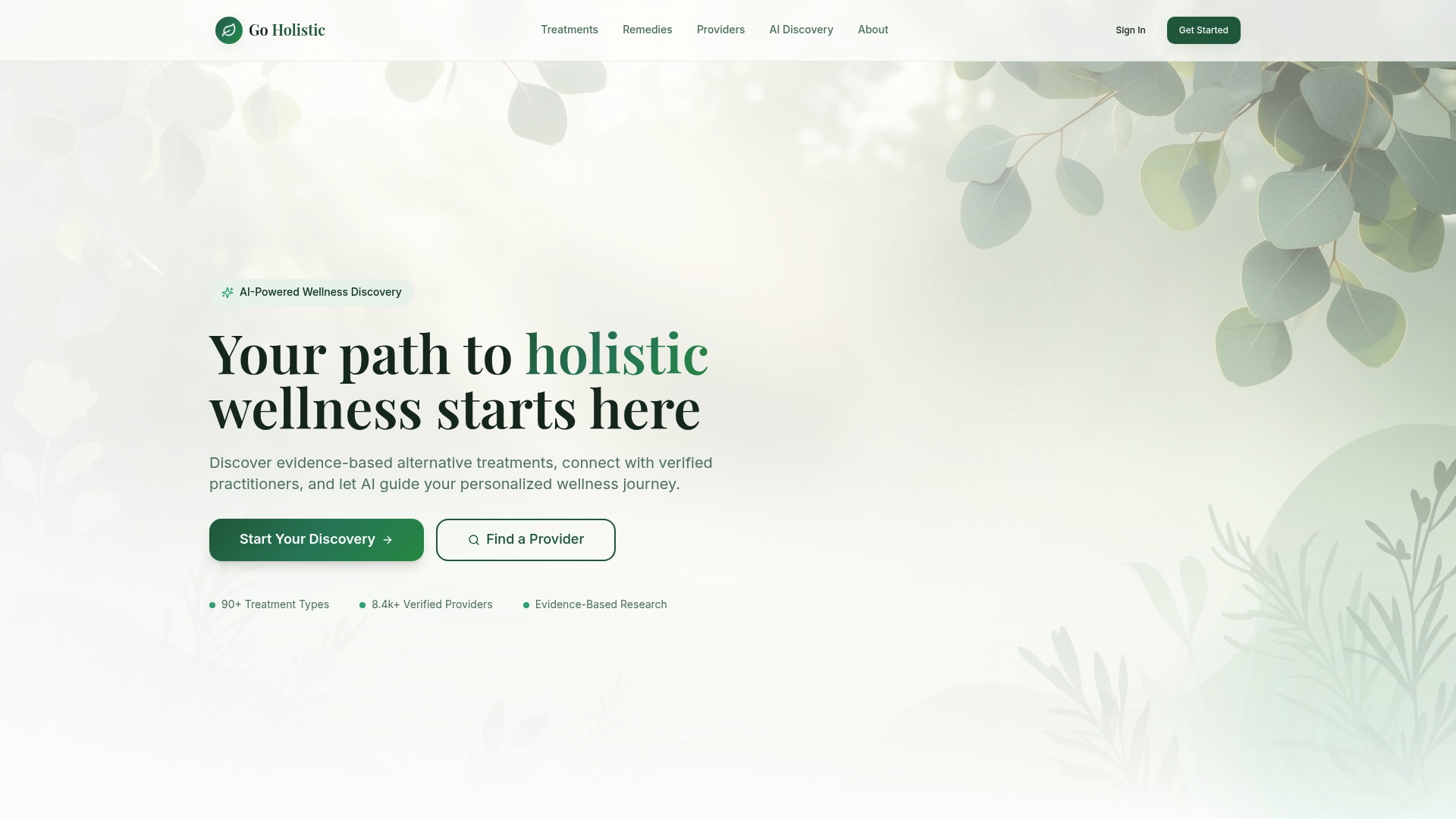
You get free access to evidence summaries and an initial AI match the moment you sign up. Premium members unlock full clinician-reviewed care plans, monitored micro-tasks, and direct booking with credentialed practitioners across acupuncture, Ayurveda, massage therapy, and more.
Browse the holistic treatments library to read evidence summaries for therapies you are already curious about. When you are ready to move from research to a real plan, find a verified practitioner and schedule your first clinician review. The evidence is already there. Your next step is to use it.
Useful sources and further reading
The sources below back the claims in this article and are worth bookmarking if you want to go deeper on evidence grading, integrative care, or platform governance.
- Alternative Medicine — StatPearls, NCBI Bookshelf: A peer-reviewed clinical overview of alternative and integrative medicine, including how physicians are incorporating evidence-based CAM into practice. Useful for understanding the research landscape behind evidence tiers.
- Benefits of Complementary, Alternative, and Integrative Medicine — Psychology Today: A clinician-authored overview of CAM benefits and limitations, including the importance of shared decision-making. Supports the personalization and safety sections.
- Parsley Health Holistic Telehealth Program — Frontiers in Digital Health: Peer-reviewed feasibility study of a large-scale holistic telehealth program. Relevant to the interoperability and care coordination points in the limitations section.
- What Evidence-Based Wellness Means for Holistic Health — Goholistic Blog: Goholistic's own explanation of how the platform evaluates and presents evidence. The primary source for governance, transparency, and clinical review claims throughout this article.
- Evidence-Based Treatment Recommendations Guide for Clinicians — Goholistic Blog: The internal practitioner guide that governs how Goholistic clinicians use the library in practice. Check this for credential and review-cycle details.
Review dates and practitioner credentials on each source page are worth checking before you act on any specific claim. Research in integrative medicine moves quickly, and a source that was current two years ago may have been superseded by newer meta-analyses.