

TL;DR:
- A treatment library is a curated, evidence-based catalog that summarizes health therapies with research support and safety information. It helps patients and clinicians compare options using standardized evidence grades, references, and contraindications for safer decision-making. Verified platforms like Goholistic connect therapy summaries to qualified providers, promoting transparent, personalized holistic care.
A treatment library is a curated, evidence-linked catalog of health interventions that summarizes what the research shows about each therapy and how to apply it safely in practice. Think of it as a structured reference where every entry connects you to the science behind a treatment, not just a description of it. Platforms like Goholistic publish patient-facing versions covering over 200 therapy types, while research-grade standards like the Cochrane Library and the James Lind Library set the methodological bar for what counts as credible evidence. For a patient researching acupuncture for chronic pain, a well-built library entry answers three questions at once: what the evidence says, how strong that evidence is, and what to watch out for.
- Definition: A curated, evidence-linked catalog of interventions with structured entries covering mechanism, evidence grade, contraindications, and references.
- Primary use case: Patients and clinicians use it to compare treatment options against real research before making care decisions.
- Key standards: Cochrane Library (systematic reviews), James Lind Library (methodological principles), and platforms like Goholistic (patient-facing, holistic-focused entries).
Table of Contents
- What a treatment library entry actually contains
- How evidence is collected, graded, and summarized
- Who uses a treatment library, and how to use one safely
- How to evaluate a treatment library's trustworthiness
- Limitations, bias sources, and safety caveats
- Where to find trusted treatment libraries in the U.S.
- Turning a library entry into an action plan with your provider
- Key Takeaways
- Why evidence-first libraries matter more than ever in holistic care
- Goholistic gives you evidence and a verified provider in one place
- Useful sources
What a treatment library entry actually contains
Every well-built entry follows a predictable anatomy. Knowing the fields helps you read any entry quickly and spot what's missing.
- Treatment name and description: What the therapy is and how it's typically delivered.
- Proposed mechanism: The biological or physiological rationale behind the intervention.
- Evidence summary: A plain-language digest of the strongest available studies.
- Evidence grade: A rating (often A–D or I–III) reflecting the quality of that research.
- Contraindications: Conditions, medications, or populations for whom the therapy carries risk.
- Dosing or administration notes: Frequency, duration, and delivery format where applicable.
- Typical populations: Who the evidence covers (age group, condition, health status).
- Known risks and side effects: Adverse events documented in the literature.
- References: Links to primary studies, systematic reviews, or authoritative summaries.
- Last-updated date: When the entry was last reviewed against new evidence.
- Contributor credentials: Who wrote or reviewed the entry, their qualifications, and any conflict-of-interest disclosures.
Entry metadata matters as much as the content itself. An anonymous entry with no update date is a red flag regardless of how polished the writing looks.
Pro Tip: Read the evidence summary and the clinical-application notes as two separate things. The summary tells you what the research found; the application notes tell you how a clinician might use that finding with a real patient. They don't always point in the same direction.
How evidence is collected, graded, and summarized
A credible treatment library prioritizes systematic reviews and randomized controlled trials (RCTs) as its primary sources, then records observational evidence with explicit caveats about its lower confidence level.

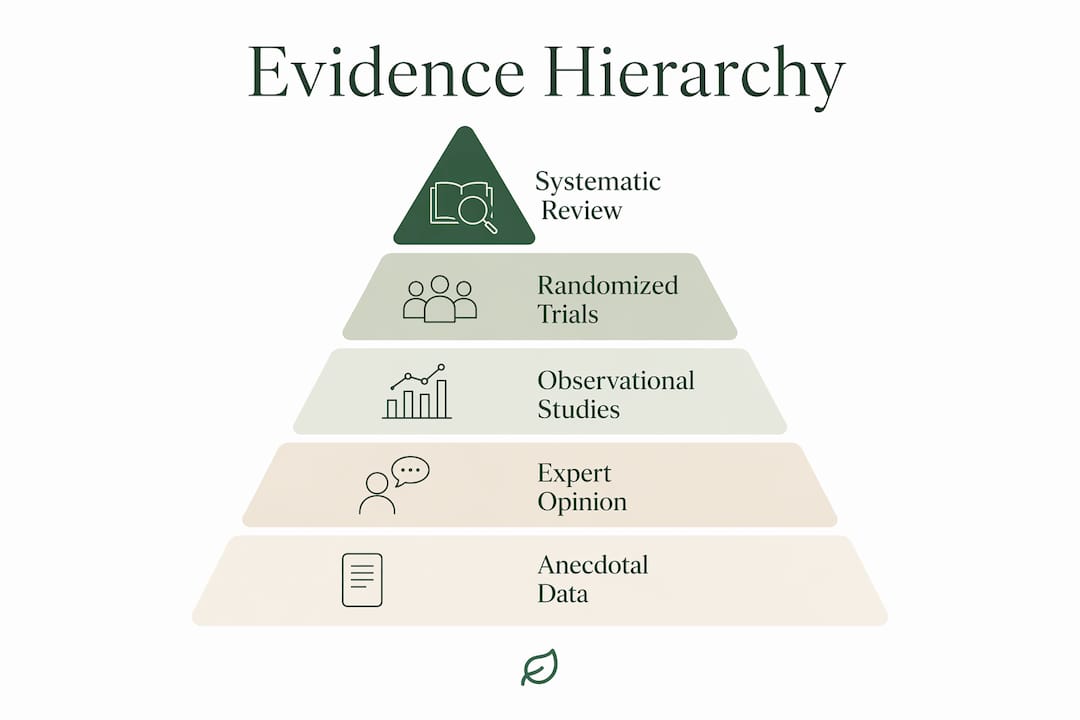
Evidence exists on a hierarchy. Systematic reviews sit at the top because they pool results across multiple studies and control for individual study quirks. The Cochrane Library is the gold standard here, producing independent, transparent reviews used worldwide. Below systematic reviews come RCTs, then cohort studies, case series, and finally expert consensus, which carries the least weight on its own.
| Evidence type | Confidence level | What it means for you |
|---|---|---|
| Systematic review / meta-analysis | Highest | Pooled findings across many studies; most reliable signal |
| Randomized controlled trial (RCT) | High | Controlled comparison; strong but limited to study population |
| Cohort / observational study | Moderate | Real-world data; prone to confounding variables |
| Case series / case report | Low | Useful for rare events; not generalizable |
| Expert consensus | Lowest | Informed opinion; use only when higher evidence is absent |
The James Lind Library adds another layer by curating methodological guidance on what makes a fair test of a treatment, helping library editors assign grades with principled reasoning rather than intuition.
Date-stamping entries is non-negotiable. A citation format you'll often see in well-maintained libraries looks like: Author(s), "Study title," Journal Name, Year, DOI or URL, with a note on when the entry was last reviewed.
Who uses a treatment library, and how to use one safely
Patients doing their own research benefit most from patient-facing libraries. Clinicians lean on them for quick evidence summaries during shared decision-making. Integrative care teams use them to align on a plan when multiple providers are involved.
For patients, a safe step-by-step approach:
- Find the entry for your therapy of interest and read the evidence grade first.
- Check the contraindications section against your current medications and conditions.
- Note the last-updated date. An entry older than two to three years may miss recent trials.
- Bring the entry's references to your appointment so your provider can review the same sources.
- Discuss the evidence grade openly. A Grade C therapy isn't automatically wrong for you, but it warrants a more careful conversation.
- Agree on how you'll monitor outcomes before you start.
For clinicians, a treatment library supports evidence-based clinical workflows in several practical ways:
- Building integrative care plans with documented rationale.
- Surfacing contraindication alerts before recommending a complementary therapy alongside conventional treatment.
- Documenting patient preferences and the evidence basis for shared decisions.
- Identifying gaps where patient preference outpaces available evidence.
Smart questions to ask your provider after reading an entry:
- Does this evidence apply to someone with my specific conditions?
- Are there interactions with my current medications or supplements?
- What outcomes should we track, and over what timeframe?
Pro Tip: Never use a library entry as a prescription. Use it as a conversation starter. The entry gives you the research; your provider gives you the clinical judgment that makes it safe for your situation.
How to evaluate a treatment library's trustworthiness
Prefer libraries with transparent sourcing, clear evidence-grading, date stamps, and named contributor credentials. That combination is the fastest signal of a credible resource.
Run through this checklist in under five minutes:
- Does every entry cite primary studies or systematic reviews?
- Is there a visible evidence-grading system with a key explaining what each grade means?
- Are entries date-stamped with a "last reviewed" note?
- Are contributors named with credentials and conflict-of-interest disclosures?
- Does the platform publish an editorial policy or methodology statement?
- Are practitioners listed with verified licenses or certifications?
Green flags: Links to Cochrane reviews or PubMed studies, a published editorial policy, practitioner verification badges, and regular update cycles.
Red flags: No citations anywhere in entries, content that reads like marketing copy, no update dates, anonymous contributors, and a heavy emphasis on products the platform sells. Learning to spot transparency in wellness resources takes practice, but these markers make it faster.
Limitations, bias sources, and safety caveats
A treatment library is not a substitute for clinical judgment, and the evidence base for many complementary therapies remains thinner than for conventional medicine.
Common limitations to keep in mind:
- Publication bias: Studies with positive results get published more often, so a library drawing only from published literature may overstate a therapy's effectiveness.
- Selective citation: Entries written by practitioners with a financial stake in a therapy may emphasize favorable studies and omit neutral or negative ones.
- Evidence gaps: Many holistic therapies have fewer large RCTs than pharmaceutical treatments, so entries may rely more heavily on observational data or expert consensus.
- Outdated entries: A library that hasn't been updated in over a year may not reflect recent safety findings.
Patient safety caveats:
- Herb-drug interactions are real and underreported. Always cross-check any botanical remedy against your current medications.
- Vulnerable populations (pregnant people, children, those with autoimmune conditions) face higher risk from therapies with limited safety data.
- Timing matters. Some therapies are contraindicated before surgery or alongside certain cancer treatments.
Pro Tip: If a library entry has no conflict-of-interest disclosure for its contributors, treat the evidence summary with extra caution and verify the cited studies independently through PubMed or the Cochrane Library.
Where to find trusted treatment libraries in the U.S.
The most credible starting points are the Cochrane Library for systematic reviews, the James Lind Library for methodological context, MedlinePlus for patient-friendly summaries from the National Library of Medicine, and Goholistic for holistic and alternative medicine entries with practitioner verification.
| Source | Best for | Entry style |
|---|---|---|
| Cochrane Library | Clinicians and researchers | Full systematic reviews; technical language |
| James Lind Library | Understanding evidence methods | Methodological essays and historical context |
| MedlinePlus | Patients and families | Plain-language summaries; condition-focused |
| Goholistic Treatments | Holistic and alternative medicine seekers | Evidence-graded entries; practitioner-linked |
Goholistic's library covers numerous therapy types spanning acupuncture, Ayurveda, massage therapy, and more. Each entry connects to evidence summaries and links directly to verified practitioners you can book. To search it, visit the treatments page, filter by condition or therapy type, and look for the evidence-grade badge on each entry.
For technical integrations, the HL7 FHIR library standard defines how treatment knowledge containers can connect to patient data systems, enabling personalized decision support based on a patient's medications, allergies, and conditions.
Turning a library entry into an action plan with your provider
Always review the evidence grade and contraindications before applying any entry to your care. That's the one rule that prevents most misuse.
A simple action-plan template to bring to your appointment:
- Goal: What symptom or condition are you addressing?
- Chosen intervention: Name the therapy and cite the library entry.
- Rationale: Note the evidence grade and the key studies supporting it.
- Monitoring metrics: What will you track (pain scale, sleep quality, energy level)?
- Stop rules: Under what circumstances will you discontinue the therapy?
- Follow-up timeline: When will you and your provider reassess?
Monitoring checklist:
- Track your chosen metrics weekly for the first month.
- Contact your provider if symptoms worsen or new symptoms appear within the first two weeks.
- Seek immediate care for allergic reactions, severe pain, or cardiovascular symptoms.
- Document what you're taking and when, including supplements, so your full picture is visible.
Using library citations in your appointment also supports personalized treatment selection, giving your provider a documented rationale to include in your care record.
Key Takeaways
A treatment library is only as useful as the evidence behind it. Prioritize entries with clear grading, named contributors, and links to primary research.
| Point | Details |
|---|---|
| Core definition | A treatment library is a curated, evidence-linked catalog with structured entries covering mechanism, evidence grade, and contraindications. |
| Evidence hierarchy | Systematic reviews and RCTs carry the most weight; expert consensus alone is the weakest signal. |
| Credibility check | Look for date stamps, named contributor credentials, primary-study citations, and a published editorial policy. |
| Safe use rule | Always review evidence grade and contraindications, then discuss the entry with a licensed provider before starting. |
| Goholistic | Goholistic's treatment library covers a wide variety of holistic therapy types with evidence-graded entries and links to verified practitioners. |
Why evidence-first libraries matter more than ever in holistic care
The gap between what patients want and what most treatment resources actually deliver is wider than it should be. People exploring acupuncture, Ayurveda, or herbal medicine deserve the same quality of evidence presentation that a cardiologist gets when reviewing a drug trial. The problem is that most holistic-focused content online skips the evidence entirely or buries it under marketing language.
What I find genuinely encouraging about the treatment library model is that it forces accountability. When an entry must cite a study, name a contributor, and carry a date stamp, the bar for publishing rises. That structure protects readers from well-meaning but unsupported claims, and it gives clinicians something concrete to work with during a shared decision-making conversation.
The limitation worth naming honestly: even a well-graded library entry is a starting point, not a finish line. Evidence for many complementary therapies is still catching up to patient demand. That's not a reason to avoid these therapies. It's a reason to use the library as a map, not a prescription, and to keep your provider in the loop at every step.
Goholistic gives you evidence and a verified provider in one place
Most people researching holistic care face two separate problems: finding credible information and then finding a qualified practitioner to help them act on it. Goholistic solves both at once.
The Goholistic treatment library covers over 200 therapy types with evidence-graded entries, clear contraindication notes, and direct links to verified, licensed practitioners. You're not just reading about acupuncture or Ayurveda in the abstract. You're reading an evidence summary and then booking a consultation with a credentialed provider who specializes in it. The platform's AI also personalizes recommendations based on your health concerns, so the entries you see are relevant to your situation, not a generic list.
This article is for general informational purposes only and is not a substitute for professional medical advice. Always consult a qualified healthcare provider before starting any new treatment.
Ready to see what the evidence says about your options? Browse the treatment library and connect with a verified practitioner today.
Useful sources
| Source | What it offers | How to use it |
|---|---|---|
| Cochrane Library | Independent systematic reviews across thousands of health topics | Search by condition or therapy; filter by review type |
| James Lind Library | Methodological essays on fair treatment testing | Browse by topic tag; useful for understanding evidence-grade rationale |
| MedlinePlus | Plain-language patient summaries from the National Library of Medicine | Search by condition or supplement name |
| HL7 FHIR Library Standard | Technical spec for interoperable treatment knowledge containers | Reference for developers integrating library data with patient records |
| Goholistic Treatments | Evidence-graded holistic therapy entries with practitioner links | Filter by therapy type or condition; check evidence-grade badge |
- Cochrane Library: Best first stop for any therapy with a significant evidence base. Free abstracts; full reviews available through many U.S. public libraries.
- James Lind Library: Particularly useful for understanding why certain study designs are more trustworthy than others.
- MedlinePlus: The most accessible option for patients who want clear, jargon-free summaries without a medical background.
- HL7 FHIR: Relevant if you're a developer or health system administrator building or evaluating interoperable library tools.
- Goholistic: The recommended starting point for anyone specifically researching holistic, integrative, or alternative medicine options in the U.S.