

What are evidence-based treatment recommendations?
Clinical practice guidelines (CPGs) are the backbone of modern healthcare decision-making. They translate mountains of research into clear, actionable clinical treatment recommendations that help you deliver care grounded in the best available evidence. Rather than relying on habit or anecdote, you're working from structured guidance built on systematic reviews, meta-analyses, and expert consensus.
A few core ideas define this space:
- Clinical practice guidelines (CPGs): Structured documents produced by authoritative bodies that synthesize research findings into evidence-based practice guidance for specific conditions or populations.
- Evidence-based medicine (EBM): The integration of the best current research evidence with clinical expertise and patient values to guide treatment decisions.
- Systematic reviews and meta-analyses: The gold standard inputs for guideline development, pooling data across studies to identify consistent patterns of benefit or harm.
- Expert consensus: Used when high-quality trial data is limited, allowing experienced clinicians to fill evidence gaps with structured, peer-reviewed judgment.
- Major authoring bodies: In the US, organizations like the American Psychiatric Association (APA), the American Heart Association (AHA), the American College of Cardiology (ACC), and the Surviving Sepsis Campaign produce and regularly update the guidelines most clinicians rely on daily.
The 2026 Surviving Sepsis Campaign guidelines, for example, include 129 recommendation statements, with 46 of those being new or updated, reflecting how living guidelines evolve as evidence accumulates. That kind of ongoing revision is what keeps clinical guidance trustworthy rather than stale.
What types of evidence-based treatments do guidelines cover?
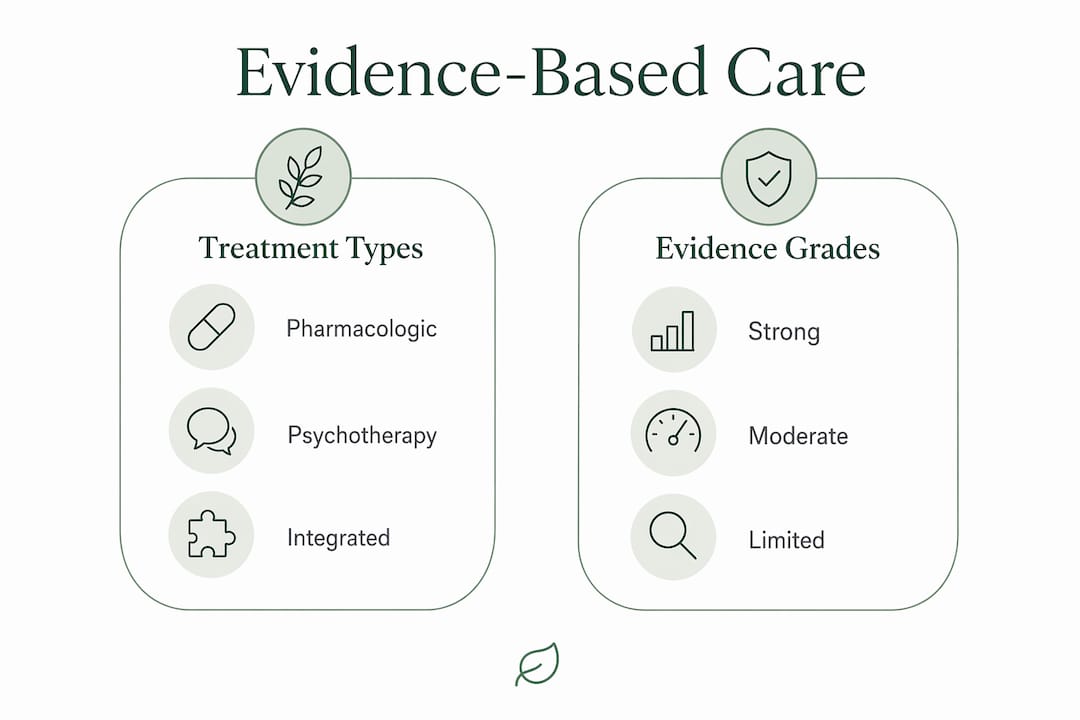
Guidelines don't prescribe a single path. They map a range of treatment categories, each with its own evidence base and clinical application. Understanding these categories helps you match the right approach to the right patient.
Behavioral and psychological treatments form a large and well-studied category:
- Cognitive Behavioral Therapy (CBT): One of the most researched psychological interventions, with applications across depression, anxiety, insomnia, and substance use disorders.
- Motivational Interviewing (MI): A collaborative, goal-oriented approach particularly effective for patients ambivalent about change, especially in substance use and chronic disease management.
- Acceptance and Commitment Therapy (ACT): Builds psychological flexibility and is recommended for depression and chronic pain, with a "C" level evidence rating for chronic pain in the ACOEM guidelines.
- Behavioral Activation (BA): A structured approach for depression that targets avoidance patterns and increases engagement with rewarding activities.
- Contingency Management (CM): An evidence-based treatment for substance use disorder, particularly effective for stimulant and cannabis misuse, using incentives tied to verified abstinence.
- Behavioral Family Therapy (BFT): Addresses relational dynamics that affect treatment engagement and outcomes.
Pharmacologic treatments anchor many guidelines for conditions where medication efficacy is well established. The VA/DoD PTSD Clinical Practice Guideline, for instance, gives a strong recommendation for paroxetine, sertraline, or venlafaxine, while explicitly recommending against benzodiazepines.
Treatment intensity matters too. Guidelines typically distinguish first-line options from further-line treatments, reserving more intensive or higher-risk interventions for patients who haven't responded to initial care. A personalized treatment approach accounts for clinical severity, prior treatment history, and patient preference when selecting from these tiers.

A meta-analysis of 15 psychotherapies for depression found effect sizes ranging from g = 0.38 to g = 1.10 across therapy types, but also flagged significant publication bias in most of the included trials. This highlights that not all evidence-supported therapies carry equal weight, and reading the underlying data carefully is important for applying guidelines well.
Which organizations produce the key clinical guidelines in the US?
Knowing where guidelines come from helps you assess their authority and scope. These are the organizations whose recommendations shape US clinical practice most directly.
- American Psychiatric Association (APA): Publishes practice guidelines for mental health conditions including depression, bipolar disorder, schizophrenia, and substance use. APA guidelines are grounded in systematic evidence review and updated through a structured consensus process.
- American Heart Association (AHA) and American College of Cardiology (ACC): Jointly produce cardiovascular care guidelines covering conditions from heart failure to dyslipidemia. Their 2026 dyslipidemia guidelines use Class of Recommendation (COR) and Level of Evidence (LOE) ratings to grade each recommendation's strength.
- Surviving Sepsis Campaign: An international initiative with direct influence on US critical care practice. Its guidelines are among the most frequently updated in medicine, with the 2026 version containing 129 total recommendation statements.
- U.S. Preventive Services Task Force (USPSTF): An independent expert panel that produces evidence-based recommendations on clinical preventive services, including screenings and counseling, for primary care settings.
- VA/DoD Clinical Practice Guidelines: Developed jointly by the Department of Veterans Affairs and Department of Defense, these guidelines cover conditions prevalent in military populations, including PTSD, and use the GRADE approach throughout.
Guideline development follows a defined process: a panel of clinical experts conducts or commissions systematic reviews, grades the evidence, drafts recommendations, submits them for external peer review, and publishes with full transparency about conflicts of interest. Most major guidelines are planned for comprehensive review every five years, with interim updates triggered by significant new evidence. These guidelines increasingly feed into clinical decision support tools embedded in electronic health records, bringing recommendations directly to the point of care.
How do evidence grading systems help you interpret guidelines?
Not all recommendations carry the same certainty. Grading systems exist to tell you exactly how confident the evidence base is and how strongly a recommendation applies to your patient.
- GRADE approach: The most widely adopted framework globally, used in VA/DoD, ACOEM, and many other US guidelines. GRADE evaluates four domains: confidence in the quality of evidence, balance of benefits versus harms, patient values and preferences, and resource implications. It produces two outputs: a quality rating (high, moderate, low, or very low) and a recommendation strength (strong or weak/conditional).
- Class of Recommendation (COR) and Level of Evidence (LOE): Used in AHA/ACC cardiovascular guidelines. COR ranges from Class I (benefit clearly outweighs risk) to Class III (no benefit or harm). LOE distinguishes between evidence from multiple randomized trials (A), limited trials or registries (B), and expert opinion (C).
- ACOEM letter grades: The ACOEM Chronic Pain Guideline uses an A through I scale, where "A" signals strong recommendation backed by high-quality evidence and "I" signals insufficient evidence for a clear recommendation.
| Grading System | Used By | Strength Levels | Evidence Quality Levels |
|---|---|---|---|
| GRADE | VA/DoD, ACOEM, WHO | Strong, Weak/Conditional | High, Moderate, Low, Very Low |
| COR/LOE | AHA/ACC | Class I, IIa, IIb, III | Level A, B-R, B-NR, C-LD, C-EO |
| A–I Scale | ACOEM | A (Strong) to I (Insufficient) | Embedded in letter grade |
Pro Tip: When reading a guideline recommendation, always check both the strength and the evidence quality. A "strong" recommendation built on low-quality evidence signals expert consensus filling a gap, not confirmed trial data.
Real barriers exist in applying these systems. Publication bias affects even well-studied therapies, as the depression meta-analysis above showed. Research heterogeneity means pooled results can obscure meaningful variation across patient subgroups. And rigid adherence to empirically supported treatments can inadvertently exclude effective therapies for populations underrepresented in trials, or be misused by payers as blunt funding criteria. Guidelines work best as flexible clinical guidance/02%3A_Perspectives_on_Abnormal_Behaviour/2.05%3A_Evidence_Based_Practice_and_Empirically_Supported_Treatments) rather than rigid prescriptions. Clinical judgment, cultural context, and patient-specific factors always belong in the equation alongside the grade.
How does shared decision-making fit into evidence-based care?
Guidelines tell you what the evidence supports. Shared decision-making determines what actually happens with your patient. The two work together, not in competition.

Shared decision-making means you and your patient review the available options together, weighing the evidence against their values, preferences, and life circumstances. For depression, treatment intensity should match the clinical severity of the episode while respecting what the patient is willing and able to engage with. A patient with mild depression who strongly prefers to avoid medication has a different starting point than one with severe depression and prior antidepressant response.
Strategies that support this process in practice:
- Present treatment options with plain-language summaries of expected benefits and common side effects.
- Ask explicitly about prior treatment experiences, including what helped and what didn't.
- Use decision aids where available; several are freely accessible through AHRQ and professional societies.
- Document the conversation and the patient's stated preferences as part of the clinical record.
- Revisit the plan at follow-up, adjusting based on response and any shift in the patient's priorities.
The ethical case for this approach is straightforward: transparent communication and patient engagement are professional responsibilities, not optional add-ons. Practically, patients who participate in their own treatment planning tend to follow through more consistently. Challenges are real, including time constraints, health literacy gaps, and patients who prefer to defer entirely to clinician judgment. Acknowledging those barriers openly, and building systems that support brief but meaningful conversations, is how you close the gap between guideline intent and bedside reality.
For clinicians working with complex presentations, integrated treatment approaches that combine pharmacologic and psychosocial interventions often align most closely with both guideline recommendations and patient goals. Exploring evidence-based holistic methods alongside conventional care can also open conversations about the full range of options your patient may be considering.
Goholistic connects you with verified practitioners across more than 200 therapy types, all supported by research summaries so you and your patients can explore evidence-backed treatment options with confidence. Whether you're looking for a practitioner directory or a deeper look at integrative care, Goholistic makes it easier to find care that fits.
Key Takeaways
Evidence-based clinical guidelines synthesize systematic research, expert consensus, and grading frameworks like GRADE to give clinicians structured, trustworthy treatment recommendations they can adapt to individual patients.
| Point | Details |
|---|---|
| Guidelines come from authoritative bodies | APA, AHA, ACC, and the Surviving Sepsis Campaign produce and regularly update the US guidelines clinicians rely on most. |
| Evidence grading clarifies certainty | Systems like GRADE and COR/LOE distinguish strong trial-backed recommendations from expert consensus filling evidence gaps. |
| Treatment types span behavioral and pharmacologic | CBT, motivational interviewing, contingency management, and targeted medications each carry distinct evidence bases and clinical roles. |
| Shared decision-making shapes real-world care | Matching treatment intensity to clinical severity and patient values improves adherence and outcomes beyond what guidelines alone can achieve. |
| Guidelines are flexible, not fixed | Rigid application risks excluding effective therapies for underrepresented populations; clinical judgment always belongs alongside the grade. |