

TL;DR:
- Personalized treatment considers genetics, lifestyle, environment, and goals rather than relying solely on DNA tests. It enhances outcomes by tailoring therapies early, reducing trial-and-error, and increasing patient engagement. However, access, data privacy, and cost remain challenges to widespread implementation.
Most people assume personalized treatment means getting your DNA tested and receiving a prescription tailored to your genes. That's part of the picture, but only a small slice of it. What is personalized treatment, really? It's a broader approach to healthcare that accounts for your genetics, yes, but also your lifestyle, environment, personal goals, and tolerance for different therapies. With the personalized medicine market projected to surpass $1 trillion by 2034, this shift in how we think about health is already reshaping the care options available to you right now.
Table of Contents
- Key takeaways
- What is personalized treatment and what it really covers
- Real-world clinical examples from 2026 guidelines
- How personalized care compares to traditional treatment
- Challenges and ethical considerations to understand
- How to apply personalized treatment principles to your care
- My perspective on where personalized care is heading
- Explore personalized wellness with Goholistic
- FAQ
Key takeaways
| Point | Details |
|---|---|
| More than genetics | Personalized treatment covers lifestyle, environment, and patient goals, not just your DNA profile. |
| Evidence-based in 2026 | Current clinical guidelines use genomic testing and biomarkers to guide cancer therapy choices. |
| Benefits over tradition | Targeted care reduces trial-and-error, lowers side effects, and often saves money over time. |
| Ethical and access gaps exist | High costs, data privacy concerns, and unequal access remain real challenges to address. |
| You can take action now | Talking to your provider about shared decision-making is a practical first step toward personalized care. |
What is personalized treatment and what it really covers
The definition of personalized treatment is the practice of tailoring medical decisions, therapies, and interventions to the specific characteristics of each individual patient. This goes well beyond a single genetic test. Your care plan can be shaped by your molecular biology, your daily habits, your stress levels, your environment, and even your stated preferences for how aggressively you want to pursue treatment.
Traditional medicine operates on averages. A doctor prescribes what works for most people with your diagnosis, and then you both wait to see if it works for you. Personalized treatment flips that model. Instead of starting broad and narrowing down, providers gather specific data about you first, then select the approach most likely to succeed from the beginning.
Personalized medicine beyond genetics includes adjusting medication dosages based on individual tolerance, modifying therapy intensity based on lifestyle demands, and using biomarker testing to confirm whether a particular drug will interact well with your body's chemistry. A person managing chronic pain who works a physically demanding job needs a different care plan than someone with the same diagnosis who works a desk job. Both deserve care that fits their actual life.
Here are the core factors that typically feed into a personalized treatment plan:
- Genetic and genomic data: How your DNA influences your response to specific drugs or therapies
- Biomarker results: Blood proteins, tumor markers, or molecular signals that indicate which treatments are most likely to work
- Environmental exposures: Pollutants, dietary patterns, and occupational hazards that affect your health
- Lifestyle factors: Sleep, exercise habits, substance use, and stress that all influence treatment effectiveness
- Patient preferences: Your comfort level with risk, invasiveness, and side effects
- Diagnostic data: Imaging, lab work, and medical history that paint a fuller clinical picture
Pro Tip: When meeting with a new provider, bring a written summary of your daily habits, past medication reactions, and personal health priorities. This information accelerates the personalization process significantly.
Real-world clinical examples from 2026 guidelines
The clearest evidence that personalized treatment has moved from theory to standard practice comes from the guidelines clinicians follow today. Two standout examples from 2026 make this concrete.
In lung cancer care, ASCO 2026 guidelines recommend comprehensive genomic biomarker testing, including RNA-based next-generation sequencing, for all stage IV non-small cell lung cancer patients. This testing tells oncologists exactly which genetic alterations are driving the cancer, allowing them to prescribe targeted therapies instead of broad chemotherapy regimens. The result is a higher chance of response and fewer unnecessary side effects.

In breast cancer, SITC 2026 guidelines recommend testing for tumor mutational burden and microsatellite instability to guide immunotherapy decisions in advanced cases. Both markers help predict whether a patient's immune system can be effectively recruited to fight the cancer, making treatment selection a data-driven process rather than an educated guess.
Beyond oncology, younger lung cancer patients illustrate personalization beyond biology alone. Younger adults often carry actionable genomic alterations and also have a greater need to preserve physical function long-term, so their treatment plans prioritize targeted therapies and tissue-sparing surgeries over approaches that might cause lasting functional damage. Age, life stage, and future goals all factor into the plan.
| Clinical area | Personalized approach | Key benefit |
|---|---|---|
| Stage IV lung cancer | RNA-based NGS biomarker testing | Matches targeted therapy to driver mutation |
| Advanced breast cancer | TMB and MSI testing for immunotherapy | Predicts immune response before treatment |
| Younger cancer patients | Targeted therapy and tissue-sparing surgery | Preserves function and quality of life |
| Schizophrenia care | Patient goals and social context integration | Aligns treatment with real-life outcomes |
Schizophrenia care offers another powerful example. Personalized medicine in schizophrenia integrates clinical evidence with social context, patient goals, and team-based care. This means a treatment plan considers not just which medication to prescribe, but whether the patient has housing stability, social support, and personal goals that will influence whether they stay on the plan at all.
Pro Tip: If you are managing a chronic or complex condition, ask your provider whether genomic or biomarker testing is covered by your insurance and clinically appropriate for your diagnosis. Many patients don't know to ask.
How personalized care compares to traditional treatment
The contrast between personalized and traditional medicine is sharpest when you look at outcomes over time. Conventional care relies on what works for the statistical majority. That means many patients go through multiple rounds of trial-and-error before landing on a therapy that fits their body and life. Personalized treatment aims to reduce trial-and-error by using diagnostic data to select effective therapies early, which means fewer side effects, less wasted time, and lower cumulative costs.
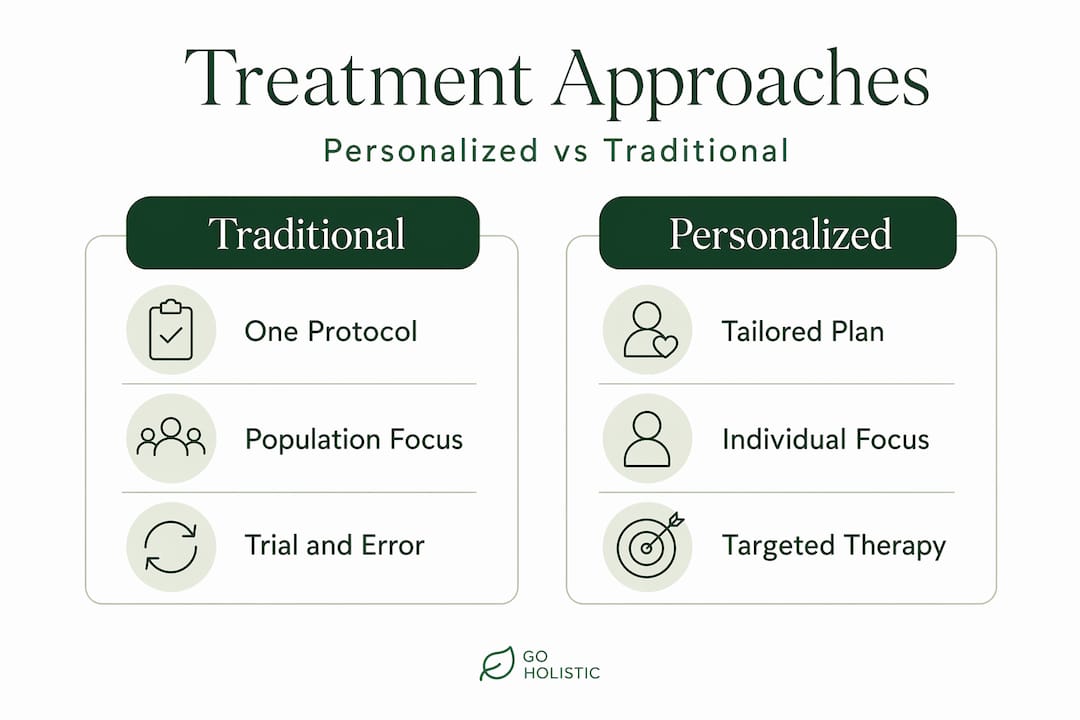
The benefits of personalized therapy extend beyond clinical outcomes. When you feel heard and understood in your care, your engagement with treatment improves. Patients who participate in shared decision-making are more likely to follow through with their treatment plans and report higher satisfaction with their care experiences.
| Factor | Traditional treatment | Personalized treatment |
|---|---|---|
| Approach | Population-average protocols | Individual-specific data-driven plans |
| Drug selection | Broad-spectrum based on diagnosis | Targeted based on biomarkers and profile |
| Side effect management | Reactive, after the fact | Proactive, anticipated before prescribing |
| Patient role | Passive recipient | Active participant in shared decisions |
| Cost over time | Higher due to trial-and-error cycles | Potentially lower with early accurate selection |
The benefits of personalized therapy also include how it enhances rather than replaces clinical judgment. Treatment recommendation systems assist clinicians by aligning patient-specific data with evidence-based guidelines, giving providers a richer foundation for decision-making. The doctor still leads. The data sharpens the direction.
Here is where personalized treatment consistently outperforms the traditional model:
- Fewer adverse drug reactions because tolerance and genetics are accounted for upfront
- Faster identification of effective therapies, reducing the weeks or months lost to treatments that don't work
- Greater patient confidence, because the plan feels designed for them specifically
- Better long-term adherence, since the plan accounts for real-life constraints like work schedules or physical limitations
- More meaningful conversations between patients and providers, grounded in individual context
Challenges and ethical considerations to understand
Personalized treatment is not without real challenges, and being informed about them helps you navigate your options more clearly.
Access is uneven. The genomic testing and advanced diagnostics that power personalized medicine are not yet available equally across communities. Rural areas, lower-income populations, and underinsured patients face higher barriers to accessing these tools. Even when testing is available, interpreting results requires specialist expertise that isn't always nearby.
Data privacy is a legitimate concern. Genomic data is deeply personal, and once it exists in a database, its protection depends entirely on the security practices of the institution holding it. Patients have every right to ask providers and platforms how their data is stored, shared, and protected before consenting to testing.
Cost remains a barrier for many. Comprehensive biomarker panels and targeted therapies can carry significant price tags, and insurance coverage varies widely. This doesn't make personalized treatment out of reach for everyone, but it does mean you need to ask questions upfront about what is and isn't covered.
"Personalized medicine is evolving rapidly, but it is not yet universally available. Understanding what is accessible to you now, and what may become available soon, helps you advocate effectively for your own care."
There are also knowledge gaps in the science itself. Not every genetic variation has a well-understood clinical implication yet. Recommendations based on incomplete data carry their own risks, which is why human clinical judgment remains central to the process. Explore non-invasive treatment approaches as a complement when cutting-edge testing isn't yet accessible to you.
How to apply personalized treatment principles to your care
You don't need access to a cutting-edge genomic lab to start benefiting from personalized treatment thinking. There are practical steps you can take right now.
-
Document your complete health picture. Before any appointment, write down your current medications, past reactions, family health history, daily habits, sleep patterns, and stress triggers. This gives your provider the raw material to personalize your care.
-
Ask about individual-specific options. When a provider recommends a treatment, ask whether there is evidence that your specific profile responds well to it. Ask about alternatives. Providers respond to patients who engage actively.
-
Request biomarker or diagnostic testing where appropriate. For chronic conditions, certain cancers, and mental health challenges, testing can reveal whether a treatment is likely to work for you before you commit to it.
-
Prioritize shared decision-making. The best personalized care happens when you and your provider co-create the plan. Bring your personal goals, values, and lifestyle constraints to the table explicitly.
-
Consider integrative and holistic approaches. Personalized care doesn't only live in conventional medicine. Acupuncture, Ayurveda, massage therapy, and other evidence-supported modalities can be tailored to your individual constitution, preferences, and health goals. Building a personalized health plan that weaves together conventional and holistic care often produces the most well-rounded results.
-
Verify your practitioners. Whether you're working with a medical doctor, a naturopath, or an acupuncturist, check credentials, seek providers with relevant experience, and don't hesitate to ask for evidence behind their recommendations.
My perspective on where personalized care is heading
I've watched the healthcare conversation shift noticeably over the past several years. What used to feel like a fringe idea, treating the person rather than the diagnosis, is now backed by major clinical guidelines and billions of dollars in research investment.
What I find most encouraging isn't the technology. It's the change in how patients see themselves in the process. People are coming to appointments with questions. They're asking why a particular drug was chosen. They're bringing their values and life goals into conversations that used to be purely technical. That shift matters more than any single genomic test.
I also think we need to be honest about the gap between what personalized medicine promises and what it delivers for most people today. The headline cases involve cancer genomics and rare disease breakthroughs. But most people navigating everyday health decisions are not yet seeing that level of precision in their routine care. The more realistic opportunity right now is applying personalized thinking: communicating your full picture to your provider, asking the right questions, and integrating lifestyle and holistic approaches that genuinely fit your body and your life.
The future is genuinely exciting. But the most useful version of personalized care available to you today is an informed, engaged version of yourself walking into every healthcare conversation ready to advocate for a plan that fits who you actually are.
— Andrew
Explore personalized wellness with Goholistic
If reading this has made you realize your current care feels a little too generic, you're not alone. That feeling is exactly why Goholistic was built.
Goholistic is a wellness discovery platform that uses AI to match your health concerns with evidence-backed, individualized treatment options across more than 200 therapy types. From acupuncture to Ayurveda, every recommendation is grounded in research and aligned with your unique profile. You can browse a curated directory of verified practitioners, filter by specialty, and book consultations directly. Whether you're looking to explore holistic health treatments or find a qualified specialist through the practitioner directory, Goholistic makes it easy to take the next step toward care that actually fits you. Start with a free account and see what personalized wellness looks and feels like when it's built around your life.
FAQ
What is personalized treatment in simple terms?
Personalized treatment is healthcare tailored to your individual characteristics, including your genetics, lifestyle, environment, and personal goals, rather than a one-size-fits-all protocol.
How does personalized medicine work?
Providers collect diagnostic data such as biomarker tests, genomic results, and medical history to select therapies most likely to work for your specific profile, reducing guesswork and trial-and-error cycles.
What are examples of personalized healthcare in practice?
Current examples include genomic testing for targeted cancer therapy, adjusting medication dosages based on individual tolerance, and integrating patient goals into mental health treatment plans.
What are the main benefits of personalized therapy?
The key benefits include more effective treatment selection, fewer side effects, lower long-term costs, and greater patient engagement through shared decision-making.
Is personalized treatment available to everyone?
Not yet equally. Access depends on your location, insurance coverage, and available specialists. However, applying personalized thinking through informed conversations with your provider is something anyone can do today.