

TL;DR:
- Multi-modal therapy combines different treatment methods to improve outcomes and enhance quality of life. It targets multiple mechanisms, with evidence supporting its effectiveness in chronic pain, mental health, and stroke recovery.
Multi-modal therapy is a coordinated, patient-centered strategy that combines two or more complementary treatment approaches to improve outcomes and reduce reliance on high-dose single treatments. Its two primary roles are clear: target different biological, psychological, and social mechanisms at the same time, and increase your overall function and quality of life. The World Health Organization and the National Institutes of Health both recognize integrated care models as effective frameworks for complex conditions. Goholistic connects you with certified practitioners who build these programs around your specific needs.
TL;DR: Combining therapies works better than one approach alone for most chronic and complex conditions, provided the combination is deliberately designed and monitored.
Table of Contents
- What does multi-modal therapy actually mean, and why does it work?
- Who tends to benefit most from combined therapy strategies?
- What modalities appear in holistic multi-modal programs?
- How is an integrated multi-modal care program designed and delivered?
- What does the research say about multi-modal therapy effectiveness?
- How do you choose a certified multi-modal practitioner in the U.S.?
- What should you expect in your first visit and over time?
- How your active participation shapes your results
- Safety considerations: what to watch for and how practitioners manage risk
- Key Takeaways
- Why coordinated care matters more than you might think
- Goholistic helps you find verified multi-modal care
- Useful sources for further reading
What does multi-modal therapy actually mean, and why does it work?
A "modality" is simply a method of treatment. Physical therapy targets muscle and joint mechanics. Cognitive behavioral therapy (CBT) addresses thought patterns and behavior. Acupuncture works on nervous system regulation. When you combine them, each one addresses a different mechanism, and the result can be greater than the sum of the parts.
"Integrative multimodal interventions improved motor control, swallowing function, and autonomic balance in stroke survivors — outcomes that no single modality achieved alone." — NCBI Bookshelf
There is an important distinction between additive and synergistic effects. Additive means two therapies each contribute their own benefit independently. Synergistic means one modality actually potentiates another. For example, physical therapy combined with biofeedback after stroke does more than add motor gains to autonomic gains; the biofeedback helps patients visualize and reinforce the motor patterns the physical therapy is building, accelerating cortical reorganization.
One modality can also reduce the side effects of another, allowing lower individual doses while preserving efficacy. That is one reason multi-modal treatment approaches are increasingly standard in pain management.
Who tends to benefit most from combined therapy strategies?
Multi-modal care fits people whose conditions involve more than one system or who have not gotten enough relief from a single treatment. The main groups who consistently benefit include:
- Chronic pain patients who need both physical and psychological support, since pain involves nervous system sensitization, movement patterns, and emotional responses simultaneously.
- People with mood disorders such as depression or anxiety, where combined treatments like antidepressants plus CBT outperform either alone in meta-analytic reviews.
- Post-stroke and rehabilitation patients, where physical therapy, biofeedback, and occupational therapy together address motor, autonomic, and cognitive recovery.
- People managing multisystem chronic diseases such as diabetes, autoimmune conditions, or metabolic syndrome, where lifestyle, nutrition, and medical management all matter.
- Anyone with comorbid conditions who needs functional improvement, not just symptom relief.
A quick self-check: Multi-modal care is worth exploring if you have tried one approach without full relief, if your condition affects more than one area of your life (physical, emotional, social), or if you want a plan with measurable goals rather than open-ended treatment.
What modalities appear in holistic multi-modal programs?
Different therapies address different dimensions of health. Here is how common modalities map to their primary roles in an integrated program:
| Modality | What it targets | Typical contribution to a multi-modal plan |
|---|---|---|
| Acupuncture | Nervous system, pain pathways | Reduces pain signaling, supports stress regulation |
| Massage therapy | Musculoskeletal tension, circulation | Improves tissue mobility, reduces cortisol |
| CBT / psychotherapy | Thought patterns, behavior | Addresses emotional drivers, builds coping skills |
| Physical therapy | Strength, mobility, movement patterns | Restores function, prevents deconditioning |
| Nutrition counseling | Metabolic and inflammatory pathways | Supports healing, reduces systemic inflammation |
| Herbal medicine | Biochemical and immune pathways | Complements pharmacological goals with lower side-effect profiles |
| Mindfulness / meditation | Autonomic nervous system, stress response | Reduces cortisol, improves pain tolerance and sleep |
| Yoga | Structural alignment, breath, nervous system | Combines movement, flexibility, and stress regulation |
| Neuromodulation | Neural circuits | Directly modulates pain and mood pathways |

You can explore the full range of evidence-based treatment options across more than 200 therapy types on Goholistic's treatment library.
How is an integrated multi-modal care program designed and delivered?
Effective programs follow a deliberate structure. Ad-hoc additions are not true multi-modal therapy; every selected intervention should map to a specific aspect of your condition. Here is how a well-designed program typically comes together:
- Holistic intake and assessment. Your practitioner gathers a full picture: physical symptoms, mental health history, lifestyle, social context, and goals. A thorough holistic intake is the foundation of everything that follows.
- Mechanism mapping. Each symptom or functional limitation is linked to a specific mechanism, and a modality is chosen to address that mechanism directly.
- Goal setting with measurable outcomes. Goals are specific and trackable: reduced pain scores, improved sleep duration, fewer anxiety episodes, better mobility range.
- Delivery model selection. Options include a coordinated multidisciplinary team, a single integrative practitioner who draws on multiple disciplines, or blended care combining in-person visits with online support.
- Timing and sequencing. Some modalities work best concurrently; others are sequenced so one prepares the body for the next.
- Communication and coordination plan. All providers share notes and progress data, so no one is working in isolation.
- Regular reassessment. The plan adapts as your condition changes and goals are met or revised.
A multidisciplinary wellness structure like this is what separates a genuine multi-modal program from a collection of unrelated appointments.
What does the research say about multi-modal therapy effectiveness?
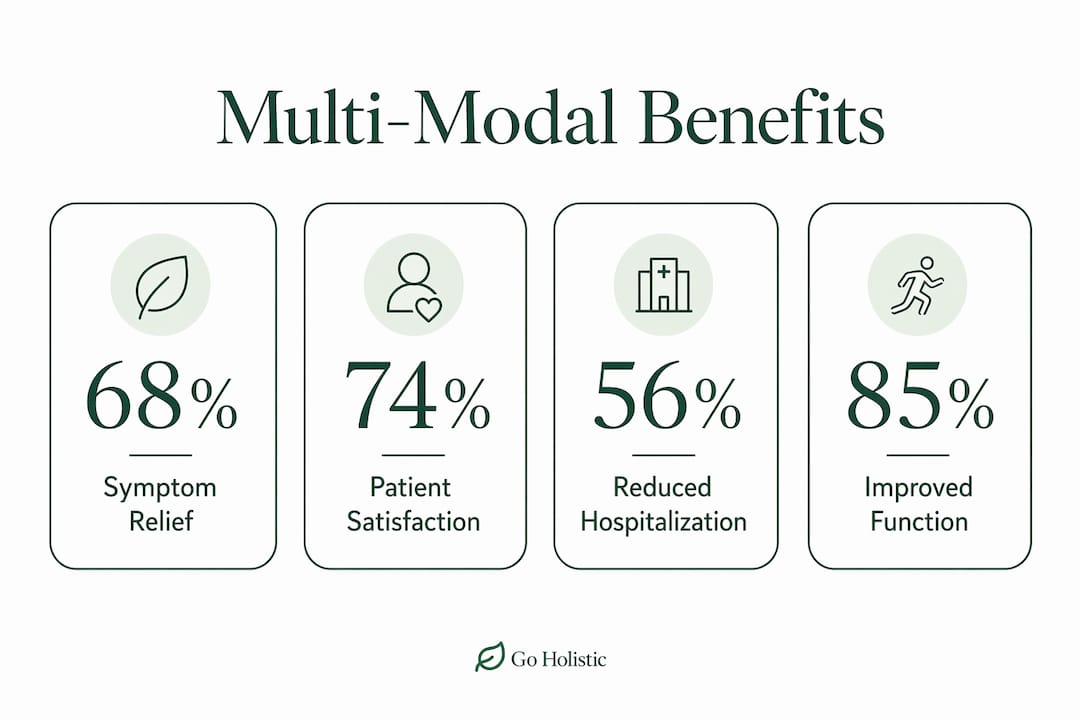
The evidence is strongest for chronic pain, psychiatric conditions, and stroke rehabilitation. Nonpharmacologic strategies including physical therapy, CBT, mindfulness, and acupuncture improve chronic pain outcomes and functional measures, and integrating them early can reduce long-term escalation. For depression and anxiety, interdisciplinary multi-modal programs report remission rates for depressive symptoms increased after the main treatment phase and rose further by the end of a relapse prevention program.
| Condition | Evidence strength | Key outcome metrics |
|---|---|---|
| Chronic pain | Strong | Symptom severity, function, medication reduction |
| Depression / anxiety | Moderate to strong | Remission rates, quality of life, relapse prevention |
| Post-stroke rehabilitation | Strong | Motor control, autonomic balance, swallowing function |
| Multisystem chronic disease | Moderate | Hospital utilization, patient satisfaction, cost |
Integrated programs addressing bio-psycho-socio-cultural needs increase patient satisfaction and may reduce hospital stays and long-term costs. Where evidence is still limited, measurable goals and ongoing monitoring become even more important.
How do you choose a certified multi-modal practitioner in the U.S.?
Vetting a provider before you book protects both your health and your investment. Use this checklist:
- Verify licensure. Confirm the practitioner holds a valid state license for each modality they offer (e.g., Licensed Acupuncturist, Licensed Massage Therapist, Licensed Professional Counselor).
- Check certifications. Look for board certifications from recognized bodies such as the National Certification Commission for Acupuncture and Oriental Medicine (NCCAOM) or the American Board of Integrative Medicine (ABOIM).
- Ask about integration. A qualified program maps each modality to a specific goal. If a provider cannot explain why each therapy is included, that is a concern.
- Confirm referral relationships. Good integrative practitioners communicate with your primary care provider and refer out when needed.
- Request a written treatment plan with specific, measurable goals and a timeline for reassessment.
- Red flags to avoid: no formal intake, vague or unmeasurable goals, unwillingness to coordinate with your medical team, or any guarantee of a cure.
A personalized treatment selection guide can help you prepare the right questions before your first appointment.
What should you expect in your first visit and over time?
Your first session is mostly about gathering information and setting direction, not delivering treatment. A typical first visit includes a comprehensive intake covering your health history, current symptoms, lifestyle, and goals, followed by baseline measurements and a short-term plan for the first four to six weeks.
Realistic timelines vary by condition, but general patterns hold:
- Weeks 1–4: Early gains in sleep quality, stress levels, or acute pain relief as the body begins to respond.
- Weeks 4–12: Functional changes become more noticeable, including improved mobility, mood stability, or reduced medication needs.
- 3+ months: Durable outcomes take shape, including habit change, reduced relapse frequency, and measurable quality-of-life improvement.
Programs reassess at regular intervals, typically every four to six weeks, and adjust the plan based on your progress. Early integration of nonpharmacologic approaches tends to produce better long-term results than adding them only after other options have been exhausted.
How your active participation shapes your results
Your role in a multi-modal program is not passive. Patients who help choose their modalities tend to have better adherence and often report stronger motivation and outcomes. Shared decision-making means you and your practitioner agree on the plan together, which makes it far more likely you will stick with it.
Practical ways to stay engaged between visits:
- Track symptoms daily using a simple journal or app, noting pain levels, mood, sleep, and energy.
- Schedule sessions in advance so appointments do not slip when life gets busy.
- Introduce one small habit change per week rather than overhauling everything at once.
- Share your tracking data with your practitioner at each visit so the plan can adapt.
- Build in an accountability check, whether with a friend, a support group, or a wellness coach.
Building a personalized holistic health plan that you genuinely own makes the difference between short-term relief and lasting change.
Safety considerations: what to watch for and how practitioners manage risk
Combined therapies require careful oversight. Uncoordinated stacking of treatments without monitoring for interactions is one of the most common pitfalls in integrative care.
Key safety checks to confirm with your practitioner:
- Herb-drug interactions: Some herbal supplements affect how medications are metabolized (e.g., St. John's Wort and antidepressants or blood thinners).
- Device-medication interactions: Neuromodulation devices can interact with pacemakers or certain implants.
- Additive side effects: Two therapies that each cause mild sedation can combine to cause significant fatigue.
- Medical clearance: Certain conditions (recent surgery, active fractures, pregnancy) require physician sign-off before specific modalities begin.
- Contraindications: Confirm that each modality is appropriate for your specific diagnosis, not just your general health.
Pro Tip: Before your first multi-modal appointment, write out every medication, supplement, and herbal product you take, including doses and frequency. Bring this list to both your integrative practitioner and your primary care provider. This single step prevents the majority of interaction risks.
Key Takeaways
Multi-modal therapy works best when each modality is deliberately mapped to a specific mechanism, not simply added to a plan as an afterthought.
| Point | Details |
|---|---|
| Core role | Combines complementary therapies to target multiple mechanisms and improve quality of life beyond what single treatments achieve. |
| Who benefits most | People with chronic pain, mood disorders, post-stroke recovery, or comorbid conditions gain the most from coordinated multi-modal care. |
| Choosing a practitioner | Verify state licensure, board certifications (e.g., NCCAOM, ABOIM), and ask for a written plan with measurable goals. |
| Safety first | Always share your full medication and supplement list with every provider; uncoordinated combinations carry real interaction risks. |
| Goholistic | Goholistic connects you with verified multi-modal practitioners and provides AI-powered personalized recommendations to help you build a safe, evidence-based plan. |
Why coordinated care matters more than you might think
The most underestimated problem in integrative wellness is not finding therapies — it is finding a practitioner who actually coordinates them. Most people who explore holistic care end up with a collection of separate appointments that never talk to each other. An acupuncturist who does not know what your nutritionist recommended, a massage therapist unaware of your medication list: that is not multi-modal care, it is parallel care with extra steps.
What genuinely changes outcomes is the integration layer: a shared treatment philosophy, a common set of measurable goals, and regular communication between providers. The research on depression and chronic pain consistently shows that the coordination of modalities matters as much as which modalities are chosen. A well-designed program with three modalities will outperform five unconnected ones every time.
For anyone exploring this path, the first question to ask is not "which therapies should I try?" It is "who is going to hold the whole plan together?" That answer shapes everything else.
Goholistic helps you find verified multi-modal care
Finding practitioners who are both certified and genuinely integrated is harder than it should be. Goholistic changes that. The platform gives you direct access to a curated directory of verified holistic practitioners across disciplines including acupuncture, massage therapy, Ayurveda, CBT-trained counselors, and nutrition specialists, all in one place.
Goholistic's AI-powered recommendation tool analyzes your health concerns and matches you with evidence-based modality combinations, backed by a treatment library covering over 200 therapy types. You can browse, compare, and book verified providers directly, with no guesswork about credentials. Whether you are starting fresh or looking to add structure to care you have already begun, explore your options on Goholistic and take the first step toward a plan that is built around you.
Goholistic is a wellness discovery platform, not a medical provider. Always confirm treatment decisions with a licensed healthcare professional.
Useful sources for further reading
- Developing Multimodal Therapies for Brain Disorders (NCBI Bookshelf) — The foundational NIH resource on mechanism-based multi-modal design; supports the core claims about synergistic effects and deliberate program planning.
- Multimodal Approaches to Pain Management (Psychiatrist.com) — Comprehensive clinical review of nonpharmacologic strategies in chronic pain; primary source for outcome metrics and early integration evidence.
- The Advantages of Combining Therapies in Treating Psychiatric Patients (MDPI) — Meta-analytic review supporting combined treatments for depression, bipolar disorder, and OCD; also covers safety and interaction monitoring.
- Interdisciplinary Multimodal Integrative Healthcare Program for Depressive and Anxiety Disorders (Frontiers in Psychiatry) — Real-world effectiveness data including remission rates; supports the evidence table and timeline section.
- Multimodal Treatment Approaches to Chronic Diseases (Xiahe Publishing) — Reviews the bio-psycho-socio-cultural-spiritual model and cost-effectiveness evidence; supports the design and delivery section.
- What Is Multimodal Therapy? (Verywell Mind) — Accessible overview of Arnold Lazarus's MMT framework; supports patient role, shared decision-making, and adherence sections.
- Multimodal Therapy in Spasticity Management (Frontiers in Neurology) — Clarifies the clinical distinction between adjunctive and multi-modal therapy; useful for understanding program design terminology.
- National Academies Workshop on Multimodal Therapies for Nervous System Disorders — Covers regulatory, reimbursement, and research design challenges for multi-modal approaches; context for the evidence limitations discussion.