

TL;DR:
- Holistic therapy is a care philosophy that addresses the interconnected aspects of mind, body, spirit, and environment, often working alongside conventional medicine.
- In contrast, alternative therapy replaces standard medical treatments and carries higher risks when used without medical supervision; coordination is crucial for safety.
Holistic therapy is defined as a whole-person approach to health that addresses the mind, body, spirit, and environment as interconnected systems, while alternative therapy refers to treatments used instead of conventional medical care. The difference between holistic and alternative therapy is not just semantic. It shapes how safe, effective, and coordinated your care actually is. Understanding this distinction helps you make smarter choices, ask better questions, and avoid the real risks that come with replacing proven treatments. This article breaks down both approaches clearly, introduces related concepts like complementary and integrative medicine, and gives you a practical framework for choosing wisely.
What is the difference between holistic and alternative therapy?
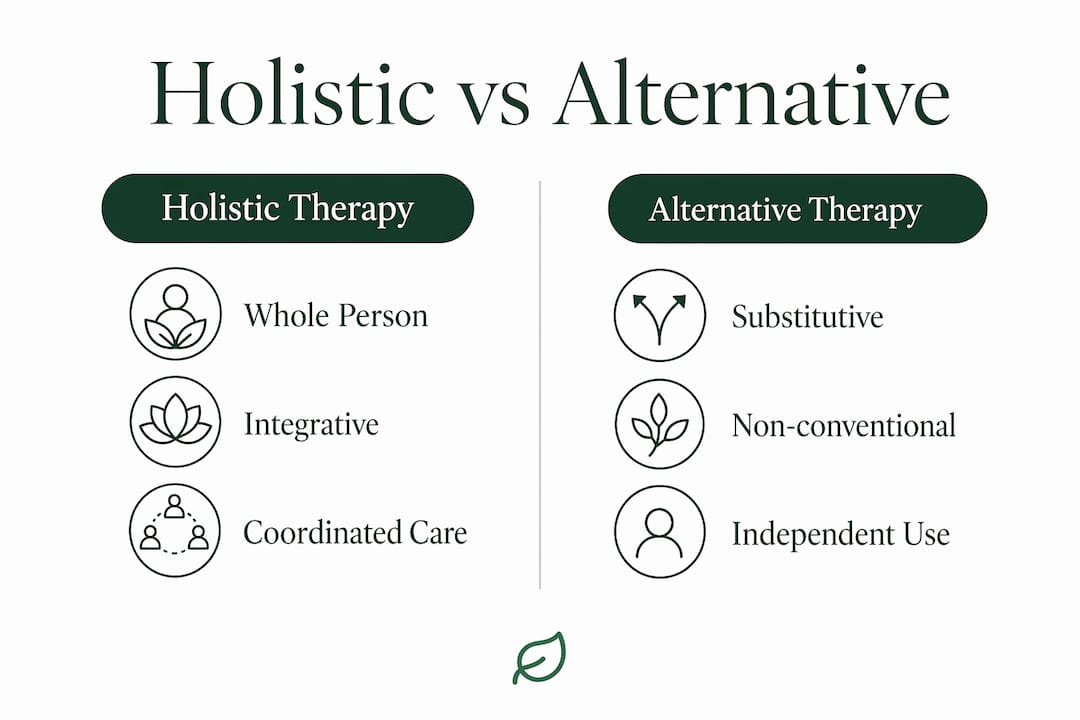
The core distinction comes down to intent and relationship with conventional medicine. Holistic therapy is a philosophy of care. It treats you as a whole person rather than a collection of symptoms, and it can include conventional medicine, complementary practices, lifestyle coaching, and mental health support all working together. Alternative therapy, by contrast, is defined by its position outside conventional care. It replaces standard medical treatment rather than working alongside it.

Complementary therapies are used alongside conventional treatment, while alternative therapies substitute for it. This single distinction has major implications for patient safety and outcomes. A person using acupuncture to manage chemotherapy-related nausea is using a complementary approach. A person using acupuncture instead of chemotherapy is using it as an alternative therapy. The modality is identical. The risk profile is not.
The World Health Organization frames this clearly in its traditional and integrative medicine strategy, distinguishing complementary medicine as additional healthcare practices outside mainstream medicine and integrative medicine as an interdisciplinary, evidence-based combination of biomedical and traditional practices. These definitions matter because they determine how therapies are evaluated, regulated, and safely applied.
What is holistic therapy and what are its key principles?
Holistic healing addresses interconnectedness of physical, mental, emotional, and spiritual health with a broad lifestyle focus. A holistic practitioner does not just treat your back pain. They explore your sleep, stress levels, nutrition, relationships, and emotional state because all of these influence how your body heals and functions.
Common holistic healing methods include:
- Mind-body techniques such as mindfulness-based stress reduction (MBSR), meditation, and guided imagery
- Energy therapies such as Reiki, therapeutic touch, and acupuncture used as a complement to medical care
- Nutritional and lifestyle coaching addressing diet, movement, and sleep as foundations of health
- Talk therapy and counseling integrated with physical wellness practices
- Ayurveda and Traditional Chinese Medicine (TCM) when used within a coordinated care plan
The WHO definition links traditional medicine to holistic care concepts, emphasizing personalized approaches that restore mind, body, and environmental balance. This is why holistic therapy is not a single treatment. It is a framework that shapes how a practitioner approaches your entire health picture.
Holistic care also emphasizes prevention and root causes rather than symptom suppression. A holistic practitioner working with a patient experiencing chronic migraines might explore hormonal imbalances, hydration, posture, and anxiety before reaching for a prescription pad. This does not mean rejecting medication. It means not defaulting to it before understanding the full picture.
Pro Tip: When evaluating a practitioner who describes their work as "holistic," ask specifically how they coordinate with your primary care physician or specialist. True whole-person care involves open communication across your care team, not just a broad wellness philosophy.
How does alternative therapy differ from holistic therapy in purpose and use?
Alternative therapy is defined by substitution. It replaces conventional, evidence-based medical care rather than supplementing it. This is where the benefits of holistic therapy diverge sharply from the risks of purely alternative approaches. Alternative therapies carry real risks when used in place of evidence-based treatment, including delayed diagnosis and disease progression.
Consider these common scenarios where the distinction becomes critical:
- A person with Type 2 diabetes who manages blood sugar through diet, exercise, and metformin is using an integrative approach. A person who stops metformin in favor of herbal supplements alone is using alternative therapy, and the risks are measurable.
- Someone with early-stage breast cancer who adds meditation and acupuncture to their oncology plan is using complementary care. Someone who delays surgery in favor of high-dose vitamin C infusions alone is using alternative therapy.
- A patient managing anxiety with cognitive behavioral therapy (CBT) alongside yoga and breathwork is using a holistic model. A patient who refuses CBT or medication entirely in favor of crystal healing alone is in alternative territory.
The same therapy can be complementary or alternative depending on context. Herbal medicine used alongside a physician-monitored treatment plan is complementary. The same herbs used to replace a prescribed medication without medical supervision become alternative. Context and coordination define the category, not the modality itself.
The risks of alternative-only strategies are not theoretical. Substituting essential treatments can worsen conditions and, in serious cases, increase mortality. This is not an argument against natural or traditional therapies. It is an argument for using them within a coordinated, informed care plan.
What roles do integrative and complementary therapies play?
Understanding the full spectrum of therapy types helps you see where holistic and alternative approaches fit within a broader system. Four terms are commonly used, and they are not interchangeable.
| Term | Definition | Relationship to conventional care |
|---|---|---|
| Holistic therapy | Whole-person philosophy addressing mind, body, spirit, and environment | Can include or work alongside conventional care |
| Alternative therapy | Treatments used instead of conventional medicine | Replaces conventional care |
| Complementary therapy | Practices used alongside conventional medicine | Adds to conventional care |
| Integrative medicine | Evidence-based coordination of conventional and complementary methods | Explicitly combines both in a structured plan |
Integrative medicine explicitly coordinates conventional and complementary care in an evidence-based, interdisciplinary approach. Institutions like the Cleveland Clinic, Mayo Clinic, and Memorial Sloan Kettering all operate integrative medicine departments where oncologists, acupuncturists, nutritionists, and mental health professionals work from a shared care plan.
Complementary therapies improve symptom management and quality of life when used with conventional treatment. Massage therapy reduces post-surgical pain. Mindfulness-based cognitive therapy (MBCT) cuts relapse rates in recurrent depression. Acupuncture manages chemotherapy-induced nausea. These are not fringe claims. They are findings from peer-reviewed clinical trials.
The WHO's 2025 to 2034 strategy frames holistic principles as core to integrating traditional and complementary medicine responsibly within health systems. This signals a global shift toward recognizing whole-person care not as an alternative to medicine, but as an evolution of it.
Pro Tip: When researching integrative health approaches, look for practitioners who cite clinical evidence for their methods and who actively communicate with your other healthcare providers. That combination predicts better outcomes than any single therapy label.
How to choose between holistic, alternative, and complementary therapies safely
Choosing the right approach requires more than reading wellness blogs. It requires a structured way of evaluating what you are considering and how it fits into your existing care. Here is a practical framework for how to choose between therapies safely and effectively.
-
Identify your goal. Are you managing a diagnosed condition, supporting general wellness, or addressing a specific symptom? The answer shapes which category of therapy is appropriate and how much coordination with a physician is needed.
-
Check the evidence base. Search PubMed or the National Center for Complementary and Integrative Health (NCCIH) for clinical trial data on the therapy you are considering. Evidence does not have to be perfect, but it should exist.
-
Ask about coordination. Successful whole-person health approaches involve open communication between patients, complementary therapists, and clinicians. Ask any practitioner directly: "Do you communicate with my primary care doctor?" A yes is a green flag. Resistance to that question is a red flag.
-
Disclose everything to your physician. Patient disclosure and clinician involvement in complementary therapy use is necessary to avoid harmful interactions and optimize benefits. Herbs, supplements, and energy therapies can all interact with medications or affect lab results.
-
Evaluate the practitioner's credentials. Look for licensed or certified practitioners. In the U.S., acupuncturists are licensed by the National Certification Commission for Acupuncture and Oriental Medicine (NCCAOM). Massage therapists are licensed at the state level. Ayurvedic practitioners vary by state, so verify credentials carefully.
-
Reassess regularly. Holistic and complementary care plans should evolve with your health. If a therapy is not producing measurable improvement after a reasonable trial period, that is worth discussing with both your complementary practitioner and your physician.
Examples of holistic and alternative therapies and their typical applications
Knowing the names of therapies is less useful than understanding how they are typically used and what the evidence says. The table below covers common modalities and their standard application context.
| Therapy | Typical use context | Evidence level |
|---|---|---|
| Acupuncture | Pain management, nausea, anxiety alongside conventional care | Strong for pain and nausea; moderate for anxiety |
| Reiki | Stress reduction, palliative care support | Emerging; primarily quality-of-life benefits |
| Mindfulness-based stress reduction (MBSR) | Anxiety, chronic pain, depression alongside CBT or medication | Strong clinical evidence |
| Ayurveda | Digestive health, lifestyle optimization with physician oversight | Moderate; varies by specific practice |
| High-dose vitamin supplements | Sometimes used as alternative to chemotherapy or antibiotics | Weak to none for replacing standard care |
| Homeopathy | Often used as alternative to conventional medicine | No clinical evidence beyond placebo |
| Nutritional therapy | Chronic disease management alongside medical supervision | Strong when evidence-based and coordinated |
The role of alternative therapies in 2026 continues to evolve as more clinical research examines traditional practices. The trend in evidence-based wellness is clear: therapies with the strongest outcomes are those integrated into coordinated care plans, not those used in isolation. Modalities like MBSR, acupuncture, and therapeutic massage have moved from fringe to mainstream precisely because they were studied within conventional medical frameworks.
Goholistic's treatment library covers over 200 therapy types with research summaries, making it easier to assess which holistic health treatments have clinical backing before you book a session.
Key takeaways
The defining difference between holistic and alternative therapy is whether care integrates with conventional medicine or replaces it, and that distinction determines both safety and outcomes.
| Point | Details |
|---|---|
| Holistic therapy is a philosophy | It treats the whole person and can include conventional, complementary, and lifestyle approaches together. |
| Alternative therapy carries risk | Using therapies instead of proven treatments can delay diagnosis and worsen health outcomes. |
| Context defines the category | The same modality, such as acupuncture or herbal medicine, can be complementary or alternative depending on how it is used. |
| Integrative medicine is the gold standard | Coordinated, evidence-based care combining conventional and complementary methods produces the strongest outcomes. |
| Disclosure protects you | Telling your physician about every therapy you use prevents harmful interactions and improves care coordination. |
Why the label matters less than the coordination
Here is something the wellness industry rarely says plainly: the word "holistic" is one of the most overused terms in health marketing. I have seen it applied to everything from evidence-based integrative oncology programs at major hospitals to unregulated supplement sellers with no clinical training. The word itself tells you almost nothing about safety or effectiveness.
What actually predicts a good outcome is coordination. When I look at the research on whole-person care, the consistent thread is not which modality someone used. It is whether their care team communicated, whether the patient disclosed everything they were doing, and whether decisions were grounded in evidence rather than ideology. Marketing uses "holistic" broadly, but practical safety depends on therapy integration with conventional medicine.
The patients I have seen benefit most from complementary and holistic approaches are those who treated their care as a team effort. They brought their acupuncturist's notes to their oncologist. They told their nutritionist what medications they were taking. They asked hard questions and expected real answers. That is not a personality type. It is a skill you can develop.
My honest advice: do not let a label, whether "holistic," "natural," or "alternative," do the work of evaluation for you. Ask about evidence. Ask about coordination. Ask who is accountable if something goes wrong. Those questions will serve you far better than any wellness category.
— Andrew
Explore holistic wellness with Goholistic
If this article has you thinking more carefully about your own wellness choices, Goholistic is built for exactly that moment.
Goholistic connects you with verified, licensed practitioners across disciplines including acupuncture, Ayurveda, massage therapy, and mindfulness coaching. Every provider in the directory is vetted, and the platform's AI-powered recommendation tool matches your health concerns to therapies with real research behind them. You can browse holistic treatments by condition, read evidence summaries, and book directly with practitioners who understand how to work alongside your existing care team. Whether you are just starting to explore or ready to build a coordinated wellness plan, find a practitioner near you and take the next step with confidence.
FAQ
What is the main difference between holistic and alternative therapy?
Holistic therapy is a whole-person care philosophy that can include conventional medicine, while alternative therapy replaces conventional treatment entirely. The distinction lies in whether the approach works with or instead of standard medical care.
Can the same therapy be both holistic and alternative?
Yes. The same therapy can be complementary or alternative depending on whether it substitutes or adds to conventional medicine. Acupuncture used alongside cancer treatment is complementary. Acupuncture used instead of cancer treatment is alternative.
Is holistic therapy evidence-based?
Many holistic healing methods, including acupuncture, MBSR, and nutritional therapy, have strong clinical evidence when used within coordinated care plans. The evidence base varies by modality, so checking sources like the NCCIH or PubMed before starting any therapy is recommended.
How do I know if a practitioner is truly holistic vs. just using the label?
Ask whether they communicate with your primary care physician and how they incorporate evidence into their recommendations. Coordinated care models lead to safer, more effective outcomes than any single therapy label can guarantee.
Should I tell my doctor about complementary or holistic therapies I am using?
Yes, always. Patient disclosure to clinicians is necessary to prevent harmful interactions between supplements, herbs, or energy therapies and prescribed medications, and to keep your full care team informed.