

TL;DR:
- Multidisciplinary wellness involves coordinated care where health practitioners share patient information and treatment plans. It treats physical, mental, and social health as interconnected systems, promoting better outcomes. True integration requires shared charts, team meetings, and unified goals, not just co-location.
Multidisciplinary wellness is defined as a coordinated care model where multiple regulated health practitioners share patient charts, align treatment plans, and work together toward a single person's well-being. This approach, also called integrative wellness in clinical settings, goes far beyond booking separate appointments with a massage therapist and a nutritionist. When you explain multidisciplinary wellness accurately, the defining feature is coordination, not just variety. Physical, mental, emotional, social, and occupational health are treated as connected systems, not isolated problems. Goholistic was built around exactly this philosophy, connecting you with verified practitioners across disciplines who understand that your health is one story, not several separate ones.
What disciplines and dimensions are involved in multidisciplinary wellness?

Multidisciplinary wellness draws from a wide range of regulated health disciplines, each addressing a different layer of your well-being. The 8 Dimensions of Well-being model provides the most widely used framework for this, covering physical, emotional, intellectual, social, spiritual, occupational, environmental, and financial health. No single practitioner covers all eight. That is precisely why coordination across disciplines produces results that solo care cannot.
The disciplines most commonly involved include:
- Physiotherapy: Restores movement, reduces pain, and rebuilds function after injury or surgery.
- Massage therapy: Addresses soft tissue tension, circulation, and nervous system regulation.
- Acupuncture: Works with the body's energy pathways to reduce inflammation and support recovery.
- Kinesiology: Applies movement science to correct biomechanical imbalances and build long-term physical resilience.
- Counseling or psychology: Addresses stress, anxiety, trauma, and behavioral patterns that affect physical health.
- Nutrition: Supports recovery and energy through diet tailored to your specific health goals.
The difference between a true multidisciplinary setup and a building full of separate clinics is functional integration. Practitioners in a genuine model share notes, discuss your case, and adjust their individual approaches based on what other providers are doing. Simply renting space in the same building does not create coordination.
Pro Tip: Ask any clinic whether your chart is visible to all treating providers. If each practitioner keeps a separate file, you are looking at co-location, not true multidisciplinary care.
How does a multidisciplinary wellness model work in practice?
A true multidisciplinary model operates through shared infrastructure and deliberate communication, not just good intentions. Shared patient charts and professional handoffs are the hallmark of genuine coordination. Every provider on your care team can see what the others are doing, which eliminates the frustrating cycle of repeating your health history at every appointment.
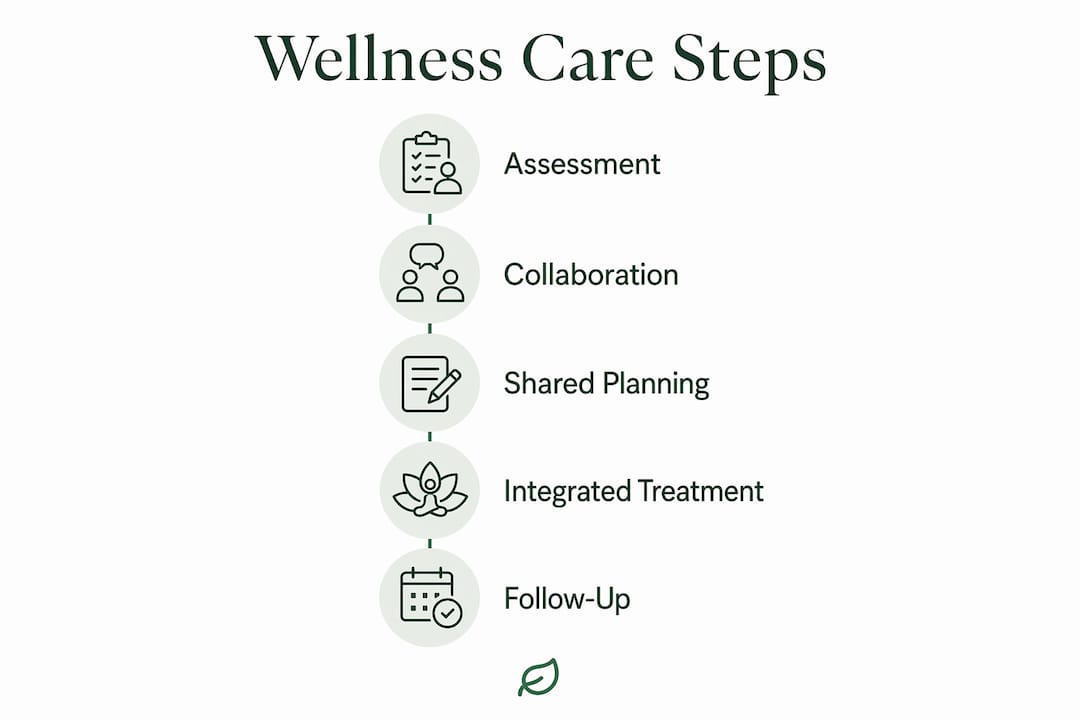
The process typically follows these steps:
- Comprehensive intake assessment: You complete a detailed health history covering physical symptoms, mental health, lifestyle, and goals. This baseline shapes the entire care plan.
- Team review: Relevant practitioners review your intake together and identify which disciplines should be involved and in what sequence.
- Unified treatment plan: A single care plan is created with measurable outcomes. Each provider's role is defined within that plan.
- Coordinated delivery: Appointments are scheduled with your overall progression in mind. A physiotherapist and a kinesiologist, for example, will time their work so one builds on the other.
- Regular plan revision: The team reviews your progress at set intervals and adjusts the plan based on multi-discipline input.
Compare this to fragmented care, where you manage your own referrals, carry paper records between offices, and hope your providers are aware of each other's work. Fragmented wellness forces patients to act as their own case managers, which leads to frustration and treatment non-adherence. Integrated clinics absorb that coordination burden so you can focus on getting better.
| Feature | Multidisciplinary model | Fragmented care |
|---|---|---|
| Patient charts | Shared across all providers | Separate per provider |
| Care planning | Unified, team-reviewed plan | Individual provider plans |
| Communication | Regular inter-provider handoffs | Rare or patient-initiated |
| Appointment design | Sequenced for synergy | Independent scheduling |
| Outcome tracking | Measured against shared goals | Tracked per discipline only |
Pro Tip: Before your first appointment at any clinic, ask whether providers hold regular case review meetings. Weekly or biweekly team meetings are a strong sign of genuine integration.
What are the benefits of choosing multidisciplinary wellness?
The benefits of multidisciplinary approaches go well beyond convenience. Coordinated, personalized health plans with measurable outcomes improve efficiency and reduce redundant appointments. You stop paying for the same assessment three times across three different offices.
The core advantages include:
- Reduced appointment fatigue: You tell your story once. Every provider who joins your care team reads your shared chart rather than starting from scratch.
- More durable results for chronic conditions: Coordinated multidisciplinary models show measurable improvements in outcomes for chronic pain, post-surgical recovery, and stress-related conditions. Athletes and ICBC patients are two groups where this has been documented clearly.
- Synergy between physical and mental health: Physical, mental, and social health are mutually reinforcing in this model. Success is measured by how treatments interact, not just by isolated symptom relief.
- Better outcome tracking: Because the team shares a single plan with defined goals, progress is visible across all disciplines at once. Adjustments happen faster and with more context.
- Fewer gaps in care: Integrated clinics reduce fragmentation gaps by connecting nutrition, mental health, and physical rehabilitation into one coherent pathway.
"Multidisciplinary wellness embraces an antifragile approach, recognizing that strength in one health dimension actively supports the others." — Jasmine Angelique, wellness researcher
This is the core insight that separates integrated care from traditional models. When your acupuncturist knows your physiotherapist is working on your lumbar spine, they can coordinate needle placement to support the same recovery goal. That kind of alignment simply does not happen when providers work in isolation.
How can you identify a true multidisciplinary wellness clinic?
Many providers operate in silos despite claims of multidisciplinary care. Marketing language alone does not define true integration. You need to look for specific operational signs before committing to a clinic.
Signs of a genuine multidisciplinary clinic:
- Shared electronic charts: All treating providers access the same patient record. If each practitioner uses a separate system, coordination is unlikely.
- Team case meetings: The clinic holds regular meetings where providers discuss patient progress together. Ask how often these happen and who attends.
- A single unified care plan: You receive one document outlining your goals, the disciplines involved, and the sequence of care. Multiple separate treatment plans from separate providers is a red flag.
- Baseline assessment with measurable goals: Your intake includes objective measurements, not just a symptom checklist. Progress is tracked against those baselines.
- Personalized protocols, not fixed packages: Effective multidisciplinary care prioritizes tailored protocols over standard packages. A good clinic assesses your individual mechanics before recommending a care path.
Questions worth asking directly: "Do your providers share patient charts?" "How do you handle communication between disciplines?" "Can you show me an example of a unified care plan?" A clinic confident in its coordination model will answer these clearly. Vague responses suggest the integration exists mainly in the brochure.
You can also explore whole-person wellness guides to understand what genuine coordinated care looks like before you walk into any clinic. Knowing what to expect makes you a more informed participant in your own care.
Key takeaways
Multidisciplinary wellness works because it treats your physical, mental, and social health as one connected system, not separate problems assigned to separate providers.
| Point | Details |
|---|---|
| Coordination defines the model | Shared charts and team meetings separate true multidisciplinary care from co-located services. |
| Eight dimensions guide the framework | The 8 Dimensions of Well-being model covers physical, mental, social, occupational, and four other health areas. |
| Fragmented care burdens the patient | Without integration, patients manage their own referrals and repeat their history at every appointment. |
| Synergy improves chronic outcomes | Coordinated care produces measurable gains in chronic pain, stress, and post-surgical recovery. |
| Ask specific questions before committing | Unified care plans and regular provider meetings are the clearest signs of genuine integration. |
Why I think most people underestimate what coordination actually means
After years of watching people cycle through wellness providers without lasting results, I've come to believe the problem is rarely the individual practitioner. It's the absence of a shared plan. A skilled acupuncturist and a skilled physiotherapist working independently can each do good work. But without knowing what the other is doing, they can also work at cross-purposes without realizing it.
The patients who get the most out of integrated care are the ones who stop thinking of each appointment as a separate transaction. When your providers share a chart and meet regularly, your care compounds. Progress in one area accelerates progress in another. That is the antifragile quality that integrated health profiles make possible.
The uncomfortable truth is that many clinics use the word "multidisciplinary" to mean "we have multiple services." That is not the same thing. True coordination requires infrastructure, time, and a genuine commitment from every provider on the team. When you find a clinic that has built that infrastructure, the difference in your experience will be immediate. You will stop feeling like a case number moving between rooms and start feeling like someone whose whole health picture is understood.
— Andrew
Goholistic and the multidisciplinary wellness approach
Goholistic connects you with verified practitioners across acupuncture, massage therapy, Ayurveda, and more than 200 other therapy types, all organized around the same principles that make multidisciplinary care effective.
The platform uses AI to analyze your health concerns and match you with practitioners whose work aligns with your specific goals. You can browse, filter, and book directly through a curated provider directory built for people who want coordinated, evidence-based care. Whether you are managing chronic pain, stress, or a post-injury recovery, Goholistic gives you access to holistic health treatments that reflect the full picture of your well-being. You can also find holistic practitioners near you who specialize in the disciplines most relevant to your needs. Getting started is free.
FAQ
What is multidisciplinary wellness?
Multidisciplinary wellness is a coordinated care model where multiple regulated health practitioners share patient charts and work from a unified treatment plan. It addresses physical, mental, social, and other dimensions of health as interconnected systems.
How is multidisciplinary wellness different from seeing multiple providers separately?
In multidisciplinary care, providers communicate directly, share records, and adjust their work based on what other practitioners are doing. Fragmented care leaves the patient responsible for connecting those dots independently.
What disciplines are typically part of a multidisciplinary wellness team?
Common disciplines include physiotherapy, massage therapy, acupuncture, kinesiology, counseling, and nutrition. The specific combination depends on your health goals and the clinic's scope of practice.
How do I know if a clinic offers true multidisciplinary care?
Ask whether providers share a single patient chart and hold regular case review meetings. A clinic with genuine integration will have clear, confident answers to both questions.
What conditions benefit most from multidisciplinary wellness strategies?
Chronic pain, post-surgical recovery, and stress-related conditions show the strongest documented improvements under coordinated interdisciplinary wellness practices. The model also supports long-term prevention by addressing multiple health dimensions at once.