

TL;DR:
- Holistic intake is a comprehensive assessment that gathers physical, emotional, social, and spiritual information to inform personalized, whole-person care. It ensures accurate diagnosis, safety, and treatment planning by evaluating interconnected domains rather than isolated symptoms. Tailored to each modality, it enhances interdisciplinary collaboration and empowers patients in their health journey.
Holistic intake is defined as a structured, whole-person assessment that collects physical, psychological, social, and sometimes spiritual information to guide personalized, person-centered care. Unlike a standard symptom checklist, this process treats you as a complete individual rather than a collection of complaints. Coordinated assessment across multiple dimensions is what separates holistic intake from conventional triage. Whether you are exploring acupuncture, naturopathic medicine, or Ayurveda, the intake process is where your care truly begins.
What is holistic intake and what does it actually cover?
Holistic intake is the foundation of any whole-person health plan. It gathers information across several interconnected domains, each one revealing something that a single symptom report cannot. Intake quality directly affects diagnosis accuracy, level-of-care decisions, and safety planning, making it a clinical step rather than an administrative formality.
The domains covered in a thorough holistic health assessment typically include:
- Physical health history: Current symptoms, past diagnoses, medications, allergies, sleep patterns, nutrition habits, and exercise routines.
- Psychological and emotional well-being: Stress levels, mood patterns, history of anxiety or depression, trauma, and coping strategies.
- Social environment: Family dynamics, work conditions, financial stressors, community support, and relationship quality.
- Spiritual or cultural context: Personal beliefs, values, and cultural practices that shape how you experience health and healing.
- Lifestyle factors: Substance use, screen time, daily routines, and environmental exposures.
Each domain influences the others in real ways. Chronic work stress, for example, can suppress immune function, disrupt sleep, and worsen digestive conditions. A practitioner who only asks about your stomach pain misses the full picture. By mapping all these areas together, holistic intake reveals patterns that isolated symptom reviews never surface.
Pro Tip: Before your first holistic appointment, spend ten minutes writing down your three biggest stressors, your sleep schedule, and any supplements you take. This preparation makes your intake conversation far more productive.

How does holistic intake compare to standard and biopsychosocial assessments?
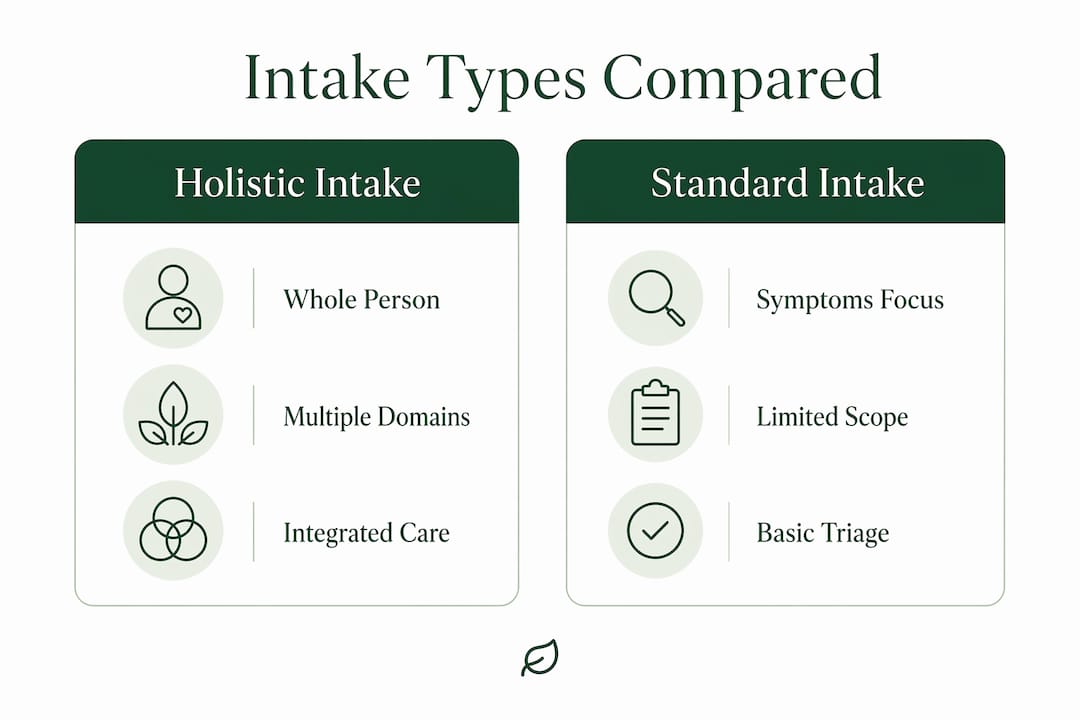
Not all intake processes are equal, and understanding the differences helps you know what to expect and what to ask for. Three models are most common in clinical and wellness settings.
| Assessment type | Scope | Primary purpose | Depth |
|---|---|---|---|
| Standard intake | Symptoms and basic demographics | Initial triage and risk screening | Brief overview |
| Biopsychosocial assessment | Biological, psychological, and social domains | Diagnosis and multidisciplinary care planning | Deep clinical evaluation |
| Holistic intake | All biopsychosocial domains plus spiritual and contextual factors | Person-centered, whole-life care planning | Broadest scope |
Standard intake may start treatment and perform initial triage, while more comprehensive assessments expand the scope across follow-up visits. This means your first appointment does not need to capture everything at once. Biopsychosocial assessments go deeper than standard intake but still tend to stop short of the spiritual and contextual dimensions that integrative intake includes.
What makes holistic intake distinct is its refusal to separate the body from the mind, the individual from their environment, or the physical from the personal. Integrative intake, a term used interchangeably in many clinical settings, signals the same whole-person philosophy. The sequential clinical flow moves from history gathering to physical examination, then to any indicated testing, and finally to collaborative treatment planning. That sequence ensures no domain is skipped in favor of speed.
How does holistic intake adapt to different treatment modalities?
One of the most overlooked aspects of holistic intake is that it looks different depending on the therapy you are pursuing. A generic intake form designed for general wellness falls short when a practitioner needs modality-specific clinical data. Holistic intake form design must balance standardized patient information with modality-specific clinical needs, including risk screening and informed consent tailored to the therapy type.
Here is how intake adapts across three common modalities:
- Acupuncture: Acupuncture intake forms incorporate Traditional Chinese Medicine diagnostics such as tongue and pulse assessment questions, alongside contraindication screening for blood thinners, pregnancy, and immunosuppressants. Explicit informed consent for needle-based treatment is required before the first session. A form that skips these elements creates both clinical and legal gaps.
- Naturopathic medicine: Patient-focused naturopathic assessments typically last 60 to 90 minutes and include a comprehensive health history, physical examination, diagnostic testing, and collaborative treatment planning. The extended time reflects the depth of information needed to build a truly personalized strategy. Mind-body-spirit connections are explicitly explored rather than implied.
- Massage therapy and bodywork: Intake forms for these modalities focus on musculoskeletal history, areas of pain or sensitivity, skin conditions, recent surgeries, and pressure preferences. Informed consent covers the physical nature of touch-based treatment and any relevant contraindications.
Why does this matter to you? If a practitioner hands you a one-page general health form before an acupuncture session, that is a signal worth noticing. Thorough, modality-specific screening protects your safety and gives your provider the clinical detail they need to treat you effectively. Asking your practitioner what their intake covers before you book is a reasonable and smart step.
What are the real benefits of holistic intake beyond data collection?
Holistic intake is often described as information gathering, but its practical value extends well beyond filling out forms. When done well, it becomes the engine behind every clinical decision your provider makes on your behalf.
Here are the core functions that a thorough holistic intake process serves:
- Establishes a clinical baseline. Your intake snapshot becomes the reference point for measuring progress. If your sleep score, stress rating, or pain level improves over three months, that change is only meaningful because the baseline exists.
- Guides diagnosis and level-of-care decisions. Comprehensive intake captures psychiatric, medical, social, and substance-use history to inform individualized treatment plans. This prevents misdiagnosis and helps practitioners match you with the right type and intensity of care from the start.
- Informs safety planning. Certain conditions, medications, and life circumstances require specific precautions. A practitioner who knows you are on blood thinners, managing grief, or navigating a high-stress work period can adjust their approach accordingly.
- Supports interdisciplinary coordination. Holistic care models emphasize interdisciplinary teams and comprehensive assessment tools. When your acupuncturist, nutritionist, and therapist all have access to a shared intake picture, their recommendations reinforce rather than contradict each other.
- Empowers you as a participant in your care. Completing a thorough intake is itself a reflective exercise. Many people report that the process of answering detailed questions about their lifestyle, emotions, and values helps them articulate health concerns they had never put into words before.
Pro Tip: Ask your practitioner to share a summary of your intake findings with you. Seeing your own health picture in writing often reveals connections between symptoms and lifestyle factors that feel invisible day to day.
You can learn more about building on these insights by reading about how to build your personalized health plan after your initial assessment.
Key takeaways
Holistic intake is the most clinically consequential step in whole-person care because it determines the accuracy of every diagnosis, recommendation, and treatment plan that follows.
| Point | Details |
|---|---|
| Whole-person scope | Holistic intake covers physical, psychological, social, and spiritual domains, not symptoms alone. |
| Modality-specific forms | Acupuncture, naturopathy, and bodywork each require tailored intake questions and informed consent. |
| Clinical baseline function | Intake data becomes the reference point for measuring your progress over time. |
| Beyond data collection | Holistic intake drives diagnosis, safety planning, and interdisciplinary care coordination. |
| Patient empowerment | Completing a thorough intake helps you articulate and understand your own health patterns. |
Why holistic intake changed how I think about health care
I spent years assuming that a good practitioner could figure everything out from a short conversation and a few targeted questions. What changed my thinking was watching how differently two people with identical chief complaints responded to the same treatment. One improved steadily. The other plateaued. The difference, almost every time, traced back to what the intake had captured or missed.
When a practitioner knows that you are sleeping four hours a night because of a newborn, managing a difficult family relationship, and eating irregularly due to work demands, they treat a completely different person than the one who simply reports "fatigue." That context is not background noise. It is the clinical signal.
I have also seen what happens when intake forms are generic. An acupuncturist using a standard wellness form misses the contraindication screening that a needle-based therapy requires. A naturopath who skips the detailed lifestyle interview ends up recommending supplements that conflict with the patient's existing medication. These are not rare edge cases. They are predictable outcomes of incomplete intake.
The other thing worth saying directly: holistic intake is not a one-time event. In multidisciplinary and behavioral health settings, intake may extend across multiple visits, with early sessions covering broad data and follow-ups adding depth. That progression is a feature, not a flaw. Your health picture changes, and your intake should grow with it.
If you are starting a new wellness relationship, ask your provider what their intake covers and how they use it. A practitioner who can answer that question clearly is one worth trusting.
— Andrew
Start your whole-person health journey with Goholistic
Goholistic connects you with verified, certified practitioners across acupuncture, Ayurveda, massage therapy, naturopathy, and more than 200 other treatment types. Every provider in the Goholistic directory is screened for credentials, so the intake process you experience is backed by genuine clinical expertise. Browse the full library of holistic health treatments to understand which modalities align with your health goals, then find a practitioner ready to conduct a thorough, personalized assessment. Whether you are new to integrative care or looking to deepen an existing wellness practice, Goholistic gives you the tools to take that next step with confidence. Get started today and let your intake be the beginning of real, lasting change.
FAQ
What is holistic intake in simple terms?
Holistic intake is a structured assessment that collects information about your physical health, emotional well-being, social environment, and sometimes spiritual context to guide personalized care. It goes well beyond a standard symptom checklist to treat you as a whole person.
How long does a holistic intake appointment take?
The length varies by modality. Naturopathic assessments typically last 60 to 90 minutes and include history, examination, and planning. Other modalities may complete intake in 30 to 45 minutes, with deeper follow-up questions added over subsequent visits.
What is the difference between holistic intake and a biopsychosocial assessment?
A biopsychosocial assessment covers biological, psychological, and social domains for clinical diagnosis. Holistic intake extends that scope to include spiritual, cultural, and contextual factors, making it the broadest whole-person evaluation model available.
Why do holistic intake forms differ between practitioners?
Modality-specific intake forms are required because different therapies carry different clinical risks and diagnostic needs. An acupuncture intake must screen for contraindications like blood thinners and include needle-specific consent, while a massage intake focuses on musculoskeletal history and touch-based precautions.
Can I do a holistic intake online before my first appointment?
Many practitioners now offer digital intake forms through platforms like MySafeTherapy and similar tools, allowing you to complete screening and consent documentation before your first visit. Completing forms in advance gives you more time during the appointment for meaningful conversation with your provider.