

TL;DR:
- Adaptogenic herbs help balance stress responses by supporting the HPA axis without overstimulation.
- Most effective adaptogens like ashwagandha and Rhodiola require consistent, gradual use over weeks.
- Safe use involves starting with one herb, choosing quality products, and consulting healthcare providers if needed.
Adaptogenic herbs have moved from ancient medicine cabinets into mainstream wellness conversations, but they're widely misunderstood. Many people assume they're just natural energy boosters or fancy supplements. In reality, these plants do something far more nuanced: they help your body find balance when stress pushes it out of equilibrium. Adaptogens interact with the HPA axis, supporting your stress response without overstimulating it. This guide covers what adaptogenic herbs actually are, how the science explains their effects, which ones have the strongest evidence, and how to use them wisely and safely.
Table of Contents
- What are adaptogenic herbs?
- How do adaptogens work? The science behind the benefits
- Most common adaptogenic herbs: A quick guide
- How to use adaptogens safely: Best practices and precautions
- Adaptogenic herbs: Beyond the hype, what most people miss
- Supporting your wellness journey with holistic solutions
- Frequently asked questions
Key Takeaways
| Point | Details |
|---|---|
| Adaptogens explained | Adaptogenic herbs support your body's ability to manage stress without overstimulation. |
| Science-backed benefits | Research supports specific herbs, like ashwagandha and Rhodiola, for reducing anxiety and fatigue. |
| Safety first | Use adaptogens cautiously, buy from reputable sources, and consult your provider—especially if pregnant, medicated, or dealing with chronic illness. |
| Not a cure-all | Adaptogens are most effective alongside healthy lifestyle changes, not as substitutes for medical treatment. |
What are adaptogenic herbs?
Adaptogenic herbs are natural plant substances that help your body adapt to stress, fatigue, and anxiety. That word, adapt, is the key. Unlike stimulants that simply push your system into overdrive, adaptogens work more like a thermostat, helping regulate your internal environment rather than cranking the heat up or down.
The term adaptogen was first coined by Soviet pharmacologist Nikolai Lazarev in the 1950s. Russian researchers were looking for substances that could help soldiers and athletes perform better under extreme physical and mental stress. What they found were plants that seemed to build resilience over time, not just mask fatigue temporarily.
True adaptogens differ from stimulants because they confer non-specific stress resistance. That means they support your body across a broad range of stressors, whether physical, emotional, or environmental, without causing dependence or rebound crashes.
To qualify as a true adaptogen, a substance generally needs to meet three criteria:
- It must be non-toxic at normal doses
- It must support the body's ability to cope with multiple types of stress
- It must help restore balance rather than push the system in one direction only
Adaptogens work primarily through the hypothalamic-pituitary-adrenal (HPA) axis, a communication pathway between your brain and adrenal glands that governs your stress response. When this system becomes dysregulated, chronic fatigue, anxiety, and burnout can follow. Adaptogens gently support this pathway's function over time.
"Adaptogens are not magic pills. They work best as part of a broader commitment to evidence-based wellness, including sleep, nutrition, and stress management."
It's worth being clear: adaptogenic herbs are not a substitute for medical treatment. If you're dealing with a diagnosed condition, please work with a qualified healthcare provider. Think of adaptogens as supportive tools, not standalone cures.
How do adaptogens work? The science behind the benefits
After defining adaptogenic herbs, it's important to understand how they actually work within the body. The mechanisms are genuinely fascinating, and understanding them helps you set realistic expectations.
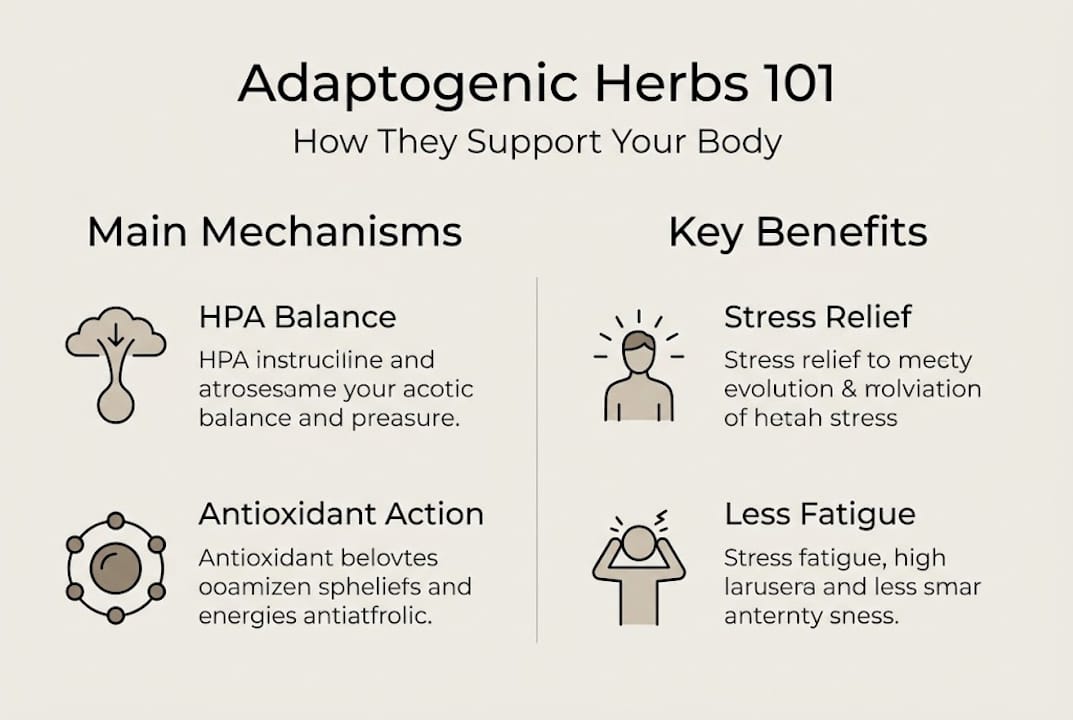
Adaptogens primarily act on the HPA axis, the body's central stress management system. When you experience stress, this axis triggers a cascade of hormones, including cortisol. Chronic stress keeps cortisol elevated, which over time can disrupt sleep, immunity, mood, and energy. Adaptogens interact with the HPA axis to help moderate this response, keeping cortisol within a healthier range.

Beyond cortisol, adaptogens offer multitarget mechanisms for stress management, including antioxidant activity and effects on key neurotransmitters like serotonin and dopamine. This is why their benefits can feel broad rather than narrow.
Here's a quick look at the primary mechanisms researchers have identified:
| Mechanism | Effect on the body |
|---|---|
| HPA axis modulation | Balances cortisol and reduces stress overload |
| Antioxidant activity | Protects cells from oxidative stress |
| Immune modulation | Supports immune function under chronic stress |
| Neurotransmitter support | Helps stabilize mood and cognitive function |
| Anti-fatigue effects | Improves energy efficiency at the cellular level |
The strength of evidence varies across individual herbs. Rhodiola rosea has strong support for reducing fatigue, while ashwagandha has been well-studied for anxiety reduction. Others, like astragalus and reishi, have solid traditional use but fewer large-scale human trials.
Pro Tip: When researching adaptogens, look for studies using standardized extracts. The quality and concentration of an herb can vary wildly between products, which affects both effectiveness and safety.
One thing worth noting is that these aren't overnight solutions. Adaptogens tend to build their effects gradually. Most people notice real shifts in mood, energy, or stress tolerance after consistent use over several weeks. Pairing them with wellness practices for stress like mindfulness, movement, and good sleep amplifies their impact significantly.
Most common adaptogenic herbs: A quick guide
The diversity among adaptogenic herbs can be confusing, so let's compare the most widely used options. Each herb has its own personality, origin, and primary strength.
Common adaptogenic herbs include ashwagandha, Panax ginseng, Rhodiola rosea, holy basil, schisandra, reishi, astragalus, and eleuthero. Here's how they compare:
| Herb | Origin | Primary benefit | Evidence level |
|---|---|---|---|
| Ashwagandha | India (Ayurveda) | Anxiety and stress reduction | Strong |
| Rhodiola rosea | Siberia/Scandinavia | Fatigue and mental performance | Strong |
| Panax ginseng | East Asia | Energy and cognitive function | Moderate |
| Holy basil (Tulsi) | India | Mood and immune balance | Moderate |
| Eleuthero | Russia/China | Stamina and immune support | Moderate |
| Astragalus | China (TCM) | Immune function and longevity | Moderate |
| Schisandra | China/Russia | Liver support and endurance | Emerging |
| Reishi mushroom | East Asia | Immune modulation and calm | Emerging |
Empirical data is strongest for Rhodiola (fatigue reduction) and ashwagandha (anxiety), making these two a natural starting point for most people exploring adaptogens.
A few highlights worth knowing:
- Ashwagandha is one of the most researched adaptogens for anxiety and cortisol reduction. It's widely available and generally well-tolerated.
- Rhodiola rosea is particularly popular among people dealing with work stress or physical training loads. It has a mild stimulating effect that most users find helpful rather than jittery.
- Holy basil is revered in Ayurvedic medicine as a sacred plant and is often consumed as a tea. It's gentle and great for beginners.
- Reishi mushroom is less about energy and more about calm and immune support, making it a good evening option.
Pro Tip: If you're just starting out, ashwagandha or holy basil are great entry points because they're gentle, widely available, and well-studied. Explore integrative health tips for guidance on building a balanced supplement routine.
How to use adaptogens safely: Best practices and precautions
Before trying adaptogenic herbs, it's vital to understand safe usage, including who should be cautious. The wellness market is full of enthusiasm about adaptogens, but rushing in without preparation can lead to disappointment or, in some cases, real health concerns.
Here's a step-by-step approach to getting started safely:
- Start with one herb at a time. Introducing a single adaptogen lets you clearly observe how your body responds before adding anything else.
- Choose a reputable brand. Since adaptogen supplements are not FDA-regulated, quality control varies widely. Look for third-party testing and standardized extracts.
- Follow the recommended dose. More is not better with adaptogens. Stick to the evidence-based dose listed on quality products or recommended by a practitioner.
- Give it time. Most adaptogens need consistent use over several weeks before you'll notice meaningful changes.
- Monitor your reaction. Keep a simple journal noting energy, sleep quality, mood, and any side effects. This makes it easier to evaluate whether the herb is helping.
- Consult your healthcare provider if you take medications, have a hormone-sensitive condition, or are pregnant or lactating.
"Some adaptogens, including ashwagandha and Panax ginseng, may interact with thyroid medications, blood thinners, and immunosuppressants. Always disclose supplement use to your doctor."
Certain groups should either skip adaptogens entirely or proceed only with professional guidance:
- Pregnant or breastfeeding individuals
- People with autoimmune conditions
- Those on medications that affect blood sugar, blood pressure, or hormone levels
- Children under 18 (most research is conducted in adults)
The holistic methods for chronic health you're already practicing, like acupuncture or Ayurveda, can often be thoughtfully combined with adaptogens. But coordination with a knowledgeable practitioner makes that process much safer and more effective.
Adaptogenic herbs: Beyond the hype, what most people miss
Here's something most beginner guides won't tell you: the biggest mistake people make with adaptogens isn't choosing the wrong herb. It's expecting the herb to do all the work.
Adaptogens are genuinely supportive, but they're not a substitute for rest, boundary-setting, therapy, or medical care. Stress is a complex experience, and no plant can resolve the root causes of a chronically overwhelming life. When people feel disappointed by adaptogens, it's almost always because they skipped the lifestyle piece entirely.
The integrative health definition we believe in at Go Holistic is about layering support, not replacing one thing with another. Adaptogens shine when they're part of a broader approach, not the whole strategy.
The market also exaggerates results. Some brands make dramatic claims that go well beyond what the research supports. Your best compass is the science, and right now the science is clear and promising for a handful of herbs while still catching up for others. That's okay. Honest, realistic expectations lead to far better outcomes than hype ever will.
Supporting your wellness journey with holistic solutions
If adaptogens have sparked your curiosity, you're already thinking about health in a more intentional way. That's a great starting point.
At Go Holistic, we make it easier to take that next step thoughtfully. Whether you're looking to explore holistic health treatments backed by research or want to connect with a qualified practitioner who can guide your adaptogen journey personally, we've got the resources to support you. Browse our directory to find holistic providers who specialize in areas like Ayurveda, herbal medicine, and integrative wellness. When you're ready to build a truly personalized wellness plan, explore holistic wellness with us and discover how far a balanced, supported approach can take you.
Frequently asked questions
Are adaptogenic herbs safe for everyone?
Most people tolerate adaptogens well, but those with chronic conditions, who are pregnant, or on medications should consult a healthcare provider before starting, as potential interactions with medications and health conditions do exist.
How fast do adaptogenic herbs work?
Most adaptogens work gradually, with effects building over days or weeks. Non-specific stress resistance develops through consistent use rather than a single dose.
What is the best adaptogenic herb for stress?
Ashwagandha and Rhodiola have the strongest research backing for stress and anxiety relief. Empirical data is strongest for these two herbs when it comes to fatigue and anxiety reduction.
Can I take more than one adaptogen at once?
It's best to start with one adaptogen at a time to clearly understand its effects on your body. Best practices for starting suggest building slowly before combining multiple herbs.