

TL;DR:
- Holistic screenings evaluate physical, mental, and social health to detect risks early before symptoms appear. Nearly half of middle-aged adults have undiagnosed conditions that comprehensive assessments can identify long before they become serious.
Holistic screenings are comprehensive health assessments that evaluate your physical, mental, and social well-being together to detect risks before they become serious conditions. Unlike a standard annual checkup, these assessments go beyond a basic blood panel to examine the full picture of who you are and how your body functions. A 2026 Scientific Reports cohort study found that nearly 50% of middle-aged adults screened with comprehensive preventive exams had at least one previously undiagnosed condition. That number alone makes the case for why holistic screenings matter in any serious preventive health plan.
Why holistic screenings matter for early detection
The most powerful thing a comprehensive health assessment does is find what you did not know to look for. Conditions like elevated LDL cholesterol and hypertension rarely announce themselves with obvious symptoms. You can feel completely fine while your body is quietly building toward a cardiovascular event or metabolic breakdown.

Standard episodic care misses these patterns because it responds to complaints rather than searching for silent signals. A systematic preventive exam examines interconnected physiological systems rather than treating each organ in isolation. When your thyroid, insulin response, and inflammatory markers are assessed together, patterns emerge that no single test would reveal on its own.
Here is what comprehensive screenings commonly catch before symptoms appear:
- Elevated LDL cholesterol that falls within a "borderline" range but trends upward year over year
- Hypertension that registers only during stress or exertion, not during a calm office visit
- Early insulin resistance showing fasting glucose still in the normal range but rising steadily
- Subclinical thyroid dysfunction that affects energy, mood, and weight without triggering a formal diagnosis
- Vitamin D and B12 deficiencies linked to fatigue, cognitive fog, and immune suppression
Pro Tip: If your doctor only runs labs when you report a symptom, ask specifically for a preventive biomarker panel at your next visit. You are entitled to request it, and many insurers cover it under annual wellness benefits.
The importance of holistic screenings is not just philosophical. It is statistical. When nearly half of adults in midlife carry an undiagnosed condition, waiting for symptoms is not a strategy. It is a gamble.
How do holistic screenings differ from conventional annual panels?
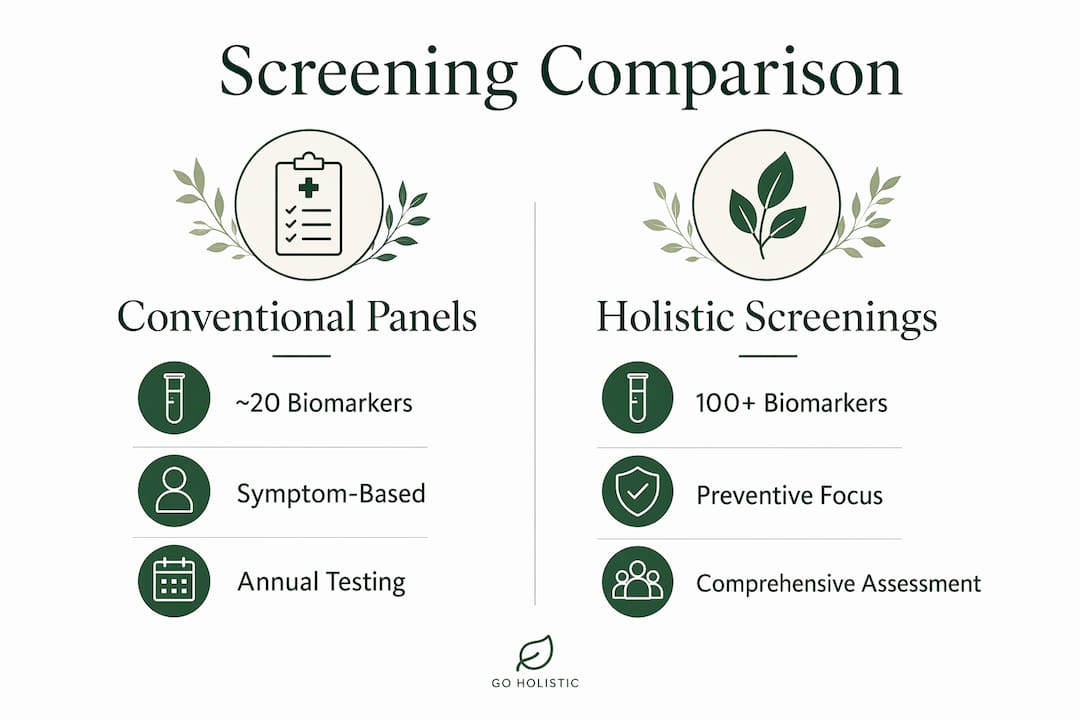
The gap between a standard annual lab panel and a comprehensive biomarker screening is wider than most people realize. Standard lab panels test roughly 20 markers, while comprehensive biomarker screenings assess over 100 markers covering interconnected physiological systems. That difference in scope translates directly into earlier risk detection, sometimes years before symptoms appear.
The table below shows how the two approaches compare across key dimensions:
| Feature | Conventional annual panel | Comprehensive holistic screening |
|---|---|---|
| Biomarkers tested | ~20 | 100+ |
| Mental health assessment | Rarely included | Directly integrated |
| Lifestyle and behavioral review | Minimal | Structured and detailed |
| Longitudinal trend tracking | Uncommon | Core feature |
| Personalized care planning | Generic | Tailored to individual risk profile |
| Early risk pattern detection | Limited | Years before symptom onset |
A common misconception is that anything labeled "holistic" sits outside mainstream medicine. That framing is outdated and inaccurate. Holistic health is an evidence-based whole-person science, not alternative medicine. It addresses biological, psychological, and social factors simultaneously, which is exactly what modern clinical guidelines increasingly recommend.
Internists and integrative medicine physicians now incorporate preventive screenings for complex and coexisting chronic conditions as standard practice. Mental health screening, lifestyle discussions, and personalized risk assessments based on age and family history are all part of what a thorough wellness visit looks like in 2026. The integrative health benefits of this model are well documented across peer-reviewed literature.
What are the long-term benefits of repeated holistic screenings?
A single lab result tells you where you stand today. A series of results tells you where you are headed. That distinction is the core value of longitudinal screening, and it changes how you and your care team make decisions.
Annual comprehensive screenings create longitudinal datasets that allow detection of subtle trends indicating early dysfunction. Consider fasting insulin as an example. Your result might sit comfortably within the normal reference range for three consecutive years. But if it rises 15% each year, that trend line predicts metabolic dysfunction long before any single reading triggers a clinical flag. A one-time snapshot would never show you that pattern.
Tracking your health over time gives you and your provider the ability to act at the right moment, not after the damage is done. The benefits of repeated assessments include:
- Personalized baselines that reflect your biology, not population averages
- Early trend detection for metabolic, cardiovascular, and hormonal markers
- Medication and supplement adjustments guided by real data rather than guesswork
- Accountability that motivates consistent lifestyle choices between visits
- Reduced chronic disease risk through timely intervention at the earliest signs of imbalance
Pro Tip: Ask your provider to graph your key biomarkers over time at each visit. Seeing a visual trend line makes the data far more meaningful than a single number on a lab report.
The primary advantage of this approach is its root-cause focus. It identifies patterns leading to imbalance before chronic disease develops. That is prevention in its most practical form.
How does the whole-person approach improve health outcomes?
The whole-person model at the heart of integrative health assessments is not a soft concept. It produces measurable results. Holistic care patients with pain experienced a 4% decrease in hospital costs per admission, averaging $898 saved per stay. Lower costs reflect better management, fewer complications, and patients who understand and follow their care plans.
That last point matters more than most people expect. Holistic health addresses biological, psychological, social, and behavioral dimensions simultaneously, leading to better patient satisfaction and improved adherence. When your care plan reflects your actual life, including your stress levels, sleep patterns, relationships, and work demands, you are far more likely to follow through with it.
Mental health is a critical piece of this picture that conventional screenings routinely miss. Patients often avoid reporting mood or social symptoms unless directly asked. A practitioner who builds mental health screening into the standard assessment removes that barrier. You do not have to volunteer that you have been anxious or exhausted for months. The screening asks.
"Holistic health is not about rejecting conventional medicine. It is about expanding what we measure, what we ask, and what we treat."
Routine preventive wellness visits that include mental health screening, lifestyle discussions, and personalized plans based on age and risk factors improve both detection rates and care alignment. The mind-body connection is not a metaphor in this context. It is a clinical reality that shapes how conditions develop and how well patients recover.
Medical guidelines increasingly require screening for co-occurring conditions, reflecting a broader shift toward non-siloed chronic disease management. The brain-heart connection, the gut-immune axis, the stress-metabolic link: these are now recognized as clinical priorities, not wellness trends. Holistic dental care follows the same logic, with oral health directly connected to cardiovascular and systemic health outcomes.
Key Takeaways
Holistic screenings detect hidden conditions, track trends over time, and integrate physical, mental, and social health to deliver preventive care that conventional panels cannot match.
| Point | Details |
|---|---|
| Early detection is the core value | Nearly 50% of middle-aged adults carry at least one undiagnosed condition that standard care misses. |
| Scope difference is significant | Comprehensive panels assess 100+ markers versus roughly 20 in a standard annual lab. |
| Trends matter more than snapshots | Longitudinal biomarker tracking reveals dysfunction years before a single test would flag it. |
| Mental health must be included | Patients rarely volunteer mood or social symptoms unless directly asked during a structured screening. |
| Cost savings are real | Holistic care patients average $898 saved per hospital admission through better chronic disease management. |
Why I think most people are getting their screenings wrong
I have spent years watching people treat their annual physical as a formality. They show up, get a basic panel, hear "everything looks normal," and leave feeling reassured. The problem is that "normal" on a 20-marker panel is a very low bar.
What I have seen change outcomes is not more frequent visits. It is deeper visits. When a practitioner sits with you long enough to ask about your sleep, your stress, your energy patterns, and your family history, and then orders a panel that reflects those conversations, the results are different. Not occasionally different. Consistently different.
The reluctance I see most often is not skepticism about the science. It is a quiet fear of finding something. People worry that a more thorough screening will uncover a problem they would rather not know about. I understand that instinct. But finding a rising fasting insulin trend at 42 is not bad news. It is the best possible news, because you still have time to act.
Proactive health management is not about anxiety. It is about confidence. When you know your numbers, understand your trends, and work with a practitioner who sees all of you, not just your symptoms, you make better decisions. You stop reacting and start planning. That shift is worth every extra marker on the panel.
Start your personalized wellness path with Goholistic
Goholistic connects you with verified, certified practitioners across disciplines including acupuncture, Ayurveda, massage therapy, and integrative medicine. The platform uses AI to match your health concerns with personalized holistic treatment options backed by evidence-based research summaries. You can browse a curated provider directory, filter by specialty, and book directly with licensed practitioners who take a whole-person approach to your care. Whether you are exploring preventive screenings for the first time or looking to deepen an existing wellness practice, Goholistic gives you the tools and the team to move forward with clarity. Find a holistic practitioner near you and take the first step today.
FAQ
What do holistic screenings actually include?
Holistic screenings assess physical biomarkers, mental health indicators, lifestyle factors, and social determinants of health together. They typically include 100+ lab markers, a structured mental health review, and a personalized risk discussion based on your age, history, and symptoms.
Do holistic screenings work for healthy people?
Yes. A 2026 cohort study found that nearly 50% of adults who felt healthy had at least one undiagnosed condition. Comprehensive screenings are most valuable precisely when you feel fine, because that is when early intervention is still possible.
How often should you get a holistic health assessment?
Annual screenings are the standard recommendation because they create the longitudinal trend data needed to detect subtle changes over time. A single assessment is useful, but repeated yearly screenings are what allow your provider to spot patterns early.
Are holistic screenings covered by insurance?
Many preventive wellness visits and associated lab panels are covered under standard insurance plans, particularly those aligned with CDC preventive care guidelines. Coverage for expanded biomarker panels varies, so checking with your insurer before scheduling is the practical first step.
Is holistic health the same as alternative medicine?
No. Holistic health is evidence-based whole-person science that integrates biological, psychological, and social factors. It works alongside conventional medicine, not in place of it, and is increasingly supported by mainstream clinical guidelines.