
TL;DR:
- Holistic prevention proactively cares for the whole person—body, mind, and environment—to reduce disease risk before symptoms arise. It focuses on root causes across physical, mental, emotional, social, and environmental dimensions, emphasizing lifestyle and behavior changes supported by strong evidence. Starting with one depleted pillar and maintaining consistency over weeks builds sustainable health habits that can significantly improve long-term well-being.
Holistic prevention is defined as the proactive practice of caring for the whole person — body, mind, and environment — to reduce disease risk before symptoms ever appear. Unlike conventional medicine, which often responds to illness after the fact, this approach draws on integrative prevention methods that address root causes across physical, mental, emotional, social, and environmental dimensions. The American Association of Naturopathic Medical Colleges (AANMC) describes it as a philosophy that combines modern clinical science with natural therapies and personalized treatment plans. The National Institutes of Health (NIH) supports this framing, noting that sustained healthy behaviors can reduce cardiovascular risk by up to 70%. That number tells you something important: prevention is not a supplement you add to your routine. It is the routine itself.
What is holistic prevention and its core components?
Holistic prevention works because it treats your health as a system, not a checklist. When one area weakens, others compensate, and over time that compensation creates its own problems. Understanding the core pillars helps you see where your own system may need attention.
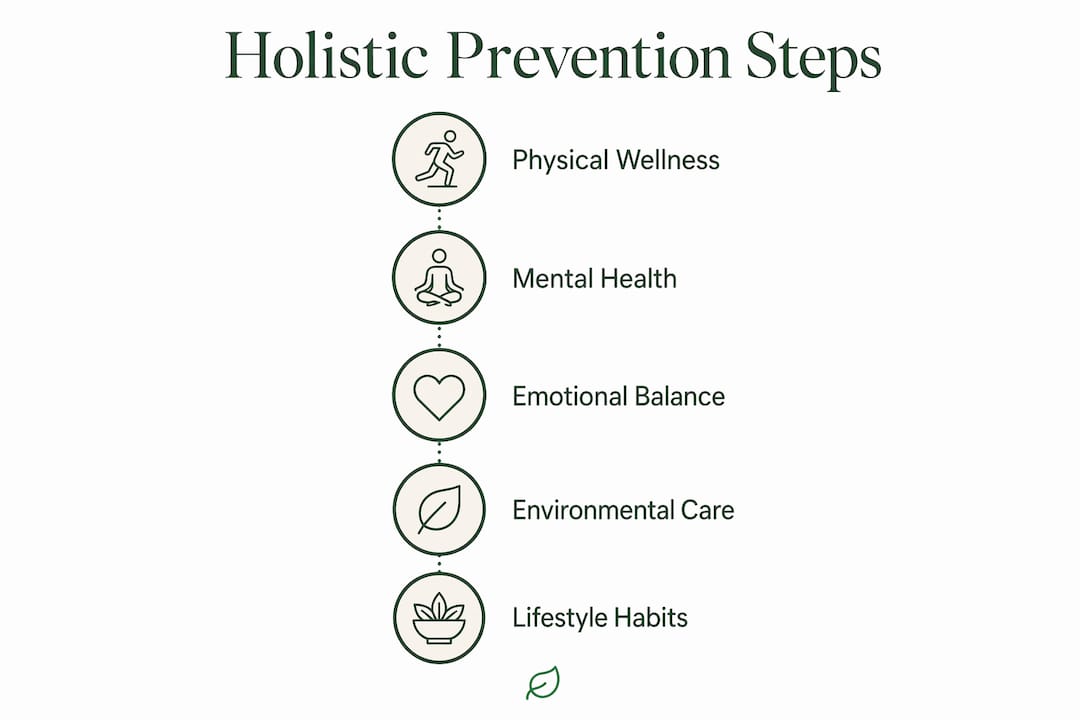
Physical wellness forms the most visible layer. This includes nutrition quality, consistent movement, and sleep hygiene. Each of these interacts with the others in measurable ways. Poor sleep raises cortisol, which disrupts appetite regulation, which undermines exercise recovery.

Mental and emotional health is equally structural. Chronic stress is not just uncomfortable. It physically degrades immune function, cardiovascular health, and cognitive performance. Practices like mindfulness, breathwork, and social connection are not soft add-ons. They are evidence-based wellness practices with documented physiological effects.
Environmental and social determinants round out the picture. The King's Fund describes successful prevention as creating "conditions for health" by treating social and environmental factors as critically as clinical ones. Housing stability, income security, neighborhood walkability, and community belonging all shape your baseline health risk in ways no supplement can override.
The core pillars of a holistic prevention approach include:
- Nutrition: Whole foods, gut-supportive fiber, and reduced ultra-processed intake
- Movement: A mix of aerobic, strength, and flexibility work tailored to your capacity
- Sleep: Consistent sleep and wake times, with a protected wind-down period before bed
- Stress regulation: Mindfulness, breathwork, journaling, or therapy depending on your needs
- Social connection: Regular meaningful contact with people who support your well-being
- Environmental awareness: Reducing toxic exposures and building supportive surroundings
Pro Tip: Start with the pillar that feels most depleted right now. Trying to overhaul all six at once is the fastest way to abandon all six. One strong root supports the whole tree.
How does holistic prevention differ from conventional preventive care?
Most people understand what is preventive care in the conventional sense: annual physicals, screenings, vaccines, and cholesterol checks. These are valuable. But they operate within a framework that is largely reactive, waiting for measurable risk markers to appear before intervening.
Holistic health approaches shift the timeline earlier and the scope wider. The Merck Manual notes that preventive care must be personalized to a patient's risk profile based on age, genetics, and environment, and that clinicians and patients should collaborate to prioritize interventions and avoid harm. That collaborative, personalized model is where conventional and holistic prevention begin to converge.
The table below captures the key structural differences:
| Dimension | Conventional prevention | Holistic prevention |
|---|---|---|
| Primary focus | Screening and risk markers | Root causes and whole-person health |
| Scope | Physical and clinical | Physical, mental, emotional, social, environmental |
| Personalization | Age and risk-based protocols | Genetics, lifestyle, values, and environment |
| Tools | Medications, vaccines, screenings | Lifestyle change, mind-body practices, natural therapies |
| Timeline | Responds to emerging risk | Builds health before risk appears |
| Prevention layer | Primary and secondary | Primordial through quaternary |
The concept of primordial prevention is worth pausing on. NIH research defines it as targeting social and environmental conditions to reduce disease risk at the population level, with examples like improving neighborhood walkability to lower obesity and cardiovascular risk. This is prevention operating at a scale that no prescription can reach. Holistic prevention borrows this systems-level thinking and applies it to individual lives.
Quaternary prevention, another layer rarely discussed in mainstream health conversations, focuses on protecting patients from unnecessary or harmful medical interventions. In a holistic framework, this means asking whether a treatment is truly needed before accepting it, and exploring non-pharmaceutical options first.
What evidence supports the effectiveness of holistic prevention?
The research base for holistic prevention has grown significantly over the past decade. The evidence is not fringe. It comes from NIH-backed studies, meta-analyses, and integrative care outcome data.
The cardiovascular finding alone is striking. Maintaining a combination of regular exercise, a balanced diet, no smoking, and normal weight, blood pressure, cholesterol, and glucose levels cuts cardiovascular risk by up to 70%. This means that lifestyle adherence, not medication, is the single most powerful lever most people have for their long-term heart health.
The mind-body connection has equally strong support. Yoga produces the largest cortisol reduction among studied exercise types, improving emotional resilience in ways that compound over time. Deep breathing practiced for as little as five minutes, up to five times daily, measurably lowers anxiety and depression markers. These are not anecdotal outcomes. They are reproducible findings.
"Holistic wellness routines build synergy between nutrition, movement, and mindfulness through biological pathways. The gut-brain axis and cortisol regulation reinforce emotional regulation and physical health in ways that no single intervention can replicate." — Science-Backed Wellness Research, 2026
Integrative care models, which combine conventional medicine with holistic therapies, show improved patient satisfaction and reduced unnecessary medication use. This matters because overmedication carries its own health risks. When mind, body, and behavior are treated together, patients often need less pharmaceutical intervention, not more.
| Evidence area | Finding | Implication |
|---|---|---|
| Cardiovascular health | Up to 70% risk reduction through lifestyle | Lifestyle is the most powerful preventive tool available |
| Cortisol and stress | Yoga produces the largest cortisol reduction | Mind-body practices belong in any prevention plan |
| Integrative care | Improved satisfaction, reduced medication use | Combining approaches outperforms either alone |
| Gut-brain axis | Diet, movement, and mindfulness create compounding effects | Prevention routines work better together than separately |
One area where holistic prevention requires honest acknowledgment is adherence. Lifestyle change is harder to sustain than taking a pill. The benefits are real, but they require consistency over weeks and months, not days.
How can you start practicing holistic prevention daily?
Understanding holistic health is one thing. Building it into your actual life is another. The good news is that you do not need to overhaul everything at once. Research on habit formation suggests that meaningful behavioral change takes eight to twelve weeks to stabilize. That timeline should feel freeing, not discouraging.
Here is a practical sequence for building your own prevention routine:
- Audit your current pillars. Spend one week noticing where you feel most depleted. Is it sleep? Energy? Mood? Social connection? Your weakest pillar is your starting point, not your most ambitious goal.
- Build one anchor habit. Choose a single daily practice that addresses your most depleted area. A ten-minute morning walk, a five-minute breathing exercise, or a consistent bedtime all qualify. Anchor it to something you already do.
- Add nutrition as a foundation. You do not need a perfect diet. You need a consistent one. Prioritize whole foods, reduce ultra-processed intake, and support your gut microbiome with fiber-rich vegetables and fermented foods. The gut-brain axis responds to dietary changes within days.
- Protect your evening window. Research from Vital Health Journal identifies the 60 to 90 minutes before sleep as critically important for recovery. Dimming lights, avoiding screens, and journaling in this window improves sleep quality more reliably than most supplements.
- Layer in movement and mindfulness. Once your sleep and nutrition anchors feel stable, add structured movement three to four times per week and a daily mindfulness or breathwork practice. Even five minutes of stress reduction exercises like box breathing or progressive muscle relaxation produces measurable results.
- Invest in social health. Schedule regular contact with people who energize rather than drain you. Social isolation is a documented health risk, and connection is a legitimate preventive measure.
Pro Tip: Track your habits for the first four weeks using a simple paper log or an app like Habitica or Streaks. Seeing your consistency builds the motivation to continue, especially during weeks when results are not yet visible.
Personalization matters throughout this process. The Merck Manual is clear that risk profiles should drive interventions to avoid overscreening or harm. What works for a 28-year-old managing work stress looks different from what works for a 55-year-old managing metabolic risk. Start where you are, not where someone else's plan begins.
For deeper guidance on holistic methods for chronic health, the Goholistic blog offers evidence-backed resources tailored to specific health concerns.
Key takeaways
Holistic prevention works because it addresses the full system of your health, not just the symptoms that surface when something goes wrong.
| Point | Details |
|---|---|
| Definition is whole-person | Holistic prevention covers physical, mental, emotional, social, and environmental health together. |
| Evidence is strong | Lifestyle adherence alone can reduce cardiovascular risk by up to 70%, per NIH research. |
| Differs from conventional care | It targets root causes and primordial risk factors, not just clinical markers. |
| Start with your weakest pillar | Identify the most depleted area first and build one anchor habit before adding more. |
| Evening window matters | Protecting the 60 to 90 minutes before sleep significantly improves overall recovery and health. |
Why I think most people misunderstand what prevention actually means
Most people hear "prevention" and picture a doctor's appointment or a vitamin bottle. After years of working in the wellness space, I have come to believe that framing is the single biggest obstacle to people actually getting healthier.
Prevention is not something you do once a year at a physical. It is the sum of your daily decisions, your sleep environment, your stress load, and the quality of your relationships. The research backs this up, but the research alone does not change behavior. What changes behavior is a shift in how you see yourself: not as someone managing illness, but as someone actively building health.
The hardest part is not finding the right practice. It is tolerating the lag between effort and visible results. Most people quit in weeks four through six, right before the compounding effects begin. I have seen this pattern repeatedly. The people who stay with it are not more disciplined. They are more patient, and they have a clear reason for doing it that goes beyond aesthetics or fear.
My honest advice: pick one practice that genuinely appeals to you, not one that sounds impressive. Consistency with something you mildly enjoy beats perfection with something you dread. And give it twelve weeks before you judge it.
— Andrew
Start your prevention journey with Goholistic
Goholistic is built for exactly this moment in your wellness journey. The platform connects you with verified holistic practitioners across disciplines including acupuncture, Ayurveda, massage therapy, and more. Its AI-powered tool analyzes your health concerns and delivers personalized treatment recommendations backed by research summaries, so you are not guessing where to start. You can browse the holistic treatments library covering over 200 therapy types, filter by your specific needs, and book directly with licensed providers. Whether you are just beginning to explore natural prevention or looking to deepen an existing practice, Goholistic gives you the tools and the support to move forward with confidence. Get started today at goholistic.health.
FAQ
What is holistic prevention in simple terms?
Holistic prevention is the practice of proactively caring for your whole self, including body, mind, and environment, to reduce disease risk before symptoms appear. It goes beyond screenings and medications to include lifestyle, stress management, and social well-being.
How is holistic prevention different from regular preventive care?
Conventional preventive care focuses on clinical screenings and risk markers, while holistic prevention addresses root causes across physical, mental, emotional, and environmental dimensions. The Merck Manual supports personalizing prevention to individual risk profiles rather than applying one-size-fits-all protocols.
What are the most evidence-backed holistic prevention practices?
Regular exercise, balanced nutrition, consistent sleep, and mindfulness practices like yoga and breathwork all have strong research support. NIH data shows that sustained healthy behaviors can reduce cardiovascular risk by up to 70%.
How long does it take to see results from holistic prevention?
Meaningful habit formation typically takes eight to twelve weeks to stabilize. Some benefits, like improved sleep quality and reduced cortisol, can appear within days of consistent practice.
Can holistic prevention replace conventional medical care?
Holistic prevention complements rather than replaces conventional care. Integrative care models that combine both approaches show improved patient outcomes and reduced unnecessary medication use, according to AANMC research.