

TL;DR:
- A wellness taxonomy classifies well-being into domains to personalize care and track progress effectively. Different models focus on physical, psychological, and social areas while confronting issues of standardization and cultural adaptability. Platforms like Goholistic translate taxonomy data into verified treatments, enabling evidence-based, personalized holistic care.
A wellness taxonomy is a structured, evidence-based classification system that organizes wellness into named domains, so you, your practitioner, or a platform like Goholistic can match you to care that fits your actual needs. Think of it as a shared map of human well-being, one that goes far beyond the absence of disease. The WHO's definition of health as "a state of complete physical, mental, and social well-being" is the most widely cited starting point, and most wellness taxonomies build directly from it.
Here is where a wellness classification system pays off in practice:
- Finding a matched practitioner: Domain scores point you toward the right specialty, whether that is acupuncture for physical recovery, counseling for psychological resilience, or Ayurveda for lifestyle balance.
- Structuring a personalized plan: Frameworks like Be Well Co's Taxonomy of Positive Mental Health and the Serene Life Wellness Classification System (SLWCS) translate broad goals into measurable priorities.
- Tracking progress over time: Scored outputs let you and your provider see whether a 3–6 month intervention is actually moving the needle, with HIPAA-aware data handling protecting your information along the way.
Table of Contents
- What does a wellness taxonomy actually contain?
- Common wellness taxonomy models and how they compare
- How to use a wellness taxonomy to find personalized holistic care
- How platforms like Goholistic put taxonomies to work
- U.S. privacy, HIPAA, and employer program considerations
- Limitations of current wellness taxonomies and where research is headed
- Key Takeaways
- Why taxonomy-driven care is more than a framework exercise
- Goholistic connects your taxonomy results to verified care
- Useful sources and further reading
What does a wellness taxonomy actually contain?
A wellness taxonomy organizes well-being into domains (broad areas of life), subdomains (specific facets within each area), and measurement outputs such as scores, archetypes, or risk strata. A systematic review of 44 wellness models found 379 unique domains that cluster into 13 themes. The six most common are physical, psychological, social, emotional, spiritual, and environmental, though occupational, financial, intellectual, and cultural dimensions appear in many modern frameworks too.
This is where wellness taxonomies part ways with clinical disease taxonomies. A medical ontology like SNOMED CT is built around diagnosis and pathology. Wellness taxonomies are multidimensional, continuous, and prevention-focused. Harmonization research confirms that some wellness concepts, such as spiritual wellness or hospitality, fall outside clinical vocabularies, which is why standalone wellness ontologies exist.
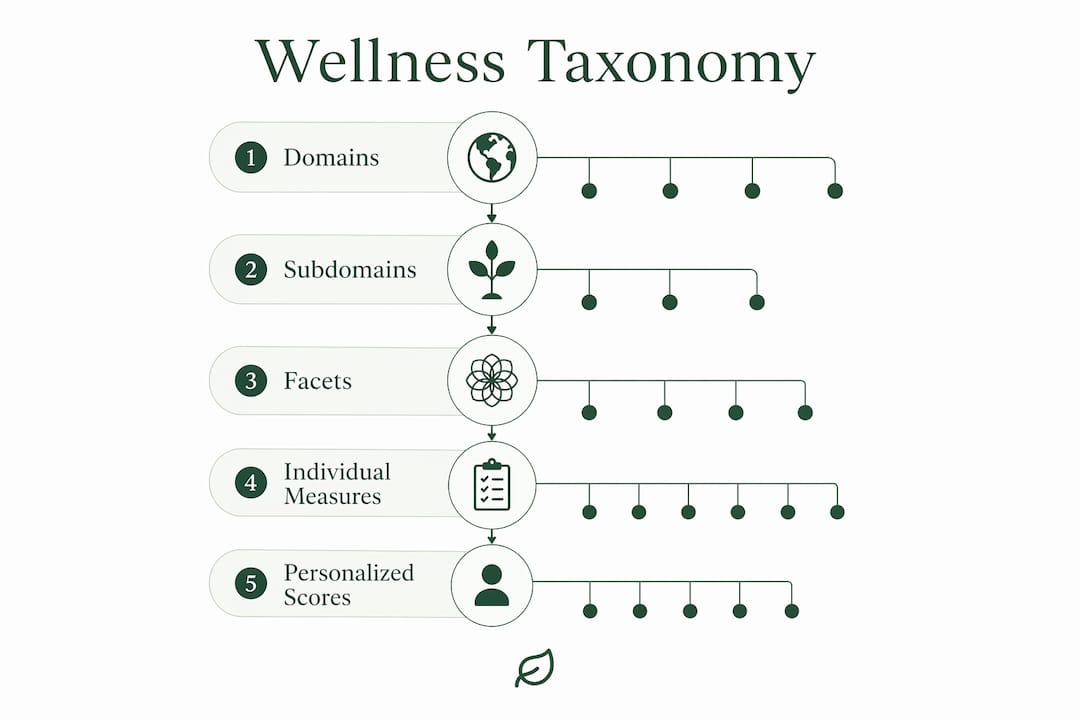
For you as an individual, a shared taxonomy means clearer provider searches, better-considered treatment plans, and the ability to track your own progress longitudinally rather than starting from scratch at every appointment. For practitioners, it creates a common language that makes collaborative wellness care across disciplines far more coherent.
Common wellness taxonomy models and how they compare
Three frameworks come up most often in U.S. practice and research: the Be Well Co taxonomy, the SLWCS, and employer-involvement frameworks used in corporate wellness programs.
Be Well Co organizes positive mental health into 19 dimensions under four pillars, designed explicitly for program design and measurement across researchers, governments, and workplaces. Its strength is the shared language it creates, letting organizations design targeted programs without expecting high scores across every dimension.

The Serene Life Wellness Classification System (SLWCS) takes a point-based, age-stratified approach, scoring individuals from 0 to 120 across five domains with life-stage stratification and culturally adapted components covering diet, sleep, activity, family history, and mental health. Practitioners report that SLWCS scores provide precise, longitudinal tracking of healthspan versus disease risk when paired with a structured assessment tool.
Employer-involvement frameworks used in U.S. corporate wellness programs classify initiatives into categories to manage program design and data flows, supporting HIPAA-aligned workflows and helping employers distinguish between participatory and health-contingent programs.
| Dimension | Be Well Co | SLWCS | Employer Framework |
|---|---|---|---|
| Scope / domains covered | 19 dimensions, 4 pillars (mental health focus) | 5 domains, age-stratified | Varies by employer; program-category focused |
| Evidence base | Research-led, advisory panel | Peer-reviewed, pilot-validated | Regulatory/legal guidance |
| Cultural & age adaptation | Limited age stratification | Built-in life-stage stratification | Minimal; program-type driven |
| Individual self-assessment | Yes, structured measurement | Yes, scored 0–120 | Typically employer-administered |
| Privacy & HIPAA fit | Designed for organizational use | Individual clinical use | Explicitly HIPAA-aligned |
| External validation | Published taxonomy | Published in IJNRD | Legal/compliance literature |
A mid-size U.S. employer might use an employer framework to classify its wellness initiatives for compliance, then layer in Be Well Co dimensions to measure mental health outcomes. An individual seeking personalized care would find SLWCS more useful because its numeric score translates directly into a care priority list.
How to use a wellness taxonomy to find personalized holistic care
Once you have a taxonomy output in hand, the practical steps are straightforward.
- Read your domain scores. Identify which areas score lowest. A score below the midpoint in the physical or psychological domain signals where to focus first.
- Prioritize one to two domains. Trying to address every dimension at once rarely works. Pick the domains with the greatest gap between your current score and your goal.
- Turn scores into a care plan. Map each priority domain to a treatment type. Physical recovery might point toward massage therapy or acupuncture; psychological resilience toward mindfulness-based practices or counseling.
- Ask your practitioner these questions: What evidence supports this modality for my specific domain? How will we measure progress? What is a realistic timeline? Are you verified or credentialed in this area?
- Schedule reassessments every 3–6 months. Lifestyle interventions typically need at least one full cycle before meaningful score changes appear.
Pro Tip: When taxonomy domains conflict, for example, a high physical need paired with low engagement readiness, address the engagement barrier first. A practitioner who ignores readiness and jumps straight to intensive physical protocols will see poor adherence. Start with a lower-intensity modality that builds confidence, then escalate.
Understanding wellness triage alongside taxonomy outputs helps you sequence care decisions rather than treating every domain as equally urgent.
How platforms like Goholistic put taxonomies to work
A well-designed platform does not just display a taxonomy. It operationalizes it. Goholistic uses a taxonomy-backed intake process to map your domain scores to specific therapy types and verified provider specializations, then surfaces evidence-linked treatment summaries so you can make informed decisions before you book.
Key features that translate taxonomy outputs into real care:
- AI-powered intake: Your responses map to domain scores, which feed the recommendation engine.
- Evidence-linked treatment library: Over 200 therapy types, each tied to research summaries, so you can see the evidence behind a recommendation.
- Verified provider directory: Practitioners are credentialed and verified before appearing in search results. Certified wellness providers carry trust signals that unverified directories simply cannot offer.
- Direct booking: No referral loops. You move from taxonomy output to booked consultation in one flow.
- Reassessment tracking: Your scores update over time, so the platform can surface new recommendations as your needs shift.
Because 85% of domain names across published models are uniquely worded, platforms like Goholistic perform a critical standardization role, translating disparate terminology into a curated, evidence-based library that makes sense to you regardless of which framework your practitioner uses.
Taxonomy data collected during intake qualifies as sensitive health information. Goholistic handles it with HIPAA-aware practices and explicit consent flows, so your data supports your care and nothing else.
U.S. privacy, HIPAA, and employer program considerations
Not all wellness taxonomy data is automatically protected under HIPAA. The rules depend on who collects the data and how it flows.
When a covered health care provider or health plan administers a taxonomy assessment, the resulting data is protected health information (PHI). When an employer administers a wellness program directly, the data may fall under a different regulatory framework, and protections can vary significantly.
Watch for these red flags:
- Wellness platforms that share assessment data with third parties without explicit consent
- Provider directories with no visible verification process
- Employer programs that require medical disclosures without clearly stating how that data is stored and who can access it
- Assessments that collect sensitive domain data (mental health, family history) without a visible privacy policy
Practical steps for staying protected:
- Ask any platform or employer program: "Is this data treated as PHI under HIPAA?"
- Request a copy of the privacy policy before completing any taxonomy assessment.
- Confirm that your practitioner's platform uses consented, encrypted data storage.
- For employer-sponsored programs, ask your HR team whether the wellness vendor is a HIPAA business associate.
Limitations of current wellness taxonomies and where research is headed
Wellness taxonomy research is genuinely promising, but the field has real gaps worth knowing about.
The most significant is the lack of standardization. A systematic review found that 85% of domain names across 44 published models were unique in their exact wording, making cross-platform comparison difficult. No global consensus on domains has been reached, and most models are presented at a single taxonomic level with roughly five domains, which limits the granularity available for complex cases.
One-size-fits-all taxonomies also fail across cultures and life stages. A framework built on Western dietary norms or age-homogeneous samples will produce misleading scores for someone whose cultural background, life stage, or health history falls outside those assumptions. SLWCS addresses this directly with its age-stratified, culturally adapted scoring, and the whole-body wellness approach emerging in consumer wellness content reflects the same demand for more nuanced, context-sensitive frameworks.
Research priorities going forward include building consensus archetypes that allow consistent benchmarking across providers, developing interoperable measurement standards, and conducting more external validation studies on existing frameworks. The International Classification of Wellness (ICW), managed by the Wellzesta Health Research Institute, recently added a ninth dimension, Cultural Wellness, reflecting this kind of adaptive evolution.
Key Takeaways
A wellness taxonomy gives you a structured, evidence-backed way to identify your priorities, find matched practitioners, and track whether your care is actually working.
| Point | Details |
|---|---|
| Core definition | A wellness taxonomy classifies well-being into named domains so care can be personalized and measured. |
| Domain variability | A systematic review found numerous unique wellness domains across many models; physical, psychological, and social domains are the most common. |
| Reassessment cadence | Plan to reassess domain scores every 3–6 months to track progress from lifestyle interventions. |
| Standardization gap | 85% of domain names are uniquely worded across models, making cross-platform comparison a known challenge. |
| Goholistic application | Goholistic maps taxonomy outputs to verified practitioners and an evidence-linked library of over 200 therapy types. |
Why taxonomy-driven care is more than a framework exercise
Most wellness content treats taxonomies as academic scaffolding, something researchers build and practitioners occasionally reference. That framing undersells what a good classification system actually does for you.
The real value is not the taxonomy itself. It is the moment when a scored output tells you that your psychological domain is significantly lower than your physical domain, and you realize you have been booking massage appointments when what you actually needed was a mindfulness-based stress reduction program. That redirection, grounded in evidence rather than intuition, is what separates a taxonomy-driven approach from generic wellness advice.
What concerns me about the current state of the field is the gap between the research and what most platforms deliver. The systematic review evidence is clear: no consensus exists, domain names are inconsistent, and most frameworks lack external validation. Yet many wellness apps present their intake questionnaires as if they were validated clinical instruments. Consumers deserve to know the difference between a rigorously validated framework like SLWCS and a proprietary quiz with no published methodology.
The most trustworthy platforms are the ones that show their work: citing the research behind their taxonomy, verifying their practitioners, and being transparent about what their scoring actually measures. That is the standard worth holding every provider to.
Goholistic connects your taxonomy results to verified care
Your taxonomy scores are only as useful as the practitioners and treatments you can access with them. Goholistic was built to close that gap. The platform's AI-powered intake maps your domain priorities to evidence-based treatments drawn from a library of over 200 therapy types, each backed by research summaries you can read before you book.
Every practitioner in the Goholistic directory is verified and credentialed, so you are not left guessing whether the person you are booking has the background your taxonomy results call for. From acupuncture and Ayurveda to massage therapy and beyond, the directory covers the full range of holistic disciplines. Your data stays private, handled with HIPAA-aware practices and explicit consent at every step.
Ready to put your wellness priorities into action? Browse verified holistic practitioners or explore the full treatment library to find the modality that fits your needs today.
Useful sources and further reading
These are the primary research sources used throughout this article. Each one is worth bookmarking if you want to go deeper.
- Assessing the structures and domains of wellness models: A systematic review — International Journal of Wellbeing. The most comprehensive review of wellness model structures available. Pooled 44 models, identified 379 unique domains, and proposed an archetype for future standardization. Essential reading for practitioners building or evaluating a taxonomy.
- Taxonomy of Positive Mental Health — Be Well Co. Describes the 19-dimension, four-pillar framework designed for program design and measurement across organizations. Useful for employers and researchers designing mental health-focused wellness programs.
- The Serene Life Wellness Classification System (SLWCS) — IJNRD. Peer-reviewed description of the 0–120 point-based, age-stratified scoring system. Practitioners will find the life-stage stratification and longitudinal tracking methodology particularly practical.
- Taxonomy: Health & Wellness Programs (Part II) — Burr & Forman. Legal analysis of how U.S. employers classify wellness initiatives for HIPAA compliance. Indispensable for HR teams and benefits administrators designing employer-sponsored programs.
- Clinically harmonized wellness concepts — UCLab/KHU. Explains why wellness concepts like spiritual health fall outside SNOMED CT and how standalone wellness ontologies bridge that gap. Relevant for practitioners working at the intersection of integrative and conventional medicine.
- International Classification of Wellness (ICW) — NCBO BioPortal. The public OWL ontology for classifying wellness activities and correlating engagement with health outcomes. A practical reference for developers and researchers building interoperable wellness tools.