

TL;DR:
- Certified wellness providers meet verified standards for education, clinical training, and ethics, ensuring accountability.
- Their credentials are issued by independent bodies like NBHWC and NCCAOM, unlike unregulated influencers with no liability.
Certified wellness providers are professionals who have met independently verified standards for education, clinical training, and ethical practice. That distinction matters more than ever when 54% of Americans say it is difficult to judge which health information is trustworthy amid conflicting messages online. Understanding why trust certified wellness providers comes down to one core fact: certification creates accountability that social media advice simply cannot. Bodies like the National Board for Health & Wellness Coaching (NBHWC) and the National Certification Commission for Acupuncture and Oriental Medicine (NCCAOM) set the bar for what qualifies as real, verifiable expertise in the wellness space.
Why trust certified wellness providers over other sources?
Certification in the wellness industry is a formal credential issued by an independent accrediting body after a practitioner meets specific education, examination, and ethical requirements. It is not a self-applied title. Anyone can call themselves a "wellness expert" online, but a certified provider has passed external review.
The credential process typically covers three pillars:
- Accredited education: Practitioners complete programs built around recognized curricula in their specialty, whether that is acupuncture, health coaching, Ayurveda, or massage therapy.
- Rigorous examination: NBHWC certification requires passing a standardized exam that tests knowledge of evidence-based behavioral frameworks and validated behavior-change methods.
- Continuing education: Certified providers must complete ongoing training to maintain their credentials. This keeps their knowledge current and their practice safe.
Ethical codes are the third layer of accountability. Certified providers agree to professional standards that are enforceable by their certifying body or state licensing board. Violating those standards carries real consequences, including license suspension or revocation.
Pro Tip: Ask any wellness provider which certifying body issued their credential and whether it requires continuing education. A legitimate provider will answer both questions without hesitation.

Are certified providers more trustworthy than wellness influencers?
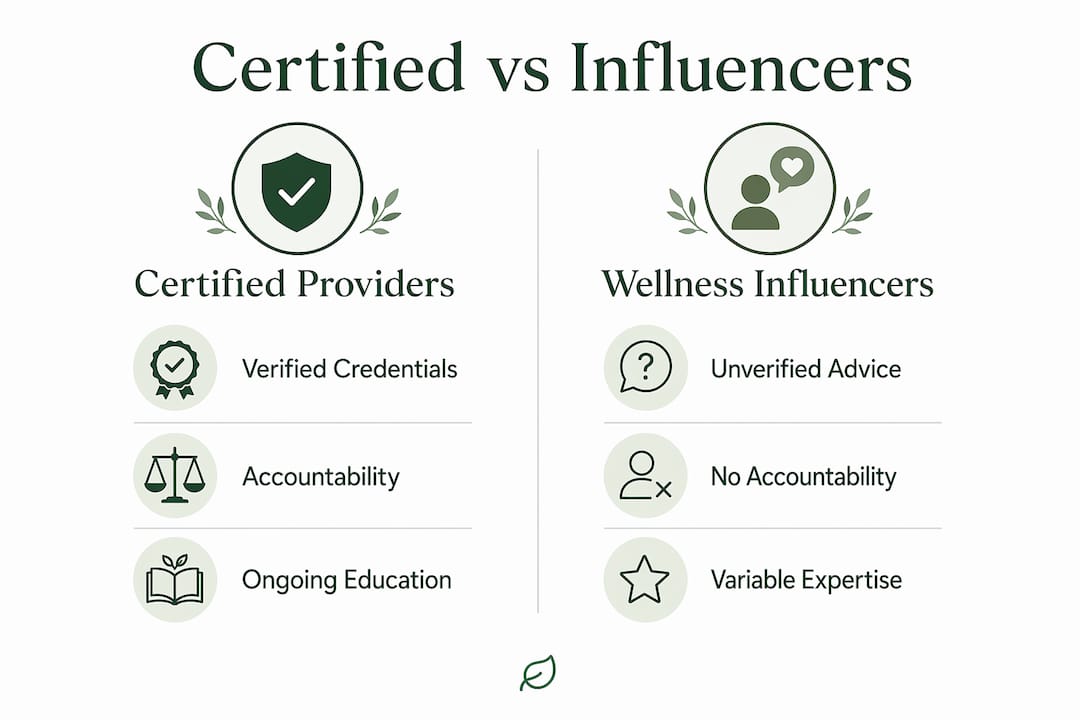
The gap between a certified provider and a wellness influencer is not a matter of style. It is a matter of legal and professional accountability.
Only 17% of prominent health and wellness influencers on social media are licensed medical professionals. The rest, including those who describe themselves as "professionals," are largely coaches or entrepreneurs with no clinical training and no formal oversight. That means their advice carries no professional liability.
Certified providers operate under a completely different framework. Consider what that difference looks like in practice:
- Formal training: A certified acupuncturist completes hundreds of supervised clinical hours before earning NCCAOM credentials. An influencer posting acupressure videos may have watched a weekend tutorial.
- Legal accountability: State-licensed practitioners can face board complaints, fines, or loss of license for harmful advice. Influencers face no equivalent consequence.
- Scope of practice clarity: Truly credentialed practitioners are explicit about what they can and cannot treat, and they refer clients to conventional medical care when needed.
- Ethical enforcement: Certified providers are bound by codes enforceable by legal and professional bodies. Influencers face no such liability.
"Social media influencers often lack professional or legal liability, while certified providers are accountable, providing an added layer of client safety. That accountability is not incidental. It is the structural difference between a professional relationship and a content strategy."
The stakes are real. When you follow unverified wellness advice, you carry all the risk. When you work with a certified provider, the accountability is shared.
What credentials and accrediting bodies should you look for?
Knowing which certifications carry weight is the practical starting point for choosing a trustworthy provider. Not all credentials are equal, and the issuing body matters as much as the title itself.
| Credential | Issuing Body | Specialty Area | Key Requirement |
|---|---|---|---|
| NBC-HWC | National Board for Health & Wellness Coaching (NBHWC) | Health and wellness coaching | Accredited training program plus standardized exam |
| Dipl. Ac. / Dipl. O.M. | National Certification Commission for Acupuncture and Oriental Medicine (NCCAOM) | Acupuncture and Oriental medicine | Graduate-level education plus clinical hours and board exams |
| LMT | State licensing boards | Massage therapy | State-approved program plus licensure exam |
| RYT (200/500) | Yoga Alliance | Yoga instruction | Registered training program with logged teaching hours |
Key accrediting bodies like NCCAOM and NBHWC signal that a practitioner has met external quality standards. State licensure adds another layer because it means a government body has also reviewed and approved the practitioner's qualifications.
NBHWC-certified health coaches are trained in validated behavior-change frameworks, which means their coaching methods are grounded in research, not personal opinion. That distinction directly affects the quality of guidance you receive.
Pro Tip: Cross-check a provider's credential on the certifying body's official website. NCCAOM and NBHWC both maintain public verification databases where you can confirm active certification status in minutes.
How do you verify and choose a certified wellness provider?
54% of Americans struggle to identify trustworthy health information. That number reflects a real problem: the wellness space is crowded, and not every provider listing credentials online actually holds them. Verification is a short process that protects you significantly.
Here is how to approach it:
- Search the certifying body's database. NCCAOM, NBHWC, and most state licensing boards offer free public lookup tools. Enter the provider's name and confirm their credential is active, not expired or lapsed.
- Ask about their training program. A credentialed provider can name the accredited program they completed. Vague answers like "I've studied this for years" are a red flag.
- Confirm their scope of practice. Ask directly: "What conditions do you work with, and when would you refer me to a doctor?" A trustworthy provider gives a clear, bounded answer.
- Check for disciplinary history. State licensing boards publish disciplinary actions. A quick search can reveal complaints or sanctions against a provider.
- Look for signs of practitioner quality beyond the credential itself, including professional affiliations, peer referrals, and transparent intake processes.
Red flags to watch for include providers who dodge questions about their training, claim to treat conditions outside their specialty, or pressure you to commit to long-term packages before a first session. Practitioners using professional titles without standardized medical training pose real risks, and credential transparency is your first line of defense.
Verifying credentials before your first session takes less than 15 minutes and removes the guesswork from one of the most personal decisions you can make about your health. For those navigating both wellness and conventional care, resources like Carexroads can help you understand how certified professionals fit into a broader care plan that includes hospital-to-home transitions and senior care options.
85% of Americans who seek health information from healthcare providers find it highly accurate. That trust is earned through exactly the kind of accountability structures that certification creates.
Key Takeaways
Certified wellness providers are the most reliable choice for holistic health guidance because their credentials are verified by independent bodies, their practice is governed by enforceable ethical codes, and their training is grounded in evidence-based methods.
| Point | Details |
|---|---|
| Certification means accountability | Certified providers face real consequences for misconduct; uncertified influencers do not. |
| Accrediting bodies set the standard | NBHWC and NCCAOM are the benchmark credentials to look for in coaching and acupuncture. |
| Verification is fast and free | Use official certifying body databases to confirm active credentials before booking. |
| Scope of practice signals integrity | Trustworthy providers clearly state what they treat and when to seek conventional care. |
| Influencer advice carries no liability | Only 17% of health influencers are licensed professionals; the rest have no formal oversight. |
Certification matters more than most people realize
I have spent years watching people make wellness decisions based on the most confident voice in the room, not the most qualified one. That pattern is understandable. Confidence is visible. Credentials require effort to check.
What changed my perspective was seeing how differently certified and uncertified providers handle the same situation: a client with a symptom that falls outside their specialty. A certified provider stops, explains their limits, and refers the client elsewhere. An uncertified influencer keeps going because there is no system telling them to stop. That boundary is not just professional courtesy. It is the mechanism that keeps people safe.
The wellness industry has a real credibility problem, and it is not going away on its own. The solution is not to distrust all alternative health practices. Many of them, including acupuncture, health coaching, and Ayurveda, have strong evidence bases when delivered by trained practitioners. The solution is to demand the same verification from wellness providers that you would from any other healthcare professional.
Certification is not a guarantee of a perfect outcome. But it is a guarantee that someone other than the provider has reviewed their qualifications and found them adequate. That external check is worth more than any number of five-star reviews or follower counts.
— Andrew
Goholistic connects you with verified wellness providers
Finding a certified wellness provider should not feel like a research project. Goholistic is built to make that process straightforward and trustworthy.
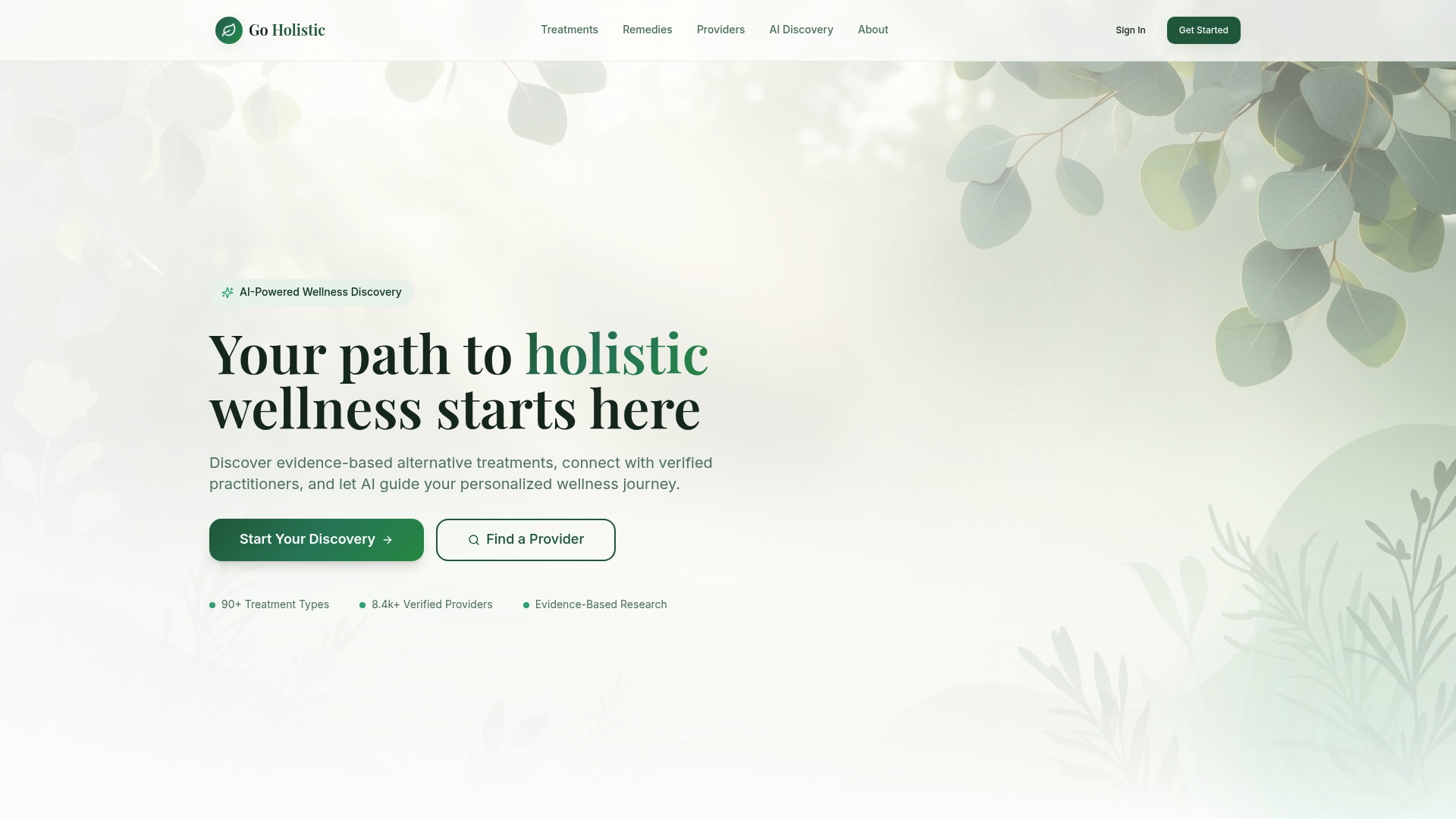
The platform verifies practitioners across disciplines including acupuncture, massage therapy, Ayurveda, and health coaching before listing them in its directory. You can browse certified holistic practitioners by specialty and location, read practitioner profiles that include credential details, and book directly without leaving the platform. Goholistic also hosts a treatment library covering over 200 therapy types, each supported by evidence-based research summaries. Whether you are new to alternative wellness or looking to deepen an existing practice, Goholistic gives you a clear, safe starting point.
FAQ
What makes a wellness provider "certified"?
A certified wellness provider has completed an accredited training program, passed a standardized examination, and agreed to an enforceable code of ethics issued by a recognized body such as NBHWC or NCCAOM. Certification is not self-assigned; it requires external review and ongoing continuing education.
How do I verify a wellness provider's credentials?
Search the certifying body's official public database, such as the NCCAOM or NBHWC verification tools, using the provider's name. You can also check your state licensing board's website for active licensure status and any disciplinary history.
Are certified wellness providers safer than social media influencers?
Yes. Certified providers are legally and professionally accountable for the advice they give, while influencers face no equivalent liability. Only 17% of prominent health influencers are licensed medical professionals.
What are the most recognized certifications in holistic wellness?
The NBHWC credential for health coaching and the NCCAOM Diplomate credential for acupuncture are among the most rigorous and widely recognized. State licensure in massage therapy and yoga instructor registration through Yoga Alliance are also meaningful markers of verified training.
What are red flags when choosing a wellness provider?
Red flags include vague answers about training, claims to treat conditions outside their stated specialty, inability to name their certifying body, and pressure to commit financially before an initial consultation. A certified practitioner checklist can help you evaluate any provider systematically before your first session.