
TL;DR:
- Verifying a holistic health practitioner's credentials through direct contact with official sources is crucial to ensure safety and reliability. Skipping this step can lead to substandard care, financial loss, and legal issues due to unregulated or unqualified providers. Regular license checks help maintain trust and protect your well-being throughout ongoing practitioner relationships.
Trusting someone with your health is a significant decision. Yet many people searching for acupuncture, Ayurveda, or massage therapy assume that if a practitioner has a website and glowing reviews, they must be qualified. That assumption can be costly. Understanding why verify practitioners matters is one of the most protective steps you can take as a natural health seeker. This article covers what practitioner verification actually means, the real risks of skipping it, and the specific steps you can take today to confirm that the person guiding your wellness is genuinely qualified to do so.
Table of Contents
- Key takeaways
- Why verify practitioners: what the process actually involves
- The real stakes of skipping verification
- The wellness industry's credibility gap
- How to verify practitioners yourself
- Verified vs. unverified practitioners: what each means for you
- My honest take on verification in holistic care
- Find verified holistic practitioners with Goholistic
- FAQ
Key takeaways
| Point | Details |
|---|---|
| Credentials are not self-evident | A polished profile or impressive title does not confirm that a practitioner holds valid, current licenses. |
| Errors are surprisingly common | Up to 15% of credential applications contain errors that can directly affect the care you receive. |
| Verification takes minutes | You can check most practitioners through official state board websites with just a name and license number. |
| Online directories are unreliable | Over 80% of listed providers in some directories are inaccurate or unavailable, making independent checks critical. |
| Holistic fields carry unique risk | Many wellness titles like "coach" or "mentor" carry no licensing requirement, so independent verification is your responsibility. |
Why verify practitioners: what the process actually involves
Before you can appreciate why this matters, it helps to understand what verification actually is. Primary source verification, often called PSV, means confirming a practitioner's credentials directly with the original issuing authority, not from a copy they hand you, not from their website bio, and not from a third-party directory. That means contacting state medical boards, accredited educational institutions, or national certification bodies directly.
The credentials typically verified through PSV include:
- State-issued professional licenses
- Board certifications and specialty designations
- Educational degrees from accredited programs
- Malpractice history and disciplinary records
- Current licensure status, including any restrictions
What makes PSV different from simply asking a practitioner to show you their certificate is the source. A paper copy of a license can be outdated, altered, or simply misrepresented. Licensure is not static. A practitioner who held a valid license two years ago may have had it suspended or restricted since then, and a certificate on their wall will not tell you that.
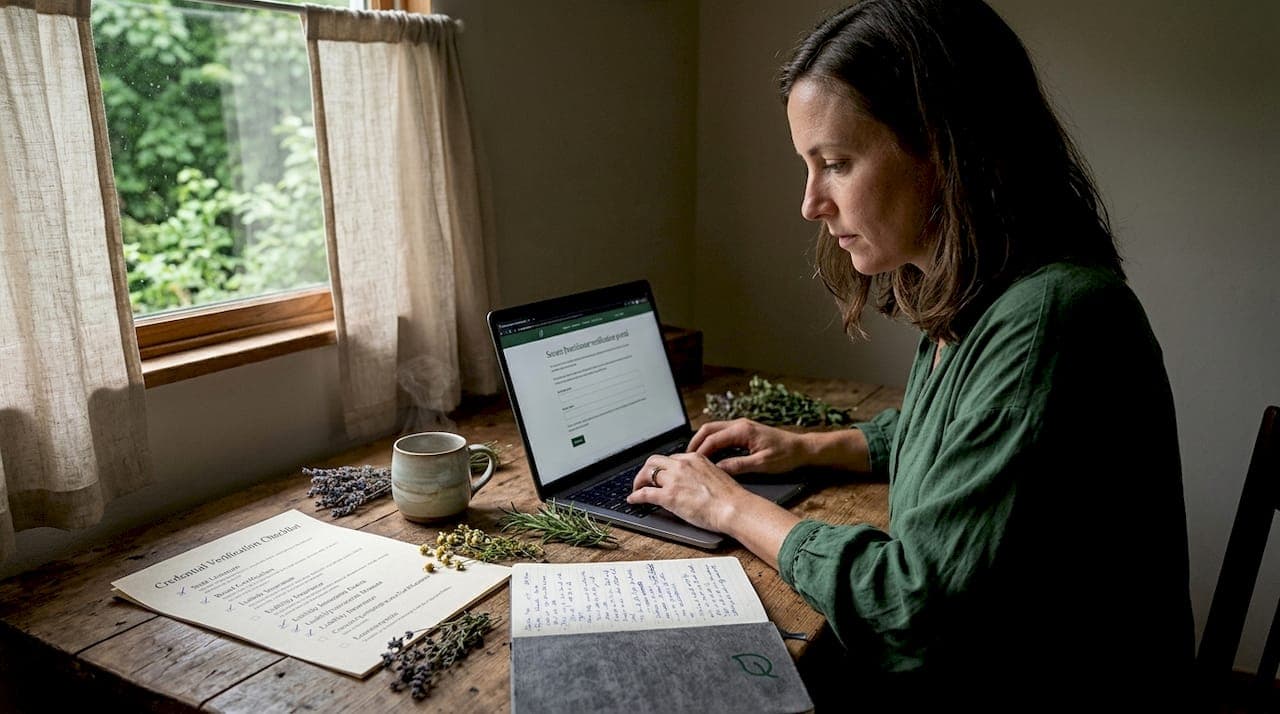
The good news is that technology has made this process far more accessible than most people realize. You can verify licenses online through state medical board websites in minutes, typically by entering a practitioner's name and license number. What once took weeks of paperwork and phone calls now takes a short lunch break.
Pro Tip: Before booking any holistic health appointment, ask the practitioner directly for their license number and licensing state. Then look it up yourself on the relevant state board website. This single step takes under five minutes and confirms their credentials at the source.
The real stakes of skipping verification
Verification is not a formality. Credentialing errors affecting patient care are found in up to 15% of applications, and the consequences range from substandard care to genuine harm. For natural health seekers, this matters just as much as it does in conventional medicine.
Consider the financial side as well. Insurance claims tied to unverified providers face a 12 to 15% denial rate, meaning you could pay out of pocket for sessions that should have been covered. And the errors are not always obvious. A single misspelling in a license number or a lapsed renewal can quietly ripple through your coverage without you realizing it until the bill arrives.
The risks worth keeping in mind when you skip the practitioner validation process include:
- Receiving care from someone who lacks the training to safely perform a technique
- No recourse if something goes wrong, since unlicensed practitioners fall outside regulatory oversight
- Financial loss from denied insurance claims or wasted sessions on ineffective advice
- Delayed access to genuinely helpful care while recovering from a poor experience
Ongoing monitoring of license status matters because a practitioner's standing can change at any time. Regulatory bodies track disciplinary actions, malpractice settlements, and license renewals continuously. What was valid at your first session may not be valid at your tenth.
Pro Tip: Do not rely solely on a one-time check. If you are seeing a practitioner regularly, revisit their license status every six to twelve months through the official state board website. This takes about two minutes and keeps you protected over time.
Beyond individual harm, verification builds the foundation of trust that every good healthcare relationship requires. When a platform or organization openly verifies its practitioners, it signals that accountability is built into the experience, not just promised in a tagline.
The wellness industry's credibility gap
The natural health space is genuinely wonderful in many ways. It offers real alternatives, real relief, and practitioners who are deeply committed to their clients' wellbeing. But it also has a credibility gap that other healthcare fields do not face to the same degree.
Many wellness titles carry no licensing requirement whatsoever. The words "coach," "guide," "mentor," or even "Dr." can appear in a bio without reflecting any state-mandated clinical qualification. Online wellness figures frequently lack the formal oversight that licensed clinicians are held to, and social media presence is not a substitute for verifiable credentials.
"Legitimate professionals are accountable to state licensing boards. Unregulated online wellness figures lack this accountability entirely." This distinction is not a technicality. It determines whether you have any recourse if something goes wrong.
This gap becomes especially clear in mental health and wellness directories. More than 80% of provider listings in some directories are either inaccurate or unavailable to patients, meaning the person listed may not be practicing, may not be in-network, or may not hold the credentials the listing implies.
The importance of verifying practitioners in holistic healthcare is heightened because the field is less uniformly regulated than, say, surgery or pharmacy. A licensed acupuncturist is accountable to their state board. A self-described "energy healer" may not be accountable to anyone. That does not make all unlicensed practitioners harmful, but it does mean you are taking on more risk without the same legal protections when something goes wrong.
How to verify practitioners yourself
The benefits of practitioner verification are clearest when you know how to actually do it. Here is a straightforward process you can follow before your next holistic health appointment.
- Ask for their license number and licensing state. Any qualified practitioner will provide this without hesitation. Reluctance to share this information is itself a red flag.
- Go directly to the state licensing board website. Each state maintains a public lookup tool. Search by name and license number to confirm current, active status.
- Check for disciplinary history. Most state board websites include publicly accessible disciplinary records, not just licensure status. Read through any complaints, suspensions, or sanctions.
- Verify educational credentials if relevant. For practitioners in fields like naturopathy or Ayurveda, contact the institution directly or check whether the degree comes from an accredited program recognized by the relevant professional body.
- Look up professional association membership. Bodies like the National Certification Commission for Acupuncture and Oriental Medicine (NCCAOM) maintain searchable membership databases. Membership does not replace state licensure but adds another layer of confirmation.
- Ask direct questions at your consultation. A confident, ethical practitioner will welcome questions about their training, supervision history, and scope of practice. Vague or defensive answers warrant further investigation.
For a deeper look at what to check before committing to a holistic health provider, the certified practitioner checklist at Goholistic covers the key verification steps tailored specifically for wellness consumers.
Pro Tip: Search the practitioner's full name alongside the word "complaint" or the name of your state in a general web search. This is not a substitute for official checks, but it can surface news articles, forum posts, or regulatory announcements that a standard license lookup would not show.
Verified vs. unverified practitioners: what each means for you
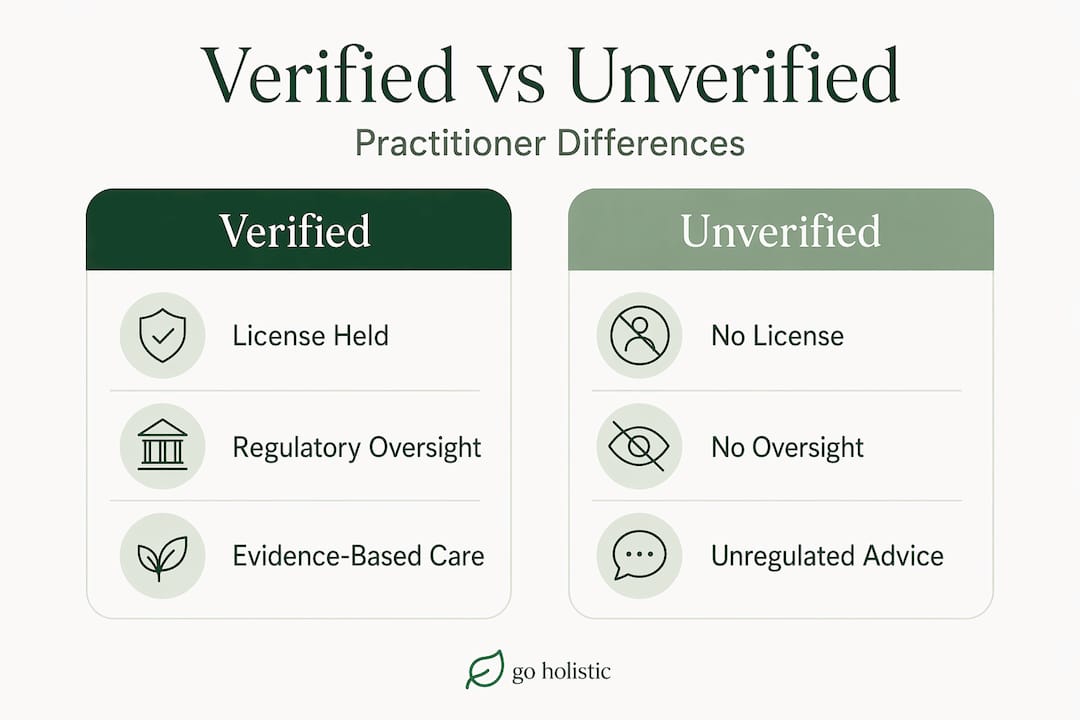
The difference between a licensed practitioner and an unregulated wellness advisor is not just a matter of paperwork. It affects the safety, effectiveness, and legal protection of every session you attend.
| Factor | Verified licensed practitioner | Unregulated wellness advisor |
|---|---|---|
| Credentials | State-issued license, verified by issuing board | Self-reported certifications, no state oversight |
| Accountability | Answerable to state licensing board | No formal accountability body |
| Disciplinary records | Publicly accessible via state board | Not available |
| Scope of practice | Legally defined and enforced | Self-defined, no legal boundaries |
| Insurance coverage | Often covered by health insurance plans | Rarely covered; denial risk is higher |
| Legal recourse if harmed | Complaint process through state board | Limited to civil litigation only |
| Ongoing monitoring | License renewals, continuing education required | No renewal or continuing education standards |
The picture this table paints is not meant to dismiss unlicensed wellness practitioners entirely. Some are caring, knowledgeable, and genuinely helpful. But the structure around licensed practice, with its oversight, continuing education requirements, and public accountability, gives you protections that simply do not exist outside of it. That structure matters most when things go wrong.
For guidance on how transparency in wellness shapes evidence-based choices, Goholistic has published detailed resources on making informed decisions in holistic healthcare.
My honest take on verification in holistic care
I've spent years watching people navigate the wellness space, and the pattern I see most often is not recklessness. It's trust misplaced in the wrong signals. A polished Instagram presence, a long list of client testimonials, a title with "Dr." attached to it. These feel reassuring. I understand why. But I've seen people spend months and real money on advisors who had no verifiable credentials, no oversight, and no accountability when the advice turned out to be wrong or even harmful.
What I've learned is that verification is not about distrust. It's about giving trust to the right people. A genuinely qualified practitioner will welcome your questions. They will tell you their license number, name their accrediting body, and explain their scope of practice clearly. The ones who resist that transparency are showing you something important.
The holistic health field has extraordinary practitioners doing genuinely meaningful work. Verification is how you find them with confidence, instead of hoping you got lucky. In my view, skipping this step is the single largest avoidable risk in the wellness space. The process takes minutes. The protection it gives you lasts as long as you are in that person's care.
— Andrew
Find verified holistic practitioners with Goholistic
Ready to put your verification knowledge to work? Goholistic was built precisely for this moment.
The platform connects you with verified holistic practitioners across disciplines including acupuncture, massage therapy, Ayurveda, and more, with practitioner verification built into the discovery process from the start. You can browse, filter, and book consultations knowing that credentials have already been checked. Explore over 200 therapy types in the holistic health treatments library, each supported by evidence-based research. Whether you are starting your natural health path or deepening it, Goholistic gives you the transparency and confidence to move forward. Get started today.
FAQ
What does it mean to verify a practitioner?
Verifying a practitioner means confirming their credentials directly with the original issuing authority, such as a state medical board, rather than relying on documents they provide. This process checks licensure, certifications, education, and any disciplinary history.
Why is verifying holistic health practitioners especially important?
Many wellness titles carry no state licensing requirement, meaning anyone can call themselves a coach or wellness advisor without formal oversight. Verification confirms that your practitioner holds a legitimate, current credential and is accountable to a regulatory body.
How do I verify a practitioner's license quickly?
Ask the practitioner for their license number and state, then search the relevant state board's public lookup tool. Most state boards allow you to confirm active licensure status within minutes.
What are the risks of seeing an unverified practitioner?
Risks include receiving substandard or harmful care, having no legal recourse if something goes wrong, and facing denied insurance claims. Credentialing errors affect up to 15% of applications, making independent checks worth the effort.
Can a practitioner's credentials change after I first verify them?
Yes. Licensure status is dynamic and can be suspended or restricted at any point. Check a practitioner's status periodically, especially for ongoing care relationships, to make sure their credentials remain active and in good standing.