

TL;DR:
- Practitioner accreditation verifies the standards of training programs and institutions, not individual practitioners. Certification confirms an individual's competency and must be renewed regularly through ongoing education, while accreditation is an ongoing quality review process for organizations. For holistic health practitioners, accreditation enhances credibility, legal compliance, and client trust, making it essential for establishing a reputable practice.
If you've ever tried to explain your credentials to a new client and stumbled over the difference between being certified and being accredited, you're not alone. What is practitioner accreditation, exactly, and how does it differ from the certification you worked hard to earn? These two terms get mixed up constantly in holistic health circles, and the confusion can quietly undermine your professional credibility. This article cuts through the noise, giving you a clear understanding of both concepts, why accreditation matters more than most practitioners realize, and how to make sure you're building your practice on the strongest possible foundation.
Table of Contents
- Key takeaways
- What practitioner accreditation actually means
- Accreditation vs. certification: understanding the difference
- Why accreditation matters for holistic health practitioners
- How to become accredited or join accredited programs
- Trends shaping practitioner accreditation in 2026
- My perspective on accreditation and holistic health standards
- Find accredited holistic practitioners on Goholistic
- FAQ
Key takeaways
| Point | Details |
|---|---|
| Accreditation vs. certification | Accreditation is granted to programs and institutions; certification is granted to individual practitioners. |
| Ongoing quality standard | Accreditation requires continuous cyclical review, not a one-time approval process. |
| Client trust at stake | Choosing accredited training protects your reputation and signals quality to clients and peers. |
| Renewal is non-negotiable | Most certifications require 6 to 12 CPD hours every two years, separate from your primary license. |
| Holistic health impact | Accreditation raises the credibility of emerging fields by tying them to recognized educational standards. |
What practitioner accreditation actually means
Practitioner accreditation is one of the most misunderstood terms in professional health circles. At its core, accreditation is a third-party validation process. An independent body evaluates whether a training program, educational institution, or healthcare facility meets specific standards of quality, safety, and rigor. It is not given to you as an individual. It is given to the organization or program that trained you.
Think of it like a restaurant inspection. The health department does not certify the chef personally during that visit. It evaluates the kitchen, the processes, and the standards. Your accreditation, in this sense, is the stamp of approval on the kitchen where you were trained.
Accrediting bodies in healthcare include well-known organizations like The Joint Commission, the National Commission for Certifying Agencies, and the Accreditation Council for Continuing Medical Education. In holistic health, bodies such as the Commission on Massage Therapy Accreditation or the Ayurvedic Accreditation Commission serve similar roles. These organizations measure programs against benchmarks covering curriculum depth, instructor qualifications, clinical hours, and ethical standards.
Here's what makes accreditation different from certification in practice:
- Recipient: Accreditation goes to an institution, program, or facility. Certification goes to an individual practitioner.
- Purpose: Accreditation validates that a training program meets external quality standards. Certification validates that a person has achieved a defined level of competency.
- Duration: Accreditation requires ongoing cyclical processes including site visits and curriculum reviews. Certification is typically earned at a point in time and renewed periodically.
- Granting authority: Accreditation is usually granted by independent government-recognized or peer-recognized bodies. Certification comes from professional associations or credentialing boards.
Pro Tip: Before enrolling in any holistic health training program, check whether that program is accredited by a recognized body. The quality of your education directly affects the strength of your future certification.
The purpose of accreditation is educational and developmental, not punitive. It exists to push programs and providers toward continuous improvement, not simply to weed out bad actors. That distinction matters because it means accreditation is a living process, not a finish line.
Accreditation vs. certification: understanding the difference
This is the section that most practitioners actually need. The confusion between accreditation and certification is real, and it has consequences. When accreditation applies to programs and certification applies to individuals, mixing them up in your marketing or client conversations can signal a lack of professional awareness.
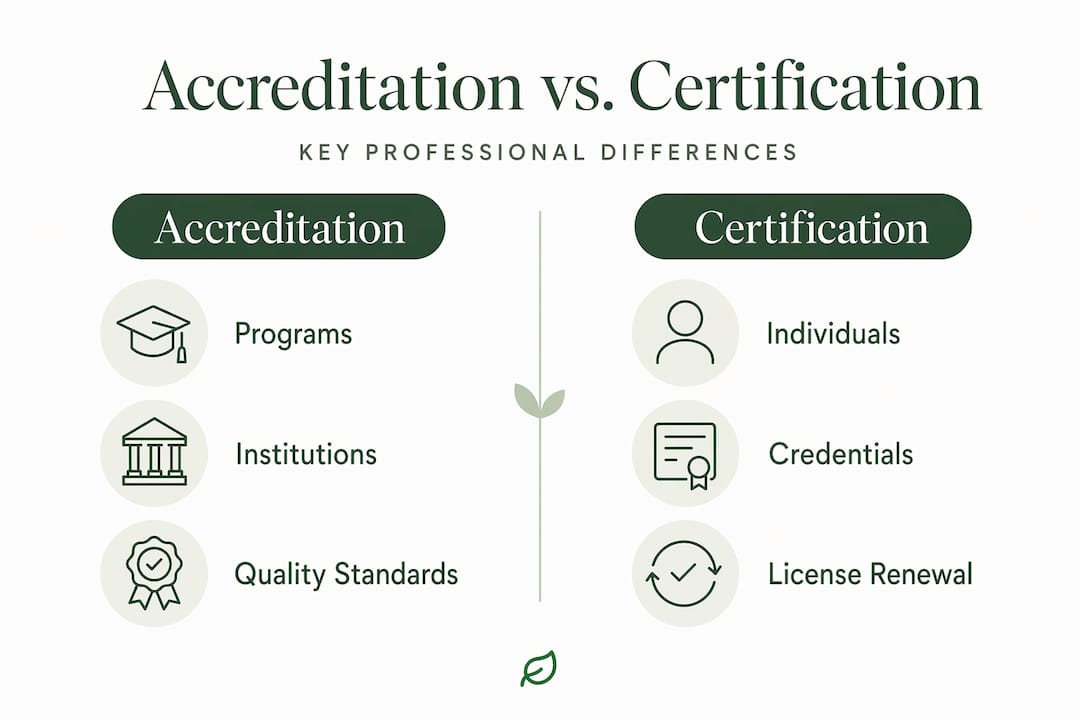
Here is a clear side-by-side comparison:
| Feature | Practitioner accreditation | Practitioner certification |
|---|---|---|
| Who receives it | Programs, institutions, facilities | Individual practitioners |
| What it validates | Quality of education and training standards | Individual skills and competency |
| Granted by | Independent accrediting bodies | Professional associations or credentialing boards |
| Process type | Ongoing cyclical review | Point-in-time exam or assessment |
| Renewal cycle | Periodic re-evaluation with site visits | Typically every 2 years with CPD hours |
| Holistic health example | Accredited massage therapy school | Certified massage therapist |
Practitioner certification typically requires an existing license and, for specialized credentials, often a minimum of a master's degree. Many certification renewal cycles require between 6 and 12 continuing professional development hours every two years, and those hours are tracked separately from your primary license renewal.
Some advanced healthcare certifications set the bar even higher. New clinical leadership credentials, for example, require at least 135 hours of specialized study alongside a current active license. That gives you a sense of the rigor involved at the higher end of the credentialing spectrum.
One more thing worth knowing: certification is not a substitute for ongoing license maintenance or for following the laws that govern your scope of practice. Your certification shows competence at a moment in time. It does not override the regulatory requirements that come with your license.
Pro Tip: When clients ask about your credentials, be ready to explain both. Tell them which accredited program you trained through and which certification you hold. That two-part answer builds significantly more trust than a single credential statement.
For holistic practitioners, the connection matters practically. If you trained at an accredited school of acupuncture, that accreditation signals to licensing boards, insurers, and clients that your education was held to an external standard. Your individual certification then confirms that you personally met the competency requirements. Together, they tell a complete story of professional quality.
Why accreditation matters for holistic health practitioners
Holistic health fields are growing fast, and that growth brings both opportunity and skepticism. Clients searching for an acupuncturist, Ayurvedic practitioner, or somatic therapist are often navigating unfamiliar territory. They want to feel confident that the person they're trusting with their health is legitimate. Accreditation is one of the clearest signals you can offer them.

Choosing accredited training protects practitioners by ensuring their education meets recognized quality standards and earns the respect of professional peers. That protection flows directly to your clients, who benefit from knowing their practitioner came through a program held accountable to external benchmarks.
The benefits of accreditation for holistic health practitioners go beyond client confidence:
- Credibility in emerging fields: Holistic health is still gaining ground in mainstream healthcare. Accreditation ties your practice to recognized institutional quality, which strengthens the field as a whole.
- Legal scope of practice: Accredited programs are designed to align with existing laws and regulations, which means your training helps you understand and operate within your legal scope of practice.
- Insurance and referral networks: Many health insurance programs and referral networks require practitioners to have trained through accredited programs before they qualify for participation.
- Continuing education quality: When your ongoing CPD credits come from accredited providers, those hours carry more weight with licensing boards and professional associations.
- Peer and employer recognition: If you ever apply for a hospital, integrative health clinic, or wellness center role, accredited training signals that your education was externally evaluated and not self-certified.
The importance of practitioner accreditation becomes especially clear when things go wrong. If a client ever challenges your qualifications or a regulatory board reviews your credentials, having trained at an accredited institution is a strong line of defense. It demonstrates that a recognized body already evaluated and approved the standards under which you were trained.
You can explore how practitioner verification affects client safety and trust in holistic care to understand what clients are actually looking for when they check credentials.
How to become accredited or join accredited programs
The phrase "how to become accredited" is a little misleading, because as an individual practitioner, you don't personally receive accreditation. What you do is pursue certification through programs that are accredited, and you maintain that certification over time. Here's how to approach that process practically.
- Verify your base qualifications. Before applying for any certification, confirm that you hold the required license for your modality. Most credentialing bodies will not accept applications without proof of a current, active professional license.
- Research accredited training programs. Look for programs in your specialty that carry accreditation from a recognized body. For massage therapy, check the Commission on Massage Therapy Accreditation directory. For acupuncture, the Accreditation Commission for Acupuncture and Oriental Medicine is the standard. For integrative and holistic disciplines, ConnectedMedics can help you understand how accreditation standards apply across healthcare fields.
- Review curriculum and clinical hour requirements. Accredited programs will list their curriculum standards publicly. Check that the program meets the minimum hour requirements set by your state licensing board or professional association.
- Submit your application with supporting documents. Most certification bodies require submission of your professional registration, proof of completing an accredited training program, and sometimes continuing education records. The application process for certifications requires proof of qualifying training as formal validation beyond your license alone.
- Maintain your certification proactively. Set calendar reminders for your renewal dates. Track your continuing professional development hours in real time rather than scrambling before the deadline. CPD hour requirements are separate from your primary license renewal, so both need active management.
- Avoid credential gaps. A lapsed certification or working under a program whose accreditation has expired exposes you to professional and legal risk. Accreditation maintenance requires a constant state of readiness with periodic re-evaluation.
Use the certified practitioner checklist from Goholistic to make sure you've covered every step before presenting your credentials to clients or employers.
Trends shaping practitioner accreditation in 2026
The accreditation landscape is not static. In 2026, several shifts are directly affecting holistic health practitioners and the programs they train through.
| Trend | What it means for you |
|---|---|
| Longer credentialing timelines | Initial credentialing now takes 90 to 150 days; plan early |
| Re-credentialing every 2 to 3 years | Build renewal preparation into your annual practice calendar |
| Increased CPD specialization | Generic continuing education hours are being replaced by field-specific requirements |
| Digital verification systems | Accreditation bodies are moving toward real-time online credential verification |
| Public reporting transparency | Practitioners and programs face greater scrutiny through publicly accessible credentialing databases |
The move toward public reporting is particularly significant for holistic health. Clients now have easier access to credentialing databases, which means any gap in your certification or training accreditation is more visible than it was even three years ago. That's not a reason for anxiety. It's a reason to stay organized and proactive.
Stat to know: Physician re-credentialing cycles run every 2 to 3 years, a timeline that holistic health credentialing bodies are increasingly mirroring as the field matures.
The trend toward continuous quality improvement through accreditation is also pushing holistic training providers to raise their curriculum standards. That's ultimately good news for practitioners who trained well. Your investment in quality education becomes more valuable, not less, as standards tighten.
My perspective on accreditation and holistic health standards
I've spent years watching the holistic health field mature, and the single biggest gap I see is practitioners who invest in excellent skills but neglect the credentialing infrastructure around those skills. Accreditation feels bureaucratic. I understand that. But what I've found is that the practitioners who build on accredited foundations are the ones who weather scrutiny, attract better clients, and build practices that last.
What surprises me most is how often the conversation about accreditation stops at "did you get your certificate?" That's the wrong question. The right question is: was the program that issued your certificate held to any external standard at all? In holistic health, the answer is not always yes, and clients are becoming more capable of finding that out.
I also think the field undersells accreditation as a tool for self-respect. When you train through an accredited program and maintain your certification, you're not just ticking a box. You're committing to a standard of care that says your clients deserve the best version of your practice. That commitment is what separates a practice built on trust from one built on good marketing.
My honest view on the future: as holistic health moves closer to mainstream healthcare integration, accreditation will stop being optional and start being the baseline. The practitioners who have already built accredited foundations will have a significant head start. The ones who haven't will face a costly and disruptive catch-up.
— Andrew
Find accredited holistic practitioners on Goholistic
If you're a client looking for a practitioner you can genuinely trust, or a practitioner wanting to position yourself alongside verified professionals, Goholistic makes that process straightforward.
Goholistic features a curated directory of accredited and certified providers across disciplines including acupuncture, Ayurveda, massage therapy, somatic healing, and more. Every practitioner listed has been reviewed for credentials, so you spend less time guessing and more time connecting with care that's right for you. You can browse holistic health treatments across more than 200 therapy types, filter by specialty, and book directly with practitioners whose qualifications are transparent. Whether you're just starting your wellness exploration or looking to deepen an existing practice, Goholistic gives you the tools to make informed, confident decisions about the care you receive and the professionals you trust.
FAQ
What is practitioner accreditation in holistic health?
Practitioner accreditation refers to the process by which a training program, school, or facility is evaluated and approved by an independent accrediting body for meeting defined quality standards. Individual practitioners do not receive accreditation directly. They receive certification after completing training through an accredited program.
How is accreditation different from certification?
Accreditation is granted to institutions and training programs, while certification is granted to individual practitioners based on demonstrated competency. Accreditation is an ongoing cyclical process, while certification is earned at a point in time and renewed periodically with continuing education hours.
Why does practitioner accreditation matter for clients?
When a practitioner trained through an accredited program, it means their education was evaluated by an independent body against recognized quality standards. That gives clients a meaningful assurance of care quality beyond a practitioner's self-reported credentials.
How often do practitioners need to renew their certification?
Most practitioner certifications require renewal every two years, which typically includes completing between 6 and 12 continuing professional development hours. These renewal requirements are separate from your primary professional license renewal obligations.
How do I find accredited holistic health programs or practitioners?
Start by identifying the accrediting body for your specific modality, such as the Commission on Massage Therapy Accreditation or the Accreditation Commission for Acupuncture and Oriental Medicine. You can also use platforms like Goholistic to find verified practitioners who have trained through recognized programs.