

What is wellness triage and why does it matter?
Wellness triage is a structured, preliminary assessment that identifies your level of need and connects you with the right care, whether that means emergency support, professional counseling, or a self-guided wellness plan. Think of it as a compass for your mental health: before you can move forward, you need to know where you are. Rather than leaving you to guess which door to knock on, wellness triage acts as a gatekeeper that separates everyday stress from high-acuity mental health crises, so resources reach the people who need them most.
The term "health triage" originally lived in emergency rooms, but wellness triage has grown well beyond that setting. Today it functions as a proactive first step in mental health care, primary care, and integrative wellness programs across the United States. Many platforms and clinics now guarantee clinician contact within 24 hours of an initial triage appointment, which meaningfully reduces the anxiety of waiting to know what comes next.
Core functions wellness triage serves:
- Sorts care needs into urgent, non-urgent, and self-care categories
- Prevents bottlenecks in mental health systems by routing people efficiently
- Gives you a clear "next step" instead of an overwhelming list of options
- Flags high-acuity situations that need immediate intervention
- Opens the door to personalized, evidence-based care pathways
How wellness triage supports your mental wellness
A wellness assessment goes deeper than a checklist of symptoms. During triage, you share details about your stressors, how intense those symptoms feel, and how much they are affecting your daily life. That conversation, whether with a clinician or through a validated digital self-assessment, gives practitioners a fuller picture of where you stand.

What makes wellness triage especially useful is its multidimensional view of health. Rather than focusing on one complaint, it evaluates emotional, social, occupational, and physical wellness domains together. That breadth catches "blind spots," the quiet struggles in your work life or relationships that a single-symptom lens would miss entirely.
Key ways triage supports mental wellness:
- Identifies emotional patterns like persistent anxiety or low mood
- Surfaces social stressors such as isolation or relationship strain
- Flags occupational pressures affecting concentration or motivation
- Detects physical factors, like poor sleep, that compound mental health challenges
- Enables personalized care pathways matched to your unique profile
Triage also plays a preventive role. By catching emerging needs early, it reduces downstream health costs and helps you avoid reaching a crisis point before getting support.
Common treatments and support pathways after triage
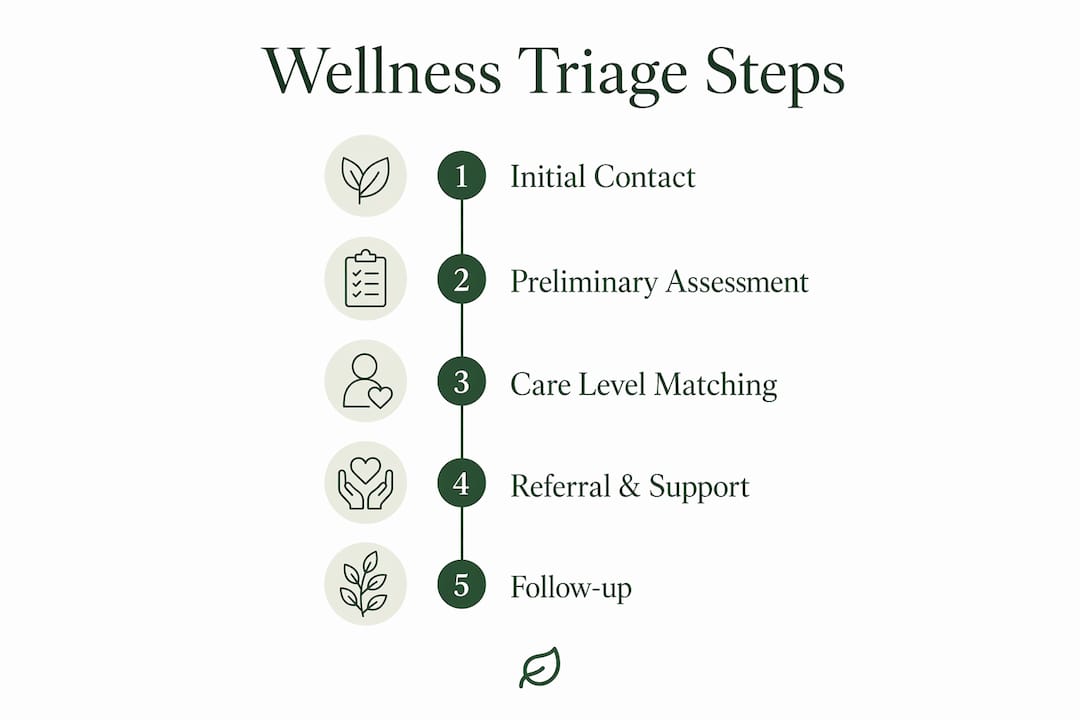
Once your triage assessment is complete, the results guide which level of care fits you best. The range is wide, and that is by design. Not everyone who seeks a wellness evaluation needs intensive therapy, and triage helps avoid unnecessary high-intensity treatment when foundational lifestyle changes would serve you better.
Typical post-triage pathways include:
- Crisis or emergency services for situations involving immediate safety concerns
- Individual psychotherapy such as cognitive behavioral therapy (CBT) or acceptance and commitment therapy (ACT)
- Group counseling or peer support programs for social connection and shared coping strategies
- Integrative and holistic health treatments including acupuncture, mindfulness-based stress reduction, and Ayurveda
- Structured self-care plans covering sleep hygiene, nutrition, and movement
- Medication management in coordination with a prescribing clinician when appropriate
The goal is care intensity matching: connecting you with exactly the level of support your assessment reveals, no more, no less.
Practical ways to improve mental wellness after a triage assessment
Your triage results are a starting point, not a verdict. The most meaningful progress happens in the days and weeks after your assessment, through consistent, manageable actions you build into your daily life. Viewing wellness as a dynamic process rather than a fixed destination makes it far easier to stay engaged over time.
Practical steps to support your mental wellness post-triage:
- Practice mindfulness or breathing exercises for 5–10 minutes each morning
- Prioritize 7–9 hours of sleep and keep a consistent sleep schedule
- Reach out to one trusted person in your social network each week
- Follow through on any referrals or care recommendations from your triage clinician
- Use a journal to track mood patterns and notice what helps or hinders your well-being
- Explore holistic self-care strategies that align with your lifestyle and values
- Schedule a follow-up triage check-in every few months to reassess your progress
Pro Tip: Set one specific, realistic wellness goal per week rather than overhauling everything at once. Small, consistent wins build momentum and make it easier to spot what is actually working.
Who conducts wellness triage and what qualifications are required?
Wellness triage is typically conducted by licensed mental health professionals, including licensed clinical social workers (LCSWs), licensed professional counselors (LPCs), psychologists, and psychiatric nurse practitioners. In some settings, trained crisis counselors or intake coordinators with specialized triage training handle initial screenings before a licensed clinician reviews the results.
Qualifications vary by setting. Hospital-based mental health triage generally requires a licensed clinician with crisis intervention training. Community mental health centers and university counseling services often use master's-level clinicians supervised by a licensed professional. Digital wellness platforms may use validated self-assessment tools reviewed by licensed practitioners, combining technology with clinical oversight to maintain accuracy and confidentiality.
Across all settings, triage practitioners follow confidentiality standards consistent with HIPAA regulations, and most programs are built around evidence-based protocols rather than individual judgment alone.
Signs and indicators that prompt a wellness triage evaluation
You do not need to be in crisis to benefit from a wellness assessment. Many people seek triage when something feels "off" but they cannot quite name it. Others come in response to a specific life event or a gradual buildup of stress.
Common signs that suggest a triage evaluation would be helpful:
- Persistent sadness, worry, or irritability lasting more than two weeks
- Difficulty concentrating, making decisions, or completing everyday tasks
- Withdrawal from friends, family, or activities you normally enjoy
- Significant changes in sleep or appetite without a clear physical cause
- Feeling overwhelmed by responsibilities at work or home
- Thoughts of self-harm or hopelessness, which warrant immediate triage
- A major life transition such as job loss, divorce, or grief
Any one of these indicators is enough reason to reach out. Triage exists precisely so you do not have to figure out the severity on your own.
Limitations and challenges of wellness triage in mental health assessment
Wellness triage is a powerful navigational tool, but it has real boundaries worth understanding. Its primary purpose is resource allocation, not diagnosis. A triage assessment tells clinicians how urgently you need care and in what direction; it does not replace a full clinical evaluation or a formal diagnostic process.
A few honest limitations:
- Triage is not therapy. It opens the door but does not provide treatment itself.
- Self-reported data has limits. Validated protocols reduce error, but standardized assessments still depend on how accurately you can describe your experience in the moment.
- Access gaps persist. In underserved communities, triage may identify a need that local resources cannot yet meet.
- Single-session snapshots. One triage appointment captures a moment in time; your needs may shift, which is why periodic reassessment matters.
Understanding these limits helps you approach triage as one part of a larger care picture, not the whole answer.
How wellness triage connects with broader mental health services
Wellness triage does not operate in isolation. It sits at the front of a care continuum and feeds directly into the broader mental health system. After triage, referral pathways typically connect you to outpatient therapy, community mental health programs, primary care providers, or integrative wellness practitioners, depending on what your assessment reveals.
This integration is what makes triage so valuable as a navigational tool. Rather than leaving you to research options while already feeling overwhelmed, triage hands you a clear direction. It also supports care coordination: when your triage record travels with you to a therapist or a holistic wellness provider, that clinician starts with context rather than from scratch.
Triage also bridges the gap between self-help and professional care. Someone whose assessment places them in the "non-urgent" category might be directed to structured wellness programs, peer support groups, or multidisciplinary wellness resources before stepping into formal therapy. That graduated approach respects both your time and the capacity of the mental health system.
Wellness triage as a living, evolving part of your care
Wellness triage has moved well beyond its emergency-room origins. Today it functions as a proactive "front door" to mental health care, used in primary care clinics, university counseling centers, digital health platforms, and integrative wellness practices. Its evolution reflects a broader shift: mental health care is increasingly preventive, personalized, and whole-person in focus.
What sets modern wellness triage apart from traditional emergency screening is its multidimensional scope. Emotional, social, occupational, and physical domains are all assessed together, giving practitioners and individuals a richer map of well-being than any single symptom could provide.
Key insights from current evidence-based practice:
- Standardized triage protocols outperform intuition-only approaches in accurately categorizing care needs
- Periodic reassessment turns triage into a progress-tracking tool, not just an intake form
- Holistic triage catches occupational and social stressors that clinical interviews alone often miss
- Early triage reduces the likelihood of escalation to crisis-level care
- Digital triage tools, when paired with licensed clinician review, extend access to underserved populations
Pro Tip: Think of wellness triage as part of your broader wellness navigation strategy, not a one-time appointment. Returning for a reassessment every few months keeps your care aligned with where you actually are, not where you were six months ago.
Ready to take the next step? Goholistic connects you with certified holistic practitioners and evidence-based treatment options tailored to your triage results.
Explore holistic treatments or find a practitioner near you to begin your personalized wellness path today.
Key Takeaways
Wellness triage is a structured, repeatable assessment that directs you to the right level of care by evaluating emotional, social, occupational, and physical wellness domains together.
| Point | Details |
|---|---|
| Triage is a starting point | It identifies your care level and connects you to appropriate resources, not a diagnosis. |
| Multidimensional assessment | Emotional, social, occupational, and physical domains are all evaluated to catch blind spots. |
| Clinician contact timing | Many programs guarantee clinician follow-up within 24 hours of an initial triage appointment. |
| Triage is repeatable | Periodic reassessments let you track progress and adjust your care as your needs evolve. |
| Prevention over crisis | Early triage reduces downstream health costs by addressing needs before they escalate. |