

TL;DR:
- Environmental wellness involves creating personal spaces that support health, safety, and well-being. Small, intentional changes like decluttering or improving air quality can produce measurable mental and physical benefits. Managing both physical and digital environments is essential for a holistic approach to health.
Environmental wellness is defined as the state of occupying and creating environments that actively support your health, safety, and well-being. The National Institutes of Health recognizes it as a core holistic health dimension that covers air quality, water safety, noise levels, and the psychological effects of your physical spaces. Most people focus on diet and exercise when they think about well-being. Your surroundings shape your health just as powerfully. This guide breaks down what environmental wellness means, why it matters, and how small, practical changes can produce real results.
What is environmental wellness and what makes it up?
Environmental wellness is the ongoing relationship between your well-being and the quality of your surroundings. It covers both your immediate personal spaces, such as your home and workplace, and the broader natural world you interact with daily. The 8 Dimensions of Wellness framework, used widely in integrative health, places environmental wellness alongside physical, mental, and social health as an equal pillar.

One common misconception is that environmental wellness and environmentalism are the same thing. They are not. Environmentalism focuses on policy and activism, while environmental wellness focuses on the personal spaces where you live, work, and rest. Many people try to save the planet before they have secured a calm, functional home environment. Personal wellness comes first.
The core components of environmental wellness fall into three areas:
- Physical surroundings: Air quality, water safety, natural light, noise levels, and toxin exposure in your home and workplace
- Psychological environment: How organized, harmonious, and calming your spaces feel, including the effect of clutter and sensory overload
- Sustainability habits: Conscious resource use, energy conservation, and waste reduction as daily practices
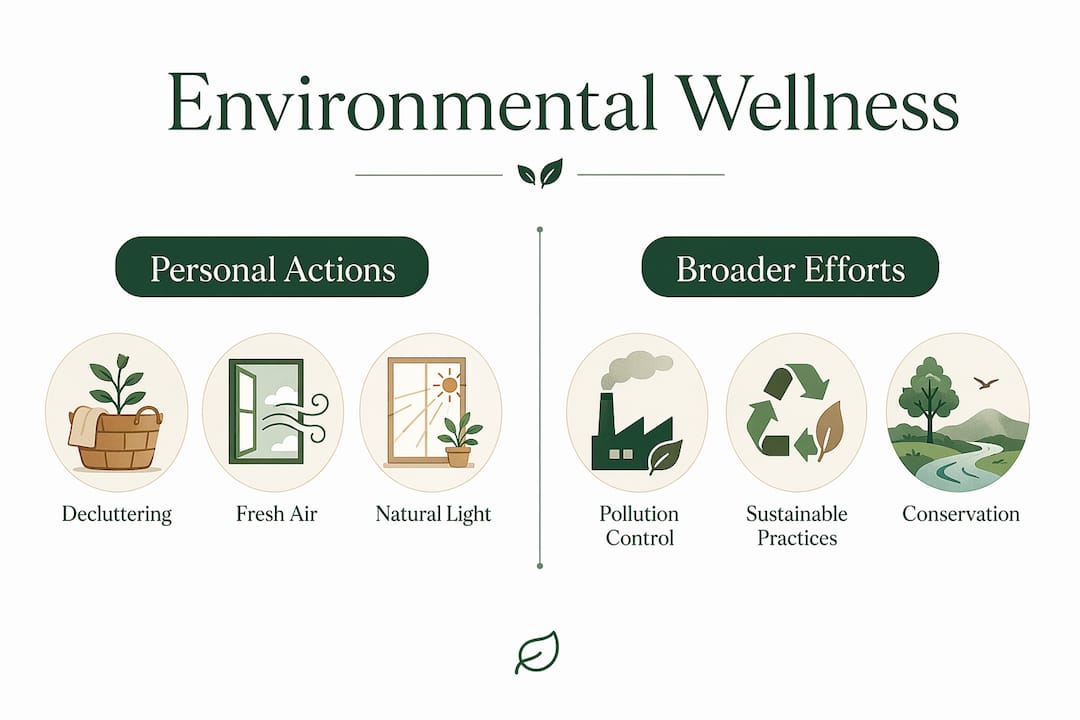
The table below shows how personal environmental wellness actions differ from broader environmental efforts.
| Personal environmental wellness | Broader environmental efforts |
|---|---|
| Decluttering your living space | Advocating for clean air legislation |
| Improving indoor air quality | Supporting reforestation programs |
| Reducing household energy use | Participating in climate policy campaigns |
| Managing noise in your home | Lobbying for noise pollution regulations |
| Organizing a calming workspace | Funding environmental research |
Pro Tip: Start with the room where you spend the most time. Even one change, like opening a window or removing visual clutter, produces a measurable shift in how you feel within hours.
What are the benefits of improving your environmental wellness?
The benefits of improving your environmental wellness are measurable and span physical, mental, and social health. Natural settings decrease cortisol and improve cognitive function. That means spending time in green spaces or simply adding a plant to your desk is not just pleasant. It is a physiological intervention.
"Optimizing environmental wellness through decluttering, improving air quality, and increasing nature exposure correlates with reduced anxiety, better sleep, and enhanced immune responses. Small, intentional changes yield significant mental health benefits and do not require major expenses." — Health & Wellness Canada
The benefits you can expect from consistent environmental wellness practices include:
- Reduced anxiety and stress from lower noise levels, cleaner air, and organized spaces
- Better sleep quality when your bedroom is dark, cool, and free of digital distractions
- Stronger immune function linked to reduced toxin and pollutant exposure indoors
- Sharper mental clarity from managing sensory clutter and digital overload
- Greater social well-being when communal spaces feel safe, welcoming, and functional
Invisible environmental factors like bad lighting, persistent background noise, and chronic clutter contribute to daily mental drain. Most people adapt to these stressors rather than removing them. That adaptation costs energy every single day. Addressing these factors is one of the highest-return investments you can make in your health.
How can you actively improve environmental wellness in everyday life?
Improving your environmental wellness does not require a renovation budget or a lifestyle overhaul. Small intentional changes like adjusting furniture placement or introducing natural light significantly reduce stress and improve mental clarity. The key is starting with your immediate surroundings before expanding outward.
Here are six practical steps you can take right now:
- Declutter one space at a time. Start with your desk or nightstand. Removing visual noise from a single surface reduces cognitive load and signals calm to your nervous system.
- Improve indoor air quality. Open windows daily when outdoor air quality permits. Add air-purifying plants like snake plants or peace lilies. Replace HVAC filters on schedule.
- Maximize natural light. Move your primary work or rest area closer to a window. Natural light regulates your circadian rhythm, which directly affects sleep and mood.
- Create distinct zones. Zoning your spaces for work, rest, and leisure helps your brain shift between mental states more effectively. A dedicated reading chair or a clear desk boundary makes a real difference.
- Reduce energy and waste. Turn off lights when leaving a room, use reusable containers, and unplug devices not in use. These habits reinforce a sense of intentional living that supports well-being.
- Manage your digital environment. Cluttered desktops and notification overload contribute directly to cognitive stress. Organize your phone's home screen, turn off non-essential notifications, and set screen-free windows during your day.
Pro Tip: Your digital environment is as real as your physical one. Treat your phone's notification settings like you would a noisy neighbor. Silence what does not serve you.
If you want support designing spaces that genuinely reflect your personality and promote calm, SelfDezign's personality-based approach to interior design offers a useful framework for connecting your environment to your mental state.
How does environmental wellness connect to your overall health?
Environmental wellness does not operate in isolation. It connects directly to physical, mental, and social health in ways that reinforce each other. The table below summarizes these connections across the 8 Dimensions of Wellness framework.
| Wellness dimension | How environmental wellness connects |
|---|---|
| Physical health | Reduced toxin and pollutant exposure lowers disease risk |
| Mental health | Organized, calm spaces reduce cortisol and anxiety |
| Social health | Safe, welcoming communal spaces encourage connection |
| Occupational health | Ergonomic, well-lit workspaces improve focus and reduce fatigue |
| Spiritual health | Natural environments support reflection and inner calm |
The link to mental health is particularly strong. Stress reduction and sleep quality both improve when your environment is intentionally designed. Physical health benefits follow from reduced exposure to indoor pollutants, mold, and synthetic toxins. Social well-being grows when shared spaces, whether a neighborhood park or a tidy living room, feel safe and inviting.
Environmental wellness is a continuous process that requires adapting your spaces as your mental and physical needs change. What supports productivity on a Tuesday morning may hinder relaxation on a Sunday evening. Recognizing that your environment needs to flex with you is a sign of mature wellness thinking. Goholistic's approach to evidence-based wellness reflects this same principle: your health practices should adapt to your whole life, not just one dimension of it.
Understanding holistic risk factors in your environment, from poor air quality to chronic noise, gives you a clearer picture of what is quietly working against your health. Addressing these factors alongside physical and mental wellness practices produces compounding benefits over time.
Key Takeaways
Environmental wellness is the most underestimated dimension of holistic health, and improving your immediate surroundings produces faster, more measurable results than most people expect.
| Point | Details |
|---|---|
| Clear definition matters | Environmental wellness covers personal spaces, air quality, noise, and digital environments, not just eco-activism. |
| Small changes work | Adjusting lighting, decluttering one surface, or silencing notifications produces real stress reduction. |
| Digital spaces count | Notification overload and cluttered screens are environmental stressors with the same impact as physical clutter. |
| Zone your spaces | Separate work, rest, and leisure areas help your brain shift states and recover more effectively. |
| It connects everything | Environmental wellness links directly to physical, mental, social, and occupational health outcomes. |
Why I think environmental wellness is the most overlooked health habit
Most wellness conversations start with food, movement, or mindset. Rarely does anyone ask: "What does your bedroom look like at 10 PM?" or "How many notifications did you receive today?" Those questions matter more than most people realize.
The biggest misconception I encounter is that improving your environment requires money or a major lifestyle change. It does not. The highest-impact changes, clearing a surface, blocking an hour of screen-free time, cracking a window, cost almost nothing. What they require is intention. That is the real barrier.
The second misconception is that environmental wellness is about saving the planet. That framing puts the focus outward before you have secured your own space. Securing calm, functional personal environments is not selfish. It is the foundation from which everything else grows.
The piece that surprises people most is the digital environment. Your phone's notification settings are an environmental factor. A cluttered desktop is an environmental stressor. Most people have never thought of it that way, but once you do, you cannot unsee it. Managing your digital space with the same care you give your physical space is one of the most practical shifts you can make in 2026.
Start small. Pick one room, one surface, or one digital habit. Build from there. The momentum is real, and the results come faster than you expect.
— Andrew
Treatments and practitioners that support your well-being
Your environment sets the stage, and the right wellness practices build on it. Goholistic connects you with certified practitioners across disciplines like acupuncture, massage therapy, and Ayurveda, all of which complement the physical and mental benefits of a healthy environment.
Whether you are managing stress, improving sleep, or supporting immune function, Goholistic's holistic health treatments library covers over 200 therapy types backed by evidence-based research. Each recommendation is matched to your specific health concerns using AI-powered analysis. You can browse, filter, and book directly with verified providers. Getting started is free, and the first step is simply telling Goholistic what you are working on.
FAQ
What is the simplest definition of environmental wellness?
Environmental wellness is the practice of creating and maintaining surroundings that support your physical, mental, and social health. It includes your home, workplace, and digital spaces.
How does environmental wellness differ from environmentalism?
Environmentalism focuses on policy, activism, and large-scale ecological issues. Environmental wellness focuses on the personal spaces where you live and work, prioritizing your own health and safety first.
What are the easiest environmental wellness activities to start with?
Decluttering one surface, opening a window for fresh air, and turning off non-essential phone notifications are three low-cost, high-impact starting points backed by wellness research.
Does digital clutter count as an environmental wellness issue?
Yes. Cluttered digital spaces and notification overload are recognized contributors to cognitive stress and mental fatigue, making digital environment management a core part of environmental wellness.
How often should you reassess your environment for wellness?
Environmental wellness is a continuous process, not a one-time setup. Reassess your spaces whenever your work schedule, mental state, or seasonal needs change significantly.