
TL;DR:
- Patient-centered wellness treats the whole person by focusing on physical, mental, social, and spiritual health.
- It encourages active patient partnership, proactive care, and ongoing coordination to improve outcomes and satisfaction.
Patient-centered wellness is defined as a holistic, evidence-based approach to healthcare that treats the whole person, not just a diagnosis. It covers physical, mental, emotional, social, and spiritual health together. The Institute of Medicine, the World Health Organization, and Medicare accountable care organizations all recognize this model as the standard for high-quality, person-first care. Where traditional medicine asks "What is wrong with you?", patient-centered wellness asks "What matters to you?" That shift changes everything about how care is planned, delivered, and measured.
What is patient-centered wellness, and what are its core principles?

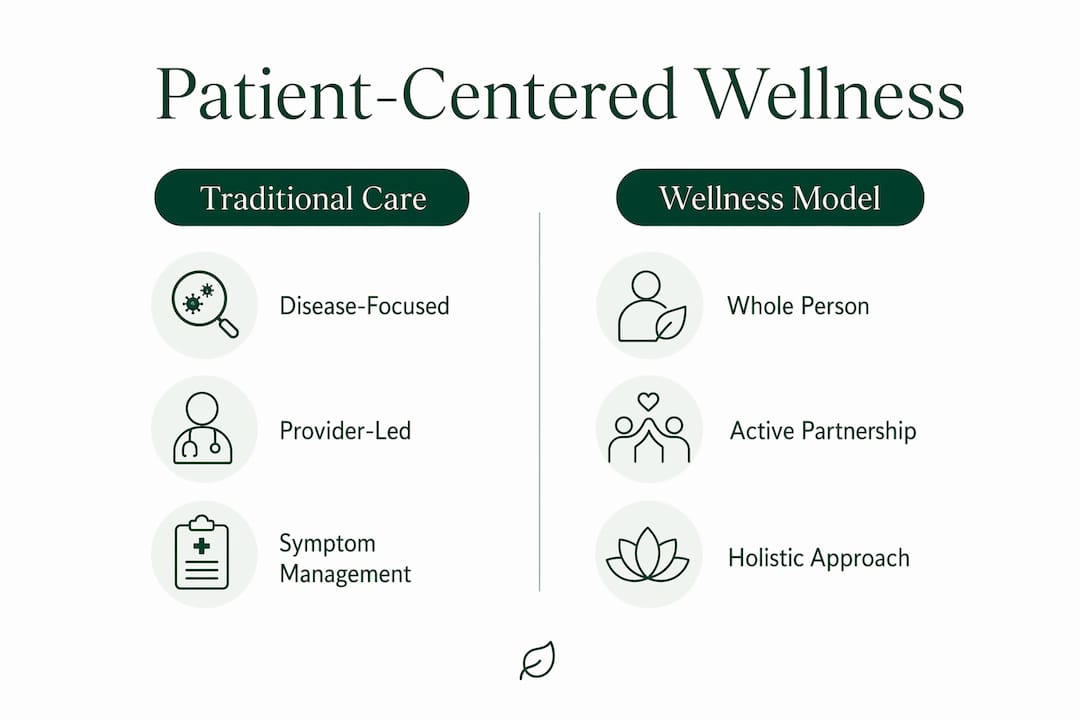
Patient-centered wellness rests on three foundational commitments: treating patients as active partners, maintaining a proactive service orientation, and coordinating care across the whole person. Leading Medicare ACOs have proven this three-pronged framework effective in real-world clinical settings, helping health systems move from volume-based to value-based care. The contrast with traditional episodic medicine is sharp and worth understanding clearly.
| Feature | Traditional care model | Patient-centered wellness |
|---|---|---|
| Focus | Disease and symptoms | Whole person and life goals |
| Patient role | Passive recipient | Active partner |
| Care timing | Reactive, episodic | Proactive, continuous |
| Success measure | Symptom reduction | Well-being and satisfaction |
| Care scope | Physical only | Physical, mental, social, spiritual |
The WHO's integrated people-centered care framework reinforces this by urging health systems worldwide to organize care around people, not diseases. That means respecting individual preferences, coordinating services across providers, and actively involving patients in every decision. Shared decision-making sits at the heart of this model. Patients bring lived expertise about their own bodies and lives. Providers bring clinical knowledge. Together, they build a plan that actually fits.
Family members and caregivers are also part of the picture. Patient-centered wellness recognizes that health does not happen in isolation. Social support, home environment, and community connections all shape outcomes in ways that a clinical visit alone cannot address.
Pro Tip: Ask your provider directly: "What are my options, and what would you recommend for someone with my lifestyle?" That one question shifts the conversation from prescription to partnership.
How does patient-centered wellness benefit patients and healthcare outcomes?
The benefits of this approach go well beyond feeling heard during an appointment. Patient-centered interventions consistently show higher satisfaction scores and stronger alignment between care plans and personal values compared to traditional models. That alignment matters because patients who feel understood are far more likely to follow through on their plans.
Here are the most well-supported benefits:
- Better prevention focus. Care targets long-term vitality, not just symptom suppression. Patients learn to spot early warning signs and act before problems escalate.
- Stronger emotional and social well-being. Addressing mental health, relationships, and community connection reduces isolation and supports recovery.
- Improved adherence. When patients help design their own care plans, they stick to them. Shared ownership drives follow-through.
- Reduced unnecessary costs. Coordinated, prevention-focused care avoids duplicate tests and emergency visits that add up fast.
- Access to complementary modalities. Nutrition counseling, acupuncture, yoga, and meditation become part of the plan, not afterthoughts.
Group-based programs offer a compelling example of what this looks like in practice. The Five Ways to Wellbeing course improves self-reported health and social connectivity while using fewer resources than intensive one-on-one care. That efficiency matters for health systems trying to reach more people without burning out providers.
"Empowerment, where patients understand how to navigate care and accept responsibilities, is the critical factor for achieving sustainable health outcomes globally." — WHO
Patient empowerment is not a soft benefit. It is the mechanism that makes everything else work. When you understand your own health and know how to advocate for yourself, outcomes improve across every measure.
What challenges affect the implementation of patient-centered wellness?
Shifting from passive patient to active partner is harder than it sounds. Many people have spent years expecting a provider to simply tell them what to do. Patients must develop self-awareness and transparency to become genuine collaborators in their care. That requires education, time, and a real cultural shift on both sides of the exam table.
One underappreciated risk is over-testing. Unproven genomic screenings and excessive imaging contribute to over $100 billion in unnecessary costs annually in the US, along with significant patient anxiety. A structured three-tier precision health framework helps avoid this trap:
- Tier 1: High-sensitivity screenings appropriate for the general population.
- Tier 2: Confirmation testing for patients with elevated risk factors.
- Tier 3: Precision interventions for patients with confirmed conditions or genetic markers.
This tiered approach protects patients from both under-treatment and over-treatment. It keeps care proportionate and evidence-based.
Another challenge is continuity. Wellness plans work best as living documents, updated regularly as your life goals and health status evolve. A plan created once and never revisited quickly becomes irrelevant. Providers need to schedule follow-up conversations, not just annual checkups.
Pro Tip: Treat your wellness plan like a personal budget. Review it every three months, adjust for what has changed, and celebrate what is working.
Meaningful improvements in stress and well-being from patient-centered interventions often require 3–6 months of sustained engagement. Patients who expect fast results often disengage too early. Setting realistic timelines from the start prevents that dropout.
How can you implement patient-centered wellness effectively?
Implementation works best when both patients and providers take clear, specific steps. Vague intentions do not produce change. Structured habits do.
For patients:
- Communicate openly. Share your full picture, including stress, sleep, relationships, and work, not just physical symptoms.
- Monitor yourself between visits. Wearables, journaling, and apps that track mood, sleep, and activity give your provider real data to work with.
- Educate yourself. Read about your conditions and treatment options before appointments. Arrive with questions written down.
- Engage beyond clinical visits. Health monitoring technology and support groups prevent care from reverting to symptom management between appointments.
For providers:
- Facilitate shared decision-making at every visit, not just at diagnosis.
- Coordinate care across specialists, mental health providers, and community resources.
- Incorporate personalized wellness planning that reflects each patient's values and lifestyle.
| Implementation step | Patient action | Provider action |
|---|---|---|
| Goal setting | Define personal health priorities | Align clinical goals with patient values |
| Monitoring | Track symptoms and lifestyle factors | Review data and adjust the plan |
| Communication | Report changes proactively | Schedule regular check-ins |
| Modality integration | Try complementary therapies | Refer to qualified holistic practitioners |
Technology plays a growing role here. Stress tracking tools, telehealth platforms, and AI-powered health apps help patients stay engaged between visits. Goholistic, for example, uses AI to analyze health concerns and match patients with verified practitioners across disciplines like acupuncture, Ayurveda, and massage therapy. That kind of continuous support is what keeps wellness plans alive.
How does patient-centered wellness connect to integrative health?
Patient-centered wellness and integrative health care are closely related but not identical. Integrative health combines conventional medicine with evidence-supported complementary modalities. Patient-centered wellness is the philosophy that guides how that care is delivered. Together, they form a complete model for whole-person health.
Whole-person care evaluates physical, mental, and social factors to treat root causes rather than suppress symptoms. Graduate medical education programs now embed this framework across their curricula. That signals a generational shift in how providers are trained to think about health.
Complementary modalities like meditation, nutrition therapy, yoga, and sound-based practices such as music therapy each address different dimensions of well-being. Scientific evidence supports their use for chronic disease management, stress reduction, and emotional resilience. They work best when integrated into a coordinated plan rather than used in isolation.
Spirituality and social connection also belong in this picture. Patients with strong community ties and a sense of meaning in their lives consistently show better health outcomes. A care plan that ignores these dimensions is incomplete by definition.
Pro Tip: When seeking a holistic practitioner, look for verified credentials and a willingness to communicate with your primary care provider. Coordination between practitioners is what makes integrative care safe and effective.
Understanding your own holistic health profile is a practical first step. It surfaces the dimensions of your well-being that need the most attention and helps you and your providers build a plan that actually fits your life.
Key takeaways
Patient-centered wellness works because it treats the whole person, builds active partnership between patient and provider, and sustains engagement well beyond the clinical visit.
| Point | Details |
|---|---|
| Core definition | Patient-centered wellness addresses physical, mental, emotional, social, and spiritual health together. |
| Three-pronged framework | Effective models treat patients as partners, maintain proactive service, and coordinate whole-person care. |
| Realistic timelines | Meaningful improvements typically require 3–6 months of sustained, multimodal engagement. |
| Living wellness plans | Plans must be updated regularly to reflect evolving goals, not treated as static documents. |
| Integrative connection | Complementary modalities like acupuncture, nutrition, and meditation strengthen patient-centered care when coordinated properly. |
Patient-centered wellness: what I have learned from watching it work
The most common mistake I see is treating a wellness plan like a prescription. You get it once, you follow it for a few weeks, and then life takes over. Real patient-centered care does not work that way. It requires the same ongoing attention you give to a relationship or a career.
What surprises most people is how much the patient's own readiness determines the outcome. Providers can create the best plan in the world, but if the patient is not genuinely ready to be an active partner, the plan stalls. I have seen this play out repeatedly. The patients who thrive are the ones who show up to appointments with notes, who track their own patterns, and who push back when something does not feel right.
Group-based wellness models deserve far more attention than they get. Programs like the Five Ways to Wellbeing course show that community and shared accountability produce real health gains, often more efficiently than intensive individual care. There is something powerful about working through health challenges alongside others who are doing the same.
My honest advice: start by reading about the whole-person care intake process before your next provider visit. Walk in knowing what dimensions of your health you want to address. That preparation alone changes the quality of the conversation.
— Andrew
Goholistic: your resource for patient-centered wellness
Goholistic is built for people who want more than a symptom-focused appointment.
The platform connects you with verified practitioners across acupuncture, Ayurveda, massage therapy, and more than 200 other therapy types. AI-powered recommendations match your specific health concerns to evidence-supported treatments, so you spend less time searching and more time healing. Every practitioner in the directory is credentialed and vetted for safety and transparency. Browse the full holistic health treatments library to find therapies aligned with your personal wellness goals, or use the provider search to find qualified practitioners near you. Getting started is free.
FAQ
What is the definition of patient-centered care?
Patient-centered care is a healthcare model that organizes all decisions around the patient's complete well-being, values, and active participation. The WHO and Institute of Medicine both define it as care that respects individual preferences and coordinates services across physical, mental, and social dimensions.
How long does it take to see results from patient-centered wellness?
Meaningful improvements in stress and well-being typically require 3–6 months of sustained engagement. Multimodal approaches that combine technology, physical activity, and social support produce the best results.
What is the difference between patient-centered wellness and integrative health?
Patient-centered wellness is the guiding philosophy that places the whole person at the center of care decisions. Integrative health is the practice model that combines conventional medicine with evidence-supported complementary therapies. The two approaches work best together.
How can patients become more active partners in their healthcare?
Patients build active partnership by communicating openly about all dimensions of their health, monitoring their own patterns between visits, and arriving at appointments with specific questions. Self-awareness and transparency are the foundation of effective collaboration with any provider.
Why do wellness plans fail?
Wellness plans fail most often because they are treated as static documents rather than living plans that evolve with the patient's goals and circumstances. Regular reviews and proactive communication between patient and provider are what keep plans relevant and effective.