

TL;DR:
- Holistic risk factors encompass behavioral, physiological, environmental, and social conditions that influence overall health. Addressing these interconnected factors through comprehensive assessment and lifestyle changes can improve wellness and prevent disease. Understanding both modifiable and non-modifiable risks enables personalized strategies for long-term health resilience.
Holistic risk factors are defined as the full set of behavioral, physiological, environmental, and social conditions that interact to shape your overall health. Most people think about risk in narrow terms: high cholesterol, smoking, or family history. That framing misses the bigger picture. Risk factors are warning signals shaped by lifestyle, environment, and emotional regulation, not fixed destinies. When you understand what are holistic risk factors and how they connect, you gain the foundation for a genuinely proactive wellness strategy.
What are the main types of holistic risk factors?
Health risk factors fall into four categories: behavioral, physiological, environmental, and demographic or social. Each category influences the others. A stressful social environment can drive poor eating habits, which raises inflammation markers, which increases cardiovascular risk. No single factor operates in a vacuum.
Behavioral factors
Behavioral factors include diet quality, physical activity levels, smoking, alcohol use, and stress management practices. These are the most visible entry points for change. The CDC's Youth Risk Behavior Surveillance System (YRBSS) monitors six core categories of high-risk adolescent behaviors linked to the leading causes of death. That surveillance exists because behavior patterns established early in life create compounding risk over decades.

Physiological factors
Physiological factors include blood pressure, cholesterol levels, body weight, blood sugar, and inflammation markers. Standard annual checkups typically measure only two cardiovascular risk markers. Researchers track at least 12 clinically meaningful markers that interact, including hs-CRP, homocysteine, fasting insulin, and NMR LDL particle size. That gap between what gets measured and what matters is one of the strongest arguments for a broader assessment approach.
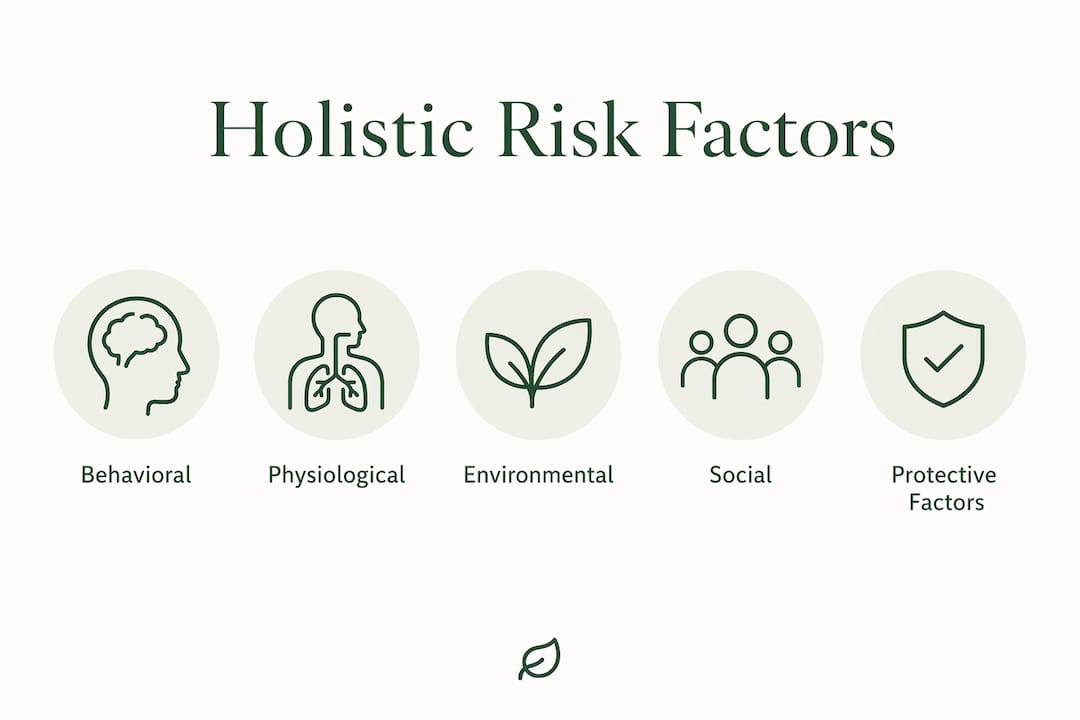
Environmental and social factors
Environmental factors cover air quality, water purity, housing conditions, and toxic exposures. The GBD 2023 Study identified particulate matter air pollution as the second-leading global risk factor for health loss. That finding places the air you breathe on par with diet and smoking as a driver of disease. Social factors, including age, sex, income level, and the strength of your personal support network, complete the picture.
The table below summarizes these four categories with real-world examples.
| Category | Examples | How it affects health |
|---|---|---|
| Behavioral | Diet, smoking, exercise, alcohol use | Directly modifiable; drives inflammation and metabolic risk |
| Physiological | Blood pressure, hs-CRP, fasting insulin | Measurable markers that signal systemic stress |
| Environmental | Air pollution, water quality, housing | External exposures that accumulate silently over time |
| Social/Demographic | Income, social support, age, sex | Shape access to care and buffer against other risks |
How do modifiable and non-modifiable risk factors differ?
Understanding risk factors means separating what you can change from what you need to monitor. This distinction drives every personalized wellness plan worth following.
Modifiable risk factors are conditions and behaviors you can directly influence:
- Nutrition quality and meal patterns
- Physical activity frequency and intensity
- Stress management practices such as meditation, breathwork, or therapy
- Sleep duration and consistency
- Alcohol and tobacco use
- Social connection and community engagement
Non-modifiable risk factors are fixed characteristics that require awareness rather than elimination:
- Genetic predispositions to certain diseases
- Age and the physiological changes that accompany it
- Biological sex and its influence on hormonal and cardiovascular risk
- Family medical history
Non-modifiable factors are not a sentence. Genetic risks often remain dormant until activated by context, meaning your lifestyle choices can delay or prevent expression of inherited vulnerabilities. Knowing your non-modifiable risks tells you where to focus your modifiable efforts most precisely.
Protective factors sit alongside both categories. Regular physical activity, strong social bonds, and consistent sleep all buffer the impact of risks you cannot change. A holistic wellness profile maps both your vulnerabilities and your protective strengths, giving you a complete starting point.
Pro Tip: Focus your first three months of wellness changes on two or three modifiable factors that overlap multiple risk categories. Improving sleep, for example, reduces cortisol, supports healthy weight, and strengthens immune function simultaneously.
What does a holistic risk assessment look like in practice?
A holistic risk assessment goes well beyond the standard blood panel your doctor orders once a year. It treats your body, mind, and environment as one interconnected system.
-
Expand your physiological markers. A thorough cardiovascular assessment tracks 12 risk markers including inflammation indicators like hs-CRP, cholesterol subtypes measured by NMR particle size, oxidative stress markers, and endothelial function. These tests reveal patterns that standard LDL and blood pressure readings miss entirely.
-
Assess emotional and social wellbeing. Emotional wellness is a key but neglected pillar of health. A practitioner conducting a full assessment will ask about your stress load, relationship quality, sense of purpose, and history of anxiety or depression. These are not soft questions. They are clinical data points.
-
Map environmental exposures. Holistic cardiovascular consultations review lifestyle, medical and family history, and environmental factors including toxic exposures, air quality in your home and neighborhood, and water source. Air quality in particular carries measurable risk. Understanding how air quality affects wellness helps you make informed decisions about your living environment.
-
Evaluate behavioral patterns in context. Behaviors like alcohol use or poor sleep rarely exist in isolation. They often signal underlying stress or social disconnection. A holistic assessment treats these behaviors as clues to root causes, not isolated failures.
-
Integrate findings into a prevention plan. Real-world risk is exponential, with escalation and propagation effects that linear screening misses. A practitioner trained in holistic assessment builds a plan that addresses the interaction between your risk factors, not just each one individually.
Pro Tip: Before your next wellness appointment, write down your three biggest daily stressors, your average sleep hours, and any environmental concerns like mold, traffic pollution, or poor water quality. Bringing this context gives your practitioner a richer starting point.
How can you apply this knowledge to improve your wellness?
Knowing your risk profile is only useful if it changes how you live. The goal is to address multiple risk domains at the same time rather than tackling them one by one.
- Combine movement with social connection. Walking with a friend addresses physical inactivity and social isolation simultaneously. Both are independent risk factors in wellness, and addressing them together multiplies the benefit.
- Treat food as information. An anti-inflammatory diet reduces physiological markers like hs-CRP and supports emotional stability through the gut-brain axis. Prioritize whole foods, omega-3 sources like salmon and walnuts, and leafy greens over processed options.
- Build a stress response practice. Chronic stress elevates cortisol, disrupts sleep, raises blood pressure, and drives inflammatory pathways. Practices like yoga, breathwork, or even consistent time in nature interrupt this cascade at the source.
- Audit your environment. Check your home's air filtration, water source, and exposure to synthetic chemicals in cleaning products or personal care items. Small environmental changes reduce your cumulative toxic load over time.
- Seek evidence-based holistic methods for chronic concerns. Practitioners trained in Ayurveda, acupuncture, or functional medicine approach risk factors as a system, not a checklist. They look for root causes rather than symptom suppression.
Comprehensive risk management requires understanding interdependencies across individual, community, and environmental levels to build real resilience. That means your wellness plan should account for where you live and who supports you, not just what you eat and how often you exercise.
Key Takeaways
Holistic risk factors span behavioral, physiological, environmental, and social domains, and addressing them together produces far better outcomes than treating any single factor in isolation.
| Point | Details |
|---|---|
| Four risk categories interact | Behavioral, physiological, environmental, and social factors compound each other's effects. |
| Most screenings are incomplete | Standard checkups measure only 2 cardiovascular markers; a full assessment tracks at least 12. |
| Modifiable factors are your leverage | Diet, sleep, stress, and social connection can buffer even strong genetic or environmental risks. |
| Emotional health is a clinical factor | Stress, isolation, and emotional patterns drive measurable physiological changes over time. |
| Assessment must include environment | Air quality, water, and toxic exposures contribute to cumulative risk that lifestyle alone cannot offset. |
Why I think most people are managing risk backwards
I have spent years reading wellness research and talking with practitioners across disciplines, from Ayurvedic doctors to functional cardiologists. The pattern I keep seeing is this: most people wait for a diagnosis before they start paying attention to risk. That is the wrong order of operations.
The deeper problem is that conventional medicine has trained us to think about risk factors as isolated data points. Your cholesterol is high, so you take a statin. Your blood pressure is elevated, so you reduce sodium. These are reasonable responses, but they treat the branches while ignoring the roots. Stress, poor sleep, and social disconnection are driving those numbers, and no medication addresses that upstream cause.
What genuinely changes outcomes is understanding that your risk profile is a living system. When you improve sleep, your cortisol drops, your inflammatory markers improve, and your food choices get better almost automatically. That is not coincidence. It is biology. The factors are connected, and so are the solutions.
The other thing most articles will not tell you is that emotional and social risks are as critical as physical ones. Loneliness carries a measurable cardiovascular risk comparable to smoking. Yet almost no annual checkup asks about the quality of your relationships or your sense of purpose. That gap is where a lot of preventable illness hides.
The shift I encourage is moving from reactive to continuous awareness. You do not need a crisis to start understanding your risk factors. You need curiosity, a good practitioner, and a willingness to look at the whole picture.
— Andrew
How Goholistic helps you understand and address your risk factors

Goholistic is built for exactly this kind of whole-person thinking. The platform connects you with verified practitioners across disciplines including acupuncture, Ayurveda, massage therapy, and functional wellness, all of whom approach care through the lens of root causes rather than isolated symptoms. You can browse the full library of holistic health treatments to find approaches matched to your specific risk profile, whether that means reducing inflammation, managing stress, or supporting cardiovascular health naturally. Goholistic also uses AI to analyze your health concerns and surface personalized recommendations backed by research. If you are ready to move from understanding your risks to actually addressing them, find a holistic practitioner near you and take the first step toward a plan that fits your whole life.
FAQ
What are holistic risk factors in simple terms?
Holistic risk factors are all the physical, mental, emotional, social, and environmental conditions that influence your health at the same time. They include things like diet, stress levels, air quality, genetics, and social support.
Can you change all holistic risk factors?
No. Risk factors divide into modifiable ones like diet and stress and non-modifiable ones like age and genetics. The goal is to use modifiable factors to reduce the impact of those you cannot change.
Why does a holistic risk assessment include emotional health?
Emotional and social risks are as critical as physical risks. Chronic stress and social isolation drive measurable changes in blood pressure, inflammation, and immune function, making them clinically relevant data points.
What markers does a holistic cardiovascular assessment include?
A thorough assessment tracks at least 12 cardiovascular markers including hs-CRP, homocysteine, fasting insulin, NMR LDL particle size, and magnesium levels, far beyond the standard cholesterol and blood pressure readings.
How does environment factor into holistic health risks?
Environmental exposures like air pollution, water quality, and toxic chemicals accumulate silently and raise your overall risk load. The GBD 2023 Study ranked particulate matter air pollution as the second-leading global risk factor for health loss worldwide.