

Guided meditation is a voice-led practice where a teacher or recording directs your attention moment-by-moment toward your breath, body sensations, imagery, or feelings of compassion, as Mindful. It's especially helpful when you're new to meditation, feeling overwhelmed by stress, or simply unsure where to begin on your own.
Common formats include:
- Live teacher: In-person or virtual class with real-time guidance
- App or audio track: On-demand recordings you can use anywhere
- Podcast: Free, subscription-free episodes for daily practice
- Video: YouTube channels and streaming platforms with visual support
Key Takeaways
Guided meditation is a voice-led attentional practice that builds real, measurable wellness benefits through consistency, not through achieving silence.
| Point | Details |
|---|---|
| Core definition | A voice-led practice directing attention moment-by-moment; the voice acts as an external scaffold. |
| Evidence base | A review of 41 trials found moderate evidence for anxiety and depression improvements at short-term follow-up. |
| Best starting length | Sessions of 5–10 minutes are often more effective for beginners than longer silent sits. |
| The key skill | Noticing when your mind wanders and returning to the anchor; that cycle is the practice. |
| Safety reminder | Guided meditation supports well-being but is not a clinical treatment; consult a professional if you have trauma or severe psychiatric symptoms. |
Table of Contents
- What is guided meditation, and how does it differ from silent practice?
- 6 types of guided meditation and what each one is best for
- What research says about the benefits of guided meditation
- How to do a guided meditation: a step-by-step beginner's session
- Three ready-to-use starter scripts you can try right now
- How to choose guided meditations, teachers, and apps
- Research summary and safety: when to consult a clinician
- What beginners can realistically expect from guided meditation
- Goholistic can help you find the right guided practice
- Sources
What is guided meditation, and how does it differ from silent practice?
Think of guided meditation as an external scaffold for your attention. Instead of sitting in silence and hoping your mind cooperates, you have a voice giving your attention somewhere to land, moment after moment. That structure is exactly what makes it so accessible, particularly during high-stress periods when silent practice can feel impossible.
In silent or unassisted meditation, you rely entirely on your own internal cues to stay anchored. That works well once you've built some experience, but for beginners it often leads to frustration. Guided practice removes that uncertainty. The voice does the cueing, so you can focus on the actual skill: noticing when your mind wanders and gently returning it to the anchor.
Both approaches train the same core capacity, which is the ability to notice and return. What changes is the level of external support. Guided meditation isn't a lesser version of the real thing; it's a supported form of practice that experienced meditators also use when learning new techniques or navigating difficult seasons.
Formats are flexible. You can follow a live teacher in a studio class, stream an audio track on your commute, open an app during a lunch break, or listen to a podcast before bed. Accessibility is one of guided meditation's genuine strengths.
Pro Tip: The goal of guided meditation is not a blank mind. Your mind will wander. That's not failure; that's the training. Each time you notice and return, you're building the skill. Expect wandering, welcome the noticing.
6 types of guided meditation and what each one is best for
Guided meditation isn't one-size-fits-all. These six styles cover most of what you'll find in apps, classes, and recordings, and each serves a different purpose.
- Breath-focused mindfulness: The teacher guides you to observe each inhale and exhale without changing them. Best for: building baseline awareness and calming a busy mind; works sitting or lying down.
- Body scan: Attention moves slowly through each region of the body, noticing sensation without judgment. Best for: releasing physical tension, pre-sleep wind-down, or reconnecting with the body after a stressful day. Works well lying down or in a reclined chair.
- Visualization / guided imagery: The teacher walks you through a calming scene or positive mental image. Best for: performance preparation, anxiety relief, and creative focus. Sitting or lying down, eyes closed.
- Loving-kindness (metta): You silently repeat phrases of goodwill toward yourself and others. Best for: self-compassion, reducing self-criticism, and improving social connection. Sitting upright tends to feel most natural here.
- Progressive muscle relaxation (PMR): You tense and release muscle groups in sequence while the teacher guides the pacing. Best for: physical stress, insomnia, and people who find purely mental anchors hard to hold. Lying down is ideal.
- Sleep meditations: A slower-paced blend of body scan, breath focus, and gentle imagery designed to ease the transition into sleep. Best for: anyone struggling with racing thoughts at bedtime. Lying in bed is the intended position.
What research says about the benefits of guided meditation
The evidence is genuinely encouraging, though it comes with important caveats worth knowing upfront.
A systematic review covering 41 trials and 2,993 participants found moderate strength-of-evidence for reductions in anxiety (an effect size indicating a moderate reduction in anxiety symptoms at short-term follow-up) and depression (an effect size indicating a modest reduction in depressive symptoms at short-term follow-up), with modest effects for pain. The researchers noted significant heterogeneity across studies and short follow-up periods, so these numbers represent a signal, not a guarantee.
A separate meta-analysis of mindfulness-based interventions reported small-to-moderate effects on stress-related outcomes, with similar caveats about variability across techniques and populations. Harvard Health summarizes the picture well: meditation can modestly improve stress, anxiety, sleep, and attention, but it works best as a supportive wellness skill, not a replacement for clinical care.
The mechanisms behind these benefits are worth understanding. Guided meditation trains attention by repeatedly directing it to an anchor and practicing the "notice and return" cycle. Over time, this builds mind-body awareness and strengthens emotion regulation. Neuroimaging research published in Frontiers in Human Neuroscience suggests meditation can modulate stress-related brain circuits, including amygdala reactivity and default-mode network activity, though findings vary by technique and study design.
The main benefits supported by current research include:
- Reduced anxiety symptoms with regular practice
- Modest improvements in depressive symptoms
- Better sleep quality for some people
- Improved attention and focus over time
- Greater emotional regulation and reduced reactivity
A clear caution: Guided meditation supports well-being; it does not diagnose or treat clinical conditions. If you're managing a serious mental health condition, speak with a licensed clinician before relying on meditation as your primary support.
How to do a guided meditation: a step-by-step beginner's session
You don't need special equipment, a quiet mountaintop, or 30 free minutes. Here's how to run your first session from scratch.
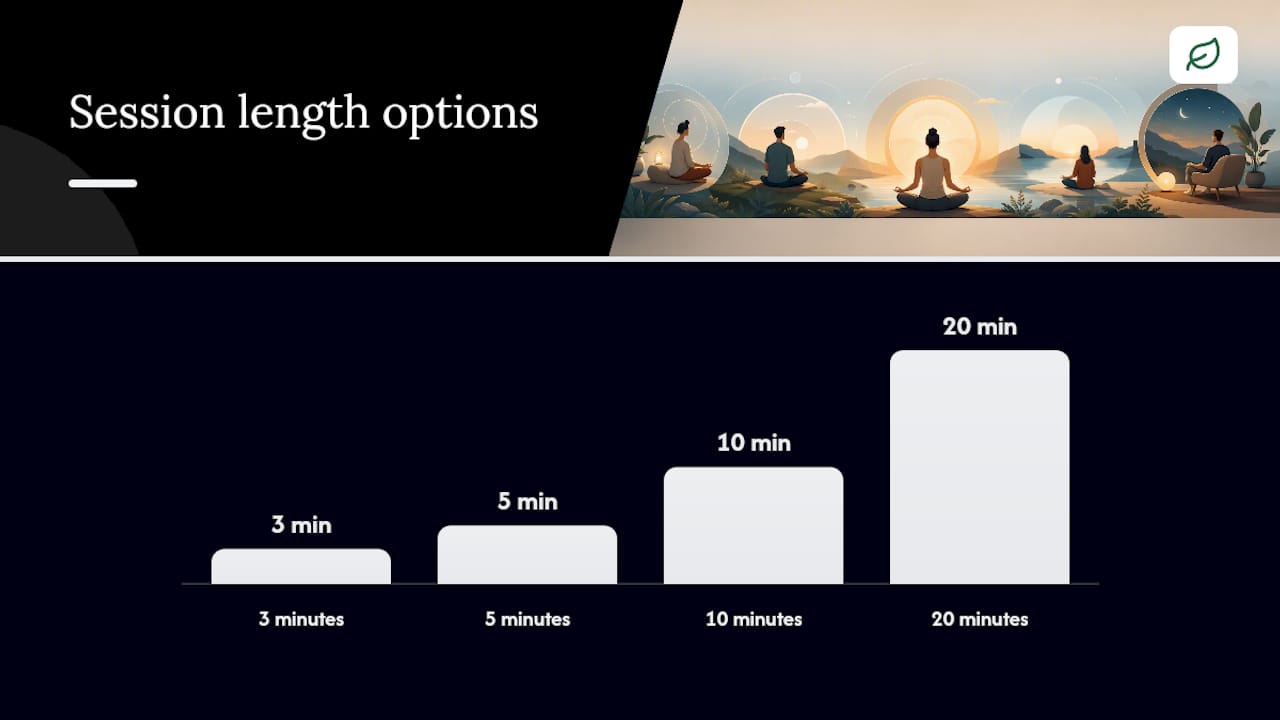
- Choose your recording. Pick a guided track that matches your available time: 3 minutes for a quick reset, 5–10 minutes for a focused session, 20 minutes when you want to go deeper. Apps like Calm, Headspace, and Insight Timer all offer beginner-specific tracks. Short sessions of 5–10 minutes are often more effective for beginners than longer silent sits because the voice keeps attention anchored.
- Set up your space. Sit in a chair with your feet flat on the floor, or cross-legged on a cushion. Lying down works too, though you may drift toward sleep. Silence your phone notifications. You don't need candles or incense; a quiet corner is enough.
- Start the recording and settle in. Close your eyes or soften your gaze downward. Let the teacher's voice become your anchor for the next few minutes.
- Follow the breathing cue. Most guided sessions open with a few slow breaths. Breathe in through your nose for a count of four, out through your mouth for a count of six. Let the exhale be longer than the inhale; this activates the body's relaxation response.
- Notice when your mind wanders, then return. Your attention will drift. When you notice it has, that noticing is the practice working. Gently bring your focus back to the teacher's voice or the breath. No frustration needed.
- Close the session intentionally. When the recording ends, take a breath before opening your eyes. Notice how you feel. That brief pause helps the session land.
- Track your consistency, not your duration. A three-minute session every day builds more than a 20-minute session once a week.
Pro Tip: If sleepiness is your main challenge, try meditating seated rather than lying down, or practice earlier in the day. If restlessness is the issue, a body-scan or PMR track gives your attention more to do.
Three ready-to-use starter scripts you can try right now
These scripts are designed for you to read slowly, pause where indicated, and adapt to your own voice or share with someone you're guiding.
3-Minute Morning Focus (sitting) Best for: starting the day with a clear head before checking your phone.

Find a comfortable seat. Close your eyes. Take one slow breath in through your nose... and out through your mouth. (Pause.) Notice the weight of your body in the chair. (Pause.) Bring your attention to your breath. You don't need to change it; just notice it moving in and out. (Pause 30 seconds.) When a thought arrives, acknowledge it quietly and return to the breath. (Pause 30 seconds.) Take one final deep breath in... and release. Open your eyes when you're ready.
5-Minute Midday Reset (sitting or lying down) Best for: a stress break between tasks or after a difficult conversation.
Settle into your position and close your eyes. Take three slow breaths, letting each exhale be a little longer than the inhale. (Pause.) Scan from the top of your head down to your feet, noticing any areas of tension without trying to fix them. (Pause 60 seconds.) Return to your breath. Imagine each exhale releasing a little of that tension. (Pause 60 seconds.) Bring to mind one thing you're grateful for right now. Let that feeling settle in your chest. (Pause 30 seconds.) Take a full breath in... and out. Gently return to the room.
10-Minute Pre-Sleep Wind-Down (lying down) Best for: quieting a racing mind before bed.
Lie on your back with your arms at your sides. Close your eyes. Begin with five slow breaths, counting each exhale. (Pause.) Starting at your feet, notice any sensation, warmth, tingling, or pressure, without judgment. (Pause.) Move your attention slowly up through your calves, knees, thighs, hips. (Pause 90 seconds.) Continue through your belly, chest, shoulders, arms, hands. (Pause 90 seconds.) Let your face soften: jaw, cheeks, eyes, forehead. (Pause 60 seconds.) Rest in the quiet. If thoughts arise, let them pass like clouds. (Pause 60 seconds.) There is nowhere to be right now. Let sleep come when it's ready.
Voice and tone matter when choosing recordings. A calm, unhurried delivery works for most people; some prefer a warmer, more conversational tone while others want a more neutral, clinical style. Try two or three voices before settling on one.
How to choose guided meditations, teachers, and apps
Not every recording or teacher is a good fit, and the wrong match can make you give up before the practice has a chance to take hold. Use this checklist when evaluating your options.
- Voice clarity and pace: Does the teacher's voice feel calming rather than distracting? Is the pacing slow enough to follow without rushing?
- Session length options: Good resources offer tracks across multiple lengths (3, 5, 10, 20 minutes) so you can match your available time.
- Teacher background: Look for teachers with verifiable training in mindfulness-based stress reduction (MBSR), yoga, or a recognized contemplative tradition. Credentials aren't everything, but they signal accountability.
- Style and theme: Match the type to your goal: sleep, anxiety, focus, or self-compassion.
- Accessibility features: Captions, offline downloads, and screen-reader compatibility matter if you have hearing or visual differences.
- Privacy policy: Apps collect data. Read what each platform stores and whether it's shared with third parties.
| Resource type | Accessibility | Personalization | Cost | Best use case |
|---|---|---|---|---|
| Guided app (Calm, Headspace, Insight Timer) | High (mobile, anytime) | Moderate (curated paths) | Free tier + paid subscription | Daily habit building |
| Podcast / free audio | High (no account needed) | Low (fixed content) | Free | Sampling styles before committing |
| Live teacher (class or virtual) | Moderate (scheduled) | High (real-time feedback) | Varies by provider | Deepening practice, accountability |
| Wellness retreat | Low (travel required) | High (immersive) | Higher investment | Intensive reset or new technique |
For live guidance from a verified teacher, the Goholistic practitioner directory connects you with certified wellness providers who offer guided sessions across multiple modalities. If you're exploring holistic guides for whole-person wellness, working with a verified teacher can improve both safety and consistency, especially in the early months of practice.
Research summary and safety: when to consult a clinician
The evidence base for guided meditation is solid enough to recommend as a wellness practice, but honest about its limits. The NCBI systematic review covering 41 trials found moderate evidence for anxiety and depression improvements at short-term follow-up, with the authors noting heterogeneity across studies and limited long-term data. A mindfulness meta-analysis echoes this: real effects, real variability.
Guided meditation is generally low risk for most people. For some, however, it can surface unexpected distress.
- Trauma history: Turning attention inward can activate trauma-related memories or sensations. If this happens, open your eyes, ground yourself in the room, and stop the session.
- Panic disorder or dissociation: Breath-focused practices can occasionally intensify symptoms in people prone to panic or dissociation. A therapist-led or trauma-informed approach is safer.
- Severe psychiatric symptoms: Guided meditation is not a substitute for clinical treatment of conditions like psychosis, severe depression, or active suicidal ideation.
If any of these apply to you, speak with a licensed mental health professional before starting a regular practice. Meditation therapy in clinical settings looks quite different from a consumer app, and a clinician can help you find the right level of support. For practical mental health self-care strategies that pair well with meditation, a psychiatry-informed perspective can help you build a plan that's both safe and sustainable.
Guided meditation works best as part of a broader wellness approach, not as a standalone fix. Think of it as one well-supported tool among several.
What beginners can realistically expect from guided meditation
The most common mistake new practitioners make is measuring success by how quiet their mind gets. That's the wrong metric entirely.
What actually happens in a well-run guided session is more interesting: you notice how busy your mind is, and you practice returning to the anchor anyway. That cycle, repeated over weeks, is where the benefit lives. The research on attention training and the relaxation response confirms that the mechanism is the repetition, not the stillness.
Realistic progress looks like this: in the first week or two, sessions feel effortful and your mind wanders constantly. By week four or five, you start noticing the wandering sooner. By week eight, many people report a subtle but real shift in how they respond to stress outside of sessions. That's the transfer effect, and it's what the evidence is actually measuring.
Guided meditation isn't a permanent crutch. Many people use it to build a foundation and then gradually introduce more silent practice. Others keep using guidance indefinitely, especially when learning a new technique or navigating a difficult period. Both paths are valid.
Goholistic can help you find the right guided practice
Whether you're ready to try your first three-minute session or looking for a verified teacher to guide you through something deeper, Goholistic makes it straightforward to find what fits. The platform connects you with certified holistic practitioners across disciplines, including meditation teachers, and lets you browse, filter, and book directly.
Explore evidence-based holistic treatments or browse the Goholistic provider directory to find a verified meditation guide near you. You can start free and upgrade when you're ready for more personalized support.
Sources
These are the primary sources referenced throughout this article. Each is worth reading directly if you want to verify claims or go deeper.
- Mindful
- Meditation techniques: How to meditate for stress, sleep, and focus - Harvard Health
- Meditation Programs for Psychological Stress and Well-Being - NCBI Bookshelf
- PMC article on mindfulness and mental health
- Frontiers in Human Neuroscience DOI (2018)