
If your jaw aches, clicks, or locks up, start here: rest your jaw with a soft diet, add gentle jaw exercises, alternate heat and cold, work in short self-massage sessions, and use OTC pain relievers only as a bridge, not a habit. Most mild or periodic TMJ symptoms improve within weeks to months using exactly these conservative steps, according to the National Institute of Dental and Craniofacial Research, which recommends reversible, non-surgical care as the first move for almost everyone.
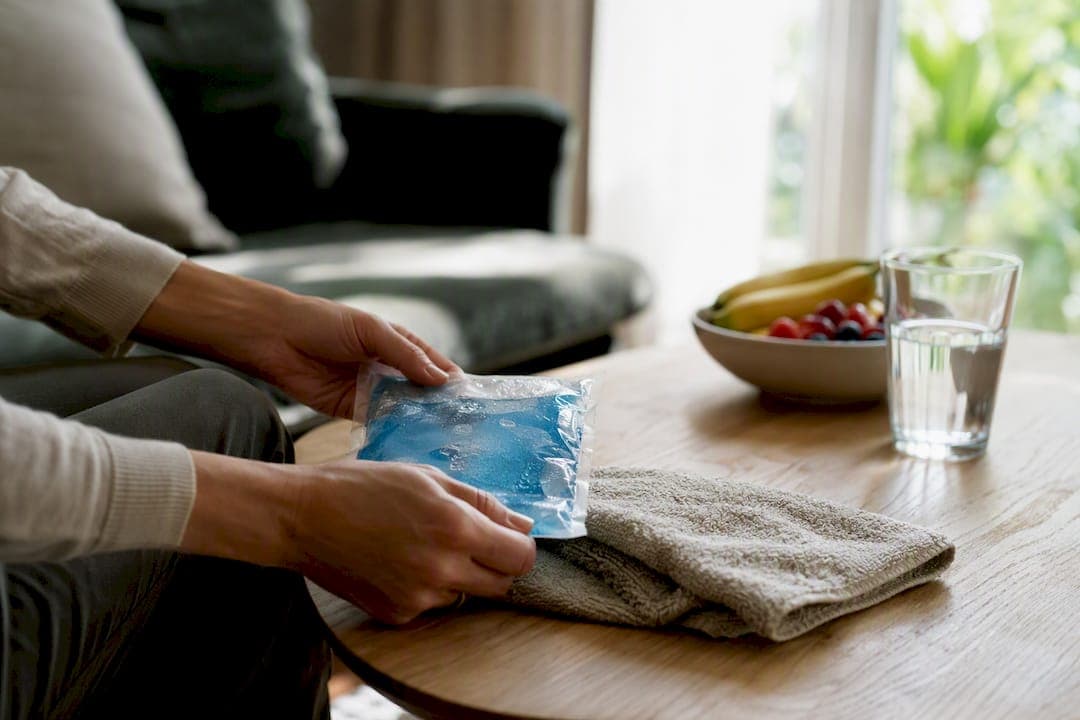
Right now, before you read another paragraph: press a warm, damp washcloth against your jaw for five minutes. That alone starts calming the muscle tension driving most flare-ups.
- Rest your jaw with a soft-food diet for a few days
- Try gentle, targeted jaw exercises daily
- Alternate moist heat and cold packs
- Add short self-massage sessions to the masseter and temporalis
- Use OTC anti-inflammatories short-term, not as a long-term fix
Key Takeaways
Conservative, multimodal self-care resolves most mild TMJ symptoms within weeks to months, and professional support becomes worthwhile only when home strategies plateau.
| Point | Details |
|---|---|
| Start conservative | Rest, soft diet, heat/cold, and gentle exercises resolve most mild TMJ cases without professional care. |
| Combine, don't isolate | Massage plus exercise works faster than either technique alone, based on controlled research. |
| Track real progress | Log pain frequency and mouth-opening distance weekly to judge whether your routine needs adjusting. |
| Know your red flags | Locking, numbness, trauma, or worsening pain despite care means it's time to see a clinician. |
| Get matched to the right provider | Goholistic connects you with verified practitioners like physical therapists and massage therapists for TMJ-specific care. |
Table of Contents
- Quick Relief: Heat, Cold, Soft Diet, and Safe OTC Use
- At-Home Exercises and Self-Mobilization for Jaw Relief
- Self-Massage and Manual Techniques That Actually Release Tension
- Professional Conservative Options Worth Knowing About
- Building a Simple 2 to 4-Week Routine You Can Actually Follow
- Nutrition and Supplements: What Helps and What's Still Unproven
- When to See a Clinician: Red Flags You Shouldn't Ignore
- Why Conservative, Multimodal Care Is the Prudent First Choice
- Find Vetted Practitioners Who Specialize in TMJ Relief
- Frequently Asked Questions
- Sources
Quick Relief: Heat, Cold, Soft Diet, and Safe OTC Use
Heat and cold serve different purposes, and mixing them up wastes your effort. Moist heat, like a warm washcloth or heating pad, relaxes chronically tight jaw muscles and works best for that dull, constant ache. Cold packs calm sharp, acute flare-ups by numbing inflammation. Either one should stay on for no more than 20 minutes at a time, wrapped in cloth to protect your skin, according to guidance from The TMJ Association.
Your diet matters just as much as temperature. During a flare, stick to foods that need minimal chewing:
- Scrambled eggs, yogurt, oatmeal, mashed potatoes, smoothies, and soups
- Cut food into small pieces and chew evenly on both sides
- Skip anything crunchy, chewy, or that requires a wide bite, like apples or bagels
Over-the-counter options like ibuprofen can take the edge off a bad day, but for practical guidance on usage, see how to stop tooth pain safely and fast, as they're a short-term bridge, not a treatment. Relying on them daily without addressing the underlying muscle tension just masks the problem.
Pro Tip: Keep an ice pack and a warm washcloth both ready in your kitchen. Some days call for one, some for the other, and having both on hand means you won't skip the step because it's inconvenient.
At-Home Exercises and Self-Mobilization for Jaw Relief
TMJ exercises for relief work best when they're specific, gentle, and consistent. Try this sequence once or twice daily:
- Goldfish exercise (partial): Place a finger on each TMJ joint and your tongue on the roof of your mouth. Drop your jaw halfway open and close. Do 6 reps.
- Goldfish exercise (full): Same setup, but open your jaw fully this time. Do 6 reps.
- Chin tucks: Pull your chin straight back, creating a double chin, holding 3 seconds. This corrects the forward-head posture that strains jaw muscles. Do 10 reps.
- Resisted opening and closing: Place a thumb under your chin and gently resist as you open your mouth; do the same with light pressure against your forehead as you close. 6 reps each direction.
- Side-to-side and forward jaw movements: Slide your lower jaw gently left, right, and forward, holding each for 3 seconds. 5 reps per direction.
Pair these with self-mobilization: light stretching of the jaw at the edge of your comfortable range, done in short bursts of 3 to 6 sessions per day rather than one long session.
A 2026 feasibility study on structured home-based self-mobilization plus exercise found clinically meaningful short-term improvements in pain frequency, jaw mobility, and muscle tenderness among people with muscle-driven TMJ disorders. It's encouraging, but still early evidence, and researchers note these programs work best with clinician follow-up if progress stalls.

Stop immediately and see a professional if your jaw locks, pain spikes sharply, or you notice numbness or tingling. Keep a simple log of pain levels and mouth-opening distance each week so you can actually see whether you're improving.
Self-Massage and Manual Techniques That Actually Release Tension
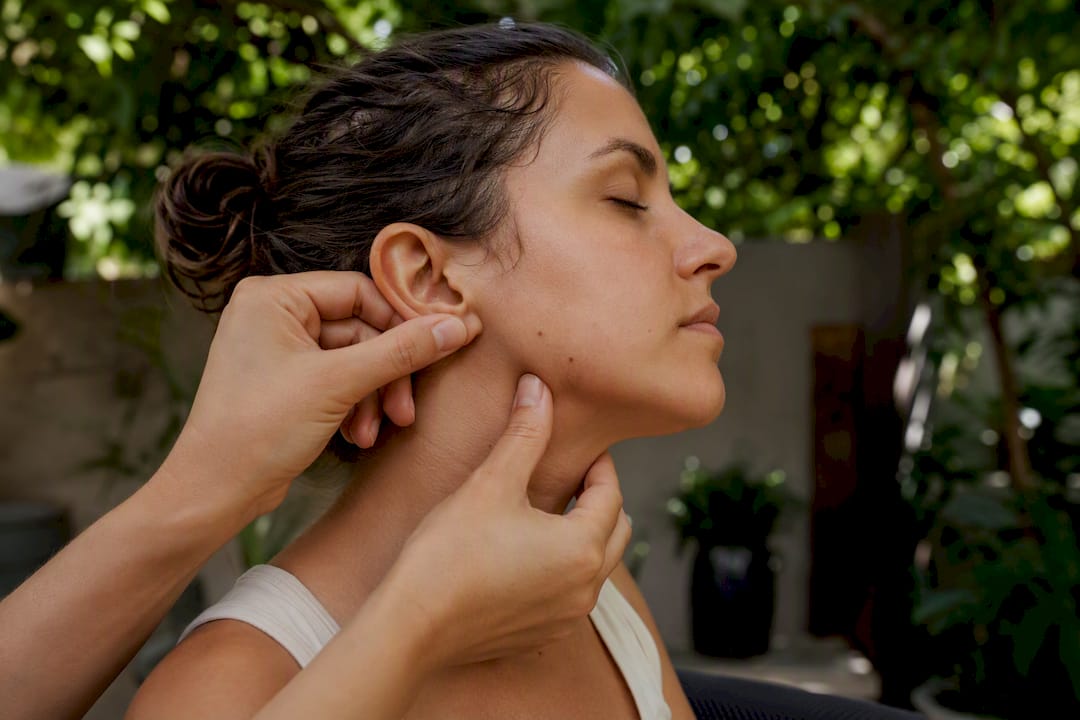
Massage for TMJ works because it improves blood flow to overworked muscles and releases the small, tight knots called trigger points. Two muscles do most of the damage: the masseter (the thick muscle you feel when you clench your back teeth) and the temporalis (the fan-shaped muscle above your ear, at your temple).
Try these three techniques, all with gentle to moderate pressure:
- Kneading: Use your fingertips to press and roll the masseter in small circles, working from your cheekbone down to your jawline.
- Cross-fiber friction: Move your fingers perpendicular to the muscle fibers along the temporalis, which helps break up tension bands.
- Suboccipital friction: Massage the base of your skull, where neck tension often feeds directly into jaw pain.
The right pressure produces mild, fading tenderness, according to Kaiser Permanente's guidance on self-massage for TMJ. If pain sharpens or lingers, ease off and consider professional help.
Massage paired with exercise or post-isometric relaxation techniques speeds up relief more than massage alone, according to controlled research on massage combined with PIR. If self-massage isn't cutting it after a couple of weeks, a registered massage therapist or physical therapist can add manual therapy techniques you simply can't do on yourself, particularly around the neck and upper back.
Pro Tip: Massage right after applying heat. Warmed-up muscle tissue responds faster to pressure and loosens more easily than cold, tense muscle.
Professional Conservative Options Worth Knowing About
Self-care goes a long way, but some tools work better with professional guidance. Physical therapy offers manual therapy, individualized exercise prescriptions, and posture correction that address the neck-jaw connection self-treatment often misses. Evidence backs this approach particularly well for muscle-driven TMJ disorders.
Other conservative, reversible options include:
- Oral splints or nightguards: Worn at night to reduce clenching and grinding pressure on the joint; helpful for many, though they don't fix underlying muscle tension alone.
- Acupuncture: Offers moderate short-term pain relief for some patients, with variable long-term results.
- TENS (transcutaneous electrical nerve stimulation): Uses mild electrical pulses to interrupt pain signals and relax muscles temporarily.
- Low-level laser therapy: Shows promise for reducing inflammation, though evidence for lasting benefit is still developing.
A systematic review of non-pharmacological TMJ interventions found that physiotherapy, acupuncture, and massage each provide moderate short-term relief, but long-term success usually depends on combining approaches rather than relying on one alone. Talk with a clinician about which combination fits your specific pattern of symptoms.
Building a Simple 2 to 4-Week Routine You Can Actually Follow
Consistency beats intensity with TMJ care. Here's a realistic plan:
- Days 1 to 4: Soft diet, moist heat twice daily, gentle jaw exercises once daily, and mindful jaw rest (no gum, no wide yawning).
- Days 5 to 10: Add self-massage sessions after heat, increase exercises to twice daily, and start tracking sleep habits, since poor sleep positioning worsens jaw clenching.
- Days 11 to 14: Reassess. If pain frequency and mouth opening haven't improved, book a physical therapist or dentist experienced with TMJ.
- Weeks 3 to 4: Continue exercises and massage while incorporating any professional recommendations, adjusting intensity based on your symptom log.
Track three simple markers weekly: how often pain occurs, how wide you can comfortably open your mouth, and whether daily function (eating, talking, yawning) feels easier. Many people expect overnight results and give up too soon. Real change from exercise and manual therapy usually takes several consistent weeks, not days.
Nutrition and Supplements: What Helps and What's Still Unproven
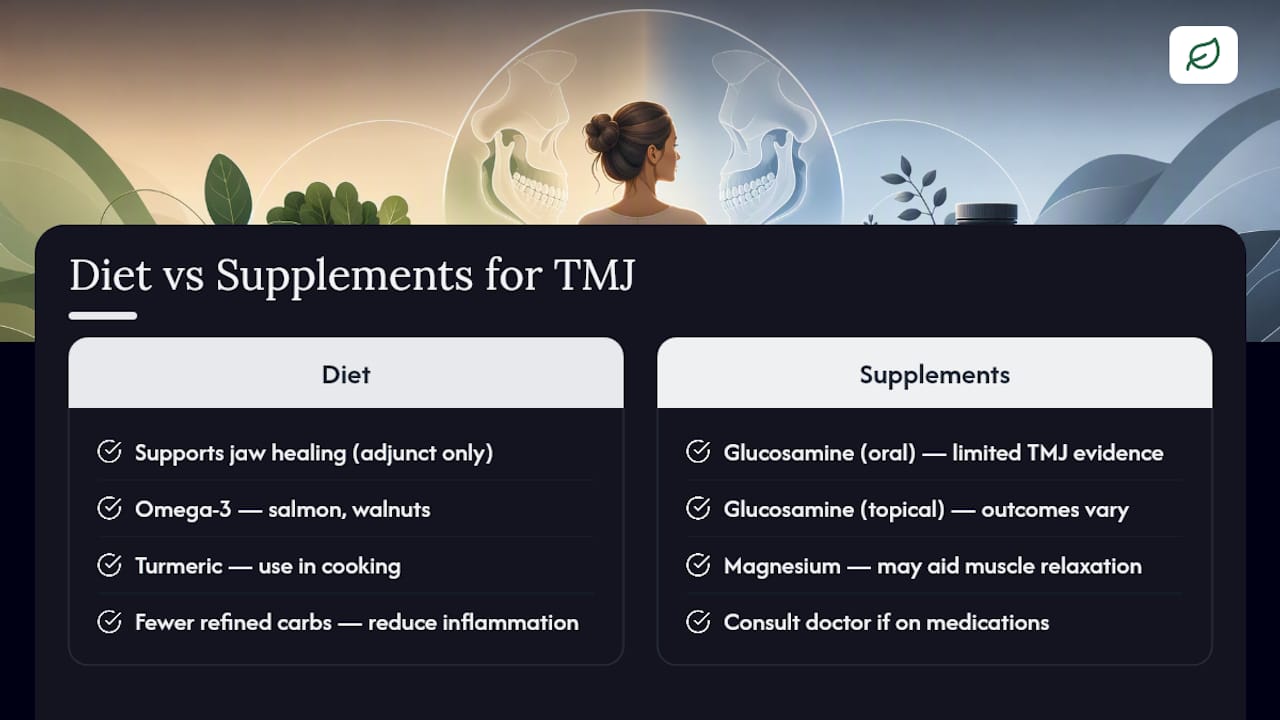
An anti-inflammatory diet supports jaw healing without replacing the mechanical work exercises and massage do. Favor omega-3 sources like salmon and walnuts, turmeric in cooking, and fewer refined carbs, which can worsen systemic inflammation.
Supplement claims deserve a skeptical eye. Glucosamine shows some limited, TMJ-specific evidence for supporting joint tissue in osteoarthritis-related cases, though the evidence base remains emerging, and outcomes vary between oral and topical forms. Magnesium may support general muscle relaxation, but talk to your doctor before adding any supplement, especially if you take other medications.
When to See a Clinician: Red Flags You Shouldn't Ignore
Self-care handles most mild TMJ symptoms, but some signs mean it's time to get evaluated:
- Pain that persists or worsens despite weeks of conservative care
- Your jaw locks open or closed and won't release
- Numbness, tingling, or weakness in your face
- Recent trauma to your jaw or face
- Fever or other systemic symptoms alongside jaw pain
Start with your dentist or a physical therapist experienced in TMJ, or your primary care doctor if symptoms seem unusual. Surgery remains a last resort, considered only after reversible options have genuinely been tried, according to Mayo Clinic's clinical overview.
Why Conservative, Multimodal Care Is the Prudent First Choice
I think the biggest mistake people make with TMJ is treating it like a single problem with a single fix. It's rarely one thing. Muscle tension, posture, stress, sleep, and clenching habits all feed into each other, which is exactly why combining exercises, massage, and lifestyle changes outperforms any single intervention alone.
.. If you've tried the basics and still feel stuck, a platform like Goholistic can help you find the right kind of practitioner support to guide the next step.
Find Vetted Practitioners Who Specialize in TMJ Relief
Goholistic cuts out the guesswork of finding a qualified provider by matching you directly with practitioners who actually treat jaw pain, not a general directory hoping you'll figure it out yourself.

If the exercises and self-massage in this guide haven't fully resolved your symptoms after a few weeks, Goholistic's directory of verified holistic practitioners lets you filter by specialty, whether that's a massage therapist trained in myofascial release, a physical therapist who treats TMJ specifically, or an acupuncturist. The platform's AI-powered recommendation tool factors in your specific symptoms and matches them against its treatment library, so you're not stuck sorting through generic wellness content that doesn't apply to your situation. Every practitioner listed is certified and verified, which matters when you're trusting someone with hands-on work near a sensitive joint. Browse the directory now and book a consultation with someone who understands TMJ specifically.
Frequently Asked Questions
How long does natural TMJ treatment take to work? Most people notice improvement within a few weeks of consistent daily exercises, heat/cold application, and dietary changes. The 2026 home rehabilitation study found meaningful short-term gains in pain and mobility within the study's timeframe, though full resolution varies by individual.
Can TMJ go away on its own with natural treatment? Many mild or periodic TMJ symptoms resolve with conservative, reversible steps like rest, soft diet, and exercise, according to NIDCR. Persistent or worsening symptoms need professional evaluation rather than continued self-treatment.
Is massage or exercise better for TMJ pain? Neither works better alone. Research on massage combined with post-isometric relaxation shows the combination produces faster, stronger relief than either technique by itself.
Are TMJ nightguards a natural treatment? Nightguards are conservative and reversible, making them a reasonable non-surgical option alongside self-care, though they address clenching pressure rather than the underlying muscle tension that exercises and massage target directly.
This article is general information, not a substitute for advice from a qualified doctor. Consult a qualified healthcare professional about your own circumstances before acting on anything here.
Sources
- National Institute of Dental and Craniofacial Research (NIDCR) — Temporomandibular Disorders
- Systematic review on non-pharmacological TMJ interventions (PMC)
- BMC Oral Health — Self-mobilization + exercise home program (2026)
- Mayo Clinic — TMJ diagnosis and treatment