

TL;DR:
- Proper preparation, including safety screening and practitioner verification, is essential before starting natural remedies for chronic health conditions. Tracking symptom changes over time and maintaining open communication with healthcare providers help ensure safe, effective, and evidence-based use. Natural remedies are tools for management, requiring ongoing evaluation, realistic expectations, and careful coordination with conventional care.
Natural remedies hold real promise for people managing chronic health conditions, but getting them right takes more than good intentions. Jumping in without a clear plan can mean wasted effort, unexpected side effects, or dangerous interactions with medications you're already taking. A solid step by step natural remedy guide helps you move from curiosity to confident, informed action. And that matters, because natural products can interact with medications in ways that feel anything but natural. This guide gives you the structure to prepare well, apply remedies safely, and actually evaluate whether they're working.
Table of Contents
- Preparation: what you need before starting a natural remedy
- Execution: step-by-step natural remedies and tracking progress
- Verification: evaluating outcomes and maintaining safety
- Common mistakes and troubleshooting in natural remedy use
- Rethinking natural remedies: realistic expectations and evidence navigation
- Explore holistic health support with GoHolistic
- Frequently asked questions
Key Takeaways
| Point | Details |
|---|---|
| Safety first | Always screen for medication interactions and consult healthcare providers before starting natural remedies. |
| One at a time | Try one natural remedy at a time and track your symptoms carefully for effective evaluation. |
| Modest benefits | Natural remedies usually offer modest symptom relief, not guaranteed cures. |
| Coordinate care | Communicate all natural remedy use with all your healthcare providers to avoid risks. |
| Evidence navigation | Learn to critically assess scientific evidence over testimonials or marketing claims. |
Preparation: what you need before starting a natural remedy
Think of preparation as building the foundation before you plant anything. Without it, even the best remedy can fall flat or cause harm. Before you ever open a bottle of herbs or schedule your first acupuncture session, there are a few essential steps every natural remedy application guide should address.
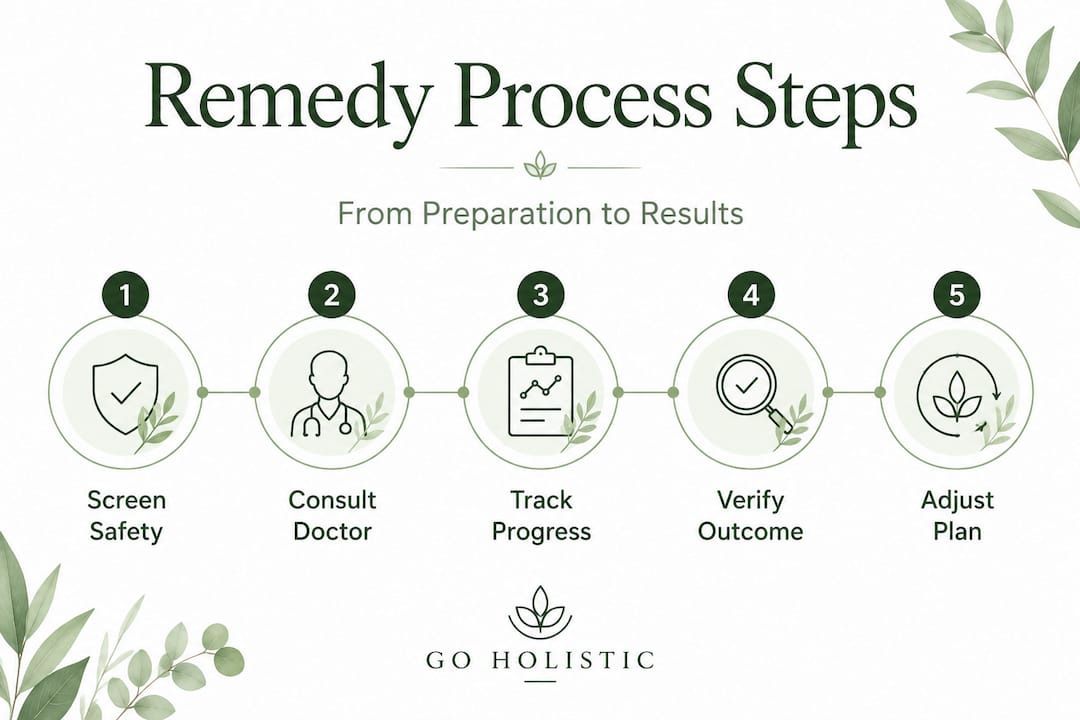
Screen for safety first. Natural products can interact with medications and worsen certain conditions, so your first task is a safety check. Write down every medication, supplement, and over-the-counter product you currently take. Bring that list to your doctor or pharmacist before adding anything new.
Choose the right practitioner. Not every person advertising holistic services is properly trained. Complementary practitioners should be checked for valid licensure in your state and a willingness to communicate with your primary care provider. Our guide on selecting qualified practitioners walks you through exactly what to ask during that first conversation.
Here are the key preparation steps in one place:
- Compile a complete list of all medications, vitamins, and supplements you take
- Note any known allergies, especially to plants or botanicals
- Document your current symptoms in detail, including frequency and severity
- Research your shortlisted remedies using credible sources, not testimonials
- Confirm your practitioner's license through your state's professional board
- Ask explicitly whether they will share notes with your conventional care team
- Set a realistic goal (symptom reduction, not cure) before you begin
Know your numbers. Beyond safety screening, review your healthcare quality guidelines and understand what quality care coordination looks like. For chronic conditions in particular, keeping your conventional and complementary providers in the same loop is not optional. It is protective.
| Preparation step | Why it matters | Who to involve |
|---|---|---|
| Medication review | Prevents dangerous interactions | Doctor or pharmacist |
| Practitioner credential check | Ensures licensed, qualified care | State licensing board |
| Symptom baseline documentation | Gives you data to evaluate results | You, your care team |
| Insurance and cost review | Avoids unexpected financial strain | Insurance provider |
| Goal-setting | Builds realistic expectations | You, practitioner |
Pro Tip: Ask your primary care doctor directly: "Are there any natural remedies I should avoid given my current medications?" That one question can prevent months of setbacks.
Now that you know the importance of preparation, let's explore the step-by-step process to safely try natural remedies.
Execution: step-by-step natural remedies and tracking progress
Having prepared thoroughly, you can now execute natural remedy steps carefully while tracking your health progress. This is where your home remedy handbook starts to take shape, one deliberate step at a time.

The core rule: one remedy at a time. A step-by-step plan includes choosing one low-risk intervention at a time, documenting your baseline, and rechecking safety as you go. When you introduce multiple remedies simultaneously, you lose the ability to know what is helping, what is hurting, and what is doing nothing at all.
Follow this numbered sequence for every new remedy you try:
- Choose one remedy that has at least some published research behind it for your specific condition.
- Document your baseline by recording your symptoms daily for one week before you begin.
- Start at the lowest recommended dose or frequency, following your practitioner's guidance.
- Track daily changes in a simple journal or app, noting symptom shifts, energy, sleep, mood, and any new sensations.
- Set a clear evaluation window of four to six weeks. Most evidence-based approaches need time before effects appear.
- Review with your practitioner at the midpoint and end of the evaluation window.
- Decide to continue, adjust, or stop based on documented evidence, not feelings alone.
Tracking does not need to be complicated. A notebook with five daily data points works perfectly well. What matters is consistency.
Herbal supplements deserve extra caution. Herbal supplements have limited oversight and can interact with prescription medications in meaningful ways. St. John's Wort, for example, is widely used for low mood, but it reduces the effectiveness of birth control, blood thinners, and HIV medications. Always disclose herbal use to your doctor before starting.
Here are science-backed natural pain relief approaches that have been studied for chronic conditions:
- Acupuncture for lower back pain and osteoarthritis
- Mindfulness-based stress reduction for fibromyalgia and headaches
- Ginger and turmeric (with medical clearance) for inflammatory pain
- Massage therapy for muscle tension and chronic neck pain
- Yoga and tai chi for balance-related conditions and joint stiffness
| Remedy type | Evidence level | Typical evaluation window | Common caution |
|---|---|---|---|
| Acupuncture | Moderate to strong | 6 to 8 sessions | Needle site infection risk |
| Herbal supplements | Varies widely | 4 to 6 weeks | Drug interactions |
| Mindfulness practices | Moderate | 8-week program | Requires consistent practice |
| Massage therapy | Moderate | 4 to 6 sessions | Contraindicated in some conditions |
Complementary approaches provide modest benefits for chronic pain, but results vary by condition and by person. "Modest" is not a failure. For someone living with daily pain, a 20% reduction in symptom severity is genuinely life-changing.
Pro Tip: Use a free symptom-tracking app or a simple spreadsheet to log morning and evening scores from 1 to 10. After four weeks, patterns will emerge that would be invisible without the data. Explore evidence-based non-invasive treatments to build out your tracking framework.
Verification: evaluating outcomes and maintaining safety
With careful execution, verifying outcomes and maintaining safety ensures your natural remedy journey is effective and secure. This stage is where many people lose discipline, and it's where the real gains happen.
Evaluate against your baseline. Pull out your symptom journal and compare your recorded scores from before and after the evaluation window. Look for trends, not single data points. One bad day does not mean the remedy failed. One great week does not mean it worked.
Watch for these signals during your review:
- Measurable improvement of 15% or more in tracked symptoms
- No new symptoms or unexplained physical changes
- Stable or improved energy, sleep, and mood
- No changes in how your conventional medications are performing
- Feedback from your practitioner aligning with your self-reported data
Disclose everything to every provider. Talk with your healthcare providers about possible interactions between supplements and medications, and disclose all complementary approaches at every appointment. This is not just about safety. It also helps your providers give you better advice because they understand your full picture.
"The most common safety gap in complementary health care is not the remedy itself. It is the information gap between the patient's conventional doctor and their holistic practitioner."
Coordinating communication among all providers and reporting new symptoms promptly is one of the most effective safety practices you can build. Review our integrative health and safety tips for practical scripts you can use during provider conversations.
Pro Tip: Before every medical appointment, update a one-page summary of all supplements, herbal products, and complementary therapies you are currently using. Hand it to every provider you see. It takes five minutes and removes a significant safety risk.
Common mistakes and troubleshooting in natural remedy use
Knowing how to troubleshoot common mistakes arms you to avoid setbacks and safely continue your natural remedy plan. Even well-intentioned people make predictable errors. Here is what to watch for.
The "natural equals safe" assumption is the most dangerous one. Many herbs can interact with medications and produce real side effects. Kava, used for anxiety, can damage the liver. Echinacea may interfere with immunosuppressant drugs. "Natural" describes origin, not risk level.
A common pitfall is assuming no drug interactions exist with natural products. Full medication lists shared with every provider close that gap. No list, no safety net.
Avoid these frequent mistakes in your DIY natural treatments journey:
- Introducing two or more new remedies at the same time
- Skipping the safety screening step because you feel healthy
- Basing your remedy choices on social media posts or testimonials without checking the evidence
- Ignoring mild side effects like digestive upset, skin changes, or unusual fatigue
- Stopping a conventional medication to "try" a natural alternative without medical supervision
- Forgetting to update your medication list after starting a new herbal supplement
If something feels off, stop and call your provider. That is not weakness. That is good judgment. Review the evidence-based holistic methods resource library for guidance on what the research actually supports versus what is mostly marketing.
Pro Tip: Keep a single running document called "Everything I take" that includes the product name, dose, start date, and the provider who recommended it. Update it every time anything changes. Share it at every appointment.
Rethinking natural remedies: realistic expectations and evidence navigation
Here is a perspective that most natural remedy content avoids saying plainly: the goal is never cure. It is management.
When you use a stepwise herbal solutions approach for a chronic condition, you are not looking for a single intervention that resolves everything. You are looking for tools that, stacked thoughtfully and used safely, shift your day-to-day quality of life in a meaningful direction. That framing matters because it changes how you evaluate success.
The NCCIH frames natural remedy decisions as evidence-navigation, not brand trust or testimonials. That is a meaningful distinction. A product with 500 five-star reviews and no published safety data is not evidence-based. A modest clinical trial with 80 participants showing real symptom improvement? That is something you can actually use.
Complementary approaches may help with day-to-day symptom variation but require ongoing trial, tracking, and adjustment. The word "require" is doing a lot of work in that sentence. There is no passive path to effective natural health care. It asks something of you, and that is actually the point. The people who get the most from natural remedies are not the ones who find the "perfect" supplement. They are the ones who track carefully, communicate openly, and stay curious without becoming credulous.
Think of your natural remedy journey as tending a garden. You prepare the soil, you plant deliberately, you watch closely, and you adjust based on what actually grows. Some things thrive. Others don't take root. Neither outcome is failure. Both are information.
Explore holistic health support with GoHolistic
You've built a strong framework for approaching natural remedies safely and thoughtfully. The next step is connecting with practitioners who can support that journey with verified credentials and evidence-based care.
GoHolistic connects you with holistic health practitioners who are licensed, vetted, and ready to coordinate with your conventional care team. Whether you're exploring acupuncture, Ayurveda, massage therapy, or herbal guidance, the holistic health treatments library covers over 200 therapy types with research summaries so you can decide from a place of knowledge. Browse the holistic health providers directory to find trusted practitioners in your area. Your wellness journey deserves real support. Get Started today and take your next step with confidence.
Frequently asked questions
How do I know if a natural remedy is safe for me?
Check with your healthcare provider about your current medications and health conditions before trying any natural remedy, since natural remedies can interact with medications in ways that require professional guidance. Selecting licensed practitioners who communicate with your existing providers adds another layer of protection.
Can natural remedies cure chronic illnesses?
Natural remedies are not proven cures for chronic conditions. Complementary health approaches may provide modest symptom relief but outcomes vary by condition and individual, so realistic expectations and careful result tracking are essential.
Why should I track symptoms when using natural remedies?
Tracking gives you objective data to evaluate whether a remedy is actually working or causing harm, making it possible to adjust safely. Symptom tracking supports evaluation and adjustment so your decisions stay grounded in evidence rather than guesswork.
Are herbal supplements regulated the same as medicines?
No. Herbal supplements are not held to medicine regulation standards and do not require proof of safety or effectiveness before reaching store shelves, which makes professional guidance and careful screening especially important.
How do I find a qualified holistic health practitioner?
Check your state's licensing board, ask your primary care doctor for referrals, verify the practitioner's credentials and experience with your specific condition, and confirm they are willing to coordinate with your medical providers before your first appointment.