

TL;DR:
- Personalized wellness addresses individual biological needs, leading to better health outcomes.
- Choosing evidence-based holistic therapies tailored to your specific concerns enhances effectiveness.
- Ongoing monitoring and simple adjustments help optimize and sustain your personalized wellness plan.
You've probably tried a wellness plan that looked great on paper but felt completely wrong for your body. Maybe the diet advice left you tired, or the exercise routine made your stress worse. Generic wellness guidance is built for the average person, and most of us aren't average. Personalized nutrition increases healthy food choices and improves mood and gut health compared to generic advice. That gap between broad recommendations and what your body actually needs is exactly what this guide addresses. You'll walk away with a clear, step-by-step process to build a wellness plan that truly fits you.
Table of Contents
- Assess your individual wellness needs
- Choose evidence-based holistic strategies
- Apply personalization and track your progress
- Troubleshooting and optimizing your wellness plan
- What most wellness guides miss about true personalization
- Find holistic wellness solutions that work for you
- Frequently asked questions
Key Takeaways
| Point | Details |
|---|---|
| Start with self-assessment | Identify your specific health concerns and unique biological factors before choosing wellness strategies. |
| Choose evidence-based therapies | Select holistic solutions proven to address your individual needs, not just trending options. |
| Track key wellness metrics | Monitor energy, mood, and biomarkers to avoid data overload and optimize your journey. |
| Adapt and refine continuously | Personalization requires ongoing adjustment and learning for the best health outcomes. |
| Connect with experts | Utilize practitioner directories and holistic platforms to access tailored guidance and support. |
Assess your individual wellness needs
Now that we've seen why broad advice often fails, let's start your personalization process by understanding your individual needs. Before you choose a single therapy or tweak your diet, you need an honest look at where you are right now. Think of this as your wellness baseline, the foundation everything else builds on.
Start with a simple self-audit. Review your health history, any chronic issues you manage, your sleep patterns, energy levels throughout the day, and how you handle stress. These factors paint a picture that no generic plan can replicate. Biological individuality, including genetics, stress response, and chronobiology, makes one-size-fits-all solutions ineffective. Your hormonal fluctuations, your nervous system's baseline, and even your body clock all shape how you respond to wellness interventions.
Here are the key areas to examine during your self-audit:
- Health history: Chronic conditions, past injuries, medications, and family patterns
- Lifestyle habits: Sleep schedule, movement frequency, work demands, and social connection
- Biological signals: Energy crashes, mood dips, digestive discomfort, or hormonal shifts
- Stress tolerance: How quickly you recover from stressful events and what triggers you most
- Personal priorities: What matters most right now, whether that's better sleep, more energy, or improved mood
Once you have this picture, it helps to organize your findings. The table below shows common wellness priorities and the biological factors most likely connected to each:
| Wellness priority | Key biological factors to consider |
|---|---|
| Energy levels | Thyroid function, sleep quality, blood sugar regulation |
| Mood and mental clarity | Cortisol patterns, gut microbiome, neurotransmitter balance |
| Gut health | Microbiome diversity, food sensitivities, stress response |
| Sleep quality | Circadian rhythm, melatonin production, nervous system tone |
| Hormonal balance | Cycle phase, adrenal health, estrogen and progesterone ratios |
Understanding these connections helps you focus your energy where it counts most. Exploring personalized wellness outcomes can also show you how this kind of tailored approach leads to measurably better results.
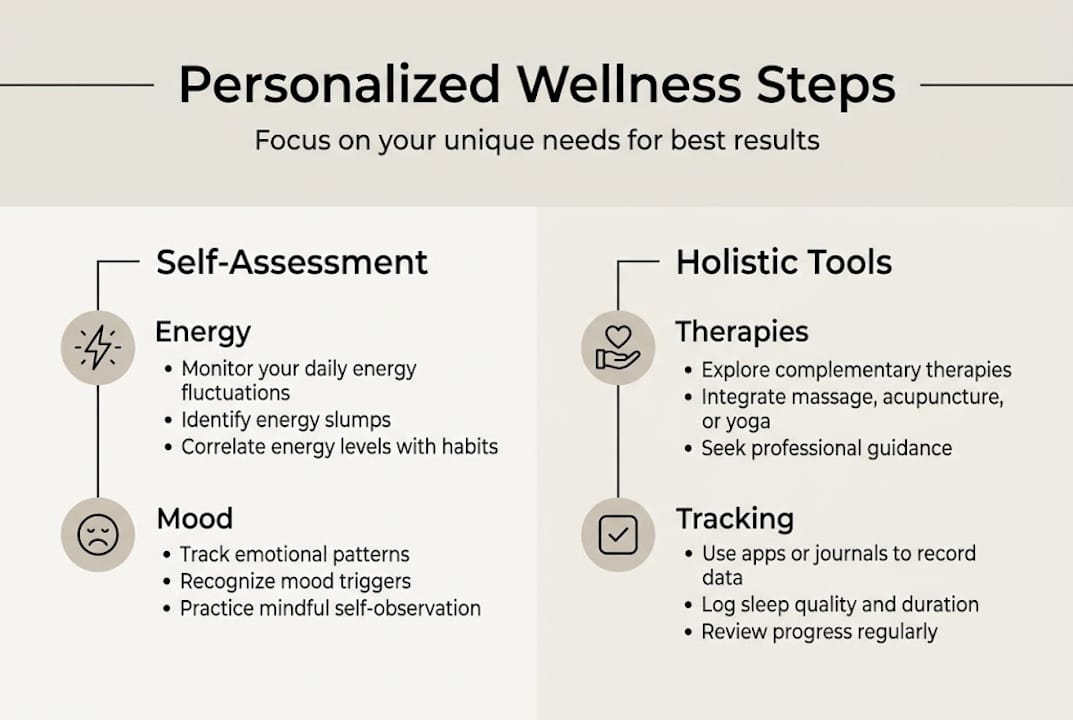
Pro Tip: Resist the urge to track everything at once. Narrow your focus to the three metrics that feel most disruptive to your daily life. Overloading yourself with data creates confusion, not clarity.
Choose evidence-based holistic strategies
Once you've defined your individual needs, the next step is to select holistic strategies backed by evidence. Not every wellness trend deserves your time or money. The good news is that several well-researched therapies offer real, documented benefits across a range of health concerns.
Holistic therapies like yoga, meditation, acupuncture, and aromatherapy are effective for personalized health needs. Each works differently in the body, and matching the right therapy to your specific concerns is where the real power lies. Reviewing top wellness practices can help you see which approaches have the strongest research support.
Here's a quick comparison of four widely used holistic approaches:
| Therapy | Best suited for | Key mechanism | Evidence strength |
|---|---|---|---|
| Yoga | Stress, flexibility, hormonal balance | Nervous system regulation, breath control | Strong |
| Meditation | Anxiety, focus, sleep quality | Cortisol reduction, mindfulness training | Strong |
| Acupuncture | Pain, digestion, energy flow | Nervous system and meridian stimulation | Moderate to strong |
| Aromatherapy | Mood, relaxation, mild anxiety | Limbic system activation via scent | Moderate |
Beyond these four, consider therapies like Ayurveda, which takes a whole-person approach rooted in thousands of years of practice. Learning about Ayurveda advantages can reveal whether this system aligns with your constitution and health goals. The integrative health benefits of combining multiple modalities are also well-documented, especially for complex or chronic concerns.
When choosing your strategies, keep these principles in mind:
- Match the therapy to the root cause, not just the surface symptom
- Start with one or two modalities before layering in more
- Check practitioner credentials to ensure you're working with verified professionals
- Review research summaries so you understand the evidence behind each approach
Personalized wellness plans are increasingly recognized as the future of holistic health, and the evidence supports moving away from one-size-fits-all models toward integrative, individualized care.

Pro Tip: Integrative medicine works best when it addresses root causes rather than just managing symptoms. Ask yourself what's driving the issue, not just what's making you uncomfortable right now.
Apply personalization and track your progress
With holistic strategies in place, it's crucial to customize your actions and monitor their effectiveness as you progress. Knowing which therapy to use is only half the equation. The other half is building it into your daily life in a way that actually sticks.
Here's a step-by-step process to get started:
- Set a clear intention. Decide what you want to feel or achieve in the next 30 days. Be specific: "I want to fall asleep within 20 minutes" is more useful than "I want better sleep."
- Schedule your practices. Assign specific times to your chosen therapies. Consistency matters more than duration, especially in the early weeks.
- Create a baseline record. Before you begin, note your current energy, mood, and any relevant biomarkers like resting heart rate or digestion quality.
- Choose your tracking method. Pick one tool you'll actually use, whether that's a wellness app, a simple journal, or weekly check-ins with a practitioner.
- Review weekly. At the end of each week, compare your current state to your baseline. Look for small shifts, not dramatic transformations.
- Adjust monthly. Based on your weekly observations, make one or two small changes each month to keep your plan aligned with your evolving needs.
The data behind personalized approaches is compelling. The ZOE nutrition trial found greater weight loss and lower triglycerides alongside improved mood and gut health in participants following personalized plans compared to generic advice. That kind of outcome is possible when you stay consistent and responsive to your own data.
Useful tools for tracking your wellness progress include:
- Wellness journals for daily mood, energy, and symptom notes
- Wearable devices to monitor sleep, heart rate variability, and activity
- Nutrition tracking apps for food sensitivity patterns
- Practitioner check-ins for professional interpretation of your progress
For deeper support, an integrative nutrition guide can help you align your food choices with your holistic plan. And if you want practical strategies to stay on course, these wellness success tips offer grounded, actionable guidance.
Troubleshooting and optimizing your wellness plan
Personalization requires ongoing refinement. Let's troubleshoot challenges and optimize your plan so it keeps working for you over time.
One of the most common pitfalls is overcomplicating things too soon. When you add too many changes at once, it becomes impossible to know what's actually helping. Keep your plan simple, especially in the first few months. Another frequent mistake is ignoring your own individuality in favor of what worked for someone else. Your neighbor's morning routine or your colleague's supplement stack may not be right for your biology.
Context matters deeply in wellness. The timing of lab tests, your current sleep phase, where you are in your hormonal cycle, and recent life stressors all influence how your body responds to any given intervention. Adjust your plan with these factors in mind, not against a fixed ideal.
Data overload can lead to paralysis, so triaging three key metrics prevents confusion and keeps your focus sharp. This is especially true for people navigating special circumstances like perimenopause, high chronic stress, or trauma recovery, where the body's signals are more complex and require more nuanced interpretation.
Here are common optimization mistakes and how to fix them:
- Overcomplicating your plan: Simplify by removing one element at a time until you find what's working
- Ignoring life stage changes: Reassess your plan during hormonal shifts, major life transitions, or illness recovery
- Poor tracking habits: Switch to a simpler method if your current system feels like a chore
- Chasing trends: Return to evidence-based choices whenever you feel pulled toward unproven solutions
Making evidence-based choices is especially important when you're troubleshooting, because it keeps you grounded in what's actually proven to work rather than what's simply popular.
Pro Tip: Treat your wellness plan like a living document. The version that serves you in spring may need adjusting by fall. Continual learning and small adaptations yield far better long-term results than any rigid program.
What most wellness guides miss about true personalization
Most wellness content focuses on what to do, but very few guides address why personalization so often falls short in practice. The honest answer is that convenience has become a substitute for context. Apps and AI tools promise tailored recommendations, but without a biological framework, they're still delivering generic outputs dressed up in personalized language.
Personalization boosts adherence and outcomes, but satisfaction depends on pairing it with education and motivation strategies. That pairing is what most platforms skip. They hand you a plan without helping you understand why it fits your body, or how to stay motivated when progress feels slow.
True personalization isn't a product. It's a practice. It requires you to stay curious about your own biology, honest about what's working, and willing to adapt. The most effective wellness journeys we've seen are built on that foundation, not on the latest trend or the most sophisticated algorithm. Exploring personalized wellness outcomes through an educated, motivated lens is what actually moves the needle.
Find holistic wellness solutions that work for you
Ready to take the next step? Your wellness journey deserves more than a generic checklist. Go Holistic connects you with verified practitioners, evidence-backed holistic treatments, and a treatment library covering over 200 therapy types, all designed to support your unique health goals.
Whether you're looking for practitioners near you or want to browse our full providers directory, we make it easy to find the right support at every stage of your journey. Start with a free account and explore personalized recommendations built around your actual health concerns. Your path to better well-being starts with one informed step.
Frequently asked questions
What makes personalized wellness more effective than generic plans?
Personalized wellness plans address your unique biological factors, leading to greater adherence and improved health outcomes. Empirical data shows greater weight loss and improved mood from personalized nutrition compared to generic advice.
How do I know which holistic therapies are right for me?
Match therapies to your top health priorities and use evidence-based approaches to ensure safety and effectiveness. Holistic therapies including yoga, meditation, and acupuncture are effective across a wide range of individual needs.
Can I use AI or apps for my wellness personalization?
Apps and AI tools can be helpful starting points, but they work best when guided by biological frameworks and your individual context. AI needs biological frameworks like Ayurveda and personal context to offer meaningful, relevant advice.
What should I track when personalizing my wellness journey?
Focus on three key metrics: energy, mood, and relevant biomarkers to avoid overwhelm and stay focused on meaningful progress. Triaging three impactful wellness metrics prevents the paralysis that comes from tracking too much at once.
How often should I adjust my wellness plan?
Monitor your results regularly and make small adjustments monthly or whenever your health needs shift. Consistent small tweaks over time are far more effective than periodic overhauls.