

TL;DR:
- Safety depends on individual health, dosage, and product quality, not just naturalness.
- Research from clinical trials and reputable sources is essential for evaluating holistic therapy risks.
- Verifying practitioner credentials and ensuring open communication with healthcare providers enhance safety.
Many people step into the world of holistic wellness with an open heart and a simple belief: if it's natural, it must be safe. That assumption feels reasonable, but it can lead you into territory that's more complicated than a label suggests. Supplements can interact with medications. Practitioners vary widely in training and accountability. And not every therapy has the clinical evidence to back up its marketing claims. The good news is that with the right framework, you can evaluate any holistic therapy clearly and confidently, protecting your health while still exploring the full range of what integrative wellness has to offer.
Table of Contents
- Understanding the foundations of holistic therapy safety
- Researching therapies and understanding potential risks
- Evaluating holistic practitioners and their credentials
- Integrating holistic therapies safely with conventional care
- Our take: What most guides miss about holistic therapy safety
- Find trusted holistic therapies and practitioners
- Frequently asked questions
Key Takeaways
| Point | Details |
|---|---|
| Evidence over hype | Prioritize scientific proof and reliable sources rather than marketing claims when evaluating holistic therapies. |
| Verify provider credentials | Check licenses and certifications to ensure your holistic practitioner is qualified and operates safely. |
| Discuss with your doctor | Consult your primary care team about any holistic therapies to prevent harmful interactions or treatment gaps. |
| Monitor and adapt | Keep track of your results and side effects when trying new therapies and be willing to change course if needed. |
Understanding the foundations of holistic therapy safety
Before you can assess whether a specific therapy is right for you, it helps to understand what "safe" actually means in the holistic health context. Safety is not a fixed label. It depends on dosage, your health history, any medications you take, and the quality of the product or practice itself.
One of the biggest misconceptions in wellness culture is that natural equals safe. This idea gets reinforced by beautiful packaging, feel-good marketing, and the general association between nature and purity. But natural doesn't mean safe: supplements may be contaminated, interact with drugs, or cause harm if taken in high doses. Arsenic is natural. So is hemlock. The source of something tells you very little about its safety profile.
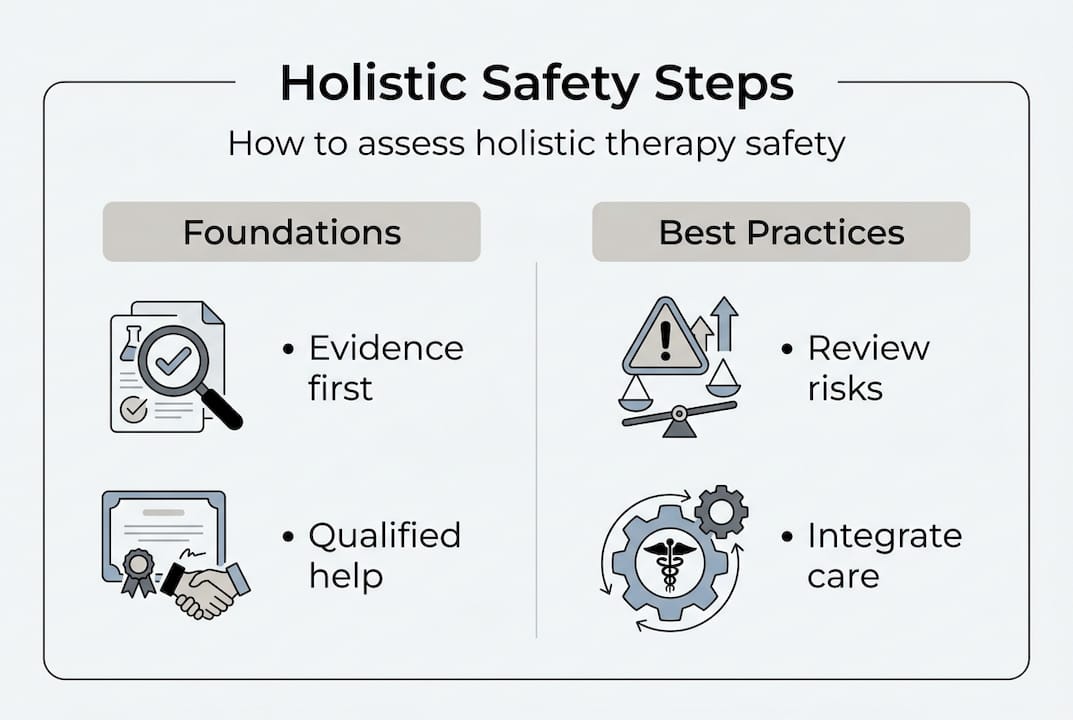
This is where evidence-based wellness becomes your most reliable compass. Evidence-based evaluation means looking beyond anecdote and tradition to ask: what does the research actually show? It means checking whether a therapy has been tested in clinical trials, whether those trials were well-designed, and whether the results have been replicated.
Here's a quick overview of what reliable evidence looks like versus what to be cautious about:
| Evidence type | Reliability level | What it tells you |
|---|---|---|
| Randomized controlled trial | High | Controlled comparison of outcomes |
| Systematic review or meta-analysis | High | Aggregated findings across studies |
| Observational study | Moderate | Patterns in real-world use |
| Traditional use records | Low to moderate | Historical context, not clinical proof |
| Testimonials or anecdotes | Low | Personal experience, not generalizable |
Reputable sources for holistic therapy research include:
- The NCCIH science resources (National Center for Complementary and Integrative Health)
- PubMed, the database of peer-reviewed medical research
- The American Cancer Society's integrative medicine guidance
- Cochrane Reviews for systematic evidence summaries
As cancer.org notes, you should consult clinical trial evidence to assess safety and efficacy, since many holistic therapies lack rigorous testing. That doesn't mean they're ineffective. It means you need to be thoughtful rather than trusting.
"The question is never whether a therapy is natural. The question is whether it is appropriate, well-studied, and safe for you specifically."
Understanding the role of alternative therapies in modern wellness also means recognizing that many practices have genuine merit when applied correctly. The goal isn't skepticism for its own sake. It's informed trust.
Researching therapies and understanding potential risks
With a foundation in evidence-based evaluation, let's look at how to research individual therapies and assess risks.
Not all holistic therapies carry the same risk profile. Gentle practices like meditation or yoga nidra have minimal adverse event data. Others, like high-dose herbal supplements or emerging psychedelic-assisted therapies, require much more careful scrutiny. A multi-level safety assessment of herbal products should consider traditional use, preclinical and clinical data, real-world evidence, and context like dosage and drug interactions.
Here's how different research sources compare when you're evaluating a therapy:
| Research source | Best used for | Limitation |
|---|---|---|
| PubMed clinical trials | Efficacy and safety data | May have small sample sizes |
| NCCIH fact sheets | Plain-language summaries | Not always up to date |
| Traditional medicine texts | Historical context | Not a substitute for clinical proof |
| Product manufacturer claims | Understanding ingredients | Biased; not independent |
Known adverse events with holistic therapies do exist. High-dose psilocybin, for example, has been linked to prolonged psychiatric effects in some individuals. Ginkgo biloba has been associated with bleeding risk. These aren't reasons to avoid all alternative therapies. They are reasons to research before you begin.
Follow this process when evaluating any new therapy:
- Identify the therapy clearly. Know the exact form, dosage range, and delivery method being recommended.
- Search PubMed or NCCIH for peer-reviewed studies specific to your health concern.
- Check for drug interactions using a pharmacist or a tool like the Natural Medicines Database.
- Review adverse event reports to understand what side effects have been documented.
- Assess your personal risk factors, including age, pregnancy, chronic conditions, and current medications.
- Consult your primary care provider before starting, especially if you take prescription medications.
Pro Tip: When searching PubMed, add the word "safety" or "adverse events" alongside the therapy name. This filters results toward studies that specifically examined harm, not just benefit.
Exploring evidence-based holistic methods for chronic health concerns is a great way to see how well-researched therapies are being applied in real clinical settings. You can also browse wellness practices research to see which practices have the strongest support.
The cancer.org integrative therapies safety guide is also a practical resource, especially if you or someone you love is navigating a serious health condition alongside holistic care.
Evaluating holistic practitioners and their credentials
In addition to researching therapies, evaluating practitioner qualifications is critical to safety.

A therapy can be well-supported by evidence and still be delivered poorly. The practitioner matters enormously. Their training, licensing, ethical standards, and willingness to collaborate with your conventional care team all affect how safe your experience will be.
Here's what to look for when assessing a holistic practitioner:
- Licensing: Is the practitioner licensed in your state? Many disciplines, including acupuncture, massage therapy, and naturopathy, have state-level licensing boards.
- Certification: Look for credentials from recognized bodies. For acupuncture, the NCCAOM (National Certification Commission for Acupuncture and Oriental Medicine) is the gold standard.
- Education: Where did they train? Reputable programs are accredited and include supervised clinical hours.
- Professional memberships: Membership in professional associations often requires adherence to ethical codes and continuing education.
- Transparency: Do they clearly explain what they do, what evidence supports it, and what risks exist?
You can verify practitioner credentials through state licensing boards and certifications from recognized bodies like NCCAOM, and ensure they collaborate with medical doctors as part of your care.
Pro Tip: Ask every new practitioner directly: "Do you communicate with my primary care provider?" A practitioner who resists this question or discourages that collaboration is a red flag worth taking seriously.
Some warning signs to watch for include:
- Promises of cures or guaranteed outcomes
- Discouraging you from seeing a conventional doctor
- Relying solely on personal testimonials to justify their approach
- Resistance to explaining their methods or credentials
- Pressure to purchase expensive supplements or packages upfront
"The best holistic practitioners see themselves as part of your care team, not a replacement for it."
For a practical starting point, you can find holistic practitioners who have been verified through a structured credentialing process. Browsing holistic health providers with filters for specialty and location makes it easier to find someone whose training aligns with your needs. You can also learn more about how to verify holistic providers before your first appointment.
The NCCIH also offers practical guidance on selecting a complementary health practitioner that covers questions to ask and what credentials actually mean.
Integrating holistic therapies safely with conventional care
After choosing qualified practitioners, ensure all therapies are safely integrated into your complete care plan.
One of the most important things you can do for your health is keep all of your care providers informed about everything you're doing. That includes supplements, herbal teas, bodywork, and energy practices. What seems minor to you might have a significant interaction with a medication or treatment you're already receiving.
Follow these steps to integrate holistic therapies safely:
- Tell your doctor everything. Discuss all holistic therapies with your conventional healthcare providers to check for interactions and risks, especially if you're managing cancer, heart disease, or taking blood thinners.
- Start one therapy at a time. Introducing multiple new practices simultaneously makes it hard to identify what's helping or causing a reaction.
- Keep a wellness journal. Document each therapy, dosage, frequency, and how you feel before and after. This data is invaluable if something changes.
- Set a review date. Revisit the therapy's impact with both your holistic practitioner and your doctor after 4 to 6 weeks.
- Watch for warning signs. New symptoms, changes in how your medications feel, or worsening of your original condition all warrant immediate attention.
It's also worth remembering that integrative approaches work best alongside conventional medicine, not as replacements. Using a holistic therapy instead of a proven treatment can lead to worse outcomes, particularly for serious conditions.
"Integration means all of your care working together. That only happens when everyone on your team knows what everyone else is doing."
You can explore a wide range of holistic health treatments to understand which ones have the strongest safety profiles when used alongside conventional care. Research also supports holistic therapy for symptom relief in specific contexts, which reinforces the value of thoughtful integration rather than replacement.
Our take: What most guides miss about holistic therapy safety
Most safety guides focus on what to avoid. We think the more powerful conversation is about what to build: an integrative care team that communicates openly, a personal habit of ongoing research, and a healthy, curious skepticism that protects you without closing you off.
The "natural means safe" belief is deeply embedded in wellness culture, and it's one of the most persistent barriers to truly informed decision-making. We've seen it lead people to delay necessary treatments, take supplements that interfere with medications, and place trust in practitioners who weren't qualified to give it.
What actually keeps you safe is not distrust of holistic therapies. It's the habit of asking good questions, checking credentials, and staying curious about the evidence. Patient stories matter. So does scientific research. The most empowered wellness journeys we've seen are the ones where both are taken seriously.
Staying current with holistic therapy trends also helps you spot when a new practice is riding a marketing wave versus actually building an evidence base. Transparency and collaboration aren't just nice to have. They're the foundation of safe, sustainable wellness.
Find trusted holistic therapies and practitioners
You've done the reading. Now it's time to put that knowledge to work in a way that feels supportive rather than overwhelming.
Go Holistic makes it easy to take your next step with confidence. You can explore holistic treatments across more than 200 therapy types, each paired with evidence summaries so you know what the research actually says. When you're ready to connect with someone, browse verified find practitioners who have been credentialed and reviewed. You can also search for wellness practitioners near you by specialty, location, and approach. Your wellness journey deserves both heart and rigor. We're here to help you find both.
Frequently asked questions
How can I verify that a holistic therapy is safe?
Search peer-reviewed databases like PubMed or NCCIH, and consult clinical trial evidence alongside a conversation with your healthcare provider before starting any new therapy.
Why is practitioner credentialing important in holistic health?
Credentialed practitioners are more likely to follow evidence-based protocols and coordinate with your medical team. You can verify credentials through NCCAOM and state licensing boards to confirm qualifications.
What are red flags to watch for with holistic therapies?
Be cautious of practitioners who guarantee cures or discourage standard medical treatment, or who rely entirely on testimonials rather than research to support their recommendations.
Are natural supplements always safe?
No. Supplements may interact with medications, contain contaminants, or cause harm at high doses, regardless of how natural their ingredients are.
Can holistic therapies replace my regular medical treatment?
No. Integrative approaches work best alongside conventional medicine. Using them as a replacement, especially for serious conditions, can lead to significantly worse health outcomes.