
TL;DR:
- Alternative health credentials include degrees, licenses, and certifications that verify a practitioner's education and legal authority. Verification through official boards and bodies ensures practitioners meet required standards, reducing safety risks for patients. Knowing these distinctions helps you choose qualified holistic health providers confidently.
Alternative health credentials are official evidence of a practitioner's education, training, and legal authority to provide holistic healthcare services. Explaining alternative health credentials matters because the field spans dozens of disciplines, from acupuncture to naturopathic medicine, each governed by different bodies and standards. Recognized credentialing organizations like the American Alternative Medical Association (AAMA), the Institute for Functional Medicine (IFM), and the North American Board of Naturopathic Examiners (NABNE) set the benchmarks that separate qualified practitioners from unqualified ones. Understanding these distinctions protects you and helps you make confident, informed decisions about your care.
What are the main types of alternative health credentials?
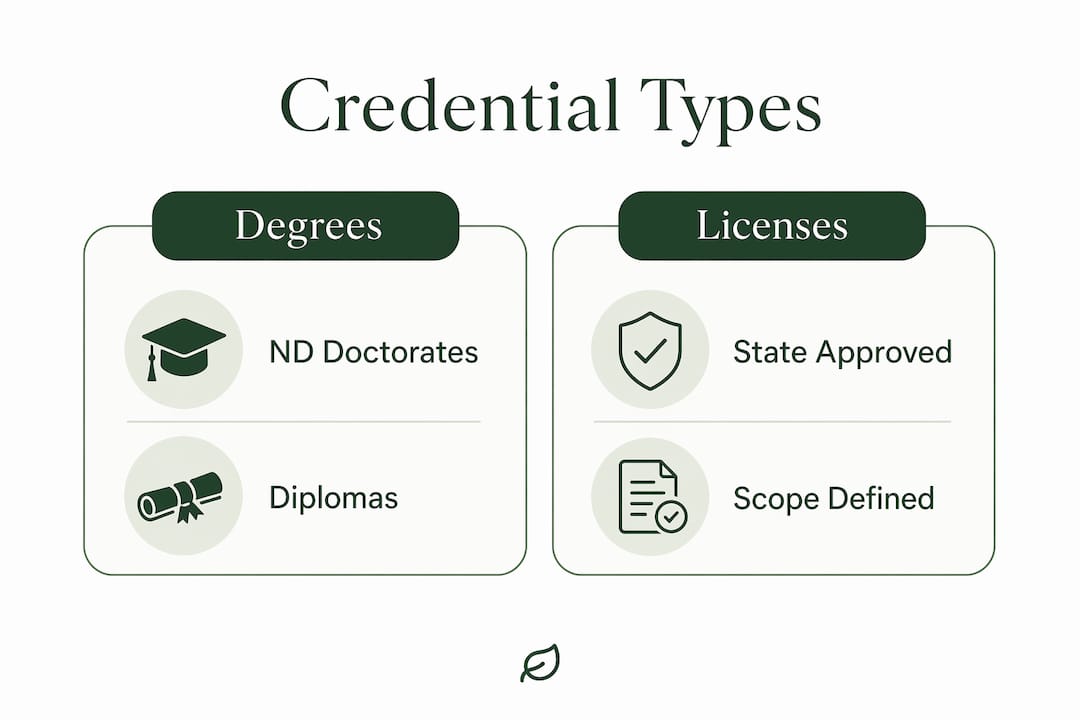
Alternative medicine qualifications fall into four categories: degrees, licenses, certifications, and professional designations. Each carries a different legal weight and signals a different level of training.

Degrees represent the deepest level of formal education. Licensed Naturopathic Doctors (NDs) complete a four-year doctoral program with approximately 4,100 hours of didactic instruction and 1,200 clinical training hours. That volume of training is comparable to conventional medical programs and explains why NDs in licensed states can act as primary care providers. Acupuncturists earn a Bachelor of Acupuncture that includes over 1,200 supervised clinical hours integrated across a four-year curriculum combining classical Chinese medicine with biomedical sciences. Clinical hours are the clearest signal of hands-on readiness.
Licenses are legal permissions granted by a state or jurisdiction. A license defines your scope of practice and carries legal consequences if violated. A certification, by contrast, is a credential issued by a professional body that confirms specialized knowledge or commitment to a field. Certifications do not replace licenses.
Professional designations like the Alternative Medical Practitioner (AMP) credential from the AAMA recognize licensed and doctoral-level professionals committed to advanced integrative practice. The AMP requires doctoral-level education or existing healthcare licensure plus professional integrative medicine training. It signals a practitioner who has gone beyond minimum requirements.
Here is a quick breakdown of what each credential type means in practice:
- ND (Naturopathic Doctor): Four-year doctoral degree plus NPLEX board exams; licensed in at least 26 U.S. jurisdictions
- B.Ac (Bachelor of Acupuncture): Four-year degree with 1,200+ supervised clinical hours
- IFMCP (IFM Certified Practitioner): Functional medicine certification requiring a primary license plus IFM training modules
- AMP (AAMA): Professional designation for licensed or doctoral-level practitioners in integrative medicine
- State license: Legal authorization to practice within a defined scope; varies by state and discipline
The title "naturopathic doctor" is legally protected in licensed states. The title "naturopath" is not. That single word difference can mean the gap between someone with 4,100 hours of training and someone with none.
How do licensure laws vary across states and regions?
Licensure for alternative health practitioners is not uniform across the United States. State-by-state variation directly impacts what a practitioner can legally do and what protections you have as a patient. This is one of the most misunderstood aspects of alternative medicine qualifications.
The table below illustrates how dramatically requirements can differ:
| State category | Naturopathic licensure status | Scope of practice |
|---|---|---|
| Licensed states (e.g., Oregon, Arizona) | Full ND licensure with NPLEX requirement | Primary care, minor surgery, prescribing |
| Limited-scope states | Partial licensure or certification only | Restricted practice, no prescribing |
| Unlicensed states (e.g., Ohio) | No licensure; proposed SB 385 pending | No legal scope; title unprotected |
| Exempt states | Practice allowed under wellness exemptions | Wellness advice only, no diagnosis |
Ohio is a clear example of the consumer risk created by licensing gaps. The state has no naturopathic licensure, and proposed Senate Bill 385 aimed to establish it. Until laws like SB 385 pass, anyone in Ohio can call themselves a naturopath without any formal training. That is a real safety concern for people seeking care.
Licensure restrictions vary widely across the U.S., resulting in uneven consumer protections and practitioner scopes. This unevenness means you cannot assume a practitioner's title reflects the same level of training from state to state.
Pro Tip: Before booking with any alternative health practitioner, search your state's health department website or the relevant professional board to confirm their license is active and in good standing.
Registration and exemption laws add another layer of complexity. Some states allow practitioners to operate under "wellness" or "health coaching" exemptions that permit advice but prohibit diagnosis or treatment. These exemptions protect practitioners legally but offer you fewer safeguards. Always ask a practitioner directly which legal category covers their practice in your state.
Why do professional certifications matter beyond basic licensure?
A license tells you a practitioner met the minimum legal standard. A certification tells you they chose to go further. That distinction matters when you are choosing someone to support your health.
Functional medicine practitioners often hold primary medical licenses (MD, DO, NP, or similar) and supplement these with specialized certifications like the IFMCP. These certifications are non-compulsory and do not replace legal licenses. They signal a practitioner who invested additional time and resources into a specific area of care.
The AAMA's AMP certification goes further than a simple course completion badge. Certification maintenance requires ongoing adherence to ethical standards and active membership, which keeps practitioners accountable and current with best practices. That ongoing requirement is a quality assurance mechanism, not just a formality.
Here is what strong certifications typically require:
- A valid primary license or doctoral-level degree as a prerequisite
- Completion of approved training modules or clinical hours in the specialty
- Passage of a written or practical examination
- Ongoing continuing education to maintain the credential
- Adherence to a published code of ethics
The unregulated use of titles is the biggest risk in this space. Credential confusion is widespread, especially in fields like functional medicine, where titles are not legally protected. A practitioner can market themselves as a "functional medicine specialist" without holding an IFMCP or any recognized credential. Verification is the only way to know what you are actually getting.
Pro Tip: Ask any practitioner to show you their primary license number and the issuing body for any certification they claim. A qualified practitioner will share this information without hesitation.
Understanding the difference between holistic and functional medicine credentials also helps you ask the right questions before your first appointment.
How do you verify alternative health credentials?
Validating health practitioner credentials is a straightforward process when you know where to look. These steps give you a reliable framework.
-
Check the state licensing board. Every licensed profession has a state board with a public license lookup tool. Search for the practitioner's name and confirm their license is active, not expired or suspended. For naturopathic doctors, the NABNE website lists licensed practitioners by jurisdiction.
-
Confirm board exam passage. For NDs, NPLEX passage is a requirement for licensure. Ask the practitioner directly or check with the licensing board. For acupuncturists, the National Certification Commission for Acupuncture and Oriental Medicine (NCCAOM) maintains a public directory.
-
Verify certifications through the issuing body. The IFM publishes a directory of IFMCP-certified practitioners. The AAMA lists AMP-certified members on its website. Cross-check any certification claim against these official sources.
-
Review education and clinical training. Ask where the practitioner earned their degree and how many clinical hours their program required. A legitimate ND program includes approximately 1,200 clinical hours. An acupuncture degree includes a comparable clinical component. Programs with significantly fewer hours warrant scrutiny.
-
Look for red flags. Be cautious of practitioners who cannot name their licensing board, hold only weekend-course certifications as their primary credential, or use vague titles like "certified wellness expert" without specifying the certifying body. A practitioner verification checklist can help you organize these questions before your first visit.
-
Use professional directories. Goholistic maintains a curated directory of verified holistic practitioners across disciplines including acupuncture, Ayurveda, and massage therapy. Filtering by credential type gives you a pre-screened starting point rather than a cold search.
Checking credentials before your first session is not skepticism. It is the same due diligence you would apply to any healthcare decision.
Key Takeaways
Alternative health credentials are only meaningful when you understand what each type represents and take the time to verify them directly with issuing bodies.
| Point | Details |
|---|---|
| Degrees signal depth of training | ND programs require 4,100+ didactic hours and 1,200 clinical hours before licensure. |
| Licenses and certifications are different | A license is a legal requirement; a certification is a voluntary signal of specialization. |
| Licensure varies by state | Some states offer no legal protection for alternative health titles, leaving patients at risk. |
| Certifications require ongoing accountability | Bodies like AAMA require active membership and ethical compliance to maintain credentials. |
| Verification is your responsibility | Use state boards, professional directories, and direct questions to confirm every credential. |
The credential gap no one talks about
The part of this conversation that rarely gets enough attention is how much the burden falls on the patient. Licensing boards exist, credentialing bodies publish directories, and professional associations set standards. But none of that helps you if you do not know to look.
I have spoken with people who spent months working with a "naturopath" in an unlicensed state, only to discover later that the person held a weekend certificate and nothing else. The practitioner was not necessarily acting in bad faith. They were operating in a legal gray area that the system has not closed. That is the uncomfortable reality of where alternative health credentialing stands in 2026.
The good news is that standardization is moving forward. More states are considering licensure bills similar to Ohio's SB 385. Certifying bodies like IFM and AAMA are raising their entry requirements. Integrative medicine is gaining ground in conventional healthcare settings, which creates pressure for clearer credential standards across the board.
My honest advice: treat credential verification the same way you treat reading a nutrition label. You do not need to be an expert to do it. You just need to know what to look for and where to find it. The signs of practitioner quality are visible once you know what questions to ask. Start there.
— Andrew
Finding verified holistic practitioners with Goholistic
Knowing what credentials to look for is one thing. Finding practitioners who actually hold them is another.
Goholistic connects you with verified holistic health practitioners across more than 200 therapy types, including acupuncture, Ayurveda, massage therapy, and functional wellness. Every provider in the Goholistic directory has been reviewed for credential status, so you are not starting from scratch. You can browse verified practitioners by specialty and filter by credential type to find someone whose qualifications match what you are looking for. For a broader look at available therapies and the practitioners who offer them, the holistic treatments library gives you a clear starting point. Credential transparency is built into how Goholistic works, not added as an afterthought.
FAQ
What are alternative health credentials?
Alternative health credentials are formal qualifications, including degrees, licenses, and certifications, that confirm a practitioner's education and legal authority to provide holistic or integrative health services.
What is the difference between a license and a certification in alternative medicine?
A license is a legal requirement issued by a state board that defines a practitioner's scope of practice. A certification is a voluntary credential from a professional body, like the IFMCP or AAMA's AMP designation, that signals specialized training beyond the legal minimum.
How do I verify a holistic health practitioner's credentials?
Check the practitioner's license status through your state licensing board, confirm any certifications through the issuing body's public directory, and ask directly about their degree program and clinical training hours.
Are naturopathic doctors licensed in all U.S. states?
No. Licensed Naturopathic Doctors are recognized in at least 26 U.S. jurisdictions. States without licensure laws, like Ohio, offer no legal title protection, meaning anyone can use the title "naturopath" regardless of training.
Why does credential verification matter for holistic health care?
Credential confusion is widespread in fields like functional medicine, where titles are not legally protected. Verification confirms that a practitioner's qualifications are genuine, current, and appropriate for the care you are seeking.