

TL;DR:
- Holistic medicine is a philosophy of treating the whole person across multiple health dimensions, while functional medicine employs detailed diagnostics to find root biological causes of illness. Both approaches prioritize patient experience and can be integrated for optimal care, especially in complex chronic conditions. Choosing the right approach depends on your health concern, preference for testing, and desire for diagnostic depth or life-context focus.
Holistic medicine is defined as a whole-person care philosophy that addresses physical, psychological, social, and spiritual health together, while functional medicine is a systems-based, root-cause methodology that asks why a condition exists by mapping biological dysfunction. Understanding the difference between holistic and functional medicine matters because the two approaches share a patient-centered spirit but diverge sharply in clinical method, diagnostic tools, and treatment targets. If you are weighing your options or trying to make sense of what a provider actually does, this guide gives you the clearest, most practical breakdown available.

What is the difference between holistic and functional medicine?
Holistic medicine and functional medicine are related but not interchangeable. Holistic care addresses multiple health dimensions within a coordinated framework, treating the person rather than the diagnosis. Functional medicine, by contrast, uses structured diagnostics to locate the precise biological drivers behind a condition. Think of it this way: holistic medicine asks "How is this person doing across all areas of life?" while functional medicine asks "What is the exact physiological mechanism causing this problem?"
The distinction matters practically. A holistic practitioner might bring together a nutritionist, a counselor, and a bodywork therapist to support your recovery from chronic fatigue. A functional medicine doctor might order advanced lab panels, map your gut microbiome, and trace your fatigue to mitochondrial dysfunction or thyroid dysregulation. Both paths can lead to meaningful improvement, but they get there through very different clinical processes.
What does holistic medicine actually involve?
Holistic medicine is not synonymous with alternative medicine, though the two often get conflated. It is a broad philosophy that can sit inside conventional, integrative, or complementary care. What defines it is the commitment to seeing every patient as a whole person, not a collection of symptoms.
A holistic health approach typically considers these interconnected factors:
- Physical health: nutrition, sleep, movement, and body function
- Mental and emotional health: stress levels, thought patterns, and emotional regulation
- Social health: relationships, community support, and environment
- Spiritual health: sense of purpose, meaning, and inner balance
A 2026 systematic review noted conceptual variability across holistic care programs, meaning no two holistic practices look identical. This is both a strength and a challenge. The strength is flexibility. The challenge is that it makes quality evaluation harder. The best measure of genuine holistic care is not the label a clinic uses but how it operationalizes whole-person concepts through team composition, assessment tools, and care coordination.
Common modalities within a holistic health approach include acupuncture, massage therapy, Ayurveda, mindfulness-based stress reduction, nutritional counseling, and energy therapies. These are often delivered by interdisciplinary teams rather than a single provider. Holistic health emphasizes mental, emotional, social, and spiritual wellbeing as integral components of overall health, not add-ons to physical care.
Pro Tip: When evaluating a holistic provider, ask specifically how they coordinate care across disciplines. A practitioner who works in isolation is offering a single modality, not true whole-person care.
How does functional medicine approach health differently?
Functional medicine is grounded in systems biology, the science of how the body's interconnected networks, including the gut, immune system, hormones, and nervous system, influence one another. Functional medicine uses a root-cause methodology involving timeline-based assessments, expanded diagnostics, and personalized lifestyle-based interventions. It integrates conventional medical training with tools that go well beyond standard lab work.
Here is how a typical functional medicine process unfolds:
- Detailed intake: The practitioner collects a comprehensive personal history covering genetics, early life events, environmental exposures, diet, stress, and relationships. Initial visits range 60 to 90 minutes, far longer than a standard appointment.
- Advanced diagnostics: Testing may include organic acid panels, comprehensive stool analysis, hormone mapping, food sensitivity testing, and genetic markers. These go beyond what most conventional physicians order.
- Systems mapping: The practitioner builds a picture of how dysfunctions in one system, such as the gut, are driving symptoms in another, such as mood or energy.
- Personalized treatment plan: Interventions typically combine targeted nutrition, supplements, lifestyle changes, and stress management. Practitioners include pharmaceuticals when appropriate, treating functional medicine as complementary rather than a replacement for conventional care.
- Ongoing monitoring: Biomarkers are tracked over time to measure whether root causes are resolving, not just whether symptoms have quieted.
Functional medicine principles center on the idea that the same disease can have different causes in different people, and the same cause can produce different diseases. This is why two people with identical diagnoses may receive entirely different treatment plans from a functional medicine provider.
Pro Tip: Before your first functional medicine appointment, write a detailed timeline of your health history going back to childhood. Practitioners use this narrative reconstruction as a core diagnostic tool, and the more specific you are, the more useful the session becomes.
Holistic vs functional medicine: key differences and overlaps
Both approaches reject the idea that treating a symptom in isolation constitutes good care. Both prioritize the patient's lived experience and lifestyle. Beyond that shared foundation, the differences in treatment methods are significant.
| Feature | Holistic medicine | Functional medicine |
|---|---|---|
| Core focus | Whole-person balance across life domains | Root-cause identification in biological systems |
| Diagnostic tools | Comprehensive life assessments, interdisciplinary input | Advanced lab panels, genetic testing, systems mapping |
| Treatment modalities | Acupuncture, massage, Ayurveda, counseling, nutrition | Nutrition protocols, targeted supplements, lifestyle medicine, pharmaceuticals when needed |
| Visit structure | Variable; depends on practitioner and setting | Structured; long initial intake, follow-up tracking |
| Definition consistency | Broad and variable across providers | More standardized through training bodies like the Institute for Functional Medicine |
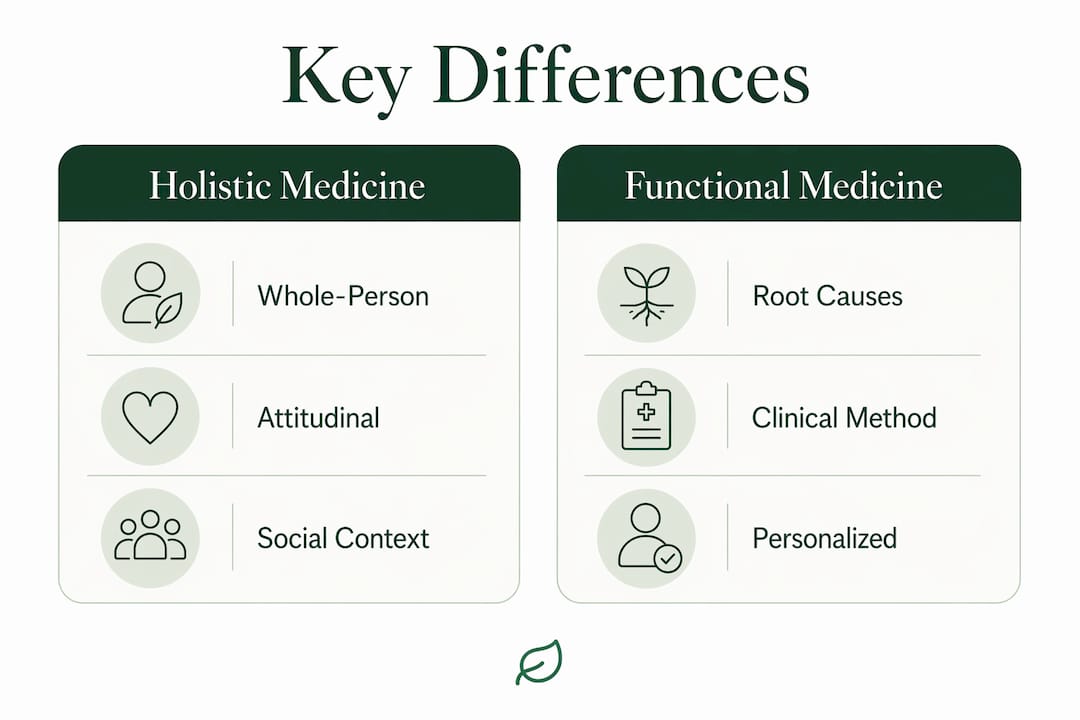
A 2026 comparison describes holistic care as an attitudinal approach and functional medicine as a clinical methodology. That framing is useful. Holistic medicine is a lens through which any provider can practice. Functional medicine is a specific protocol with defined steps.
One important overlap: both approaches work best when they connect biological findings to a patient's real life. Experts warn that functional medicine can become compartmentalized if practitioners focus only on lab results without integrating patient goals, values, and daily routines. True whole-person care, regardless of the label, requires that connection.
The benefits of holistic medicine are most visible in conditions where life context drives outcomes: chronic stress, burnout, autoimmune flares, and mental health challenges. Functional medicine tends to shine in complex, chronic conditions with measurable biological drivers, such as metabolic disorders, gut dysfunction, hormonal imbalances, and persistent inflammation.
How to decide which approach fits your health needs
Choosing between these two models does not have to be an either-or decision. Collaborative care models combining functional and holistic methods show improved patient outcomes and satisfaction, with integrated approaches potentially reducing hospitalization and enhancing recovery rates. That means the smartest choice for many people is a thoughtful combination of both.
To figure out where to start, consider these questions:
- What is driving your health concern? If you suspect a specific biological imbalance, such as thyroid dysfunction, gut issues, or hormonal shifts, functional medicine's diagnostic depth is a strong fit. If your concern is more about overall wellbeing, stress, or life balance, a holistic health approach may serve you better first.
- How do you feel about testing? Functional medicine involves significant lab work and data interpretation. If that appeals to you, it is a good match. If you prefer a more experiential, relationship-centered approach, holistic care may feel more natural.
- What does your provider actually do? Focus less on marketing terms and more on actual clinical processes during your first appointment. Ask how they assess your health, who else is involved in your care, and how they measure progress. These operational details reveal far more than a title does.
- Are you managing a chronic condition? For chronic illness, the evidence-based holistic methods and functional medicine diagnostics often work best together, addressing both the biological root and the life context that sustains recovery.
You are the most important variable in any health plan. Both models work best when you are an active participant, asking questions, tracking changes, and communicating openly with your care team.
Key takeaways
Holistic medicine and functional medicine both reject symptom-only care, but holistic medicine centers on whole-person balance while functional medicine targets measurable biological root causes through structured diagnostics.
| Point | Details |
|---|---|
| Core philosophical difference | Holistic medicine is an attitudinal approach; functional medicine is a structured clinical methodology. |
| Diagnostic depth | Functional medicine uses advanced lab panels and systems mapping; holistic care uses interdisciplinary life assessments. |
| Condition fit | Holistic approaches suit stress and lifestyle-driven concerns; functional medicine excels with complex biological dysfunction. |
| Quality evaluation | Judge providers by their actual clinical processes, not the label they use to market their practice. |
| Best outcome strategy | Combining both approaches through collaborative care produces stronger patient outcomes than either model alone. |
Why the line between these two models matters more than most people realize
From where I stand, the biggest mistake people make when researching holistic vs functional medicine is treating the names as guarantees. A provider who calls their practice "holistic" may offer a single modality with no team coordination. A functional medicine clinic may run impressive labs but never ask how your stress levels, relationships, or sleep habits connect to your results.
What I have observed is that the most effective practitioners, regardless of which model they claim, do two things consistently. They take a genuinely long history, and they tie their findings back to the patient's actual life. A functional medicine doctor who hands you a supplement protocol without understanding your work schedule, your food access, or your emotional state is not practicing whole-person care. They are practicing expensive lab interpretation.
The holistic vs functional medicine debate also obscures a practical truth: most people benefit from elements of both. If you have a complex chronic condition, you probably need the diagnostic rigor of functional medicine AND the life-context integration of a holistic approach. Seeking one without the other often leaves gaps.
My honest advice is to walk into any first appointment with a short list of operational questions. How long is the intake? Who else is on the care team? How do you measure whether I am improving? The answers will tell you more about the quality of care than any label on the door.
— Andrew
Explore holistic health treatments with Goholistic
If this comparison has you curious about what a whole-person approach could look like for your own health, Goholistic makes it straightforward to take the next step.
Goholistic connects you with verified, certified practitioners across more than 200 therapy types, from acupuncture and Ayurveda to massage therapy and nutritional counseling. The platform uses AI to match your health concerns with personalized treatment recommendations backed by research, so you are not guessing. You can browse the full holistic health treatments library, filter providers by specialty, and book directly. Whether you are drawn to the whole-person philosophy of holistic care or want to pair it with functional medicine insights, find a qualified practitioner who fits your goals and get started at your own pace.
FAQ
What is the main difference between holistic and functional medicine?
Holistic medicine is a whole-person philosophy addressing physical, mental, emotional, social, and spiritual health together. Functional medicine is a structured clinical methodology that uses advanced diagnostics and systems biology to identify the root causes of biological dysfunction.
Can holistic and functional medicine be used together?
Yes. Collaborative care models that combine both approaches show improved patient outcomes and satisfaction. Many practitioners integrate functional medicine diagnostics with holistic lifestyle and emotional support for a more complete care plan.
Is functional medicine the same as alternative medicine?
No. Functional medicine integrates conventional medical training with advanced diagnostics and may include pharmaceuticals when appropriate. It is better described as an extension of evidence-based medicine rather than a replacement for it.
How do I know if a provider is truly practicing holistic care?
Ask about their assessment process, team composition, and how they coordinate care across disciplines. A provider working in isolation with a single modality is not delivering true whole-person care, regardless of how they label their practice.
Which approach is better for chronic conditions?
Both have value for chronic conditions. Functional medicine excels at identifying measurable biological drivers, while a holistic health approach addresses the life context that sustains recovery. Combining both typically produces the strongest outcomes for complex, long-standing health issues.