
Practitioner-client matching, in the holistic and integrative care context, is the process of pairing you with a certified, evidence-informed practitioner — such as a licensed acupuncturist, naturopathic doctor, or integrative physician — using AI-curated recommendations combined with human credential verification. Your first step after finding a match: confirm the practitioner holds an active state license, check for board certification (the American Board of Integrative Medicine through ABPS is the gold standard for integrative physicians), and ask whether they will coordinate care with your primary care provider. The National Center for Complementary and Integrative Health (NCCIH) recommends using professional organization directories and state licensing boards to verify any complementary health practitioner before booking. The Cleveland Clinic reinforces that integrative care works best as a complement to conventional medicine, not a replacement.
Key Takeaways
Practitioner-client matching pairs you with a certified holistic or integrative practitioner using AI-curated recommendations, human credential verification, and evidence-mapped treatment summaries.
| Point | Details |
|---|---|
| Verify credentials first | Check active state license, board certification (ABOIM/ABPS), and discipline-specific certs (NCCAOM, CCE) before booking. |
| Coordination with your PCP matters | Ask every matched practitioner how they will communicate with your primary care provider in writing. |
| Prepare for your first visit | Bring your medication list, recent labs, and a clear symptom timeline to make the first session productive. |
| Expect a 4–8 week reassessment | Most integrative protocols need at least one reassessment cycle before measurable progress can be evaluated. |
| Goholistic as your starting point | Goholistic surfaces only human-verified, credentialed practitioners and links evidence summaries to every recommendation. |
Table of Contents
- How practitioner-client matching actually works
- Which practitioner types are included and what credentials to check
- What actually makes a practitioner a good match for you
- How to prepare for your first visit with a matched practitioner
- What matching and recommended services typically cost
- What a trustworthy matching platform does for you
- How practitioners are verified before they reach your results
- A note on what safe matching actually requires
- Goholistic connects you with verified holistic practitioners
- Sources
How practitioner-client matching actually works
The matching pipeline follows a clear sequence: you complete a health intake, an AI engine filters and ranks practitioners by fit, a human team audits credentials, and you book and receive follow-up support.
Typical data inputs the intake collects:
- Primary health concern or condition
- Preferred modalities (acupuncture, massage, Ayurveda, naturopathy, chiropractic, etc.)
- Insurance coverage or budget range
- Language preference and location (in-person or telehealth)
- Practitioner availability and scheduling needs
The AI layer cross-references your inputs against practitioner profiles, evidence summaries, and verified credentials. Human reviewers then confirm that every recommended profile meets licensing and certification standards before it surfaces in your results. After your first appointment, feedback loops refine future suggestions.
Pro Tip: Be as specific as possible during intake. Naming your exact condition, listing any prior labs or imaging, and stating whether you want a practitioner who will communicate with your primary care doctor will sharpen your results considerably.
Which practitioner types are included and what credentials to check
You may be matched with integrative MD/DOs, licensed naturopathic doctors (in states where ND licensure exists), licensed acupuncturists, chiropractors, licensed massage therapists, registered dietitians, physical therapists, or certified clinical herbalists. Scope of practice varies by state, so verify before booking.
| Practitioner Type | Key Credential | Where to Verify |
|---|---|---|
| Integrative MD/DO | ABOIM board certification (ABPS) | ABMS or ABPS |
| Licensed acupuncturist | NCCAOM diplomate certification | NCCAOM.org, state licensing board |
| Chiropractor | State license, CCE-accredited degree | State chiropractic board |
| Naturopathic doctor | ND state license (where applicable) | State ND licensing board |
| Licensed massage therapist | State license, NCBTMB certification | State massage board |
| Registered dietitian | RDN credential (CDR) | CDR.net |
| Certified clinical herbalist | AHG or CCH credential | AHG.org |
Trust signals to look for on any profile: active state license, ABOIM/ABPS board certification for integrative physicians, discipline-specific national certification (NCCAOM, CCE), a clearly stated scope of practice, malpractice disclosure, and documented identity and background verification. The NCCIH specifically recommends cross-checking with state boards and professional organization directories.
What actually makes a practitioner a good match for you
A good client-practitioner pairing rests on five criteria: clinical specialization in your condition, an evidence-informed treatment approach, willingness to coordinate with your primary care provider, a clearly defined scope of practice, and a measurable progress plan from day one.
Use this checklist when reviewing any profile:
- Does the practitioner list your specific condition as an area of focus?
- Do they reference evidence-based protocols rather than vague wellness claims?
- Will they send written notes or share records with your primary care doctor?
- Is their scope of practice clearly stated and within state-licensed limits?
- Do they offer a defined reassessment schedule (typically every 4–8 weeks)?
Red flags to avoid: promises of guaranteed cures, discouraging you from prescribed medications, unlisted or unverifiable credentials, and nontransparent pricing.
You can also review signs of holistic practitioner quality to build a sharper eye for profiles worth booking.
How to prepare for your first visit with a matched practitioner
Preparation directly shapes what you get out of that first consultation. Arrive with your records organized and your goals written down, and the session can move straight to planning rather than background-gathering.
Gather before you go:
- A current medication and supplement list (including doses)
- Recent lab results and any imaging reports
- Specialist notes or referral letters
- A brief symptom timeline noting when issues started and what has helped or worsened them
Ask these questions during the initial call: How will you measure my progress? What is the evidence basis for the treatments you are recommending? How do you communicate with my primary care provider? Harvard Health specifically advises confirming that the practitioner will coordinate care in writing, whether through shared portal notes, letters, or phone calls.
Plan for a 4–8 week reassessment window before expecting measurable change in most integrative protocols. Simple symptom trackers or a weekly journal work well for capturing shifts between visits. For more preparation guidance, the integrative wellness booking guide walks through the full first-visit flow.

What matching and recommended services typically cost
Most holistic and integrative services are out-of-pocket, though licensed practitioners (MD/DO, RDN, licensed acupuncturist) can sometimes bill insurance when services fall within covered categories.
Common cost items to budget for:
- Initial intake or evaluation fee
- Follow-up visit fees (usually lower than the intake)
- Lab or functional testing ordered by the practitioner
- Supplements or herbal formulas recommended after your visit
- Platform subscription or membership tiers for premium features
- Wellness product purchases through a marketplace
Insurance tip: Practitioners with MD/DO or RDN licensure are most likely to bill your insurer directly. Licensed acupuncturists may provide a superbill for out-of-network reimbursement. Always confirm coverage before your first appointment.
Statistic: A significant portion of adults who use herbs or supplements do not inform their conventional doctor — a gap that can create dangerous interactions. Choosing a practitioner who actively coordinates with your primary care team closes that gap.
What a trustworthy matching platform does for you
A high-quality platform uses clear intake forms, evidence-mapped recommendations, verified practitioner profiles, easy booking, and outcome tracking. Here is what the user journey looks like in practice:
- Intake: You answer questions about your health goals, conditions, preferences, and budget.
- Personalized suggestions: The platform surfaces practitioner profiles with evidence summaries tied to your condition.
- Credential verification: Each profile has passed identity, license, and certification checks before appearing in results.
- Secure booking: You schedule directly through the platform, with confirmation and reminders.
- Follow-up: Post-visit feedback refines future recommendations and tracks your progress over time.
Features to look for in any platform: evidence summaries linked to each treatment recommendation, visible credential badges, messaging or care-coordination tools, transparent cancellation and refund policies, and a clear privacy policy for your health data. The safety-first filtering guide explains why each filter layer matters for patient protection.
How practitioners are verified before they reach your results
Robust verification covers five distinct checks, each protecting you from a different risk.
- Identity verification: Government-issued ID confirms the person matches the license on file.
- Active state license check: Confirms the license is current and in good standing with the relevant state board.
- Board certification check: For integrative physicians, ABMS and ABPS databases confirm ABOIM status; ABOIM-recognized fellowships require a minimum of 1,000 hours of graduate medical education.
- Discipline-specific certification: NCCAOM diplomate status for acupuncturists, CCE accreditation for chiropractors, and equivalent national credentials for other modalities.
- Malpractice and discipline history: State board complaint records and malpractice databases flag past disciplinary actions.
Each badge on a verified profile should correspond to a specific, checkable credential. "Board-certified integrative physician" means ABOIM/ABPS confirmed. "State-licensed acupuncturist" means the state board shows an active, clean license. "Verified background check" means identity and discipline history have been reviewed. For a step-by-step walkthrough, the credential verification guide covers each check in detail.
A note on what safe matching actually requires
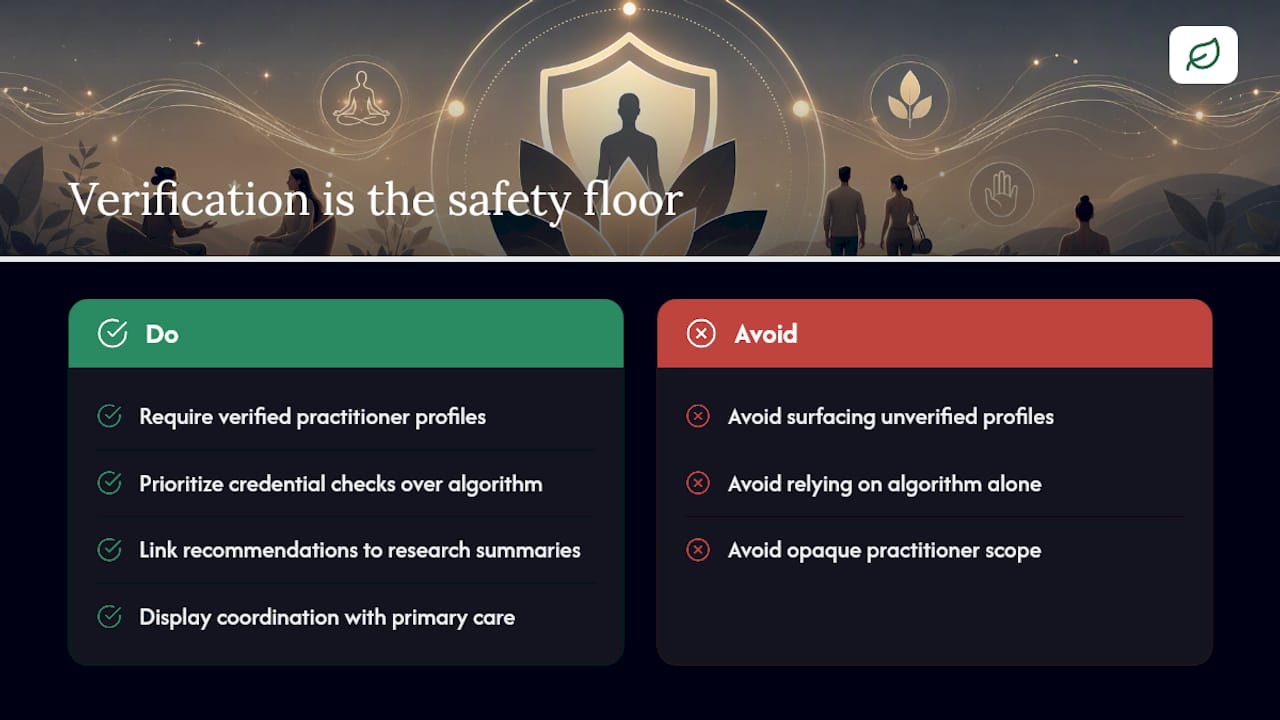
The promise of AI-powered matching is real, but the safety of any match depends entirely on what happens before the algorithm runs. Verification is not a feature — it is the floor. A platform that surfaces unverified profiles with impressive bios is more dangerous than no platform at all, because it lends false confidence.
What matters most is not the sophistication of the recommendation engine but the rigor of the credential layer underneath it. The Cleveland Clinic is clear: integrative care must complement conventional medicine, and trustworthy practitioners are transparent about scope and willing to coordinate. That principle should be non-negotiable in any matching system you use.
At Goholistic, evidence-first and transparency are the values the platform is built around. Every practitioner in the directory has passed identity, license, and certification checks. Every treatment recommendation links to research summaries. And every profile shows whether the practitioner is open to coordinating with your primary care team.
Goholistic connects you with verified holistic practitioners
Finding a certified integrative practitioner on your own means cross-checking state boards, national certification databases, and professional directories one by one. Goholistic does that work for you before a single profile appears in your results.
The platform combines AI-curated recommendations with human credential verification, so every practitioner you see has passed identity, license, and certification checks. Evidence summaries tied to your condition appear alongside each profile, and you can book directly without leaving the platform. Flexible free and premium tiers mean you can start browsing verified holistic providers right now, or explore the full treatment library to understand your options before booking. When you are ready, get started at Goholistic and connect with a practitioner who fits your goals, your budget, and your care team.
Sources
These authoritative resources help you check credentials and learn more about safe integrative care:
- Integrative Medicine Board Certification | ABPS
- Tips to find integrative health practitioners - Harvard Health
- How to find a complementary health practitioner | NCCIH
- Cleveland Clinic
For state licensing board lookups, search "[your state] + [practitioner type] + licensing board" to reach the official verification portal. ABMS and ABPS both offer free online tools for primary source physician certification checks.
This article is general information, not a substitute for advice from a qualified doctor. Consult a qualified healthcare professional about your own circumstances before acting on anything here.