

TL;DR:
- Credential verification involves confirming a practitioner's licenses and certifications directly with issuing authorities. Most holistic health practitioners are not licensed, but verifying associations, certifications, and education ensures their qualifications are legitimate. Regular re-verification and thorough record-keeping help maintain safe and trustworthy holistic healthcare.
Credential verification is the process of authenticating a practitioner's licenses, certifications, and professional affiliations directly with the original issuing authorities. For anyone seeking holistic health care, knowing how to verify practitioner credentials is the first line of defense against unqualified or fraudulent providers. The holistic health field spans disciplines like acupuncture, Ayurveda, and massage therapy, each with its own credentialing standards. That variability makes verification not just useful but necessary before you book your first session.
How to verify practitioner credentials: what you need to know first
Credential verification is not simply glancing at a framed certificate on a wall. Primary Source Verification (PSV) means confirming credentials directly with the original issuing entity, whether that is a state licensing board, a national certifying body, or a professional association. PSV is the gold standard because copies of licenses and certificates are prone to alteration and are insufficient on their own. Accepting a practitioner's self-reported documents without independent confirmation leaves you exposed to risk.
The American Board of Medical Specialties and state licensing boards set the benchmark for licensed medical practitioners. For holistic and alternative health providers, professional associations like the American Alternative Medical Association fill a similar role. Holistic health fields vary widely in credentialing standards, which makes checking association memberships especially important for your safety. Knowing which bodies govern your practitioner's specialty tells you exactly where to look.
What essential credentials should you check for holistic practitioners?
Not every holistic practitioner holds a government-issued license, but many do. The credentials worth checking fall into four clear categories.
- State licenses: Naturopathic doctors, acupuncturists, and massage therapists are licensed in most states. A valid, active license from the relevant state board is the strongest credential a holistic provider can hold.
- National certifications: Bodies like the National Certification Commission for Acupuncture and Oriental Medicine (NCCAOM) issue nationally recognized certifications. These go beyond a single state's requirements.
- Educational background: Degrees from accredited institutions confirm that a practitioner completed formal training. Ask for the school name and graduation year, then verify accreditation through the U.S. Department of Education's database.
- Professional association memberships: Organizations like the American Alternative Medical Association maintain public directories showing active membership and certification status. Association certification is distinct from governmental licensure but signals professional standing and accountability.
- Specialty certifications: Practitioners in Ayurveda, Reiki, or herbal medicine may hold certifications from specialty boards. Confirm these directly with the issuing organization.
Pro Tip: Ask your practitioner for the exact name of every credentialing body and their membership or license number before you start searching. This cuts your verification time significantly.
Holistic fields are less standardized than conventional medicine. A title like "certified wellness coach" may come from a weekend course or a rigorous two-year program. Checking the issuing body's reputation is as important as confirming the credential itself.
Which official sources can you use to validate credentials?
Several authoritative tools make the credentials verification process faster and more reliable. Use them in combination for a thorough check.
- State licensing board portals: Every state maintains a free, public online license lookup tool as the primary method to confirm license status and disciplinary actions. State boards update their data in days, making them far more reliable than national insurance directories or third-party listings.
- CertificationMatters.org: This is the industry standard for national verification of physician specialty board certification. Note that "board eligible" status means a practitioner completed residency but has not yet passed the specialty boards.
- NPPES NPI Registry: The National Plan and Provider Enumeration System assigns a stable National Provider Identifier to each practitioner. The NPPES registry confirms provider identity and specialty taxonomy but does not verify license status or board certification. Use it as your first step to confirm you have the right person.
- American Alternative Medical Association directory: This public directory shows active membership and certification status for holistic practitioners who belong to the association.
- Federation of State Medical Boards (FSMB): The FSMB's DocInfo tool aggregates license and disciplinary data across states for medical doctors and osteopathic physicians.
| Source | What it confirms | Cost |
|---|---|---|
| State licensing board portal | License status, disciplinary actions | Free (letters may carry a fee) |
| CertificationMatters.org | National board certification | Free |
| NPPES NPI Registry | Provider identity, specialty taxonomy | Free |
| Association directories | Membership and association certification | Free |
| FSMB DocInfo | Multi-state license and discipline history | Free |
Pro Tip: State medical board websites update faster than any third-party directory. Always check the board portal last, after confirming identity through NPPES, so you are looking up the correct individual.

How to conduct primary source verification step by step
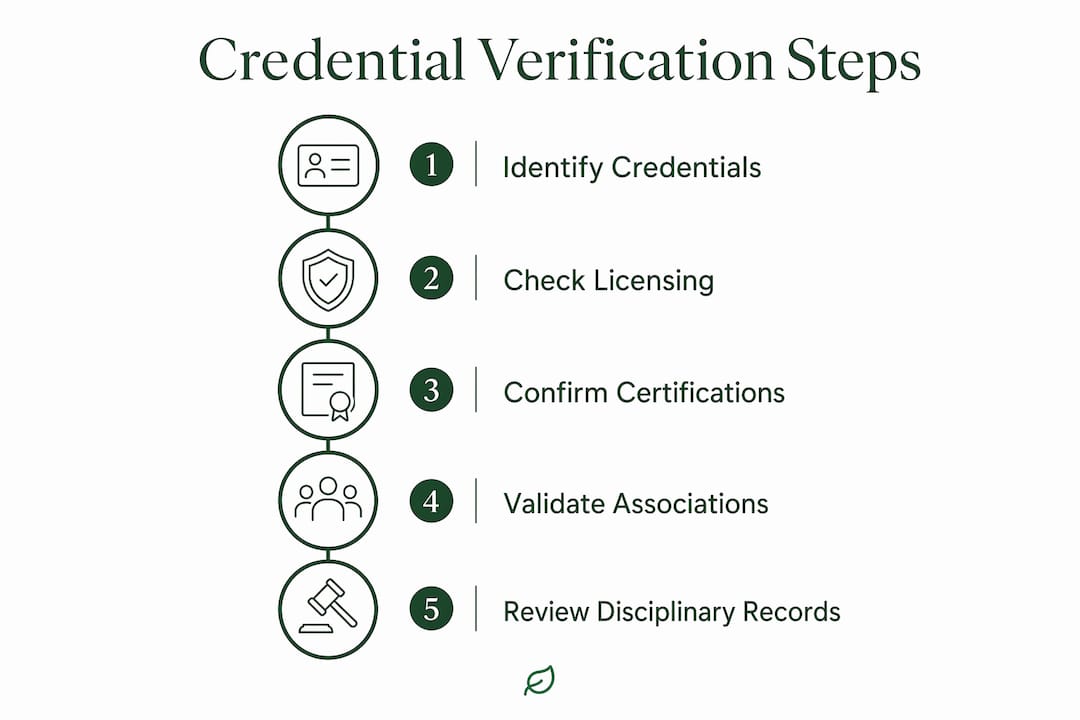
Primary source verification removes the guesswork from checking credentials. Follow these steps in order.
-
Collect practitioner details. Gather the full legal name, license or certification number, issuing body, and specialty. Errors in any of these fields will produce a failed search that has nothing to do with the practitioner's actual status.
-
Confirm identity through NPPES. Search the free NPPES NPI Registry to match the practitioner's name, specialty, and practice location. This step confirms you are verifying the right individual before contacting any licensing body.
-
Search the relevant state licensing board portal. Enter the license number and confirm the license is active, not expired or suspended. State boards may charge a fee for formal written verification letters, though online lookups are typically free.
-
Verify certifications with the issuing body. Contact the certifying organization directly, whether by secure web portal, documented phone call, or written correspondence. Copies of licenses are prone to alteration, so direct contact with the source is the only reliable method.
-
Check association membership. Search the practitioner's name in the relevant association's public directory. Active membership confirms the practitioner meets the association's ongoing standards.
-
Document every step. Record the date of each check, the source you used, the specific result, and your name as the verifier. The Joint Commission requires documentation that includes all four of these elements. A copied license alone does not satisfy this standard.
-
Schedule re-verification. Credentials expire, and disciplinary actions can occur at any time. Re-verification every two years is the standard for compliance. Set a calendar reminder so the check does not slip through the cracks.
Pro Tip: If a state board portal is temporarily down, call the board directly and document the call with the representative's name, date, and the information they provided. This creates a valid audit trail even without an online record.
What red flags and disciplinary records should you investigate?
Confirming that a license is active is only part of the picture. Disciplinary history tells you whether a practitioner has faced formal complaints, sanctions, or restrictions.
- License suspensions or revocations: A suspended license means the practitioner cannot legally practice. A revoked license means the privilege to practice was permanently removed. Both appear on state board portals.
- Probationary status: Some practitioners continue to practice under conditions set by the board. Read the full disciplinary order to understand what restrictions apply.
- Formal reprimands: A reprimand is a formal written warning. One reprimand from years ago may be less concerning than a pattern of recent complaints.
- Malpractice settlements: Malpractice history is not always publicly accessible, but the National Practitioner Data Bank (NPDB) holds this information. The NPDB is primarily accessible to healthcare organizations, though practitioners can request their own report.
- Gaps in licensure: A gap between license expiration and renewal can indicate a period when the practitioner was not legally authorized to practice. Ask directly if you find one.
When you find a disciplinary record, read the full document rather than just the summary. The severity, date, and nature of the action matter. A single administrative violation from a decade ago differs significantly from a recent patient safety complaint. If the record raises genuine concern, look for a qualified alternative rather than proceeding with uncertainty.
How to organize your verification records
Thorough documentation protects you and creates a clear record of your due diligence. Comprehensive credentialing files that include all verification records and correspondence are the standard for responsible credential management.
A well-organized credential file for each practitioner should include the following:
- A copy of the license or certification as a reference document (not as proof of verification)
- The date, source, and result of each verification check
- The name of the person who conducted the verification
- Screenshots or printouts from official portals
- Notes from any phone calls, including the representative's name and the information provided
- A re-verification schedule with the next due date
| Record type | What to capture | Storage tip |
|---|---|---|
| License check | Date, board portal used, result | Save as PDF with date in filename |
| Certification check | Issuing body, method, result | Store in practitioner's dedicated folder |
| Association membership | Directory name, date checked, status | Screenshot with timestamp |
| Phone verification | Rep name, date, information given | Written note signed and dated |
Digital storage in a password-protected folder or a secure cloud service keeps records accessible and protected. Credential verification must be periodically repeated to comply with evolving healthcare regulations and accreditation standards. Treat your records as living documents, not a one-time task.
Key Takeaways
Verifying a holistic practitioner's credentials requires Primary Source Verification through state boards, national certifying bodies, and professional associations, combined with documented records and scheduled re-checks.
| Point | Details |
|---|---|
| Primary Source Verification is the standard | Confirm credentials directly with issuing bodies, not from copies or self-reported documents. |
| State board portals are your first stop | Every state offers a free online lookup for license status and disciplinary actions. |
| Association membership matters in holistic fields | Public directories from bodies like the American Alternative Medical Association confirm active standing. |
| Document every verification step | Record the date, source, result, and verifier name for each check you complete. |
| Re-verify on a schedule | Credentials expire and disciplinary actions can occur anytime; check again every two years. |
Why I think most people skip the most important step
Most people who research a holistic practitioner stop at the license lookup. They confirm the license is active, feel satisfied, and book the appointment. That is understandable. The lookup takes two minutes and returns a clean result, so it feels complete.
The step most people skip is reading the full disciplinary record when one exists. A summary line that says "reprimand" tells you almost nothing. The actual order explains what happened, when, and what the board required as a consequence. I have seen cases where a summary looked minor but the underlying document described a serious lapse in patient care. Reading the full record takes ten minutes and changes everything.
The second overlooked step is re-verification. You verify once before your first session, and then you assume the status holds indefinitely. Licenses expire. Practitioners face new complaints. A practitioner who was in good standing two years ago may not be today. Building a simple annual reminder into your calendar costs nothing and keeps your information current.
Holistic health care can be genuinely effective and deeply supportive. The practitioners in this field who are doing the work with integrity welcome your questions about their credentials. If a practitioner becomes defensive when you ask for their license number or the name of their certifying body, that reaction tells you something important. Verification is not a sign of distrust. It is a sign that you take your own health seriously, and any qualified practitioner will respect that. You can start your practitioner verification process with confidence knowing exactly what to look for.
— Andrew
Goholistic makes finding verified practitioners straightforward
Sorting through state board portals, association directories, and certification databases takes real effort. Goholistic simplifies that process by connecting you with practitioners who have already been vetted through a structured verification process.
The Goholistic provider directory lists holistic health practitioners across disciplines including acupuncture, massage therapy, and Ayurveda, with credential information surfaced directly in each profile. You can browse, filter by specialty, and book consultations without starting your search from scratch. The platform also hosts a treatment library covering over 200 therapy types, so you can research your options before you commit to a provider. Get started at Goholistic and take the next step toward informed, confident holistic care.
FAQ
What does primary source verification mean?
Primary Source Verification (PSV) means confirming a practitioner's credentials directly with the original issuing body, such as a state licensing board or certifying organization, rather than relying on copies or self-reported documents.
How do I check if a holistic practitioner's license is active?
Search your state's free online licensing board portal using the practitioner's name or license number. State boards update their data within days and show current license status and any disciplinary actions.
Can I verify holistic practitioner credentials if they are not licensed by the state?
Yes. For practitioners in fields without state licensure, check professional association directories such as the American Alternative Medical Association, which publish active membership and certification status publicly.
How often should I re-verify a practitioner's credentials?
Re-verification every two years is the recognized standard. Licenses expire and disciplinary actions can occur at any time, so periodic checks keep your information accurate.
What should I do if I find a disciplinary record?
Read the full disciplinary order, not just the summary. Assess the severity, date, and nature of the action. A pattern of recent complaints or a serious patient safety violation warrants seeking a different practitioner.