

TL;DR:
- Holistic quality assurance integrates people, processes, technology, and culture into a continuous, company-wide system. It emphasizes proactive, real-time management from the inception of projects to improve outcomes and reduce costs. AI and shared accountability are transforming future quality practices across health, wellness, and software sectors.
Holistic quality assurance is defined as a company-wide, integrated approach to quality that embeds people, processes, technology, and culture into a single continuous system. Unlike traditional testing, which catches defects after the fact, this model treats quality as a shared organizational responsibility from the very first day of a project. In health and wellness sectors, that distinction matters enormously. A missed defect in a wellness app or a flawed intake process at a care clinic affects real people. Frameworks like ISO 9001, ISO 14001, and Minitab's quality pillars of visibility, accountability, and predictability give organizations the structure to get this right.
What is holistic quality assurance and why does it matter?
Holistic quality assurance, often called integrated quality management in formal standards literature, is the practice of embedding quality across every stage of an organization's work rather than inspecting for it at the end. The industry term you will encounter in ISO documentation is "integrated management system," but holistic QA is the working phrase used by practitioners across health, wellness, and software sectors alike.
The core insight is simple. Quality cannot be bolted on at the end of a development cycle or a care delivery process. It must be present at inception. Holistic quality must begin at product inception, embedding quality attributes alongside functionality, because late-stage assessment misses the majority of defect prevention benefits.
In health and wellness contexts, this translates directly. A wellness platform that only reviews practitioner credentials after a complaint arrives is practicing reactive quality control. A platform that builds verification, feedback loops, and continuous monitoring into every stage of provider onboarding is practicing holistic QA. The difference is not philosophical. It shows up in patient outcomes, organizational trust, and operational costs.
What are the key components and pillars of holistic quality assurance?
The three foundational pillars of this approach are visibility, accountability, and predictability. Minitab identifies these as the core of building confidence through quality, and each one does specific work.

Visibility means every team member can see quality data in real time. Without shared dashboards and transparent reporting, problems hide in departmental silos until they become crises.
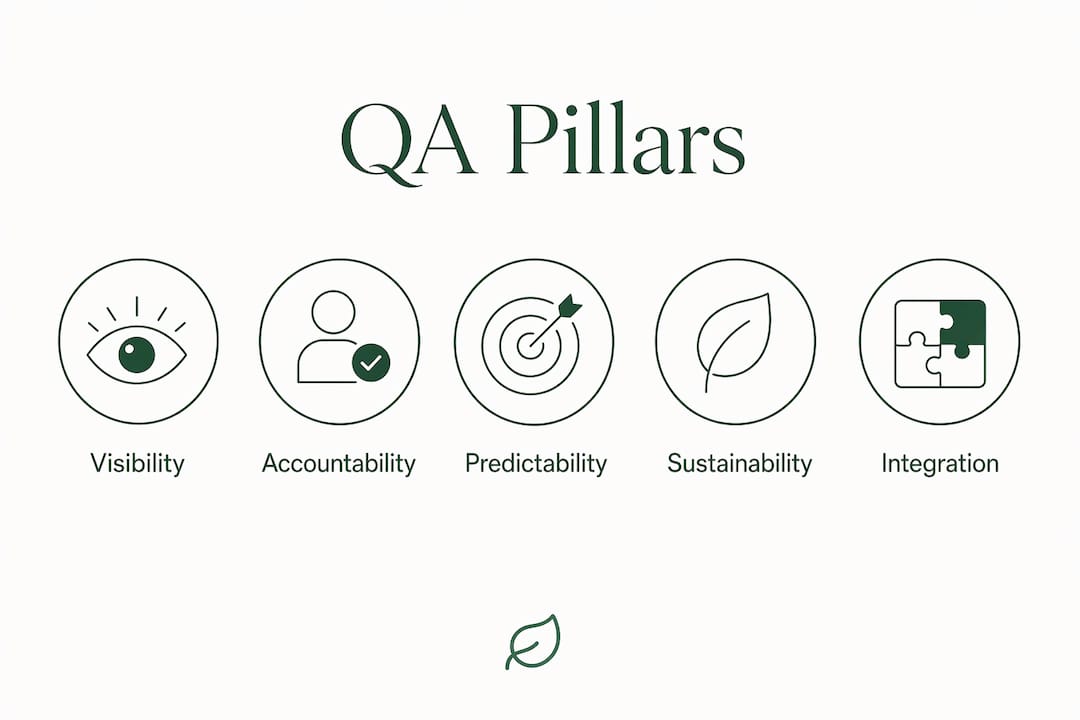
Accountability is the cultural component most organizations underestimate. Accountability embedded culturally is what separates a quality program that lives in a policy document from one that shapes daily decisions. Quality becomes a collective responsibility only when data and decisions are transparently connected across teams.
Predictability means using data to anticipate problems before they occur. Predictive analytics, continuous feedback loops, and early-stage testing all serve this pillar.
Beyond the three pillars, a fully realized holistic QA program integrates four dimensions:
- People: Developers, QA engineers, clinicians, and stakeholders share ownership of quality outcomes, not just the QA department.
- Processes: Cross-functional workflows replace sequential handoffs. Testing begins weeks before release, not days before launch.
- Technology: Unified management systems consolidate data from multiple sources, replacing fragmented reporting tools.
- Culture: Leadership frames quality as an organizational capability, not a compliance checkbox.
Healthcare quality measurement adds another layer. Integrating patient, provider, and manager perspectives into quality assessment gives organizations a complete picture that siloed metrics cannot provide. A wellness organization that only measures patient satisfaction scores, for example, misses the operational and clinical dimensions that drive those scores in the first place.
How does holistic quality assurance differ from traditional testing and quality control?
Traditional testing and quality control are reactive by design. They identify defects after work is complete. Holistic QA is proactive and continuous. The table below clarifies the key distinctions.
| Dimension | Traditional testing / quality control | Holistic quality assurance |
|---|---|---|
| Timing | End of development or production cycle | Begins at project inception |
| Scope | Functional defects and compliance checks | Functional, non-functional, cultural, and strategic quality |
| Ownership | QA team or quality department | Every role across the organization |
| Focus | Finding and fixing defects | Preventing defects and anticipating risk |
| Feedback | Post-release or post-audit | Continuous loops throughout the lifecycle |
| Standards | Single-standard compliance | Integrated standards (ISO 9001, 14001, 50001) |
Zanoo's integrated QA model illustrates this clearly in software development. Their approach incorporates functional and non-functional testing, including usability, security, and performance, alongside continuous collaboration with developers and proactive risk management. That same logic applies directly to wellness product development, where a supplement brand or digital health platform must address regulatory compliance, user experience, and clinical accuracy simultaneously.
The practical implication for health and wellness organizations is that quality control alone cannot protect patients or clients. A clinic that audits care records quarterly but has no real-time feedback mechanism between practitioners and administrators is operating with a significant blind spot.
How to implement holistic quality assurance in health and wellness sectors
Implementation follows a clear sequence. Skipping steps, particularly the early alignment phase, is the most common reason holistic QA programs fail to deliver results.
-
Start with alignment, not tools. Bring together clinical staff, operations teams, and leadership before selecting any technology. Define what quality means for your organization and agree on shared metrics. This kickoff phase sets the cultural foundation.
-
Simplify processes before digitizing them. Integrating multiple ISO standards without simplifying underlying processes creates complexity rather than clarity. Map your current workflows, remove redundancies, and then layer in digital tools.
-
Integrate relevant ISO standards. ISO 9001 covers quality management, ISO 14001 covers environmental management, and ISO 50001 covers energy management. Merging these into a single management system reduces compliance time by 25–40% and eliminates duplicated audits and documentation.
-
Build continuous feedback loops. Holistic testing starts weeks before release with kickoff alignment and ongoing feedback cycles, enabling identification of 50–60% of critical issues before user testing begins. In wellness settings, this means gathering practitioner and patient input throughout a program's development, not just after launch.
-
Assign shared ownership. Designate quality champions in every department. Quality cannot live only in a compliance office. Practitioners, administrators, and technology teams each carry a portion of the responsibility.
-
Use predictive analytics. Data-driven forecasting reduces defects and rework. Predictive analytics yields 20–30% defect reduction when applied consistently across the quality lifecycle.
Pro Tip: Never bolt QA onto the end of a project phase. If your team is only reviewing quality after a product ships or a program launches, you are practicing quality control, not quality assurance. Move your first quality checkpoint to the planning stage.
For health and wellness organizations specifically, holistic provider vetting is one of the clearest entry points for applying these principles. Verifying credentials, gathering ongoing feedback, and monitoring outcomes creates a living quality system rather than a one-time credentialing check.
What are the benefits and challenges of adopting holistic quality assurance?
The benefits of a well-implemented program are concrete and measurable.
- Defect reduction: Predictive analytics reduces defects by 20–30% when integrated across the quality lifecycle.
- Operational efficiency: Unified management systems eliminate duplicate audits and consolidate documentation, freeing teams to focus on core work.
- Better risk management: Early-stage testing and continuous feedback catch problems when they are cheap to fix, not after they have affected clients or patients.
- Stakeholder satisfaction: Patients, clients, and partners experience more consistent, reliable service when quality is embedded rather than inspected.
- Sustainability alignment: Reactive compliance models inadequately address interconnected environmental, social, and economic factors. A value-creation mindset integrates sustainability into the quality system itself.
The challenges are equally real.
"Breaking silos and simplifying processes before digitization are critical for success. Leadership must frame quality as a collective capability, not just a departmental task." — Building Confidence Through Holistic Quality
Cultural resistance is the most common barrier. Teams accustomed to siloed workflows resist shared accountability. Data ownership disputes between departments stall unified reporting efforts. Leadership that frames quality as a compliance burden rather than a shared capability will see adoption stall at the policy level.
For wellness organizations, the challenge often shows up in practitioner autonomy. Clinicians and alternative medicine practitioners value independence, and a quality system that feels like surveillance will face pushback. The solution is co-designing the system with practitioners, not imposing it on them. Teams at U4RIA have demonstrated how aligning healthcare teams around shared quality goals, rather than mandating compliance, produces more durable outcomes.
How will holistic quality assurance evolve with AI and emerging technology?
AI is reshaping what quality professionals can do. The shift is not just about automation. AI integration transforms holistic quality management by converging compliance, data strategy, and organizational intelligence into a single function. Quality leaders of the near future must be system architects, not standards enforcers.
In wellness technology, AI already enables real-time analysis of patient feedback, automated flagging of practitioner performance anomalies, and personalized care pathway recommendations. Platforms like Goholistic use AI to analyze health concerns and match people with verified practitioners, which is itself a form of quality assurance embedded into the user experience. The role of AI in wellness platforms is moving from a support function to a core quality mechanism.
The mindset shift matters as much as the technology. Holistic approaches embed sustainability and stakeholder well-being into core business strategy, moving organizations from compliance-first thinking to value creation. That shift requires quality professionals who understand data science, organizational behavior, and clinical or wellness domain knowledge simultaneously.
Pro Tip: When evaluating AI tools for quality management, prioritize platforms that connect data across departments rather than those that optimize a single function. A tool that improves scheduling but cannot share data with your clinical outcomes system creates a new silo, not a solution.
Key takeaways
Holistic quality assurance works because it embeds visibility, accountability, and predictability across every team, process, and technology in an organization, making quality a continuous practice rather than a periodic check.
| Point | Details |
|---|---|
| Start at inception | Embed quality attributes from day one; late-stage assessment misses most defect prevention benefits. |
| Three pillars drive success | Visibility, accountability, and predictability must all be present for quality to be sustained culturally. |
| Simplify before digitizing | Map and streamline processes before integrating ISO standards or unified management systems. |
| Shared ownership is non-negotiable | Quality champions across every department, not just a QA team, make the system work. |
| AI expands what is possible | Predictive analytics and AI-driven feedback loops reduce defects and shift teams from reactive to proactive quality management. |
Why the cultural piece is the hardest part
Most organizations I have worked with get the technical side of holistic QA right on the first or second attempt. They integrate the ISO standards, they build the dashboards, they run the kickoff meetings. What they consistently underestimate is the cultural work.
Quality as a shared organizational capability sounds straightforward in a strategy document. In practice, it means a practitioner in an acupuncture clinic and an administrator in a billing office both feel responsible for the same outcome. That requires trust, shared language, and leadership that models accountability rather than just mandating it. I have seen well-funded quality programs collapse because leadership treated quality as a project phase rather than a permanent operating principle.
The wellness sector has a particular advantage here. Practitioners in integrative health already think in whole-person terms. They understand that a patient's outcome depends on physical, emotional, and environmental factors working together. That mindset, applied to organizational quality, is exactly what holistic QA requires. The challenge is helping administrative and technology teams adopt the same systems-level thinking.
The organizations that get this right do not announce a quality initiative. They build quality into how they hire, how they onboard practitioners, how they collect feedback, and how they respond when something goes wrong. That is the difference between a quality program and a quality culture.
— Andrew
Goholistic supports quality-centered wellness care
Goholistic is built on the same principles that define strong quality assurance: verified practitioners, evidence-based treatment options, and continuous feedback between clients and providers.

The platform connects you with certified specialists across acupuncture, Ayurveda, massage therapy, and more than 200 other therapy types, all vetted through a structured provider review process. Whether you are a wellness professional researching quality standards or an organization building a care program, Goholistic offers a curated treatment library and a verified provider directory to support informed, quality-centered decisions. Get started at Goholistic and connect with practitioners who meet the standards your clients deserve.
FAQ
What is holistic quality assurance in simple terms?
Holistic quality assurance is a company-wide approach that embeds quality into every stage of a process, from planning through delivery, rather than inspecting for defects at the end. It integrates people, processes, technology, and culture into one continuous quality system.
What are the three pillars of holistic quality management?
The three pillars are visibility, accountability, and predictability. Visibility means shared access to quality data; accountability means every team member owns quality outcomes; predictability means using data to prevent problems before they occur.
How does holistic QA apply to health and wellness organizations?
In health and wellness, holistic QA means integrating patient, provider, and operational perspectives into quality measurement, building continuous feedback loops between practitioners and administrators, and embedding credential verification and outcome monitoring into every stage of care delivery.
What is the biggest challenge in implementing holistic quality assurance?
Cultural resistance is the primary barrier. Teams accustomed to siloed workflows resist shared accountability, and quality programs fail when leadership treats quality as a compliance task rather than a collective organizational capability.
How does AI fit into holistic quality assurance?
AI enables real-time feedback analysis, predictive defect detection, and automated performance monitoring, shifting quality teams from reactive inspection to proactive management. Quality professionals must increasingly function as system architects who connect compliance, data strategy, and organizational goals.