

TL;DR:
- Holistic provider vetting involves verifying credentials, clinical experience, ethical history, and philosophy alignment to ensure safe, patient-centered care. It requires assessing modality-specific certifications, disciplinary records, and communication during consultations, with vetting depth varying according to risk level. Using official verification tools and being alert to red flags helps patients make informed, confident choices in holistic health providers.
Defining holistic provider vetting means applying a structured, multi-criteria evaluation process to confirm that a practitioner holds verified credentials, a clean ethical record, documented clinical experience, and a genuine patient-centered philosophy. This process, sometimes called practitioner credentialing in integrative health, goes well beyond a quick Google search. The four core pillars are credential verification, minimum 1,000 hours of client interaction, a 5-year clean disciplinary record, and alignment with whole-person wellness. Certifying bodies like NCCAOM (National Certification Commission for Acupuncture and Oriental Medicine) and NBHWC (National Board for Health and Wellness Coaching) set the benchmarks that make this process meaningful. This guide walks you through every layer of that process so you can choose practitioners with confidence.
What are the essential criteria in defining holistic provider vetting?
Rigorous provider evaluation criteria rest on four pillars that work together rather than independently. Miss one, and the picture of a practitioner's qualifications becomes incomplete. Here is what each pillar requires in practice.

Credential verification means confirming that a practitioner holds an active license from the relevant state or national board, plus a certification from a recognized accrediting body. For acupuncturists, that means NCCAOM certification. For health coaches, it means NBHWC board certification. For integrative medicine physicians, it means an MD or DO degree. Checking licenses through official board portals, not just a practitioner's website, is the only reliable method.
Clinical experience is the second pillar. A minimum of 1,000 hours of documented client interaction is the baseline standard for vetted wellness practitioners. This figure matters because training volume correlates directly with practitioner competence and patient safety. Ask for documented outcomes, not just a list of hours.
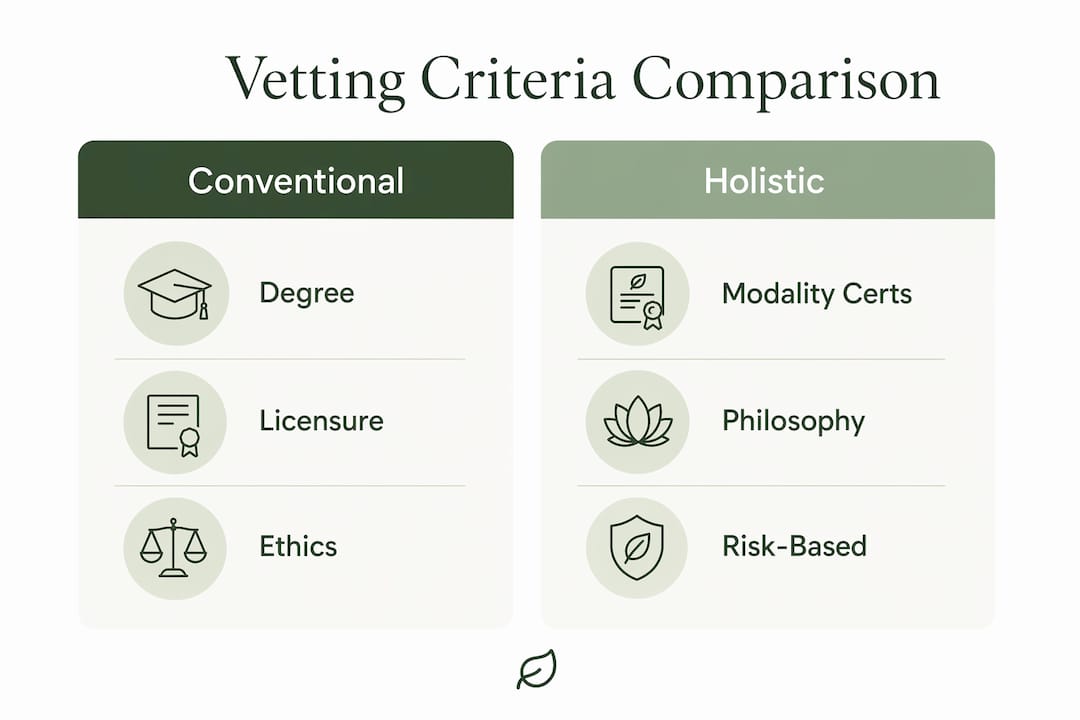
Ethical standing requires reviewing disciplinary records over at least the past five years. Independent ethical audits include public disciplinary record reviews and consumer complaint screenings spanning 5 to 10 years. Vetting bodies increasingly include cultural competence assessments as part of this review, recognizing that patient trust depends on respectful, inclusive care.
Philosophy alignment is the pillar most unique to holistic care. A qualified practitioner treats the whole person rather than suppressing symptoms. They explain their approach clearly, welcome questions, and support collaboration with your other healthcare providers.
- Confirm active licensure through state or national board portals
- Verify modality-specific certifications such as NCCAOM, NBHWC, or Ayurvedic board credentials
- Request documented clinical hours and outcome records
- Review disciplinary history through official public records
- Assess philosophy through a direct consultation before committing to care
Pro Tip: Ask any prospective practitioner directly: "Are your certifications current, and when did you last complete continuing education?" A practitioner who cannot answer clearly is a practitioner worth reconsidering.
How does medical vetting in holistic care compare to conventional medical vetting?
Medical vetting in holistic care shares a foundation with conventional medical vetting but extends into territory that standard credentialing does not cover. Understanding the overlap and the differences helps you apply the right level of scrutiny.
Both sectors require verified degrees, active state licensure, and clean ethical histories. An integrative medicine physician must hold an MD or DO degree plus a recognized fellowship for board certification through the American Board of Physician Specialties. That standard mirrors what you would expect from any conventional specialist.
The differences emerge in modality-specific certifications and philosophy assessment. A licensed acupuncturist is not required to hold an MD, but NCCAOM certification signals rigorous training in that discipline. A health coach certified by NBHWC has met a defined competency standard that a self-described "wellness advisor" has not. The label "integrative medicine doctor" lacks tight regulation, which makes credential verification even more critical in this space.
Risk level also shapes how deep your vetting should go. A risk-based vetting approach matches screening depth to the potential impact on your health. Invasive procedures like acupuncture or spinal manipulation warrant stricter checks than low-risk services like nutritional coaching. This proportional logic protects you without creating unnecessary barriers to accessible wellness care.
| Vetting criterion | Conventional medical | Holistic care |
|---|---|---|
| Degree requirement | MD, DO, or equivalent | Modality-specific (e.g., NCCAOM, NBHWC) |
| Licensing body | State medical board | State or national specialty board |
| Ethical history review | State board records | Public records plus consumer complaints |
| Philosophy assessment | Not typically required | Central to provider evaluation criteria |
| Continuing education | Required for license renewal | Required; verify renewal status directly |
Pro Tip: Use the NCCAOM practitioner search tool or the NBHWC directory to confirm certification status in under two minutes. These portals show active, inactive, and lapsed credentials in real time.
What are common vetting pitfalls and red flags to avoid?
Knowing what a qualified practitioner looks like is only half the picture. Recognizing warning signs protects you from wasted time, wasted money, and genuine health risk. These are the red flags that signal inadequate vetting or untrustworthy care.
-
Unverified use of "doctor" or "holistic doctor" titles. "Holistic" is a philosophy, not a legally protected credential. Anyone can use the term. Always ask which specific board or institution issued their credentials and verify it independently.
-
No transparent licensing documentation. A trustworthy practitioner provides license numbers, certifying body names, and renewal dates without hesitation. Vague answers or redirection to testimonials instead of credentials is a clear warning.
-
Guaranteed cure claims. Practitioners making guaranteed cure claims or dismissing conventional medicine entirely signal both ethical and competency problems. Realistic, evidence-informed language is the mark of a credible provider.
-
Heavy product sales pressure. A practitioner whose primary revenue model involves selling proprietary supplements or exclusive treatment packages has a financial conflict of interest. This pattern often accompanies inadequate clinical training.
-
Refusal to collaborate with conventional providers. Collaboration with conventional healthcare is a marker of a seriously vetted practitioner. A provider who discourages you from seeing your primary care physician is prioritizing their practice over your safety.
-
Fabricated or unverifiable credentials. Falsified credentials are a critical risk indicator that often reveals a pattern of bypassing professional protocols. If a credential cannot be verified through an official directory, treat it as absent.
Reading client reviews is useful, but cross-reference them with official board records. A practitioner with glowing testimonials and a disciplinary action on file presents a real risk that reviews alone will not reveal.
How to practically apply the holistic vetting process when evaluating providers
Applying a thorough holistic vetting process does not require a background in healthcare. It requires a clear checklist, the right verification tools, and a willingness to ask direct questions before your first session.
Start with credential verification. Visit the relevant state licensing board website or national certification directory for the modality you are exploring. NCCAOM's online search confirms acupuncture credentials. The NBHWC directory confirms health coaching certification. For integrative medicine physicians, the American Board of Physician Specialties maintains a public verification tool. Verifying credentials before your first appointment is the single most protective step you can take.
Next, confirm clinical experience. Ask the practitioner directly how many client hours they have logged in your specific area of concern, not just their total career hours. A practitioner with 2,000 hours in general wellness but minimal experience with chronic pain management is not the right fit for a chronic pain concern.
Then conduct an ethical standing audit. Search the practitioner's name in your state's health department disciplinary database. Check the National Practitioner Data Bank if they hold an MD or DO. Review the Better Business Bureau and Google reviews together, looking for patterns rather than isolated complaints.
- Verify active licensure through official board portals
- Confirm modality-specific certifications are current and not lapsed
- Request documented clinical hours relevant to your health concern
- Search disciplinary databases for the past five years minimum
- Schedule a consultation to assess philosophy alignment and communication style
- Ask about continuing education completed in the last two years
- Confirm willingness to coordinate with your existing healthcare providers
Adjust your vetting depth based on risk level. A massage therapist providing relaxation sessions warrants a solid credential check. A practitioner performing acupuncture or recommending herbal protocols that interact with medications warrants the full multi-pillar review. This risk-based approach keeps your effort proportional to what is actually at stake.
Pro Tip: Ask every prospective practitioner: "When did you last renew your certification, and what continuing education have you completed since?" Lapsed or outdated certification renewal status is one of the most commonly overlooked vetting gaps.
Key takeaways
Effective holistic provider vetting combines credential verification, documented clinical experience, ethical history review, and philosophy alignment into one structured process.
| Point | Details |
|---|---|
| Four pillars define vetting | Credential verification, 1,000+ clinical hours, 5-year clean record, and patient-centered philosophy are all required. |
| "Holistic" is not a credential | Always verify modality-specific certifications like NCCAOM or NBHWC rather than relying on the title alone. |
| Risk level shapes vetting depth | Invasive or medication-adjacent services require stricter checks than low-risk wellness coaching. |
| Red flags are specific | Guaranteed cure claims, product sales pressure, and refusal to collaborate with conventional providers are concrete warning signs. |
| Verification tools are free | State board portals, NCCAOM search, and NBHWC directories confirm credentials in minutes at no cost. |
Why vetting standards in holistic care deserve more respect than they get
I have spent years watching people approach holistic care with one of two extremes. Either they apply zero scrutiny because the practice feels gentle and low-stakes, or they dismiss the entire field because it lacks the rigid regulatory structure of conventional medicine. Both responses miss the point.
The 2026 shift toward multi-layered vetting standards in integrative health is real and meaningful. Platforms and certifying bodies are raising the bar, and patients who understand the criteria benefit directly. The most important mindset shift I can offer is this: vetting is not gatekeeping. It is a filter for quality. A practitioner who welcomes your questions about their credentials, their training hours, and their ethical history is a practitioner who respects your right to informed care.
The regulatory gaps in holistic practitioner titles are genuine. "Holistic doctor" carries no legal definition in most U.S. states. That gap places the responsibility on you as the patient, which is not ideal, but it is the current reality. Informed skepticism combined with genuine openness to integrative approaches is the most protective stance you can take. Use the certified practitioner checklist as your starting point, not your ending point.
— Andrew
Find vetted holistic providers through Goholistic
Goholistic was built specifically for people who want the benefits of holistic care without the guesswork of vetting providers from scratch.
Every practitioner listed on Goholistic has passed a credential verification process aligned with 2026 standards, covering active licensure, modality-specific certifications, and ethical standing. The platform spans disciplines including acupuncture, massage therapy, Ayurveda, health coaching, and over 200 additional therapy types. You can browse detailed provider profiles, read verified patient reviews, and book consultations directly. Whether you are exploring holistic care for the first time or looking for a specialist in a specific modality, find vetted practitioners through Goholistic and start your wellness path with confidence.
FAQ
What is holistic provider vetting?
Holistic provider vetting is a structured evaluation process that confirms a practitioner's credentials, clinical experience, ethical history, and alignment with patient-centered care philosophy. It goes beyond a basic license check to include modality-specific certifications and disciplinary record reviews.
Which certifications should I look for in a holistic provider?
Look for NCCAOM certification for acupuncturists, NBHWC certification for health coaches, and MD or DO degrees with fellowship training for integrative medicine physicians. These credentials signal training that meets recognized professional standards.
How do I check if a holistic practitioner's license is valid?
Visit the relevant state licensing board website or national certification directory for the practitioner's modality. NCCAOM and NBHWC both offer free public search tools that show active, inactive, and lapsed credential status.
What are the biggest red flags when evaluating a holistic provider?
Guaranteed cure claims, heavy proprietary supplement sales, unverifiable credentials, and refusal to collaborate with conventional healthcare providers are the clearest warning signs. Any of these patterns warrants finding a different practitioner.
Does vetting differ based on the type of holistic service?
Yes. A risk-based approach means that invasive or medication-adjacent services like acupuncture or herbal medicine require deeper vetting than low-risk services like relaxation massage or general wellness coaching. Match your scrutiny to the potential health impact of the service.