

TL;DR:
- Health coaching is a collaborative process where trained coaches help individuals discover their motivations, set realistic goals, and develop lasting habits. It is distinct from advice-giving or clinical treatment, focusing on behavior change and lifestyle support alongside medical care. Due to industry unregulated status, verifying NBHWC certification ensures safety and quality in coaching services.
Health coaching is one of the most talked-about wellness tools right now, yet most people misunderstand what it actually involves. It is not a personal trainer telling you to eat less. It is not a nutritionist handing you a meal plan. What is health coaching, really? At its core, it is a collaborative process where a trained coach helps you discover your own motivations, set realistic goals, and build the habits that make lasting change possible. This guide breaks down how it works, what the research says about outcomes, and how to find a qualified coach you can trust.
Table of Contents
- Key takeaways
- What health coaching really means
- How a typical health coaching session works
- The benefits of health coaching, backed by research
- What you need to know about regulation and credentials
- Is health coaching right for you?
- My honest take on health coaching
- Start your wellness path with Goholistic
- FAQ
Key takeaways
| Point | Details |
|---|---|
| Coaching is not advice-giving | A health coach facilitates self-discovery rather than prescribing diet plans or medical treatments. |
| Evidence backs the results | Research links health coaching to measurable gains like lower HbA1c, reduced BMI, and more daily steps. |
| The industry is unregulated | Anyone can call themselves a health coach in the U.S., so verifying NBHWC certification matters. |
| Sessions are structured and personal | Coaches use motivational interviewing and goal-setting to address your specific barriers and values. |
| It complements medical care | Health coaching works best alongside your existing healthcare team, not as a replacement for it. |
What health coaching really means
The health coaching definition most people carry around is off-target. Many assume a coach will tell them exactly what to eat, how to exercise, or which supplements to take. That model is closer to consulting than coaching, and it rarely produces lasting change.
True health coaching is a collaborative, client-driven process where the coach acts as a guide, not a director. The emphasis is on helping you uncover your own intrinsic motivations. When change comes from within rather than from external pressure, it tends to stick.
The theoretical foundation here is Self-Determination Theory, a well-established psychological framework. It holds that people are most motivated when they feel autonomous, competent, and connected to others. Health coaching is built around activating all three. A coach supports your autonomy by asking questions instead of issuing instructions, builds your sense of competence through small wins, and creates connection through the coaching relationship itself.
What does a health coach do in practical terms? They help you identify what genuinely matters to you, spot the patterns holding you back, and co-create a realistic path forward. That is a fundamentally different role from a dietitian, therapist, or physician.
- Health coaches do not diagnose conditions or prescribe treatments
- They do not replace medical care but work alongside it
- Their focus is behavior change and lifestyle, not clinical intervention
- Sessions center on your goals, values, and lived experience
Pro Tip: Ask any potential coach whether they practice motivational interviewing. If they do not know the term or cannot explain it, that is a meaningful signal about the depth of their training.
How a typical health coaching session works
Knowing how health coaching works helps you show up prepared and get more out of every session. Most coaches follow a recognizable structure, though the content is always tailored to you.
- Progress check-in. The session usually opens with a review of what happened since you last spoke. Did you hit your goals? What got in the way? This is not a judgment exercise. It is information gathering.
- Barrier exploration. Your coach uses open-ended questions and reflective listening to help you understand what is actually blocking progress. This step often surfaces things you had not consciously noticed.
- Goal setting. Together, you identify one or two specific, manageable goals for the coming week or month. Small, concrete targets consistently outperform sweeping lifestyle overhauls.
- Accountability planning. You agree on how progress will be tracked and what support you need between sessions.
- Close and commitment. The session ends with you stating your commitment in your own words. Research shows that verbal commitment strengthens follow-through.
Sessions vary in format: in-person, phone, or video. Many people find virtual coaching just as effective and far more convenient. Frequency typically ranges from weekly to biweekly, depending on your goals and the program structure.
The technique underpinning most of this is motivational interviewing. It is clinically proven to produce significant behavior changes, including meaningful weight loss, by helping people resolve their own ambivalence toward change. Think of it less as a technique and more as a philosophy: the coach believes you already have most of what you need. The sessions help you access it.

Pro Tip: Before your first session, write down three things you genuinely want to change about your health and one reason each change matters to you personally. Coaches can work faster and deeper when you arrive with that kind of self-awareness.
The benefits of health coaching, backed by research
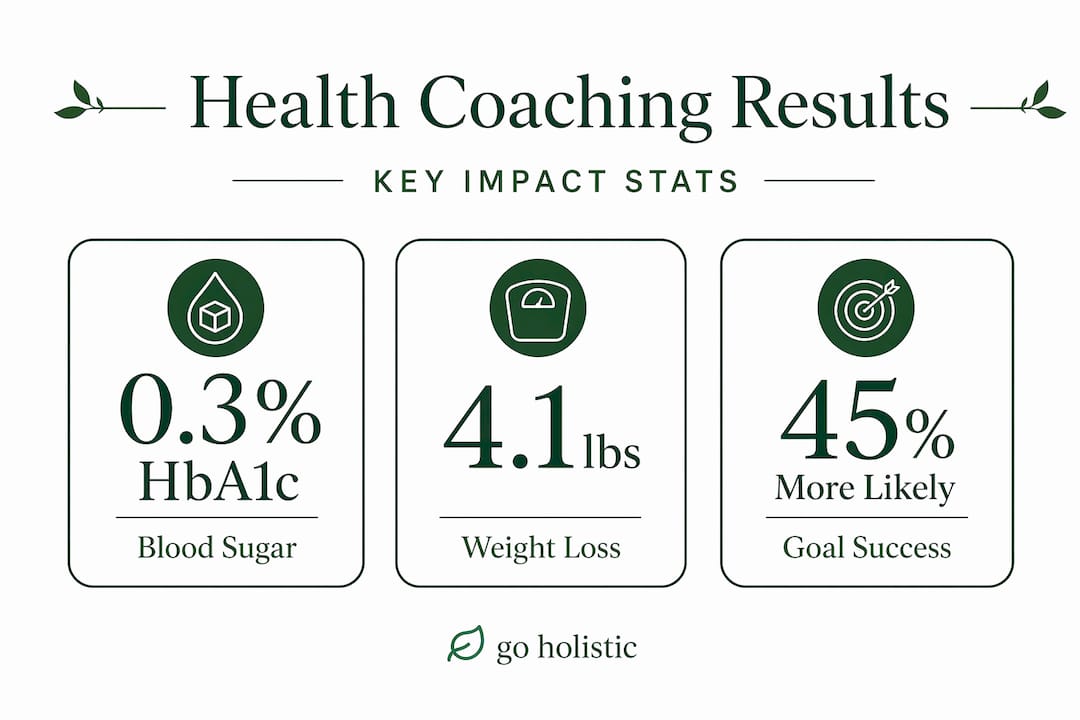
The benefits of health coaching are not just anecdotal. A growing body of research tracks real clinical outcomes, and the numbers are worth knowing before you commit to a program.
| Outcome | What the research shows |
|---|---|
| Blood sugar control | 0.3% reduction in HbA1c in people with type 2 diabetes |
| Weight management | 44.2% of coached participants lost 5% or more of body weight |
| BMI reduction | Average decrease of 0.52 BMI points over the coaching period |
| Physical activity | Participants gained approximately 665 additional steps per day |
| Self-efficacy | Clients report stronger belief in their ability to maintain changes long-term |
These are not dramatic overnight shifts. They are steady, sustainable improvements that compound over time, which is exactly the point. Quick fixes rarely hold. Coaching is designed to build the kind of personalized wellness outcomes that continue well after the formal coaching relationship ends.
The benefit that does not show up in a table is perhaps the most important one: closing the gap between knowing and doing. Most people already know they should sleep more, move their bodies, and manage stress. Coaching addresses why they are not doing those things, rather than simply reminding them to try harder.
"Health coaching is not about receiving a prescription for diet or exercise. It is about a collaborative process where clients discover the intrinsic motivations to achieve sustainable change." — VA Health Services Research & Development
The importance of health coaching becomes especially clear for people managing chronic conditions. When evidence-based holistic methods are combined with consistent coaching support, clients tend to stay on track with medical recommendations and build healthier daily routines. Coaches also serve as translators, turning complex medical guidance into personalized, livable plans.
What you need to know about regulation and credentials
Here is the part of the health coaching conversation that most wellness articles skip: the industry has a real safety problem rooted in a lack of oversight.
Health coaching in the U.S. is entirely unregulated. As of 2021, approximately 128,000 people identify as health coaches, but there is no federal licensing requirement and no universal standard for training or education. That means someone who completed a weekend online course can legally call themselves a health coach, charge premium rates, and advise clients on lifestyle changes.
The gap between a certified, trained coach and an uncredentialed one is enormous. This is not a minor technicality. It affects the quality of support you receive and, in some cases, your physical safety.
The current gold standard is certification through the National Board for Health & Wellness Coaching (NBHWC). Coaches who hold this credential have completed approved training programs, logged supervised coaching hours, and passed a standardized exam. Only a small percentage of practicing coaches hold this certification.
Beyond credentials, there is the matter of scope of practice. A health coach should never:
- Diagnose a medical condition
- Prescribe medication, supplements, or specific therapeutic diets
- Provide mental health counseling or psychotherapy
- Recommend stopping or adjusting prescribed medications
Unlicensed coaches who cross these lines are not just operating unethically. They may be practicing medicine without a license. Reputable coaches know exactly where their role ends and consistently refer clients back to licensed medical professionals for clinical questions.
Before hiring a coach, use a certified practitioner checklist to verify their credentials. Ask directly about their certification, training hours, and how they handle questions that fall outside their scope of practice. A trustworthy coach will welcome these questions.
Is health coaching right for you?
Health coaching is not a universal prescription. It works best for people who are ready to take an active role in their own well-being and are willing to show up honestly to the process.
You are likely a strong candidate if you:
- Are managing a chronic condition like type 2 diabetes, hypertension, or obesity and want better daily support
- Know what you should be doing for your health but struggle to stay consistent
- Have tried rigid diet or exercise programs and found them unsustainable
- Want accountability and a thinking partner, not someone to tell you what to do
- Are navigating a health-related life transition such as postpartum recovery, stress management, or quitting smoking
When you start looking for a coach, pay attention to a few things beyond certification. Do they ask more questions than they give answers? Do they seem genuinely curious about your specific life and context? Do sessions feel like a conversation rather than a lecture? These are the signs of effective coaching.
Set realistic expectations going in. Most programs run for three to six months. Change at the behavioral level takes time, and sustainable progress often looks slower than you would hope in the short term. The research, however, consistently shows that coached clients achieve durable results that persist because the habits were built from the inside out.
If you are currently working with a physician, therapist, or registered dietitian, let them know you are starting health coaching. The best outcomes happen when coaching is integrated with your broader care team rather than siloed from it.
My honest take on health coaching
I have watched health coaching get dismissed as wellness fluff and simultaneously get overhyped as a cure for everything. Both reactions miss the point.
What I have come to believe is this: most people do not need more information about healthy living. They need a structured, supportive relationship that helps them act on what they already know. That is where coaching genuinely delivers. I have seen clients who had failed at every conventional program find real traction through coaching simply because someone finally asked them why they wanted to change instead of telling them what to change.
The frustrating reality is that the unregulated state of this industry lets a lot of people call themselves coaches while offering little more than opinions dressed up as expertise. That is not coaching. That is advice with a premium price tag. The distinction matters enormously for your outcomes and your safety.
My honest recommendation: treat coach selection with the same seriousness you would treat hiring any other healthcare provider. Credentials, transparency about scope of practice, and a genuine coaching methodology are non-negotiable. When those things are in place, health coaching can be one of the most meaningful investments you make in your long-term wellness.
— Andrew
Start your wellness path with Goholistic
If this guide has you thinking seriously about health coaching, Goholistic makes it easier to take that next step with confidence. The platform connects you with certified, verified practitioners across a wide range of disciplines, including health coaching, acupuncture, Ayurveda, and more. AI-powered recommendations match your health concerns to evidence-backed modalities, so you are never guessing.
You can browse holistic health treatments by condition or goal, read research summaries for each approach, and book directly with vetted providers. Whether you are just beginning to explore your options or ready to commit to a program, Goholistic helps you make informed decisions at your own pace. Find certified practitioners near you and start building a wellness plan that actually fits your life.
FAQ
What is the health coaching definition?
Health coaching is a client-centered, collaborative process that helps individuals set personal health goals, identify barriers, and build sustainable lifestyle habits through behavior-change techniques like motivational interviewing. It is not medical advice or therapy.
How does health coaching work in practice?
A typical session involves reviewing progress, exploring what is getting in the way, and co-creating specific goals for the coming weeks. Coaches use open questions and reflective listening rather than telling you what to do.
Is health coaching effective for chronic conditions?
Yes. Research shows health coaching produces a 0.3% reduction in HbA1c in people with type 2 diabetes, along with measurable improvements in BMI and physical activity levels.
What is the difference between coaching and therapy?
Therapy addresses psychological conditions, trauma, and mental health disorders and is delivered by licensed clinicians. Health coaching focuses on behavior change and lifestyle goals and does not treat mental health conditions.
Do health coaches need to be certified?
There is no federal requirement for certification, but NBHWC certification is the recognized quality benchmark. Always verify a coach's credentials before starting a program to protect your safety and outcomes.