

Evidence-based practice in holistic care means choosing therapies like acupuncture, massage, Ayurveda, or herbal remedies based on the best available research, combined with practitioner expertise and your own values and goals. It is not guesswork, and it is not blind tradition either. It is a deliberate blend of both.
- What counts as evidence: clinical trials, systematic reviews, case reports, and documented traditional use, weighed together rather than in isolation.
- How it complements conventional care: the WHO Traditional Medicine Strategy calls for integrating safe, effective complementary approaches into broader health systems, not replacing medical care.
- What to do right now: check a practitioner's license, ask what research supports their recommendation, and look to resources like the Cochrane Library or a platform like Goholistic to confirm the evidence yourself.
Key Takeaways
Evidence-based holistic care works by combining research quality signals, practitioner credentials, and your own measurable goals into one coordinated plan.
| Point | Details |
|---|---|
| Definition anchors everything | Evidence-based holistic practice blends research, practitioner expertise, and patient values, not one alone. |
| Evidence types vary in strength | RCTs and systematic reviews offer the strongest signal; traditional use needs modern verification to stand alone. |
| Appraisal is a repeatable skill | Run any claim through population match, study design, sample size, and conflict-of-interest checks. |
| Practitioner vetting is non-optional | Confirm licensure, request evidence citations, and insist on coordination with your primary care provider. |
| Complexity-informed research fills gaps | Pragmatic trials and mixed methods capture personalized effects that standard RCTs often miss. |
Where to Find Trusted Evidence on Holistic Therapies
Start with the WHO's traditional medicine resources, the Cochrane Library, and PubMed for systematic reviews and trial registries. Search using your condition plus the modality plus "systematic review" for the fastest results, and prioritize recent reviews with GRADE ratings when available. Goholistic's treatment library offers a practical starting point, curating research summaries so you don't have to dig through academic databases alone.
Table of Contents
- What Evidence-Based Practice Looks Like Day-to-Day in Holistic Care
- What Types of Evidence Support Holistic Therapies?
- How Do You Appraise a Study or Treatment Claim?
- Which Holistic Modalities Have the Strongest Evidence?
- How Do You Find and Vet Verified Holistic Practitioners?
- How Do You Build a Personalized, Evidence-Based Plan?
- Why Do Standard Clinical Trials Miss Some Holistic Benefits?
- Ready to Find Care Backed by Real Evidence?
- An Integrative Practitioner's Perspective on Evidence and Individual Care
- Sources
What Evidence-Based Practice Looks Like Day-to-Day in Holistic Care
In practice, evidence-based holistic care rarely looks like a lab coat and a clipboard. It looks like a practitioner who explains why they are recommending acupuncture for your migraines instead of massage, points you to research that supports it, and checks in with your primary care doctor if you are managing a chronic condition. That is the difference between someone offering a service and someone practicing evidence-informed care.
You can spot the difference fairly quickly. Signals worth watching for:
- The practitioner holds a valid state license and can produce it without hesitation.
- They reference specific studies or reviews, not just "years of experience."
- Pricing is transparent, with no pressure toward expensive add-on packages.
- They are willing to coordinate with your physician or ask about medications you take.
The WHO's guidance on traditional, complementary, and integrative medicine urges health systems to strengthen the evidence base, integrate safe and effective practices, and keep implementation people-centered and culturally respectful. That framing matters because it puts the patient, not the modality, at the center of the decision.
Mayo Clinic's own integrative medicine team echoes this: evidence-based holistic care blends clinical trial data with accumulated traditional knowledge, always in service of patient-centered choices.
What Types of Evidence Support Holistic Therapies?
Not all evidence carries the same weight, and understanding the hierarchy helps you read a treatment claim with a clearer eye. Randomized controlled trials (RCTs) offer the strongest signal for cause and effect, but they are expensive and sometimes impractical for individualized, multi-component therapies like Ayurveda. Systematic reviews pool multiple RCTs and observational studies to find consistent patterns, which is often more useful than any single trial. Observational studies track real-world outcomes without controlled conditions, useful for spotting trends but weaker for proving causation. Case reports and practitioner experience document what worked for specific individuals. They matter, but they cannot generalize. Traditional use, documented over generations, offers plausibility and historical safety data, though it needs modern verification before being treated as proof.
When you're sizing up a piece of evidence, look for a few quality markers:
- Sample size large enough to detect a real effect, not just a handful of participants.
- Replication across multiple studies rather than one standout result.
- Product standardization, especially for herbal or botanical treatments where dosing varies widely.
- Risk-of-bias signals, like who funded the study and whether outcomes were self-reported.
- GRADE-style certainty, which rates evidence as high, moderate, low, or very low confidence.
Traditional use and modern clinical data are not competitors. Combined with mechanistic plausibility, they form a legitimate evidence ecosystem rather than two separate camps.
How Do You Appraise a Study or Treatment Claim?
Before you trust a headline or a practitioner's pitch, run it through a short mental checklist:
- Does the study question match your actual situation (age, condition, severity)?
- Was the study design controlled, observational, or just a case report?
- Was there a comparison group, or did everyone just get the treatment?
- Was the sample size large enough to trust the result?
- Has the finding been replicated elsewhere?
- What outcomes were measured, and do they matter to you specifically?
- Were adverse events tracked and reported honestly?
- Who funded the research, and does that create a conflict of interest?
Red flags to walk away from:
- Guarantees of a cure or dramatic, universal results.
- Proprietary supplement lines with no quality control documentation.
- A practitioner who cannot produce a license on request.
- Refusal to coordinate with your primary care provider.
For a fast gut check, search trial registries, browse Cochrane Library summaries, or skim PubMed abstracts. Most systematic reviews state their conclusion in the first paragraph.
Which Holistic Modalities Have the Strongest Evidence?
Some holistic therapies have a deep research base. Others rely more on traditional use and emerging data. Knowing the difference helps you set realistic expectations.
- Acupuncture: systematic reviews and RCTs support use for chronic pain and migraine.
- Massage therapy: growing clinical evidence backs its use for chronic low-back pain specifically.
- Mindfulness and meditation: strong RCT support for stress reduction and anxiety management.
- CBT-informed sleep therapy: well-established evidence base for chronic insomnia.
- Turmeric and curcumin: promising but mixed results, heavily dependent on product standardization and bioavailability.
- Nutritional interventions: strong observational data, with RCT support varying by condition.
- Ayurveda (whole-system): mostly traditional use and observational data, with fewer large-scale RCTs.
Where evidence is mixed, dosing and product quality usually explain the gap. That is where a treatment library with sourced research summaries becomes genuinely useful.
How Do You Find and Vet Verified Holistic Practitioners?

Vetting a practitioner takes ten minutes, and it is ten minutes well spent. Start with the basics: check their state license and, where applicable, their National Provider Identifier (NPI). Ask directly whether they can point you to published research supporting their recommended approach, and whether they have a plan to track your progress with measurable outcomes.
On your first call or consultation, ask:
- "What evidence supports this treatment for my specific condition?"
- "How will we monitor whether this is working?"
- "Will you coordinate with my primary care doctor?"
- "What is the realistic timeline before we know if this is helping?"
- "What does this cost, and are there any recurring fees?"
Red flags to avoid entirely: guaranteed cures, pressure toward expensive proprietary supplement lines, and any practitioner who refuses to work alongside your existing medical team. A verified practitioner directory removes most of this guesswork by confirming credentials before you ever book a session.
How Do You Build a Personalized, Evidence-Based Plan?
Good holistic care starts with a clear goal, not a treatment, as explained in personalized medicine explained, which tailors evidence to individual biomarkers and goals. Once you know what you're solving for, matching the evidence gets much easier.
- Define your specific goal (reduce migraine frequency, improve sleep quality, manage joint pain).
- Match the modality's evidence base to that goal, not to general wellness claims.
- Set a measurable outcome you can track (pain scale, sleep hours, symptom frequency).
- Agree on a monitoring cadence with your practitioner from day one.
- Flag any medications or supplements for interaction checks before starting.
Reassess after four to eight weeks, depending on the modality. Acupuncture and mindfulness often show early signals within a month; botanical interventions may take longer to evaluate fairly. A personalized treatment plan built this way keeps expectations grounded and gives you a clear signal for when to adjust or escalate to conventional care.
Why Do Standard Clinical Trials Miss Some Holistic Benefits?
Classic RCTs work by stripping out variation. That is a problem for therapies where the practitioner relationship, personalized dosing, and multi-component treatment plans are part of the effect, not noise to control for. Researchers increasingly argue that a complex systems perspective captures more of what personalized holistic care actually delivers.
Newer methods fill that gap: pragmatic trials that test therapies in real-world settings, non-randomized studies of interventions (NRSIs), mixed-methods research combining numbers with patient narratives, and practice-based evidence drawn from actual clinics. A recent evidence synthesis framework for traditional and integrative medicine explicitly builds in context, complexity, and patient perspective rather than stripping them out.
Pro Tip: When reading a study, check whether it reports patient-reported outcomes, describes the treatment setting, and tracks whether the therapy was delivered consistently. Those three details signal a complexity-informed design worth trusting.
Ready to Find Care Backed by Real Evidence?
Reading research is one thing. Finding a practitioner who actually practices this way is another. Goholistic's AI-powered recommendation tool matches your health goals to modalities with genuine research support, then connects you to a directory of licensed, verified holistic practitioners across acupuncture, massage, Ayurveda, and more. Every provider listing includes credentials you can check before you book, and the platform's treatment library summarizes the evidence behind each modality so you are never guessing. Explore Goholistic to start building a plan grounded in research, not marketing.
An Integrative Practitioner's Perspective on Evidence and Individual Care
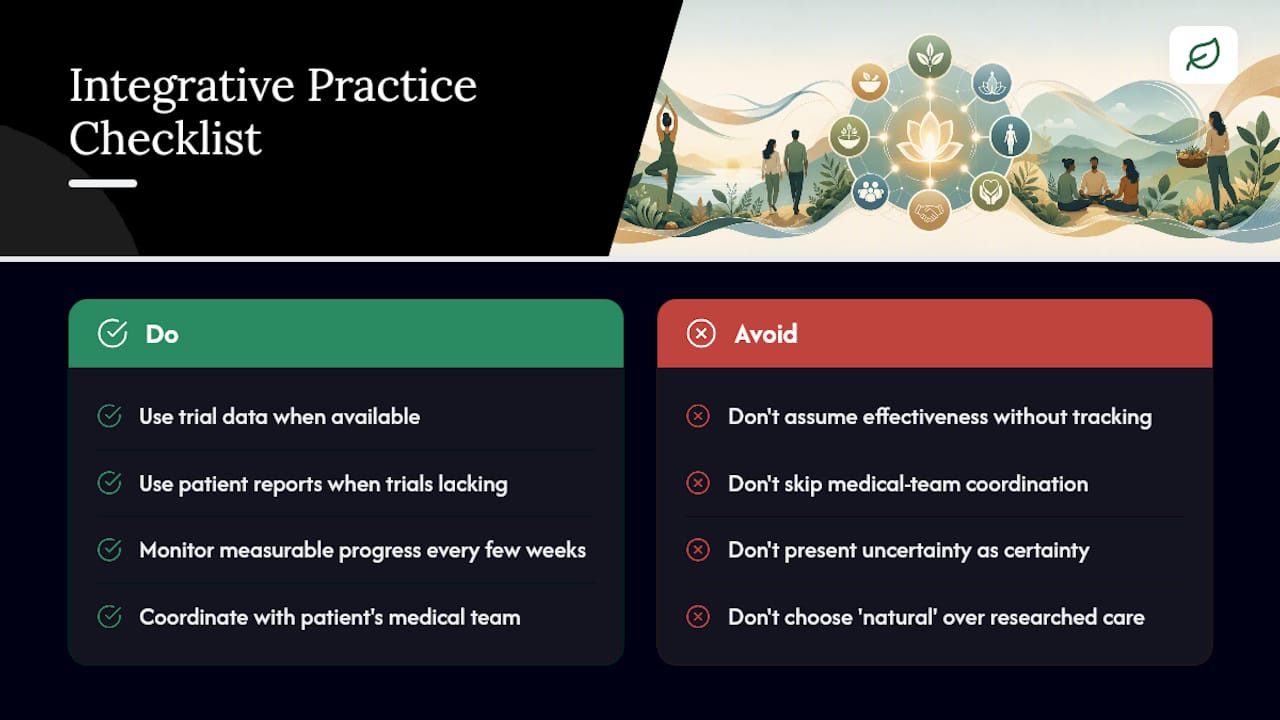
Evidence guides most of what I recommend, but it rarely gives a complete answer. When someone asks about a therapy with thin research behind it, I say so plainly, and I explain what we do know about safety even when efficacy data is limited. I lean on trial data when it exists, patient-reported outcomes when it doesn't, and I track measurable progress every few weeks rather than assuming something is working. Coordination with a patient's medical team isn't optional in my view. It's the difference between complementary care and reckless care. Tools like Goholistic make this easier by surfacing verified practitioners and research-backed summaries in one place, which means patients no longer have to choose between "natural" and "researched." Realistic expectations, honest uncertainty, and consistent monitoring are what actually make holistic care safe.
This article is general information, not a substitute for advice from a qualified doctor. Consult a qualified healthcare professional about your own circumstances before acting on anything here.
Sources
- Traditional, complementary and integrative medicine — World Health Organization
- Evidence synthesis for Traditional, Complementary and Integrative Medicine — Frontiers in Public Health
- A holistic approach to integrative medicine — Mayo Clinic Proceedings: Innovations, Quality & Outcomes
- Complementary & Alternative Medicine: Evidence-Based Practice & CAM — NYU Libraries