

TL;DR:
- Client engagement in holistic wellness is a long-term, outcome-focused relationship built on personalized care and consistent follow-up. It relies on proactive outreach, data-driven personalization, structured feedback, and delivering value at every touchpoint. Effective engagement improves results and prevents clients from drifting away or abandoning treatment plans.
Client engagement is the active, ongoing relationship between a practitioner and a client, built around shared goals, personalized care, and consistent follow-through. It is not a one-time check-in or a confirmation email. In holistic wellness, strong engagement is what keeps someone moving through a multi-session acupuncture plan, returning for Ayurvedic consultations, or actually applying the guidance their practitioner gave them. When engagement works, outcomes improve. When it breaks down, even the best treatment plan loses its effect.
Table of Contents
- What is client engagement, and why does the definition matter?
- The four core components of effective client engagement
- Why client engagement matters more in holistic wellness
- How do you measure client engagement effectively?
- How to build a client engagement strategy step by step
- Common misconceptions and mistakes to avoid
- How Goholistic applies these principles in practice
- Key Takeaways
- What actually drives lasting engagement in wellness
- Goholistic brings these engagement principles together for you
- Useful sources and further reading
What is client engagement, and why does the definition matter?
The formal client engagement definition draws a clear line between two things that often get confused: client engagement and customer engagement. Customer engagement is broad and often transactional. You buy something, you receive it, the relationship ends there. Client engagement, by contrast, is long-term and outcome-focused rather than transactional. The relationship is a strategic partnership with shared goals and shared accountability.
For holistic wellness seekers, this distinction is personal. You are not purchasing a single product. You are working with a practitioner over time, adjusting your care plan based on how you feel, and building a relationship that requires trust on both sides. That is client engagement at its core.

The four core components of effective client engagement
An effective client engagement strategy rests on four pillars. Each one plays a distinct role in keeping the relationship alive and productive.
- Proactive outreach means the practitioner or platform reaches out before you ask. In holistic care, this looks like a booking reminder two days before a massage appointment, a check-in message after your first acupuncture session, or a prompt to update your health profile before a follow-up consultation.
- Data-driven personalization uses what you share about your health concerns, preferences, and progress to shape every recommendation. Generic advice does not move the needle. Personalized guidance, grounded in your specific situation, does.
- Structured feedback loops give you a clear channel to share what is working and what is not. Critically, the practitioner or platform must act on that input. When feedback disappears into a void, engagement fatigue sets in fast.
- Consistent value delivery means every touchpoint, from onboarding to follow-up, adds something useful. A treatment plan update, a relevant article from the wellness library, or a clear next step all count.
Pro Tip: Focus on two or three high-impact touchpoints first, such as the onboarding message and the post-session follow-up, rather than increasing your total message volume. More communication is not the same as better engagement.
Why client engagement matters more in holistic wellness
Holistic care is not a single appointment. It is a process. Acupuncture for chronic pain may require multiple sessions over a period of time. An Ayurvedic protocol involves lifestyle changes that unfold over months. Without consistent engagement, clients drift, miss sessions, or abandon plans before they see results.
"Every interaction should feel like a curated step in a personalized care relationship, not a tactical information blast. In high-trust fields like holistic health, technology should enable human-centric connections rather than replace them." — Highspot, Client Engagement Strategies
The stakes in holistic care are also higher than in many service categories. Safety matters. Practitioners need to know if a client is combining treatments, experiencing side effects, or feeling uncertain about a protocol. Engagement creates the channel for that conversation. Without it, practitioners are working blind, and clients are navigating alone.
Learning about personalized wellness outcomes reinforces why this two-way relationship produces measurably better results than passive, one-directional care.
How do you measure client engagement effectively?
Measuring engagement means tracking participation, not popularity. Email open rates and click counts tell you very little about whether someone is actually moving toward their wellness goals. The metrics that matter are participation actions: completing a health profile, booking a follow-up session, using an AI recommendation tool, or saving a resource from the treatment library.
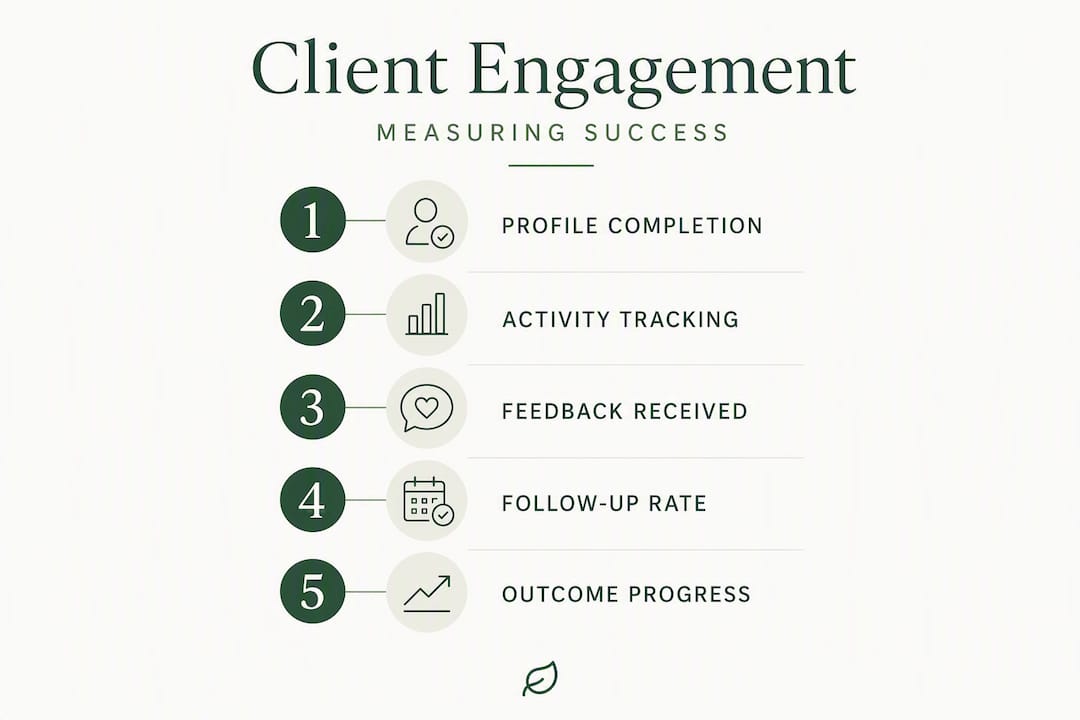
| KPI | What it measures | Realistic timeline to see movement |
|---|---|---|
| Profile completion rate | Depth of onboarding and personalization readiness | First 48–72 hours |
| First booking rate | Conversion from interest to active care | First week |
| Repeat session rate | Retention and treatment plan adherence | Months 1–3 |
| AI recommendation use | Active platform engagement and trust in guidance | First 48–72 hours |
| Feedback response rate | Two-way relationship health | Ongoing, monthly |
The first 48–72 hours after someone joins a platform or begins working with a practitioner are the highest-leverage window. Getting a client to their first meaningful result, whether that is a personalized recommendation or a booked consult, dramatically improves long-term retention.
For small wellness practices, the resource investment is modest. A simple onboarding email sequence, a feedback form after each session, and a monthly check-in message cover the basics. Automation handles the timing; human judgment handles the content.
How to build a client engagement strategy step by step
A clear sequence makes this manageable, even for solo practitioners or small teams.
- Define outcome milestones. Know what success looks like for each client: reduced pain, better sleep, a completed treatment cycle. These milestones anchor every touchpoint.
- Simplify onboarding. Get the client to their first useful result within 48–72 hours. On a platform, that means completing a health profile and receiving a personalized recommendation. In a practice, it means leaving the first session with a clear written plan. A smooth wellness consultation workflow removes friction at this critical stage.
- Personalize using profile and behavior data. Use what clients share to shape follow-up messages, treatment suggestions, and content recommendations. A client focused on stress relief should not receive generic content about sports recovery.
- Establish structured feedback loops. After each session or at monthly intervals, ask a specific question: "How are you feeling about your progress?" Then show the client how their answer shaped the next step. This closes the loop and builds trust.
- Schedule consistent value touches. A brief check-in at week two, a relevant article at week four, and a progress summary at month three keep the relationship warm without overwhelming anyone. Collaborative care models show that this rhythm consistently improves adherence.
For small teams, automate the timing of messages but write the content with a human voice. Reserve manual outreach for moments that matter most: after a difficult session, when a client misses an appointment, or when a treatment plan needs adjustment.
Common misconceptions and mistakes to avoid
The most common mistake is equating volume with engagement. Sending more messages does not build a stronger relationship. Relevance and a clear path forward improve participation; excessive updates push clients away.
"Over-communicating harms engagement. The right metric is active participation — completing tasks, booking sessions, or using recommendation tools — rather than opens or clicks." — Bitly, Engaging with Professional Services Clients
Other pitfalls worth knowing:
- Tracking vanity metrics. If your dashboard shows high open rates but low booking rates, you are measuring the wrong thing. Shift focus to participation actions.
- Ignoring feedback. Asking for input and then making no visible change is worse than not asking at all. Clients notice when their feedback goes nowhere.
- Confusing onboarding. A complicated intake process loses clients before the relationship begins. One clear step at a time, with a visible reward at the end, works far better.
- Skipping the human touch. Automation handles consistency, but human conversations carry the relationship forward, especially when discussing treatment progress or adjusting a care plan.
Digital tools can also support clients in advocating for their own care. Resources on patient empowerment through technology offer a useful perspective on how informed clients become more engaged ones.
How Goholistic applies these principles in practice
Goholistic is built around the same engagement framework described above. Here is how the principles map to the platform in practice.
A new wellness seeker completes a brief health profile. Within minutes, Goholistic's AI analyzes their concerns and surfaces personalized treatment recommendations backed by evidence-based research summaries. That first result, delivered quickly, is the platform's version of the critical 48–72 hour onboarding milestone.
From there, the engagement deepens:
- AI-powered recommendations update as the client's profile and preferences evolve, keeping suggestions relevant rather than static.
- The provider directory connects clients with verified holistic practitioners across disciplines including acupuncture, massage therapy, and Ayurveda, with direct booking built in.
- The treatment library, covering over 200 therapy types, delivers consistent value between sessions, giving clients something useful to return to.
- Subscription tiers let clients choose the level of access that fits their needs, from free browsing to premium personalized guidance.
Goholistic also prioritizes practitioner verification and safety, so every provider in the directory meets a defined standard before appearing in search results.
Key Takeaways
Effective client engagement in holistic wellness requires personalization, structured feedback, and consistent follow-through, not just more communication.
| Point | Details |
|---|---|
| Client vs. customer engagement | Client engagement is long-term and outcome-focused; customer engagement is transactional. |
| Four core components | Proactive outreach, data-driven personalization, structured feedback loops, and consistent value delivery. |
| Critical onboarding window | The first 48–72 hours determine long-term retention; get clients to their first result fast. |
| KPIs that matter | Track profile completion, booking rate, repeat sessions, and AI recommendation use, not opens or clicks. |
| Goholistic in practice | The platform delivers AI recommendations, verified provider booking, and a 200+ therapy library to support every engagement stage. |
What actually drives lasting engagement in wellness
The conventional wisdom says engagement is about communication frequency. Send more emails, post more content, check in more often. That framing misses the point entirely.
What actually keeps a wellness client engaged is the feeling that the relationship is working for them specifically. Not a generic newsletter. Not a reminder that could have been sent to anyone. A message that reflects what they shared, responds to where they are in their care plan, and gives them one clear next step.
The four-component framework covered here is not complicated. But most practitioners and platforms underinvest in the feedback loop piece. They build good onboarding and decent personalization, then stop listening. Clients feel that absence. They disengage quietly, miss a session, and eventually stop returning. Closing the loop, showing clients that their input actually changed something, is the highest-leverage action most wellness businesses are not taking.
The platforms and practitioners that retain clients longest are the ones that treat engagement as a two-way conversation, not a broadcast.
Goholistic brings these engagement principles together for you
Finding the right holistic practitioner and staying connected through a full care plan are two different challenges. Goholistic addresses both in one place, without requiring you to piece together a directory, a booking tool, and a research library separately.
The platform's AI matches your health concerns to personalized treatment recommendations drawn from an evidence-based treatment library covering over 200 therapy types. You can browse and book directly with verified practitioners across disciplines, from acupuncture to Ayurveda, through the practitioner directory. Subscription options start free, so you can explore before committing.
If you are ready to move from browsing to a care plan that actually fits your goals, get started at Goholistic today.
Useful sources and further reading
- What Is Client Engagement? — Fiontar: Covers the depth-of-partnership distinction between client and customer engagement, including the consequences of ignoring feedback.
- An Effective Client Engagement Strategy — monday.com: Details the four core components and the critical 48–72 hour onboarding milestone.
- What Is Client Engagement? — Rocketlane: Explains why participation metrics outperform vanity metrics like opens and clicks.
- Client Engagement Strategies — Highspot: Makes the case for human-centric, curated engagement over tactical information delivery.
- Engaging with Professional Services Clients — Bitly: Addresses engagement fatigue and the relevance-over-volume principle.
- Client Engagement Best Practices — Seismic: Focuses on when human conversations should replace automated outreach, especially in treatment discussions.