
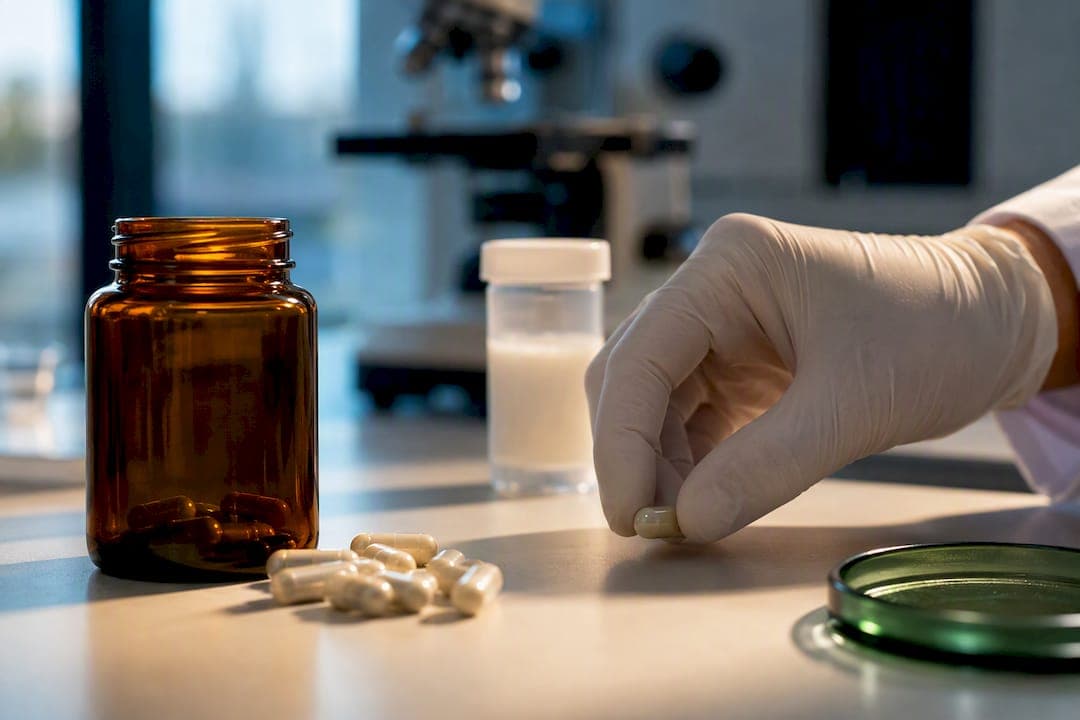
CoQ10, L-carnitine, and a small group of antioxidants (zinc, selenium, vitamins C and E) carry the strongest clinical evidence for improving sperm health, and they work best in men whose semen shows measurable oxidative stress, a condition called MOSI. Most benefit shows up after about three months of consistent use, roughly one full sperm production cycle. Before starting anything, a semen analysis and a conversation with a clinician will tell you whether supplementation is even the right move for your body.
TL;DR:
- Most benefits from supplements like CoQ10 and L-carnitine emerge after about three months, aligning with one sperm production cycle.
- Evidence strongly supports CoQ10 for improving sperm motility, but it has minimal proven impact on pregnancy or live birth rates.
- Only about 15% of common fertility supplement ingredients have confirmed positive effects in randomized trials, highlighting limited high-quality evidence.
- Supplements are most effective for men with oxidative stress-related infertility, and testing should always precede supplementation to avoid unnecessary or risky intake.
- Reliable supplementation should disclose ingredient doses, cite specific clinical trials, and carry independent testing seals to ensure quality and efficacy.
Table of Contents
- Which Male Fertility Supplements Have the Best Evidence?
- What Do Systematic Reviews Say About Fertility Supplements?
- Who Actually Benefits From Fertility Supplements, and When Should You Test First?
- How to Use Fertility Supplements Safely: Dosing, Timing, and Red Flags
- Combining Supplements With Lifestyle and Practitioner Support
- Are the Benefits Real, or Just the Placebo Effect?
- What Do Fertility Supplements Typically Cost?
- How to Spot Red Flags in Fertility Supplement Marketing
- Editorial Take: Supplements Are a Tool, Not a Strategy
- Get a Personalized Fertility Plan Through Goholistic
- Sources
Which Male Fertility Supplements Have the Best Evidence?
CoQ10 has the deepest research base of any ingredient in this category. A systematic review of CoQ10 trials found consistent improvements in sperm motility and, in several trials, morphology, with study doses ranging from 20 to 400 mg per day. Ubiquinol, the reduced form of CoQ10, absorbs more efficiently than standard ubiquinone, which matters if you're comparing labels at a pharmacy. Benefits tend to build slowly and correlate with rising levels of antioxidant markers like total antioxidant capacity and glutathione peroxidase measured in blood and semen.
L-carnitine and its acetylated form show up in multiple randomized trials at doses around 1 to 2 grams per day, with researchers reporting gains in both motility and total sperm count. Zinc paired with folic acid has produced improvements in sperm concentration in some trials, though the effect appears to depend on starting zinc status. Selenium, vitamin C, vitamin E, lycopene, and omega-3 fatty acids show more mixed results. Some trials find a bump in one semen parameter (usually motility or morphology) while others find nothing significant, and the effect often depends on which population was studied.
Here's where the ingredients land by evidence strength:
- CoQ10: Strong evidence for motility, moderate for morphology, weak for pregnancy outcomes.
- L-carnitine / L-acetyl-carnitine: Consistent gains in motility and count across several RCTs.
- Zinc + folic acid: Some evidence for concentration, mainly in combination rather than alone.
- Selenium, vitamin C/E, lycopene: Mixed results, effect size varies by study population.
- Omega-3 fatty acids: Modest support for morphology, less consistent for motility.
One number worth sitting with: a Cleveland Clinic review of 90 common ingredients in fertility supplements found that only 20 had any published evidence at all, and just 15 showed a positive effect in randomized trials. That's roughly 17% of ingredients with a genuine research signal behind them.
None of this evidence extends confidently to pregnancy or live birth rates. Trials measure sperm parameters because they're easier to track in a few months. Whether better motility on paper translates into a baby is a separate, much harder question, and the current data doesn't answer it cleanly.
What Do Systematic Reviews Say About Fertility Supplements?
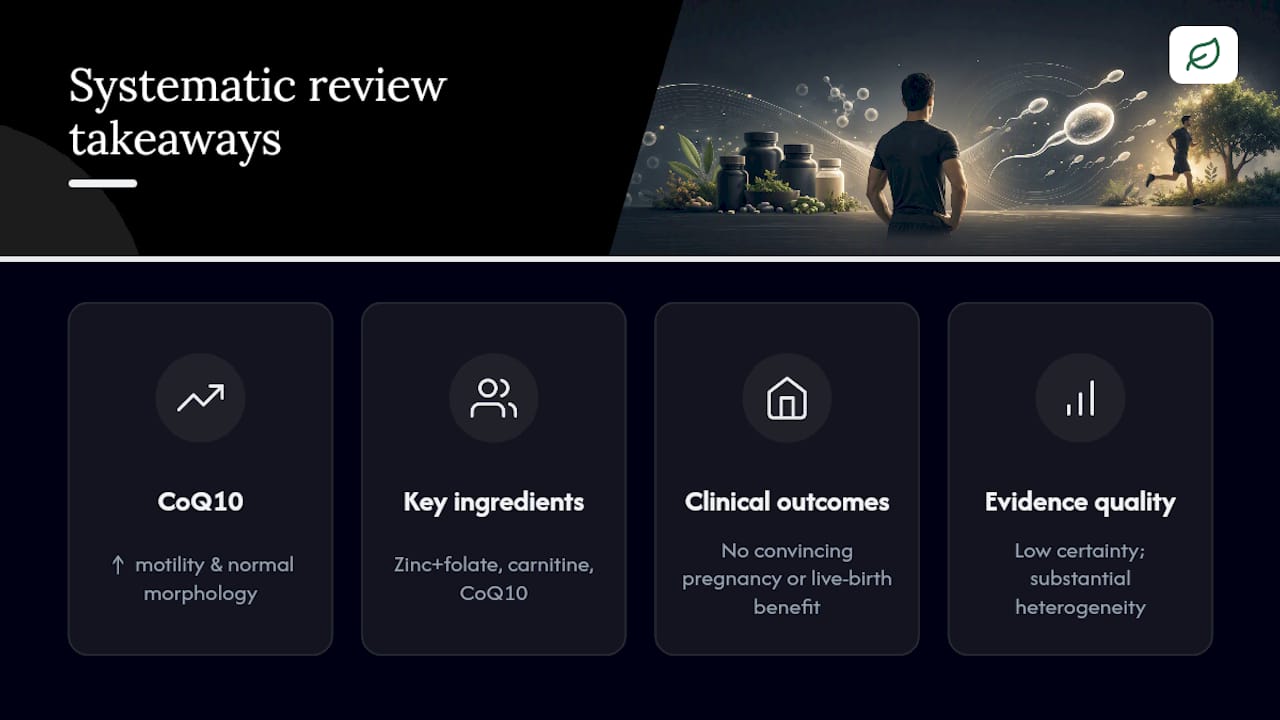
Individual studies can be persuasive on their own, but they don't always hold up once researchers pool the data. A 2024 meta-analysis on CoQ10 found real increases in total and progressive motility along with a higher proportion of normally shaped sperm across the pooled trials. That's a meaningful signal. But the same analysis flagged substantial heterogeneity between studies, meaning dosing, trial length, and patient populations varied enough that combining the results required real statistical caution.
A broader systematic review covering roughly 50 randomized trials across many supplement types reached a more sobering conclusion:
There is no convincing evidence that dietary supplements improve pregnancy or live birth rates in male infertility, even though specific ingredients like zinc with folic acid, carnitine, and CoQ10 showed benefit for isolated sperm parameters. Overall certainty of evidence remains low.
That's the honest state of the science right now. Some supplements move the needle on what a lab report measures. Whether that translates into a pregnancy is a different question the current trials weren't built to answer with confidence, and geographic variability in trial populations (Iran, India, and parts of Europe produced a large share of the CoQ10 data) adds another layer of uncertainty about how well findings generalize.
The Nutrients systematic review is worth reading in full if you want the granular breakdown by ingredient rather than a summary. It's the closest thing to a scoreboard the field currently has.
Who Actually Benefits From Fertility Supplements, and When Should You Test First?
Male Oxidative Stress Infertility, or MOSI, describes a specific clinical picture: sperm damaged by excess reactive oxygen species, detectable through markers like oxidation-reduction potential (ORP) and sperm DNA fragmentation (SDF). This is the group antioxidant supplements are actually designed to help.
If your semen parameters are normal, taking CoQ10 or vitamin E is unlikely to move anything, and it isn't free of risk. Here's the sequence clinicians recommend before you spend money on a bottle:
- Get a baseline semen analysis to check count, motility, and morphology.
- Ask about oxidative-stress testing (ORP or SDF) if your results are borderline or abnormal.
- Discuss findings with a clinician before starting any antioxidant regimen.
- Reserve supplementation for cases where oxidative stress or a specific deficiency is confirmed.
Loading up on antioxidants without a documented need can backfire. Excess antioxidant intake pushes cells into reductive stress, an imbalance that can be just as disruptive to sperm function as the oxidative stress it was meant to fix.
How to Use Fertility Supplements Safely: Dosing, Timing, and Red Flags
Patience matters more than most men expect. Sperm takes about 74 to 90 days to fully develop, so nothing you take will show up on a semen analysis before that cycle completes. Most clinical trials run supplementation for three to six months before reassessing, and several report that gains fade once the supplement stops.
Trial doses give a rough reference point, though they vary study to study:
- CoQ10: typically 100 to 300 mg per day (ubiquinol formulations often dosed lower due to better absorption).
- L-carnitine: typically 1 to 2 grams per day.
- Zinc: typically 15 to 30 mg per day, usually paired with folic acid.
Repeat a semen analysis after the full cycle, and if you had abnormal oxidative-stress markers at baseline, retest ORP or SDF too. Watch for interactions: CoQ10 can interact with blood thinners, and high-dose zinc over long stretches has been linked to copper deficiency and, in rare cases, neuropathy. Excess vitamin E and selenium carry their own accumulation risks. Look for a third-party testing seal like USP or NSF on any product you buy, and run your regimen past a pharmacist or clinician, especially if you're on other medications.
Pro Tip: Set a calendar reminder for day 90 before you even open the bottle. Reassessing too early is the single most common reason men give up on a supplement that might have actually been working.
Combining Supplements With Lifestyle and Practitioner Support
Supplements work better as one piece of a broader plan, not a standalone fix. Diets rich in omega-3s, walnuts, and lycopene-heavy foods like cooked tomatoes have been linked to improved semen quality in observational research, and sleep and stress management shape hormone levels in ways a pill can't replace. Goholistic's approach pairs that kind of lifestyle groundwork with access to verified practitioners who can help interpret testing results and build a plan around them.
Fertility rarely improves from one lever alone. The men who see the clearest gains usually test first, target the actual deficiency or oxidative-stress finding, and support that with sleep, diet, and stress changes running in parallel.
Are the Benefits Real, or Just the Placebo Effect?
Placebo response in fertility trials is real and worth naming honestly. Semen analysis has natural variability from one sample to the next, influenced by illness, stress, abstinence period, and even the time of year. That noise makes it easy to mistake a normal fluctuation for a supplement effect, especially when you're hoping hard for good news.
This is exactly why randomized, placebo-controlled trials matter more than anecdotes. When a supplement like CoQ10 outperforms placebo across multiple controlled studies, that's a stronger signal than one person's before-and-after story. But even in well-designed trials, some of the improvement in the placebo arm is common. Men who start paying closer attention to their health, cut back on alcohol, or simply reduce stress because they're "doing something" often see modest gains regardless of what's in the capsule.
Manage your expectations accordingly. A supplement backed by solid trial data might improve motility by a meaningful margin, but it's not going to turn a severe abnormality into a normal result overnight, and it's not guaranteed to translate into pregnancy. Track your own semen parameters before and after a full cycle rather than relying on how you feel. Feeling more optimistic is not the same as a measurable change in sperm count, and confusing the two is how people end up disappointed or, worse, convinced a product works when the real driver was something else entirely.
What Do Fertility Supplements Typically Cost?
Pricing for male fertility supplements varies widely depending on formulation and ingredient count. Single-ingredient CoQ10 or ubiquinol products tend to sit at the lower end of the range, since they contain one active compound at a defined dose. Multi-ingredient "fertility blend" formulas that combine ten or more ingredients, antioxidants, amino acids, and vitamins in one capsule, usually cost more per bottle and per month of use.
That price difference doesn't always buy you better evidence. Given that only a small fraction of commonly used ingredients have any published RCT support, a $60 blend with fifteen ingredients isn't automatically a better investment than a $25 bottle of CoQ10 dosed at a level trials actually tested. Cost per active, evidence-backed ingredient is a more useful comparison than cost per bottle.
Budget for the full three-to-six-month trial period, not just one bottle. A supplement that seems affordable at a single purchase adds up differently across a full spermatogenesis cycle, and stopping early to save money defeats the purpose before you've given it a fair test. If you're also paying for semen analysis or oxidative-stress testing, factor that into the overall cost of a proper evaluation rather than treating the supplement as the only expense that matters.
How to Spot Red Flags in Fertility Supplement Marketing
Supplement labels are governed loosely compared to prescription drugs, and marketing language often outpaces what the underlying research supports. A few patterns are worth watching for.
Claims of "clinically proven" results without a citation to an actual published trial should raise suspicion. So should proprietary blends that list a total milligram amount for a combination of ingredients without breaking down each one individually, since that formatting makes it impossible to know if any single ingredient is dosed at a level trials actually tested. Testimonials and before-and-after anecdotes are marketing tools, not evidence, no matter how specific or emotional they sound.
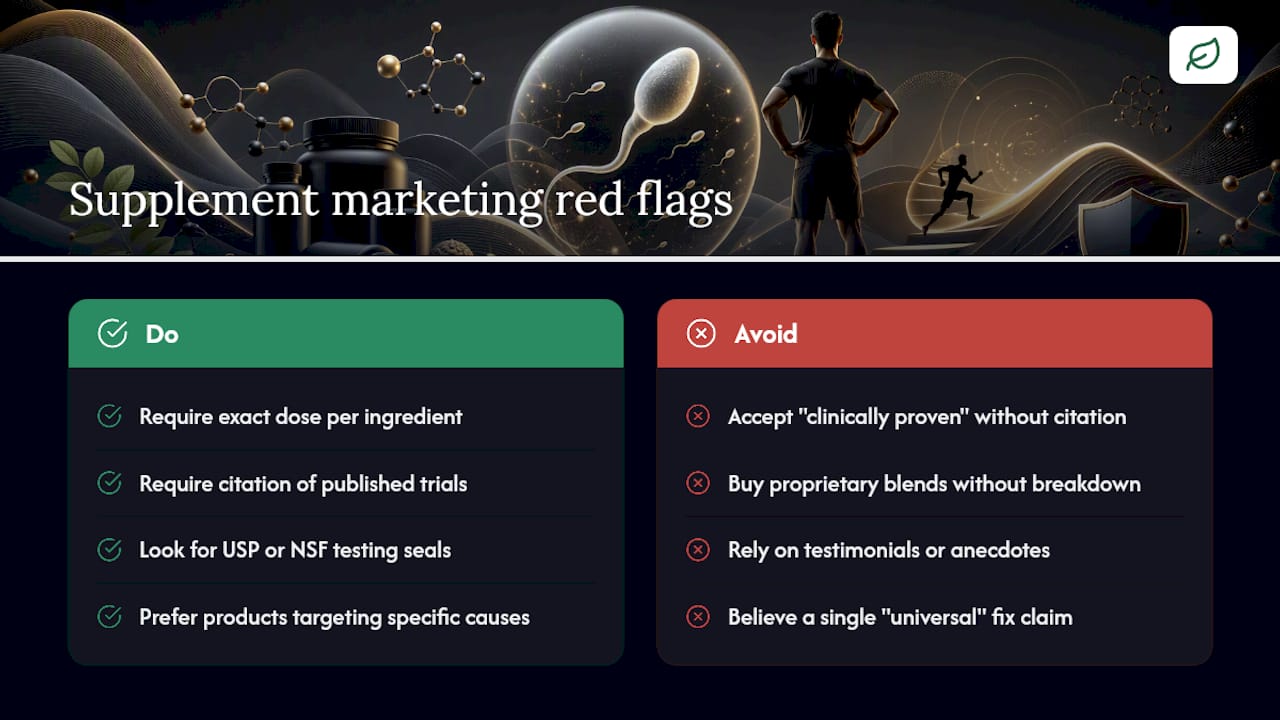
Products claiming to work for every man regardless of underlying cause deserve skepticism too. Fertility issues have many possible drivers, hormonal, structural, oxidative, and no single formula addresses all of them. A label promising a universal fix is oversimplifying a genuinely complicated picture. Favor products that disclose exact doses per ingredient, cite specific trials rather than vague "studies show" language, and carry independent testing seals such as USP or NSF, which verify that what's on the label matches what's in the capsule.
Editorial Take: Supplements Are a Tool, Not a Strategy
The research supports a narrower conclusion than most product pages let on. A handful of ingredients, mainly CoQ10 and carnitine, move specific semen parameters in men who have measurable oxidative stress or abnormal results to begin with. That's real, and it's worth acting on. What the research does not support is the broader promise sold at checkout: that any man can take a fertility blend and expect better odds of conception.
Conventional advice tends to skip the testing step entirely, treating supplementation as a harmless first move. It isn't always harmless, and it's rarely the most useful first move. The better sequence starts with a semen analysis, adds oxidative-stress testing when the results are ambiguous, and only then reaches for a targeted ingredient at a dose trials have actually studied. Lifestyle changes, sleep, diet, stress, deserve equal billing, not an afterthought after the pills.
If you take one thing from this: test before you buy. The supplement aisle will still be there once you know what you're actually treating.
— Andrew
Get a Personalized Fertility Plan Through Goholistic
Generic supplement blends guess at what your body needs. Goholistic starts with your actual situation. The platform's AI-powered assessment asks about your health history and goals, then points you toward practitioners and treatment options suited to what you're dealing with, not a one-size-fits-all label claim.

Once you have a direction, you can browse the directory of verified holistic practitioners and book a consultation directly, whether that's a fertility-focused nutritionist, an acupuncturist, or a specialist who can help interpret oxidative-stress testing alongside your semen analysis. The free tier gives you access to the treatment library and provider search; premium plans unlock deeper personalized recommendations and priority booking. Browse the full treatments directory to see what's available, and book a consultation to get guidance built around your actual results instead of a generic label claim.
This article is general information, not a substitute for advice from a qualified doctor. Consult a qualified healthcare professional about your own circumstances before acting on anything here.
Sources
- Coenzyme Q10 in male infertility: physiopathology and therapy (systematic review)
- Does coenzyme Q10 improve semen quality and circulating testosterone level? (meta-analysis)
- How effective — and necessary — are male fertility supplements? (Cleveland Clinic)
- The effect of dietary supplements on male infertility: systematic review and meta-analysis (Nutrients, 2024)