

Manual lymphatic drainage (MLD) is a gentle massage technique that moves excess fluid out of swollen tissue, most often after surgery or with a condition called lymphedema. For a healthy person with no swelling, the main payoff is relaxation and some temporary de-puffing, not detox or weight loss, according to UCLA Health.
If you're weighing whether MLD fits your situation, here's the short version before you go further:
- Best evidence for: lymphedema (especially after lymph node removal), post-surgical swelling, chronic venous insufficiency.
- Weak or mixed evidence for: fibromyalgia symptoms, general "detox," cosmetic-only swelling in healthy people.
- Stop and check with a doctor first if you have: an untreated blood clot, active infection or cellulitis, unstable heart failure, or uncontrolled kidney disease, per Cedars-Sinai.
You deserve a clear picture before you book a session or try anything at home, so let's walk through how this actually works.
Key Takeaways
Lymphatic drainage massage works best as a light-pressure, sequenced technique for diagnosed swelling conditions, not as a detox or weight-loss tool for healthy people.
| Point | Details |
|---|---|
| Best-supported uses | Lymphedema, post-surgical swelling, and chronic venous insufficiency have the strongest clinical backing for MLD. |
| Pressure is the whole technique | Strokes should only stretch the skin a few millimeters; deep pressure can collapse lymph capillaries and reduce effectiveness. |
| Contraindications are non-negotiable | Untreated blood clots, active infection, unstable heart failure, and uncontrolled kidney disease require medical clearance first. |
| Detox and weight-loss claims are unsupported | Effects in healthy people are mainly relaxation and temporary de-puffing, not systemic detoxification. |
| Verified practitioners matter | Go Holistic's provider directory lets you confirm a therapist's MLD certification and coordinate care before booking. |
Table of Contents
- How Does Lymphatic Drainage Massage Work?
- Who Actually Benefits From Lymphatic Drainage Massage?
- Who Should Avoid Lymphatic Drainage Massage?
- What Happens During a Professional MLD Session?
- Can You Do Lymphatic Drainage Massage at Home?
- Does the Research Actually Support Lymphatic Drainage Massage?
- How Do You Choose a Qualified MLD Therapist?
- How Do You Know if Lymphatic Drainage Massage Is Working?
- Before, During, and After: A Safety Checklist
- Why Evidence-Based Guidance Matters More Than Trends
- Find a Certified Lymphatic Drainage Therapist Through Go Holistic
- Sources
How Does Lymphatic Drainage Massage Work?
Your lymphatic system is a quiet, second circulatory network running just under your skin. It collects excess fluid, proteins, and waste that leak out of blood vessels, then funnels that fluid through lymph nodes in your neck, armpits, and groin before returning it to your bloodstream. When this drainage slows down, whether from surgery, injury, or a genetic condition, fluid pools and tissue swells.
MLD works with that plumbing instead of against it. A trained therapist uses very light, rhythmic strokes that stretch the skin just a few millimeters, because the lymph capillaries responsible for drainage sit right beneath the surface. Press too hard and you can actually collapse those tiny vessels, which defeats the purpose. That's the opposite instinct from deep-tissue massage, where firm pressure works into muscle layers to release tension and knots.
The sequence matters as much as the pressure. Therapists typically clear the nodes closest to the torso first, the neck, underarm, or groin, before ever touching the swollen area itself. Think of it like opening a drain before you start pouring water toward it. Skip that step and congested fluid has nowhere new to go.
Pro Tip: If a massage feels firm enough to leave your skin pink or sore afterward, it's not MLD. True lymphatic work should feel closer to a light caress than a deep-tissue session.
A few contrasts worth keeping in mind:
- Deep-tissue massage targets muscle fibers; MLD targets fluid just under the skin.
- Deep-tissue massage can leave soreness; MLD should never hurt during or after.
- Deep-tissue massage follows muscle groups; MLD follows lymph pathways toward specific node clusters.
Who Actually Benefits From Lymphatic Drainage Massage?
Lymphedema sits at the top of the list, particularly for people who've had lymph nodes removed during cancer treatment, breast cancer surgery being the most common example. When nodes are removed or damaged, the arm or leg on that side can swell permanently without ongoing management, and MLD is one part of the standard care plan for keeping that swelling in check.
Post-surgical swelling is the second major use case. Research on lymphatic massage after cosmetic procedures like liposuction and facelifts suggests it may speed fluid resolution and improve comfort during recovery, though the existing studies are still calling for larger, better-controlled trials. If you're planning a procedure, ask your surgeon whether MLD fits into your recovery protocol rather than assuming it's automatic.
Chronic venous insufficiency (CVI), where leg veins struggle to return blood to the heart, causing swelling and heaviness, is another area where MLD shows up in treatment plans. Lipedema, a condition causing abnormal fat and fluid buildup usually in the legs, is treated similarly, often alongside compression and specialized exercise.
Where the evidence gets thinner:
- Fibromyalgia: some smaller studies report improved symptoms or quality of life, but sample sizes are limited and results haven't been widely replicated.
- Cosmetic-only swelling in people without a medical diagnosis: MLD can temporarily reduce puffiness, but the effect fades within a day or two.
- General wellness in healthy people: the main measurable outcome is relaxation, not any structural change to your lymphatic function.
If you're generally healthy and swelling-free, you can still enjoy MLD. Just go in expecting a calming, low-pressure session rather than a medical intervention, and don't expect it to replace anything your doctor has prescribed.
Who Should Avoid Lymphatic Drainage Massage?
Because MLD's entire purpose is moving fluid through your body, certain conditions make that movement genuinely risky rather than just unhelpful. Here's how to sort real red flags from minor discomfort.
Absolute contraindications, meaning don't proceed without medical clearance:
- Untreated deep vein thrombosis (DVT) or any active, unresolved blood clot.
- Active infection or cellulitis in or near the treatment area.
- Unstable or decompensated heart failure.
- Uncontrolled kidney failure, since your kidneys manage the fluid balance MLD is designed to shift.
Medical experts are consistent on this point: mobilizing fluid in someone with these conditions can actively make things worse, not just fail to help.
Relative contraindications, meaning talk to your doctor first:
Active cancer in the area being treated requires a conversation with your oncology team before any lymphatic work begins, since the concern is whether massage could theoretically encourage the spread of malignant cells, an area where clinical opinion still varies by cancer type and stage. Pregnancy with complications, such as preeclampsia or a history of clots, also calls for clearance rather than a blanket "no."
By the numbers: No large-scale statistic exists for how often MLD causes complications in healthy candidates, but the pattern in clinical guidance is consistent. Every major contraindication ties back to fluid movement making an existing problem worse, not to the massage technique being inherently dangerous.
Minor reactions that don't require stopping treatment altogether, but are worth mentioning to your therapist: mild fatigue, a dull headache, or slight nausea after a session. These usually reflect your body processing the fluid shift and typically resolve within a day. If any of these persist, worsen, or come with fever, swelling that increases rather than decreases, or redness spreading from the treated area, stop and call your doctor.
What Happens During a Professional MLD Session?
Walk into a certified therapist's office for MLD and you'll notice right away it doesn't look like a typical massage appointment. There's no oil, no deep kneading, and often no undressing beyond what's needed to access the treatment area.
Most sessions follow a consistent structure:
- Breathing first. Deep diaphragmatic breathing activates the thoracic duct, the major lymphatic highway near your chest, priming your system before any hands-on work begins.
- Clearing proximal nodes. The therapist works the neck, underarm, and groin nodes closest to your torso, even if your swelling is in your ankle. This opens a drainage pathway before fluid gets moved toward it.
- Working toward the congested area. Strokes move from the cleared nodes progressively toward the swollen tissue, using gentle, rhythmic pumping motions rather than continuous rubbing.
- Reassessment. A skilled therapist checks tissue texture and swelling reduction throughout the session and adjusts accordingly.
The hand motions themselves rely on skin stretch, a light pull that moves the surface layer just enough to encourage fluid movement, paired with slow, rhythmic pumps. Cedars-Sinai's clinical guidance is explicit that this should never feel like deep-tissue pressure. If it does, something's off.
For chronic conditions like lymphedema, MLD is rarely a standalone fix. It's usually one piece of decongestive lymphatic therapy, a broader approach pairing massage with compression garments, targeted exercise, and careful skin care to prevent infection in vulnerable tissue. A therapist who only offers the massage portion without discussing compression or exercise as adjuncts may not be giving you the full picture.
Can You Do Lymphatic Drainage Massage at Home?
Simple self-massage techniques can support drainage between professional sessions or help with mild, everyday puffiness, as long as you respect the same light-pressure, clear-then-work sequence that clinical therapists use. Here's a routine adapted from documented clinical guides that you can realistically do in ten to fifteen minutes.
1. Start with lymphatic breathing (three to five minutes). Lie down or sit comfortably. Breathe in slowly through your nose, letting your belly expand fully, then exhale slowly through pursed lips. This deep breathing pattern activates the thoracic duct near your collarbone, essentially opening the main return valve for your entire lymphatic system before you touch anything else.
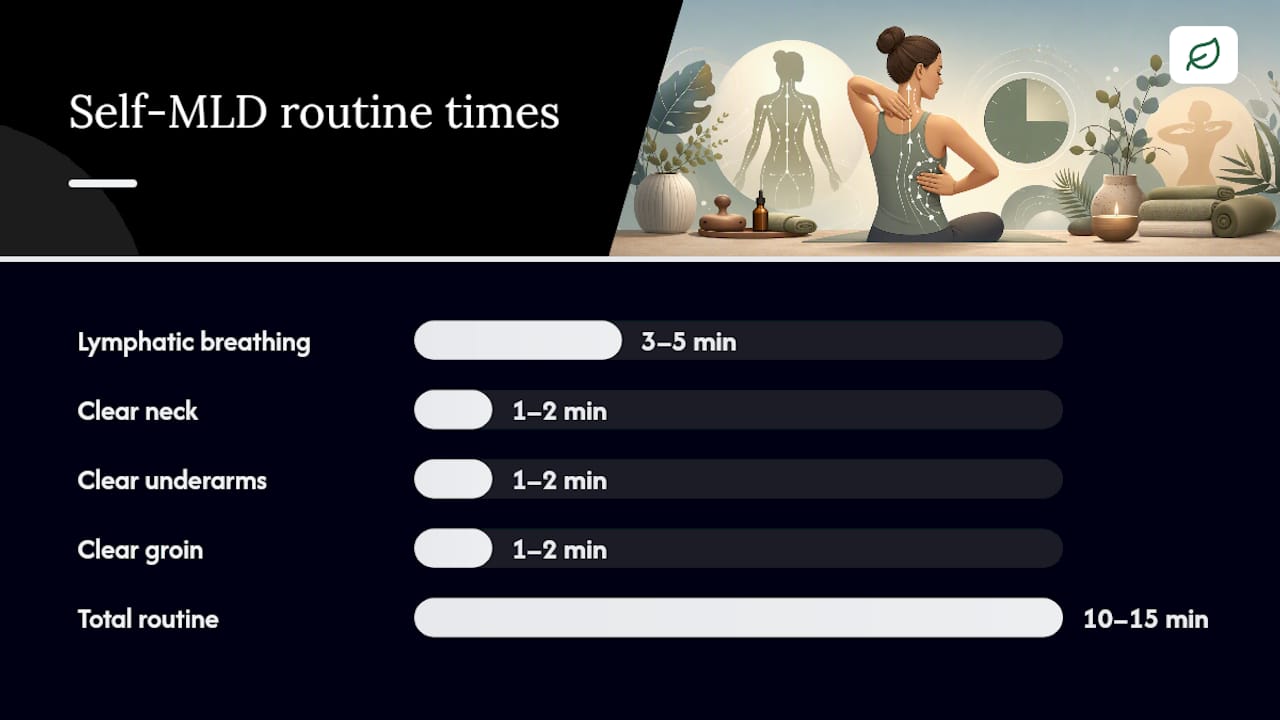
2. Clear your neck (one to two minutes). Using two or three fingers, apply feather-light pressure just below your ears and stroke down toward your collarbone. Repeat five to ten times on each side. You're not massaging muscle here. You're barely moving the skin.
3. Clear your underarms and groin (one to two minutes each). Gently stroke from the outer edge of each armpit inward, toward your chest, five to ten times. Do the same at the crease where your thigh meets your torso, stroking toward your midline. These are your major node clusters, and clearing them first creates somewhere for fluid to go once you start working a limb.
4. Work the limb, starting closest to the torso. If you're addressing a swollen arm or leg, always start with the section nearest your body and move outward in stages, then repeat with long strokes moving fluid back toward the trunk. For an arm: upper arm first, then forearm, then hand. Use flat hands or fingers, apply just enough pressure to stretch the skin (not press into muscle), and always stroke in the direction of the nearest cleared nodes. Five to ten repetitions per section is typical.
5. Skip the oils and lotions. Lubricant lets your hands glide over the skin without moving it, which defeats the point. MLD strokes rely on skin stretch, meaning you need enough friction to actually drag the surface layer slightly with each pass.
Pro Tip: Do this routine first thing in the morning, before you've been upright and gravity has already pulled fluid downward into your legs and feet. You'll likely notice the difference in how your hands and face feel by midday.
A few supporting habits make a real difference alongside the massage itself:
- Stay hydrated. Your lymphatic fluid is largely water, and dehydration makes it thicker and harder to move.
- Move regularly. Muscle contraction is one of the main pumps driving lymph flow, so short walks or gentle stretching throughout the day help more than you'd expect.
- Wear compression if it's been recommended. For anyone managing diagnosed lymphedema or CVI, compression garments support the work you're doing with your hands and should be used exactly as your care team advises.
- Never massage over infected, injured, or actively treated cancerous skin. If you notice new redness, warmth, or pain in the area you plan to work on, skip it and call your doctor instead.
For more detail on building safe home massage habits generally, Go Holistic's step-by-step massage guide for beginners covers foundational technique and pacing that pairs well with this routine.
Does the Research Actually Support Lymphatic Drainage Massage?
The strongest evidence sits squarely with lymphedema management and post-surgical recovery, where MLD is folded into broader care protocols rather than tested as a lone cure. Clinical reports and systematic reviews back its use in these contexts, though study quality varies considerably, and researchers consistently call for larger, better-designed trials before making sweeping claims, a gap that shows up across studies on cosmetic-procedure recovery as well.
Outside lymphedema, the picture gets murkier. Some studies on fibromyalgia and chronic venous insufficiency report symptom improvement, but sample sizes tend to be small and findings haven't been widely replicated across independent research teams. That's not the same as saying MLD doesn't help these groups. It means the evidence isn't yet strong enough to call it a proven treatment.
What the numbers show: Measured sessions in healthy volunteers have shown brief drops in heart rate and blood pressure during MLD, a relaxation response similar to what you'd see with any calming touch therapy, not evidence of systemic detoxification or immune-system enhancement.
That distinction matters because a lot of the confusion floating around online comes from social media. Wellness influencers, sometimes nicknamed "lymphfluencers," have built entire content categories around claims that lymphatic massage flushes toxins, melts fat, or resets your immune system. Clinicians pushing back on this trend note that the benefits in healthy people are local and largely temporary, a shift in how puffy your face or ankles look for a day, not a systemic overhaul.
Here's a quick gut check on common claims:
- "MLD detoxifies your body." No solid evidence supports this. Your liver and kidneys handle detoxification, not massage strokes.
- "MLD boosts your immune system." Unsupported for healthy individuals. Effects measured are relaxation responses, not immune markers.
- "MLD causes significant weight loss." Any change on the scale reflects temporary fluid shifts, not fat loss, and it reverses within days.
- "MLD helps manage diagnosed lymphedema." Well-supported and standard practice, particularly alongside compression and exercise.
Go Holistic evaluates therapies against exactly this kind of evidence hierarchy, and you can see the broader framework in the evidence-based healing methods overview if you want to understand how claims get separated from clinical support across other modalities too.
How Do You Choose a Qualified MLD Therapist?
Credentials matter more here than in almost any other massage category, because incorrect technique can worsen swelling rather than reduce it. Look for a Certified Lymphedema Therapist (CLT) credential, which typically requires completing a Certificate of Determined Training (CDT) program, usually 135 hours minimum of supervised coursework covering MLD technique, bandaging, and compression fitting.
Physical therapists and occupational therapists sometimes carry MLD training as an add-on to their primary license, which is fine, but ask specifically how many hours of MLD-focused training they completed and which technique school they trained under. The major recognized methods, Vodder, Foldi, Casley-Smith, and Leduc, each have their own certification pathways with defined training hour requirements.
Before booking, a short conversation can save you a wasted appointment:
- Ask about their direct experience treating your specific condition, whether that's post-mastectomy lymphedema, CVI, or post-surgical swelling.
- Ask how they coordinate with your surgeon, oncologist, or primary care physician, especially if compression garments or exercise programs are part of your plan.
- Ask what a typical session looks like, listening for mentions of light pressure and node-clearing sequence rather than vague reassurance.
Red flags worth walking away from: a provider who bills deep-tissue work as "lymphatic drainage," anyone unwilling to share credentials or client references, or a therapist who shows no interest in communicating with your broader medical team. If you're managing a diagnosed condition, that coordination isn't optional. You can browse verified credentials and specialties directly through Go Holistic's directory of holistic health providers checklist, which outlines exactly what to confirm before your first session.
How Do You Know if Lymphatic Drainage Massage Is Working?
Progress with MLD tends to show up gradually rather than in one dramatic session. Watch for reduced puffiness in the treated area, easier movement in a swollen limb, and a general sense of lightness or comfort that lasts longer between sessions as treatment continues.
For diagnosed lymphedema, a typical intensive treatment phase runs multiple sessions per week for a few weeks, followed by a maintenance phase with less frequent visits, often combined with self-massage and compression garment wear at home. If you're not seeing any measurable reduction in swelling after several weeks of consistent treatment, that's a signal to revisit your plan with your therapist and physician rather than assuming more of the same will eventually work.
Long-term success rarely comes from massage alone. Compression garments maintain the reduction MLD achieves between sessions, and pairing manual work with fitted compression therapy is standard practice for anyone managing a chronic condition. Regular movement and exercise round out the picture, since muscle contraction does a meaningful share of the pumping work your lymphatic system relies on day to day.
Before, During, and After: A Safety Checklist
Keep this nearby whether you're heading to a professional session or trying a self-massage routine at home.
- Before: get medical clearance if you have heart disease, kidney issues, active cancer, or a history of blood clots. Never work over infected, injured, or actively treated skin.
- During: pressure should always stay light enough that you're barely moving the skin's surface. Stop immediately and speak up if you feel pain, unusual pressure, or discomfort of any kind.
- After: drink water to support the fluid your body just moved. Watch the treated area over the next day or two for warmth, redness, or spreading swelling, all signs that call for a follow-up with your doctor.
Pro Tip: Keep a simple note on your phone tracking swelling, comfort, and any reactions after each session. Patterns that would otherwise blur together become obvious after two or three weeks, and that record is genuinely useful if you ever need to loop in your doctor.
Why Evidence-Based Guidance Matters More Than Trends
Lymphatic drainage massage sits in an unusual spot online. The clinical use cases, lymphedema and post-surgical recovery, are genuinely well supported, while the social-media version promising detox and weight loss is not supported at all. That gap is exactly why so many people end up either dismissing MLD entirely or expecting far more from it than it can deliver.
What gets underestimated, in our view, is how much the sequencing and pressure actually matter compared to which "brand" of technique a therapist uses. Vodder, Foldi, Casley-Smith, and Leduc all rest on the same core principle: clear the drain before you fill it. A therapist who skips proximal clearing or presses too firmly isn't doing a slightly weaker version of MLD. They're doing something else entirely, and it likely won't help.
Go Holistic exists to close that gap between marketing claims and clinical reality. Every practitioner in our directory is vetted for credentials, and our treatment library breaks down what research actually supports for each modality, MLD included, so you're not left guessing whether a claim is backed by evidence or just well marketed. This guidance is educational and doesn't replace a conversation with your doctor, particularly if you're managing a diagnosed condition or recovering from surgery.
— Andrew
Find a Certified Lymphatic Drainage Therapist Through Go Holistic
Finding a therapist who's actually trained in MLD, rather than someone offering a rebranded deep-tissue session, is the hardest part of this whole process. Go Holistic's provider directory lists certified holistic practitioners with their credentials, training background, and specialties clearly visible, so you can confirm CDT hours or technique certification before you ever book a consultation.

Search the directory by condition, whether that's post-surgical swelling, lymphedema, or chronic venous insufficiency, and our AI-backed recommendations will surface practitioners whose training matches your specific need. Each profile includes enough detail to ask informed questions before your first session, and you can book directly once you find a fit. Pair that with our treatment library, which breaks down what research actually supports for MLD and dozens of other modalities, so you walk into your appointment already knowing what to expect. If you're managing a diagnosed condition, loop in your physician alongside whichever therapist you choose. Ready to see who's available near you? Browse holistic providers now and book your first consultation.
Sources
- Lymphatic drainage massage: separating fact from fiction — UCLA Health
- FAQs About Lymphatic Drainage Massage — Cedars-Sinai
- The Utility of Lymphatic Massage in Cosmetic Procedures — PMC
- Clinical overview of manual lymphatic drainage — NCBI Bookshelf
This article is general information, not a substitute for advice from a qualified doctor. Consult a qualified healthcare professional about your own circumstances before acting on anything here.